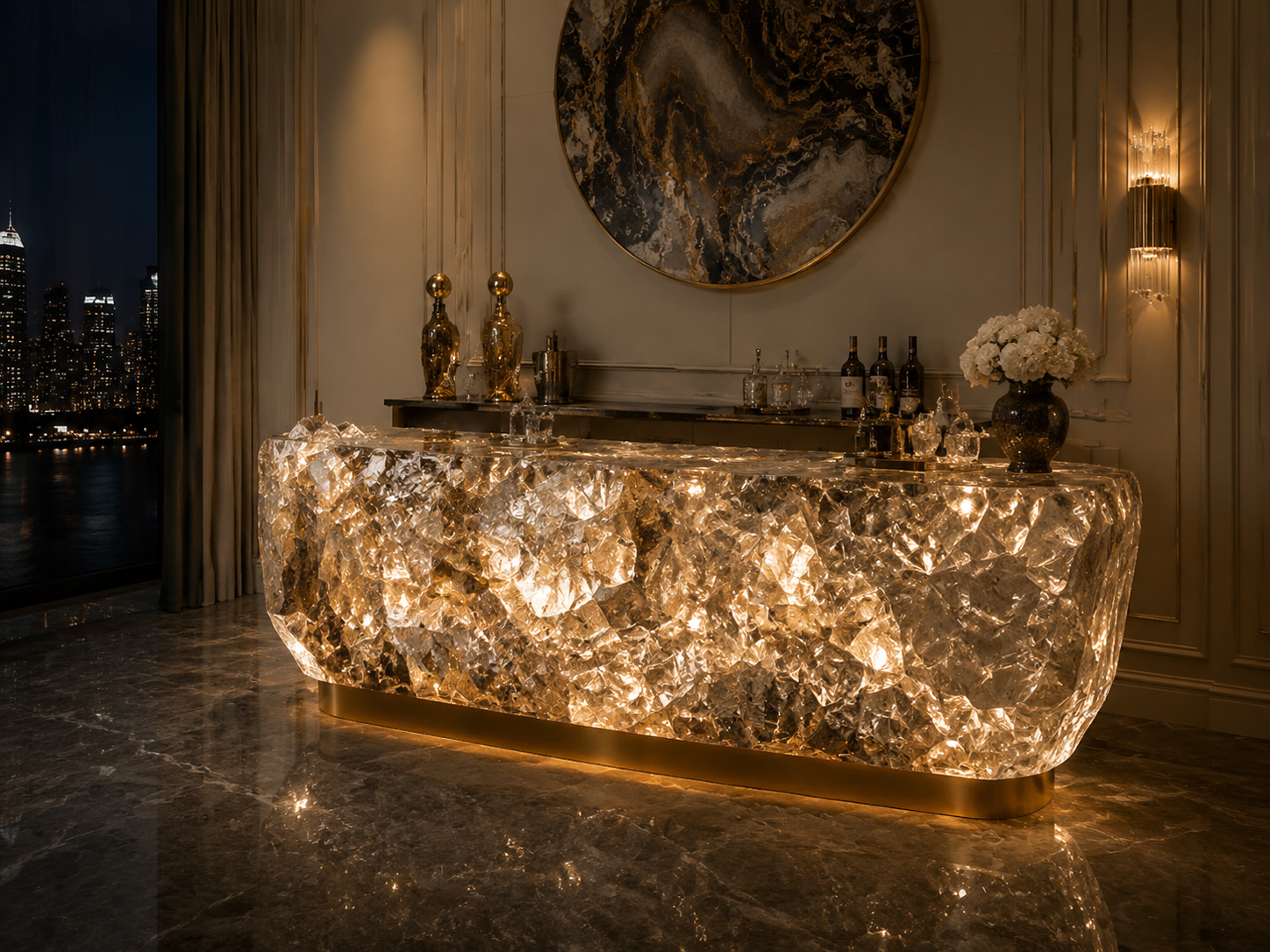
Transparent and reflective furniture never has one fixed appearance.
A synthetic crystal console that looks almost colorless in a bright showroom may become warm and luminous under 2700K lighting. A clear table placed beside a west-facing window may produce dramatic reflections in the afternoon but appear visually quiet in the morning. A lightly tinted reception desk can look elegant under soft indirect light, yet lose its depth when illuminated by flat ceiling lighting.
This is why lighting cannot be treated as a separate decorative layer when transparent furniture is involved.
For high end hospitality, luxury residential, retail, and restaurant projects, lighting directly affects how transparent materials are perceived. It changes color, depth, transparency, edge definition, reflection, shadow, and visual weight. It can make a piece feel refined and architectural, or it can expose glare, internal structures, uneven illumination, and distracting reflections.
The same furniture can therefore produce completely different results depending on where the light comes from, how warm or cool it is, how intense it is, and what surfaces surround it.
For designers working with synthetic crystal, platinum acrylic, glass, reflective metal, polished stone, or high gloss resin, the key question is not simply whether the material looks attractive in a sample.
The more useful question is whether the material and lighting have been designed to perform together in the actual space.
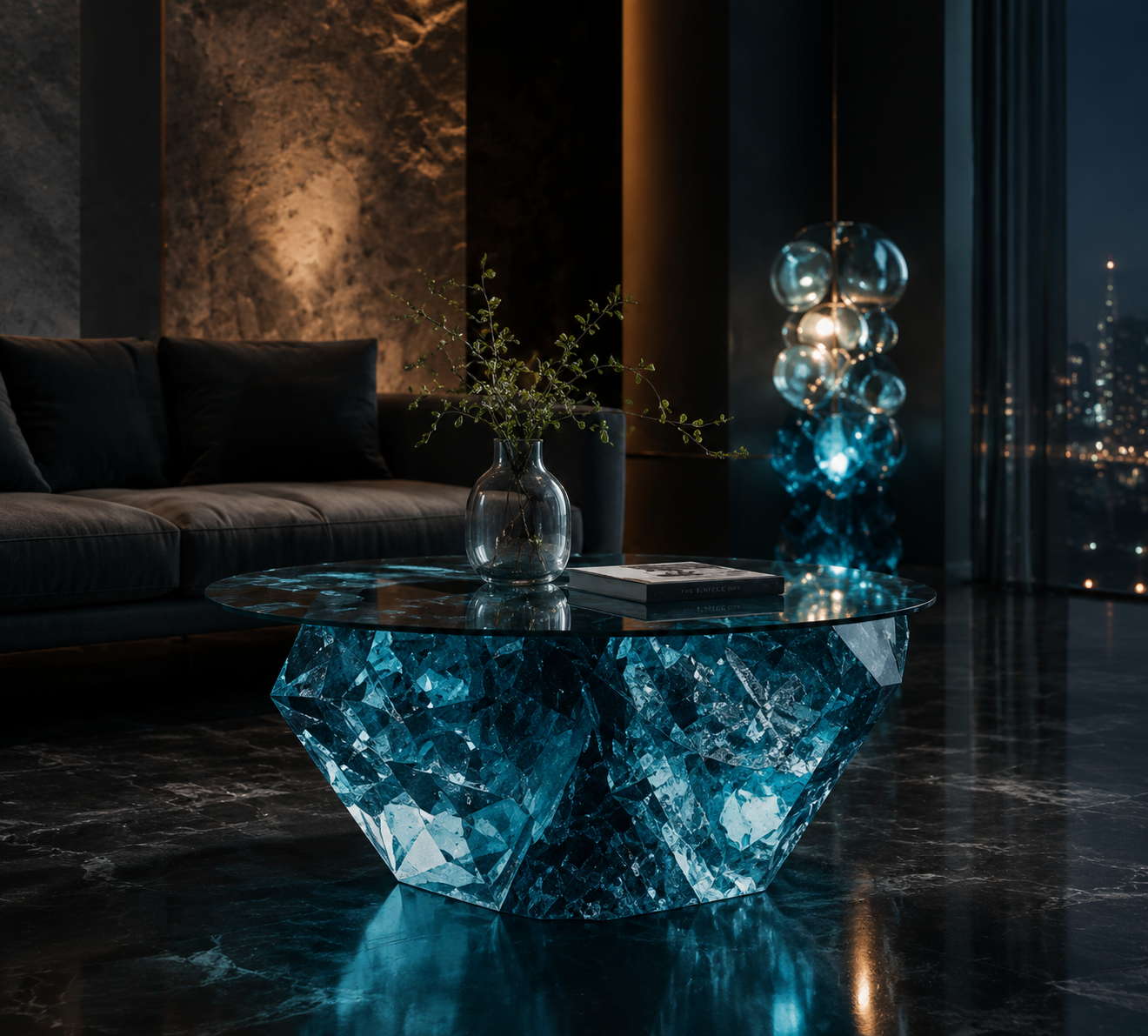
Lighting Is Now Part of the Material Specification
In many traditional projects, materials are selected first and lighting is developed later.
This sequence may work for some opaque surfaces, but it creates significant risk when the design includes transparent or reflective furniture. These materials do not simply receive light. They transmit it, redirect it, reflect it, absorb part of it, and interact with the colors around them.
As a result, the final appearance depends on several conditions that are not visible in a standard sample box.
A clear synthetic crystal sample may seem neutral when viewed against a white background. Once placed beside dark timber, warm stone, blue upholstery, or brushed metal, it begins to collect and reflect those colors. A thicker section may appear deeper and more saturated than a thin sample. A polished edge may create bright highlights, while a frosted edge may diffuse light more softly.
Lighting can strengthen or weaken all of these effects.
When light is directed through a transparent object, the material may appear more dimensional. When light falls directly onto a glossy surface, the reflection may become stronger than the material itself. When light is placed behind the furniture, silhouettes, internal textures, and edge details may become more visible. When the room is illuminated evenly from above, a sculptural transparent piece may lose much of its visual character.
For this reason, lighting should be discussed during material selection, not after furniture production has already started.
Five Changes Shaping the Relationship Between Materials and Lighting
1. Material and Lighting Design Are Becoming Integrated
High end design teams increasingly evaluate material and lighting as one system.
This is particularly important for reception desks, lobby tables, bar counters, decorative partitions, sculptural installations, and custom furniture with translucent or reflective surfaces.
A synthetic crystal reception desk may require lighting inside the base, beneath the top, behind the front panel, or within a shadow gap. Each option creates a different effect. Internal lighting can make the piece appear luminous, but poor diffusion may reveal bright spots. Backlighting can emphasize transparency, but it may also expose internal frames or cables. Downlighting can highlight the top surface, but it may create uncomfortable reflections at the guest’s eye level.
Integrated design allows these issues to be resolved before production.
The designer, lighting consultant, furniture manufacturer, and contractor should therefore review the piece together. The furniture form, material thickness, transparency level, internal structure, lighting position, access panels, wiring routes, heat management, and maintenance requirements all need to be coordinated.
A beautiful concept can lose much of its value if lighting access is impossible or if the internal frame becomes visible after the light is switched on.
2. Natural Light Is Becoming More Valuable
Natural light is one of the most important influences on transparent furniture.
It changes throughout the day, and this movement can make the same piece appear different from hour to hour. Morning light may create a soft and clear effect. Midday light may intensify reflections. Afternoon sunlight may introduce warmer tones and longer shadows. Overcast conditions may reduce contrast and make transparent objects appear more subtle.
In hotels and luxury residences, designers increasingly use transparent furniture to preserve natural light and visual openness.
A synthetic crystal table can occupy a central position without blocking a landscape view. A translucent console can create presence while allowing light to continue through the space. A reflective side table can capture the colors of a garden, pool, ocean, or city skyline.
However, natural light must be studied carefully.
A transparent table placed directly in strong sunlight may produce glare. A reflective surface near full-height glazing may mirror exterior movement in a distracting way. Strong ultraviolet exposure may also need to be considered depending on the exact material formulation and installation condition.
The location of the sun, orientation of the façade, type of glazing, curtains, blinds, nearby water, and surrounding finishes all influence the result.
3. Hidden Lighting Is Becoming More Popular
Hidden lighting has become a common method for enhancing transparent and translucent furniture.
Rather than exposing the light source, designers place lighting beneath, behind, or inside the object. This creates a cleaner visual effect and allows the material to appear as though it is producing light on its own.
Synthetic crystal can work particularly well with concealed lighting because the material can capture, transmit, and diffuse illumination.
A hidden linear light beneath a table base may create a floating effect. Lighting behind a reception desk may emphasize color and depth. A concealed source inside a sculptural installation may reveal internal texture. A small amount of light beneath a bar front may create visual energy without making the entire piece overly bright.
The challenge is achieving even illumination.
If the light source is too close to the material, individual points or lines may become visible. If it is too far away, the effect may become weak. If diffusion is insufficient, bright and dark areas may appear. If the internal structure interrupts the light path, shadows may reveal technical elements that were intended to remain hidden.
Hidden lighting therefore requires physical testing.
Digital renderings can suggest the intended mood, but they cannot fully predict diffusion, reflection, material depth, or hot spots.
4. Light and Shadow Are Becoming a Design Language
Lighting no longer serves only to make furniture visible.
In many luxury projects, light and shadow are used as part of the design language. Transparent and reflective materials are valuable because they can create changing patterns, layered shadows, edge highlights, and visual movement.
A faceted synthetic crystal table may produce multiple reflections as guests move around it. A curved translucent panel may create a soft gradient. A polished edge may catch a narrow line of light. A frosted surface may generate a diffuse glow rather than a sharp reflection.
These effects can make furniture feel more dynamic.
In hospitality spaces, this is especially useful because the atmosphere often changes throughout the day. A lobby may feel bright and open in the morning, calm in the afternoon, and dramatic in the evening. One transparent piece can contribute to all three conditions if the lighting strategy is planned carefully.
The goal is not always maximum brightness.
Subtle shadow, controlled reflection, and partial transparency often create a more sophisticated result than uniform illumination.
5. Transparent Materials Are Being Used More Precisely
Transparent materials were once selected mainly for their ability to make spaces feel lighter.
Today, designers are using them more precisely. They consider different levels of transparency, tint, frosting, thickness, edge treatment, internal texture, and reflective quality according to the location and function.
A completely clear finish may be suitable for a low-contact decorative console. A lightly frosted surface may be more practical for a restaurant table. A smoke tint may help a lobby piece remain visible against a bright background. An amber tone may strengthen the relationship with warm interior lighting. A blue or green tint may connect the furniture with water, landscaping, or a coastal setting.
Lighting makes these differences more visible.
The same smoke-colored synthetic crystal can appear nearly neutral in daylight and much richer under warm evening lighting. A pale tint can become stronger in thick sections. Frosted surfaces can look soft under indirect light but flat under harsh frontal illumination.
Precise use of transparent materials therefore requires precise use of light.
What Clients Are Asking More Often
Hotel design companies, lighting consultants, developers, and luxury residential clients are becoming more aware that furniture and lighting cannot be approved independently.
Their questions are increasingly practical.
Will the color look the same during the day and at night?
Will the light source be visible through the material?
Can the furniture be photographed without glare?
Will the material reflect guests or surrounding equipment?
How warm should the lighting be?
Will integrated lighting create hot spots?
Can the lighting be replaced without dismantling the entire piece?
Will several furniture pieces remain visually consistent under different lighting zones?
Can the material still look premium after the lighting system has been operating for several years?
These questions are important because the appearance of transparent furniture is highly dependent on the environment.
A successful project should therefore define not only the material finish, but also the lighting conditions under which that finish was approved.
Ten Lighting Questions That Should Be Resolved Before Production
1. What Direction Does the Natural Light Come From?
Natural light direction affects reflection, transparency, shadow, and color.
A north-facing space may receive soft and consistent daylight. An east-facing room may have strong morning light. A west-facing lobby may experience intense warm light in the afternoon. A south-facing interior may receive high levels of daylight for much of the day, depending on the location and façade design.
Transparent furniture should be positioned with these conditions in mind.
A synthetic crystal table placed perpendicular to a window may show different edge highlights than one placed parallel to it. A reflective console opposite glazing may mirror outdoor movement. A translucent bar beside a pool may capture reflected water light.
Design teams should review the furniture from the main guest viewpoints at the times of day when the space is most active.
2. What Color Temperature Is Appropriate?
Color temperature strongly influences the appearance of transparent and reflective materials.
Warm lighting between approximately 2700K and 3000K can make clear or amber materials feel inviting and luxurious. Neutral lighting around 3500K may provide a balanced and contemporary appearance. Cooler lighting around 4000K may emphasize clarity and precision but can make some interiors feel less intimate.
The correct choice depends on the space.
A hotel lounge may benefit from warm lighting. A contemporary reception area may use a slightly more neutral temperature. A spa may require soft and calm illumination. A luxury residence may combine several temperatures depending on time of day and activity.
Synthetic crystal colors should be tested under the intended temperature.
A pale blue finish may look refined under neutral light but slightly gray under very warm light. A smoke tint may become richer under 2700K. A clear finish may reflect the warmth of surrounding timber and stone.
The final approval should therefore be made under the actual specified lighting whenever possible.
3. What Is the Angle of Illumination?
The angle of light determines whether the material glows, reflects, or appears flat.
Frontal lighting can reveal the surface but may create strong reflections. Side lighting can emphasize edges, curves, and texture. Backlighting can increase transparency and silhouette. Uplighting can create a floating or dramatic effect. Downlighting can highlight the top surface but may also produce glare.
For sculptural synthetic crystal furniture, side or backlighting often reveals form more effectively than flat overhead illumination.
However, the angle should be tested from guest eye level.
A reflection that looks attractive in a rendering may become uncomfortable when viewed from a seated position. A spotlight aimed at a polished table may produce a bright reflection directly into the guest’s eyes. A hidden light beneath a counter may reflect on the floor and create an unintended visual line.
The lighting angle should be evaluated in relation to both the object and the user.
4. How Will Reflections Be Controlled?
Reflective furniture can collect visual information from the entire room.
It may reflect windows, ceiling fixtures, people, digital screens, artwork, service equipment, or exterior views. Some reflections enhance the design. Others create clutter.
The surrounding environment should therefore be considered part of the furniture appearance.
A polished synthetic crystal surface placed opposite a clean stone wall may look controlled and refined. The same piece placed opposite an active service zone may constantly reflect movement and equipment.
Reflection control can be improved through placement, tint, frosting, lighting direction, and background design.
In some cases, reducing surface gloss slightly can improve the overall result without removing the material’s high end character.
5. How Transparent Should the Material Appear?
Transparency is not only a material property.
It is also a lighting effect.
A clear piece can appear more transparent when the background is bright and evenly lit. It can appear darker when placed against a shadowed wall. Edge lighting can make the object feel more solid. Backlighting can reveal internal depth. Frontal illumination can reduce the sense of transparency by increasing surface reflection.
The intended appearance should be defined clearly.
Should the piece almost disappear into the room?
Should it remain visibly present while preserving sightlines?
Should it glow?
Should it reveal internal texture?
Should it appear clear during the day and more dramatic at night?
These questions help determine the correct combination of material finish and lighting strategy.
6. How Will Visual Layers Be Created?
Transparent furniture can create depth when several visual layers are carefully arranged.
A synthetic crystal console may reveal the wall behind it, reflect the lighting above it, and show internal color at its edges. A bar front may combine a translucent panel, hidden light, metal frame, and stone top. A lobby table may reflect the ceiling while preserving the flooring pattern beneath it.
These layers can make a space feel more complex and refined.
However, too many layers can become visually confusing.
The background should be controlled, and the lighting should help separate the furniture from nearby surfaces. A softly illuminated wall behind a transparent object may improve definition. A darker floor may strengthen the silhouette of a clear table. A shadow gap may help a luminous panel appear independent from its structure.
Layering should create depth, not clutter.
7. What Shadow Relationship Is Desired?
Transparent objects still create shadows, although the result may be softer or more complex than with opaque furniture.
The shadow may include clear edges, tinted areas, reflected highlights, and overlapping patterns. A faceted or textured surface can produce particularly expressive effects.
In some projects, these shadows are part of the design concept.
A sculptural synthetic crystal installation may cast changing patterns across a wall or floor. A table near a window may create a moving composition during the day. A translucent screen may soften the boundary between two spaces.
The project team should decide whether the shadow is intended to be visible, subtle, or minimized.
This decision influences the light angle, intensity, distance, and material finish.
8. How Will Glare Be Controlled?
Glare is one of the most common problems in transparent and reflective furniture applications.
It can come from direct sunlight, spotlights, exposed linear lighting, polished surfaces, or reflections at eye level.
Glare may make a space uncomfortable and reduce the perceived quality of the design.
Control methods include changing the lighting angle, reducing brightness, increasing diffusion, using warmer or softer light, adjusting surface gloss, adding a slight tint, or repositioning the furniture.
In hospitality projects, glare should be reviewed from several positions.
Guests may stand at reception, sit in a lounge, dine at a table, or approach the furniture from different directions. A light source that is not visible from one viewpoint may become distracting from another.
9. What Should the Furniture Look Like at Night?
Nighttime appearance should be designed separately from daytime appearance.
During the day, transparent furniture may depend on natural light and surrounding views. At night, the background becomes darker, artificial lighting becomes dominant, and reflections may increase.
A piece that looks subtle during the day can become the main visual focus in the evening.
This is especially important in hotel lobbies, lounges, bars, restaurants, and residences with large glazed façades.
The project team should review whether the furniture needs integrated lighting, nearby accent lighting, wall washing, or controlled background illumination.
The goal should not necessarily be to make the object brighter.
Sometimes a small amount of edge light or indirect light creates more depth than full internal illumination.
10. How Will Visual Consistency Be Maintained Over Time?
Luxury projects require long-term visual consistency.
Lighting output can change over time. Replacement lamps or drivers may have slightly different color temperatures. Dimming systems may be adjusted. Furniture may be moved. Surrounding finishes may be renovated.
These changes can affect the appearance of transparent materials.
The project documentation should therefore record the approved lighting temperature, brightness level, fixture position, control settings, material sample, finish reference, and installation photographs.
For integrated lighting, maintenance access should be planned from the beginning.
A lighting system that cannot be serviced easily may create significant operational problems later.
How Synthetic Crystal Responds to Different Lighting Conditions
Daylight
Under daylight, synthetic crystal can appear clear, light, and connected to the surrounding architecture.
Its appearance depends on the direction and intensity of the light, the background, and the material thickness. Clear finishes may preserve openness, while tinted finishes can capture and strengthen environmental colors.
Near water, the material may reflect blue and moving highlights. Near landscaping, it may collect green tones. In an urban setting, it may mirror building façades and sky.
Daylight often produces the most natural variation, but it can also create the strongest glare.
Warm Interior Lighting
Warm light can make synthetic crystal feel softer and more luxurious.
Amber, smoke, bronze, and neutral tones often respond especially well. Clear material may take on the warmth of surrounding timber, metal, and stone.
This can be effective in hotel lounges, restaurants, bars, suites, and high end residences.
The main risk is uneven color.
If one part of the furniture receives warm light and another receives cooler ambient light, the piece may appear inconsistent. Lighting zones should therefore be coordinated carefully.
Neutral Lighting
Neutral lighting can emphasize clarity, geometry, and precision.
It may suit contemporary hotel lobbies, modern residences, galleries, and retail environments.
Synthetic crystal under neutral light often appears cleaner and more architectural. However, the space may feel less intimate if the brightness is too high or the lighting is too uniform.
A combination of neutral general lighting and warmer accent lighting can create balance.
Backlighting
Backlighting can make translucent and textured synthetic crystal highly expressive.
It can reveal depth, color gradients, embedded effects, and internal patterns. This is often used for reception counters, bar fronts, decorative panels, and sculptural installations.
The key challenge is diffusion.
The light source should not appear as individual points or harsh lines unless that effect is intentional. The distance between the light and material, type of diffuser, material thickness, and internal structure should all be tested.
Edge Lighting
Edge lighting can emphasize the outline of transparent furniture.
It may create a floating appearance or make a clear piece more visible against a complex background.
This technique can work well for tables, counters, shelving, and decorative panels.
However, the edge finish must be consistent.
Polished, frosted, beveled, and textured edges will produce different results.
Integrated Lighting
Integrated lighting gives furniture a more complete and customized identity.
The piece can become both furniture and light source.
This is particularly effective for destination bars, hotel reception desks, private dining tables, and sculptural features.
Integrated lighting requires close coordination between design and engineering. The lighting should be replaceable, wiring should remain hidden, heat should be managed, and access panels should not damage the visual purity of the piece.
A Practical Testing Process
Transparent and reflective furniture should be tested before final approval.
A useful process can include several stages.
Small Material Samples
Begin by comparing several transparency levels, colors, surface finishes, and thicknesses.
Review the samples under daylight, warm lighting, and neutral lighting. Place them against the proposed stone, timber, metal, fabric, and wall finishes.
This stage helps eliminate unsuitable options quickly.
Larger Samples
A larger sample gives a more realistic understanding of color intensity and reflection.
Transparent materials often look different at larger scale. Thick sections may appear darker, and surface reflections may become more noticeable.
For important projects, the sample should include the intended edge treatment.
Lighting Mock-Up
A lighting mock-up should test the actual fixture type, color temperature, brightness, distance, angle, and diffusion.
For hidden lighting, review whether individual light sources remain visible.
For reflective surfaces, check glare from standing and seated positions.
For integrated lighting, test maintenance access and heat management.
Partial or Full-Size Prototype
A prototype is valuable for reception desks, bar counters, large tables, and sculptural installations.
It allows the project team to evaluate scale, transparency, structure, joints, lighting, reflection, and guest interaction together.
The prototype should be photographed during both daytime and nighttime conditions.
Final Factory Test
Before shipment, the completed furniture should be tested with the approved or equivalent lighting conditions whenever possible.
This is especially important for pieces with integrated illumination.
Factory testing can identify uneven light, exposed wiring, visible internal frames, inconsistent diffusion, or color differences before the piece reaches site.
Common Mistakes to Avoid
One common mistake is approving the material from a small sample under office lighting.
Office lighting rarely represents the atmosphere of a hotel lobby, restaurant, lounge, or luxury residence.
Another mistake is selecting the furniture finish before confirming the lighting temperature.
A color that looks balanced under neutral light may become too warm or too dark under the final specification.
A third mistake is relying entirely on renderings.
Renderings are useful for communication, but they cannot fully predict reflection, transparency, glare, internal visibility, or diffusion.
Another frequent problem is placing light sources too close to translucent surfaces.
This often creates visible hot spots and reduces the sense of quality.
Design teams may also overlook the background.
Transparent furniture does not have a separate visual identity from its surroundings. It constantly interacts with walls, floors, windows, people, and other objects.
Finally, maintenance access is sometimes considered too late.
Integrated lighting should be serviceable without damaging the furniture or requiring major disassembly.
Applying Lighting Strategies in Different Spaces
Hotel Lobby
A hotel lobby usually combines daylight and artificial lighting.
Synthetic crystal furniture in this environment should be reviewed from the entrance, reception, lounge, and circulation paths.
A central table may benefit from controlled downlighting and soft side light. A reception desk may use concealed backlighting or underlighting. The lighting should support the piece without competing with chandeliers, wall features, artwork, or exterior views.
Restaurant and Bar
Restaurants and bars often use warmer, lower-level lighting.
This can make tinted synthetic crystal feel rich and atmospheric.
Bar fronts may use integrated lighting, while tables may depend on focused pendant or accent lighting. Glare should be controlled carefully, especially on horizontal polished surfaces.
The material should also be reviewed when the space is fully occupied, because guests, table settings, glassware, and service lighting will change the reflections.
Spa and Wellness Area
Spa environments require softer lighting and reduced visual stimulation.
Frosted or translucent synthetic crystal can work well with indirect illumination.
The light should be diffuse, warm, and carefully shielded. Strong reflections and visible light sources should be avoided.
Luxury Residence
Residential projects often require flexibility.
The same room may use daylight, task lighting, decorative lighting, and evening ambient lighting.
Transparent furniture should remain attractive under several scenes.
Dimming control can be useful, but the material should be tested at both high and low brightness levels.
Ballroom and Event Space
Ballrooms use changing lighting conditions.
A statement table or sculptural installation may be exposed to bright setup lighting, warm event lighting, colored entertainment lighting, and photography flash.
The piece should be reviewed under more than one scenario.
Materials that respond dramatically to colored light may be valuable, but the result should remain consistent with the brand and event program.
A Better Coordination Process
The most reliable approach is to coordinate furniture and lighting from the beginning of the project.
The design team should define the intended daytime and nighttime appearance. The lighting consultant should identify fixture positions, color temperatures, control zones, and brightness levels. The furniture manufacturer should confirm how the material responds to light and whether integrated lighting is technically feasible.
Samples should then be tested under realistic conditions.
Once the finish is approved, the project team should record the exact material reference, sample thickness, surface treatment, lighting temperature, fixture type, position, and control settings.
For large or important pieces, the design should move through sample review, lighting mock-up, prototype, factory testing, and site adjustment.
This process may appear more detailed at the beginning, but it reduces late changes.
It is far more efficient to adjust a sample or mock-up than to modify a completed reception desk, bar counter, or sculptural installation after it has been shipped and installed.
Creating a More Valuable Visual Experience
Transparent and reflective furniture creates value because it does not remain visually static.
It responds to daylight, artificial light, surrounding color, movement, viewing angle, and time of day. This allows one piece to support several atmospheres within the same space.
Synthetic crystal is particularly effective because it can combine transparency, color, optical depth, sculptural form, and light interaction.
However, the material reaches its full potential only when lighting is treated as part of the design from the beginning.
The most successful projects do not ask whether the furniture should be illuminated after the form is complete. They define how the piece should appear in the morning, afternoon, evening, and night, then develop the material, structure, finish, and lighting around that intention.
For hotel designers, lighting consultants, developers, and luxury residential clients, this integrated approach improves visual quality, reduces approval risk, and creates a more consistent final result.
Share your drawings, material references, lighting temperature, installation location, and intended viewing angles before finalizing a custom synthetic crystal piece, because the furniture you approve under ordinary light may reveal an entirely different identity when the right light finally finds it.
READ MORE:
- Future Luxury Home Trends: How Synthetic Crystal Acrylic Is Redefining Furniture Aesthetics
- Synthetic Crystal Acrylic Furniture: Creating Irreplaceable Spatial Experiences Through Transparent Aesthetics
- Why Are High-End Customers Increasingly Focused on the “Material Expression” of Furniture?
- From “Furniture” to “Art Installation”: How Synthetic Crystal Acrylic Enhances Spatial Value
- Synthetic Crystal Acrylic Furniture: Why Is It Becoming the Visual Focus of High-End Spaces?
- Custom Furniture Without Project Delays: What Designers Should Confirm Before Production
- Where Statement Furniture Creates the Most Value in a Luxury Hotel
- How to Compare Decorative Materials Faster: A Practical Framework for Hospitality Projects
- Material Inspiration for Overseas Resort Projects: Creating a Distinctive Sense of Escape


