Statement furniture is meant to be noticed.
That is precisely what makes it valuable, and also what makes it difficult to use well.
In a professionally designed interior, every object participates in a visual hierarchy. Some elements are intended to attract attention immediately. Others provide support, rhythm, contrast, or background structure. When a statement piece becomes too dominant, the room can lose balance. The furniture begins to compete with the architecture, artwork, lighting, and surrounding materials rather than working with them.
Transparent statement furniture presents an interesting solution to this design challenge.
Pieces commonly described as acrylic furniture can create drama through scale, geometry, transparency, and light without necessarily adding the same visual weight as solid wood, stone, or metal. In high-end interiors, premium synthetic crystal furniture can take this idea further by combining transparency with sculptural depth, polished surfaces, and a stronger sense of luxury.
The challenge is not simply choosing a beautiful transparent piece.
The real skill lies in knowing how to make that piece memorable without allowing it to disrupt the hierarchy of the room.
For interior designers, architects, stylists, and homeowners interested in refined contemporary spaces, the question is not whether statement furniture should attract attention. It should.
The question is how much attention it should attract, and what should happen visually after the eye notices it.
Understanding Visual Hierarchy in Interior Design
Visual hierarchy is the order in which the eye experiences a room.
When someone enters a well-designed interior, they do not usually notice every object at once. Instead, the eye moves through the space in stages.
A large window may be the first focal point.
A chandelier may attract attention next.
An artwork, fireplace, sofa composition, or sculptural table may then guide the eye deeper into the room.
Secondary furniture, accessories, and materials support this sequence.
Good visual hierarchy helps a room feel calm, intentional, and easy to understand.
Poor hierarchy creates competition.
If too many pieces demand attention at the same time, the room can feel noisy even when the color palette is minimal.
This is particularly relevant when using statement furniture.
A dramatic synthetic crystal dining table, coffee table, console, or chair can become a major visual event. If it is placed without considering the existing hierarchy, it may overpower the room. But when carefully integrated, it can reinforce the composition rather than interrupt it.
Statement Furniture Does Not Always Need to Be Visually Heavy
Traditional statement furniture often relies on mass.
A large marble table, dark timber cabinet, sculptural sofa, or heavily textured chair creates impact partly because of its visual density.
Transparent statement furniture creates impact differently.
Synthetic crystal furniture can attract attention through shape, scale, reflection, thickness, and craftsmanship while remaining visually open.
This is a major advantage.
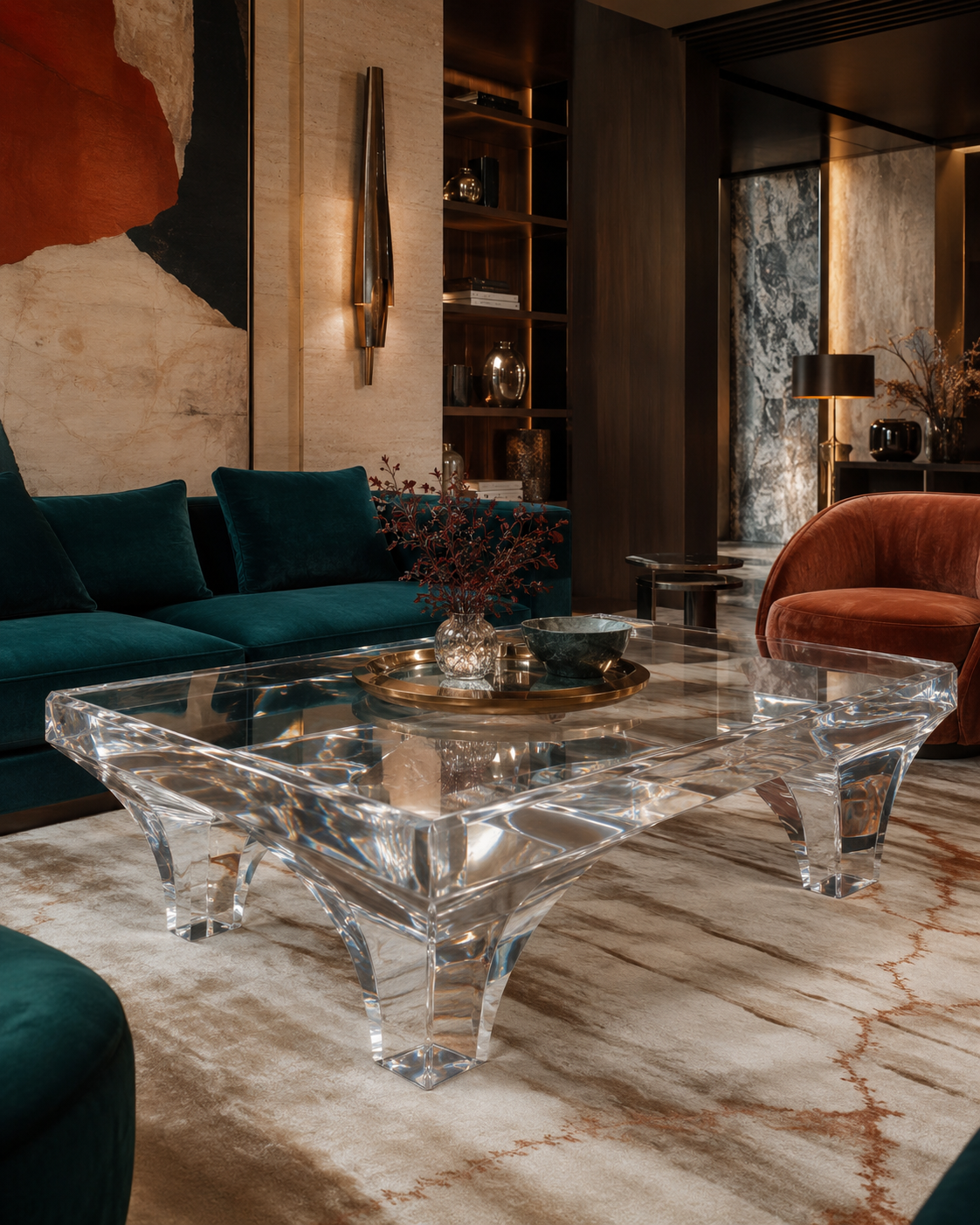
A substantial synthetic crystal coffee table can occupy the center of a living room without completely blocking the rug beneath it.
A transparent console can introduce a strong architectural line without creating an opaque wall of visual material.
A sculptural crystal chair can become memorable while allowing the surrounding architecture to remain visible.
The piece is still present.
It simply does not carry the same visual mass.
This allows designers to create drama without making the room feel overloaded.
Decide What the Primary Focal Point Should Be
Before introducing statement furniture, designers need to identify the room's dominant visual priority.
Is the main focal point the architecture?
A fireplace?
An artwork?
A panoramic view?
A chandelier?
A custom staircase?
Or is the furniture itself intended to become the primary visual event?
This decision should come before selecting the statement piece.
If the room already has a strong architectural focal point, the furniture should support it rather than compete with it.
For example, imagine a penthouse living room with floor-to-ceiling windows overlooking a city skyline.
A large opaque coffee table with dramatic color and texture may interrupt the visual relationship between the seating area and the view.
A synthetic crystal coffee table can still feel sculptural and luxurious, but its transparency allows the skyline to remain dominant.
The furniture becomes important without becoming the first and only thing the eye sees.
This is one of the most effective ways to preserve visual hierarchy.
Use Transparency as a Form of Visual Restraint
Restraint is one of the defining characteristics of sophisticated interiors.
Luxury does not require every object to be visually loud.
In fact, high-end design often depends on careful editing.
Transparent furniture gives designers a way to introduce an unusual form without introducing excessive visual density.
A synthetic crystal table with a bold base may look highly distinctive, but because the material allows the eye to move through it, the object can feel more controlled than an equally dramatic form made from dark stone or solid wood.
This creates an important balance between presence and restraint.
The piece is noticeable because of its form.
It remains integrated because of its transparency.
Designers can use this quality strategically when they want a piece to be memorable but not dominant.
Let Scale Create Impact Instead of Excessive Ornament
One of the easiest ways to make transparent furniture feel sophisticated is to rely on proportion rather than decoration.
A statement synthetic crystal piece does not need unnecessary ornament to attract attention.
A generous tabletop, thick support, curved profile, geometric base, or sculptural silhouette may be enough.
Scale can provide drama while transparency controls visual weight.
This is especially effective in large residential interiors, hotel lobbies, luxury lounges, villas, and open-plan spaces.
A large transparent table can match the proportions of the architecture without appearing as visually heavy as an opaque alternative.
The result feels intentional rather than decorative.
This distinction is important.
Statement furniture should look as though it belongs to the architecture of the room, not as though it was added afterward simply to create a reaction.
Protect the Room's Sight Lines
One of the strongest advantages of synthetic crystal furniture is its ability to preserve sight lines.
Visual hierarchy depends not only on what is present in the room, but also on what remains visible behind and around the furniture.
A large piece placed in the middle of a room can easily interrupt the relationship between foreground and background.
Transparent furniture allows designers to maintain that connection.
For example, a statement dining table can define the center of an open-plan space while still allowing the eye to read the flooring, chairs, walls, and surrounding architecture.
A console can create structure in an entryway without visually narrowing the corridor.
A transparent bench or pedestal can provide function without blocking artwork or architectural details behind it.
This is particularly useful when the interior includes expensive materials that deserve to remain visible.
Marble floors, custom rugs, wall panels, sculptural staircases, and decorative stone surfaces can all benefit from furniture that does not conceal them unnecessarily.
Use Statement Pieces as Secondary Focal Points
Not every statement piece needs to become the primary focal point.
In many high-end interiors, the best role for synthetic crystal furniture is as a secondary visual anchor.
The viewer notices the architecture first.
Then the furniture.
Then smaller details.
This layered experience gives the room depth.
For example, in a living room with a dramatic fireplace, a synthetic crystal coffee table can create interest in the center of the seating arrangement without competing with the fireplace.
In a dining room with a large artwork, a transparent dining table can support the composition while allowing the artwork to remain dominant.
In a hotel lobby with a sculptural lighting installation, a crystal console can reflect and complement the light rather than challenge it.
The key is to think about sequence.
What should the viewer notice first?
What should they notice second?
What should become interesting only after they move closer?
A successful interior rarely gives every object the same visual priority.
Contrast Transparency With Heavier Materials
Transparent furniture is most effective when surrounded by materials that provide grounding.
A room filled entirely with transparent furniture can lose hierarchy because there is not enough contrast between elements.
Synthetic crystal works particularly well when paired with materials that have strong tactile or visual weight.
Stone provides solidity.
Timber provides warmth.
Leather provides richness.
Upholstery provides softness.
Metal adds precision.
Textiles add depth.
The transparent piece then becomes a balancing element.
For instance, a synthetic crystal coffee table in front of a deeply upholstered sofa creates a clear contrast between softness and clarity.
A crystal console against a natural stone wall creates a contrast between transparency and mass.
A transparent dining table with sculptural upholstered chairs allows the chairs to create visual rhythm without making the composition feel too dense.
This is how statement furniture can remain interesting without destabilizing the room.
Avoid Competing Statement Pieces in the Same Visual Zone
One of the most common design mistakes is placing several strong focal points too close together.
A dramatic chandelier, oversized artwork, sculptural sofa, bold rug, and statement table can all be beautiful individually.
Together, they may create visual competition.
When using synthetic crystal furniture as a statement element, designers should consider the intensity of nearby objects.
If the table has an extremely sculptural base, the rug underneath may need to be quieter.
If the chairs have elaborate forms, the table may need cleaner geometry.
If the lighting is highly expressive, the transparent furniture can help reduce visual conflict.
The room does not need fewer interesting pieces.
It needs better distribution of interest.
Good hierarchy is about spacing visual emphasis across the room rather than concentrating it in one area.
Use Shape to Control Attention
Transparency reduces visual weight, but form still determines how strongly the furniture attracts attention.
A simple rectangular synthetic crystal table may appear calm and architectural.
A curved or faceted design may feel more sculptural.
A thick monolithic form can create a stronger sense of luxury.
An irregular silhouette can become highly expressive.
Designers should choose the shape according to the role the furniture needs to play.
If the room already contains many curves, a clean geometric piece may provide structure.
If the architecture is highly linear, a rounded crystal form can introduce softness.
If the interior is restrained and minimal, a more sculptural piece may become the necessary focal point.
The goal is not to choose the most dramatic shape available.
The goal is to choose the shape that strengthens the room's visual logic.
Consider the Viewing Angle
Statement furniture is rarely seen from only one position.
In open-plan interiors, the same table may be visible from the entrance, sofa, dining area, kitchen, and hallway.
This means the design should be evaluated from multiple angles.
Synthetic crystal furniture is particularly interesting in this regard because transparency changes depending on the viewer's position.
A thick edge may appear strong from one side.
A polished surface may reflect light from another.
A sculptural base may overlap visually with objects behind it as the viewer moves.
This creates a dynamic experience.
However, it also means placement must be carefully considered.
A transparent piece may look minimal from one viewpoint but visually complex when positioned in front of patterned surfaces, shelving, or multiple decorative objects.
Designers should consider not only the piece itself, but also what will be visible through it.
.png)
Use Lighting to Support, Not Overpower, the Furniture
Lighting can dramatically increase the presence of synthetic crystal furniture.
Reflections, highlights, polished edges, and transparent surfaces can all respond strongly to light.
This makes lighting a powerful tool, but it should be used carefully.
If every surface is brightly illuminated, the furniture may become too visually active.
If the lighting is too flat, the material may lose some of its depth.
The most successful approach often involves controlled highlights.
Natural daylight can create subtle changes throughout the day.
Warm directional lighting can emphasize edges and thickness.
A nearby pendant or chandelier can introduce reflections.
Integrated architectural lighting can help the piece feel connected to the room.
The lighting should reveal the material without turning it into a spectacle unless that is the intended design concept.
Allow Negative Space Around Statement Furniture
Statement furniture needs room to be seen.
Placing a highly distinctive synthetic crystal piece in a crowded area reduces its impact and creates visual confusion.
Negative space is therefore essential.
A clear area around the furniture allows the viewer to understand its shape.
It also prevents the object from competing with nearby furniture.
For example, a sculptural crystal console may look much stronger on a relatively quiet wall than in front of a dense gallery arrangement.
A statement coffee table may feel more refined when the surrounding seating is carefully spaced.
A transparent pedestal can highlight an artwork more effectively when there are fewer decorative objects nearby.
Negative space is not wasted space.
It is part of the composition.
In luxury design, the ability to leave space around important objects often communicates confidence.
Use Color Strategically
Transparent synthetic crystal furniture is visually neutral in one sense, but the colors surrounding it strongly influence how it is perceived.
Against a pale interior, the piece may feel subtle and almost weightless.
Against dark walls, it may appear more luminous and defined.
With colorful upholstery, it can help prevent the room from becoming too saturated.
With neutral materials, it can contribute to a quiet, architectural atmosphere.
Designers can use this flexibility to control the hierarchy.
If the room contains a strong color story, transparent furniture can provide visual relief.
If the room is monochromatic, the form and reflections of the synthetic crystal can create interest without introducing another color.
This is one of the reasons transparent furniture is so adaptable in high-end interiors.
Let the Surrounding Materials Show Through
One of the most interesting characteristics of transparent furniture is that it does not exist visually in isolation.
The flooring, rug, wall, artwork, and objects behind it all become part of its appearance.
This means the surrounding environment should be considered as part of the furniture design.
A synthetic crystal table placed over a custom rug allows the rug's pattern to remain visible.
A transparent console against veined stone creates a layered effect.
A crystal chair in front of textured wall panels allows the surface behind it to remain part of the composition.
The result can feel sophisticated because multiple visual layers occupy the same physical area without becoming opaque.
This is particularly useful in interiors where material richness is already high.
Instead of adding another heavy layer, synthetic crystal can connect the existing ones.
Keep Accessories Under Control
Transparent statement furniture can easily become visually cluttered if too many objects are placed on or around it.
Because the material allows the eye to see through the piece, everything associated with it becomes more visible.
This makes styling especially important.
A synthetic crystal console may need only one strong lamp and a sculptural object.
A coffee table may look better with a carefully edited arrangement rather than multiple small accessories.
A dining table may not require elaborate permanent decoration if the form itself is already expressive.
The objective is to allow the furniture to remain readable.
Too many accessories can obscure the geometry and reduce the sense of clarity that makes transparent furniture attractive in the first place.
Consider the Furniture as Part of the Architecture
The most successful statement furniture often feels architectural.
Its proportions relate to the room.
Its lines respond to nearby elements.
Its placement reinforces circulation.
Its material interacts with light.
Synthetic crystal furniture can perform particularly well in this role because it combines physical presence with visual openness.
A long transparent console can echo the horizontal lines of a wall.
A substantial dining table can anchor an open-plan space.
A crystal pedestal can repeat the proportions of columns or architectural niches.
A sculptural table base can introduce a geometric language that appears elsewhere in the room.
When furniture and architecture share a visual relationship, the statement piece feels intentional rather than isolated.
Use Repetition Carefully
A single synthetic crystal statement piece can feel highly distinctive.
Repeating the material can help create continuity, but too much repetition may weaken the hierarchy.
For example, a crystal coffee table and a pair of subtle side tables can work well together.
A transparent dining table in an adjacent space may also create a connection.
However, if every table, console, chair, and accessory uses the same transparent material, the statement quality disappears.
The eye no longer understands which piece is important.
Designers should therefore use repetition selectively.
One major piece may establish the language.
Smaller supporting pieces can repeat the material in quieter ways.
This creates cohesion without reducing impact.
Match the Statement Level to the Room Size
Scale affects visual hierarchy.
A large room can support a stronger statement piece.
A smaller room may require more restraint.
However, transparent furniture offers greater flexibility because its visual weight is lower than its physical size suggests.
This means a relatively large synthetic crystal piece can sometimes work successfully in a smaller space.
The key is circulation.
A coffee table may be visually light, but it still occupies real floor area.
A large dining table may appear open, but it still needs comfortable clearance around the chairs.
Designers should never confuse visual transparency with physical absence.
The piece must still function correctly within the room.
Create Luxury Through Precision
Statement furniture does not need excessive complexity to feel luxurious.
In fact, some of the most sophisticated transparent pieces rely on very simple forms executed with exceptional precision.
Clean edges.
Controlled thickness.
Balanced proportions.
Polished surfaces.
Careful transitions.
Strong geometry.
These details become particularly important with synthetic crystal because transparency reveals construction.
There is less opportunity to hide inconsistencies.
The quality of the piece becomes part of the visual experience.
For this reason, high-end synthetic crystal furniture can communicate luxury through craftsmanship rather than ornament.
This works especially well in contemporary interiors where the overall design language is controlled and refined.
Do Not Confuse Transparency With Neutrality
Transparent furniture may lack strong color, but it is not necessarily neutral.
A large sculptural synthetic crystal piece can still have a powerful personality.
Its silhouette, thickness, reflection, scale, and placement can all make it highly expressive.
Designers should therefore treat it with the same level of care as any other statement object.
The fact that a table is transparent does not mean it can be placed anywhere.
The fact that a console is clear does not mean it will disappear.
The fact that the material has low visual mass does not mean it has no visual influence.
Transparency is a design characteristic, not an absence of design.
Create a Visual Pause
One of the most valuable roles of transparent statement furniture is its ability to create a pause between heavier design elements.
Imagine a room with a stone wall, dark sofa, large artwork, and substantial rug.
Adding another dense material in the center may make the space feel visually complete but overly heavy.
A synthetic crystal coffee table can interrupt that density.
The eye gets a moment of clarity.
The room feels more breathable.
This visual pause can be extremely effective in layered luxury interiors.
It allows the designer to include rich materials without allowing the entire composition to become dense.
The statement piece is memorable precisely because it creates contrast with everything around it.
Give the Eye Somewhere to Go Next
This may be the most important principle.
A successful statement piece should not stop the viewer's attention.
It should redirect it.
After noticing the synthetic crystal table, perhaps the eye moves toward the artwork.
After seeing the transparent console, perhaps the viewer notices the textured wall behind it.
After noticing the sculptural chair, perhaps attention moves toward the window or lighting installation.
This is what separates visual hierarchy from simple decoration.
The furniture becomes part of a sequence.
It contributes to the experience of the room rather than becoming the entire experience.
Designers should therefore ask a simple question when evaluating a statement piece:
What does the eye notice immediately after this?
If the answer is nothing, the furniture may be too dominant.
If the answer is another competing focal point, the room may be too busy.
If the eye naturally moves toward another important element, the hierarchy is working.
Statement Furniture Should Strengthen the Room, Not Announce Itself
The most sophisticated interiors rarely depend on one object shouting louder than everything else.
They depend on relationships.
Architecture supports furniture.
Furniture supports art.
Lighting reveals material.
Negative space creates emphasis.
Texture creates warmth.
Transparency creates visual relief.
Synthetic crystal furniture is especially useful within this system because it can create a strong design identity while preserving visual access to the rest of the room.
It can be dramatic without becoming dense.
It can be luxurious without being excessive.
It can be sculptural without blocking sight lines.
And it can become memorable without demanding permanent visual dominance.
This makes it particularly valuable for designers who want to introduce an unconventional material while maintaining control over the overall composition.
In the end, the success of statement synthetic crystal furniture is not measured by how quickly someone notices it, but by how naturally it belongs to the entire space. When proportion, transparency, light, contrast, and placement are carefully controlled, a bold piece can become one of the strongest elements in the room without weakening the architecture, artwork, or surrounding materials. The most compelling question, then, is not how to make statement furniture stand out, but how to design a room so well that the statement piece makes everything around it look even better.


