A transparent coffee table can be one of the most elegant objects in a room.
It can also be one of the easiest pieces to get wrong.
That contradiction is exactly what makes transparent furniture so interesting.
When designers talk about acrylic coffee tables, they often focus on the material itself: clarity, lightness, minimalism, and the ability to visually open a space. But those qualities do not exist independently. A coffee table is always seen in relation to the sofa, the rug, the flooring, the lighting, the architecture, and the negative space around it.
This is why the same table can look exceptionally refined in one room and strangely out of place in another.
For high-end interiors, this becomes even more important when the table is made from premium synthetic crystal. The material may be beautifully polished, substantial, precise, and sculptural, but even exceptional craftsmanship cannot compensate for poor spatial relationships.
A successful transparent coffee table does not simply match a room.
It participates in the room.
And understanding why one environment supports it while another rejects it is one of the most useful lessons in designing with transparent furniture.

The Table Is Never Seen Alone
Furniture is often judged in isolation.
A designer may look at a product image and admire the proportions of a coffee table. A client may fall in love with the shape, clarity, or thickness of a transparent design. A showroom presentation may make the piece look effortless.
But once the table enters a real interior, everything changes.
The surrounding furniture alters how large or small it appears.
The rug changes how transparent it feels.
The flooring changes how visible its edges become.
The lighting changes how reflective the material appears.
The sofa height changes whether the proportions feel balanced.
The objects placed on the table determine whether it feels elegant or cluttered.
This is why judging a transparent coffee table only from a product photograph is risky.
A synthetic crystal coffee table may be technically identical in two rooms, but visually it can become two completely different objects.
Scale Is the First Major Difference
Scale is one of the most common reasons a coffee table looks right in one room and wrong in another.
A table that feels perfectly proportioned beside a low, wide sectional may look too small next to a deep, oversized sofa.
A substantial synthetic crystal table that works beautifully in a large living room may overwhelm a compact seating area.
Transparency can make a table visually lighter, but it does not eliminate physical scale.
This distinction matters.
A transparent coffee table may appear less bulky than a solid stone table of the same dimensions, but it still occupies the same amount of floor space.
Designers need to consider both perceived scale and actual scale.
The table should be large enough to relate to the seating composition, but not so large that it restricts movement.
It should feel connected to the sofa without appearing visually trapped beneath it.
It should create a center without becoming a barrier.
A good table is not simply the correct size.
It is the correct size for the furniture around it.
Sofa Proportions Can Completely Change the Result
The sofa is usually the strongest reference point for a coffee table.
Its height, depth, width, and visual weight all influence whether the table feels appropriate.
A very low synthetic crystal coffee table may look sophisticated beside a low-profile contemporary sofa.
Place the same table beside a traditional high-backed sofa, and it may suddenly feel too low.
A narrow transparent table may work beautifully in front of a slim, architectural sofa.
Place it beside a deep modular sectional, and it may appear insignificant.
This is one reason professional designers rarely select coffee tables without considering the seating plan.
The relationship matters more than the object.
Transparent furniture makes this relationship especially noticeable because there is less visual mass to disguise proportion problems.
If the dimensions are wrong, transparency will not hide them.
In some cases, it makes them more obvious.
The Rug Can Make or Break the Table
Because synthetic crystal is transparent, the surface underneath the table becomes part of the furniture.
This is one of the most important differences between transparent and opaque coffee tables.
A solid wood table covers the rug beneath it.
A transparent table reveals it.
That means the rug is not simply a background element.
It becomes part of the visual identity of the table.
A synthetic crystal coffee table placed over a subtle, high-quality rug can look elegant because the texture remains visible through the material.
The table appears light while the rug provides grounding.
But if the rug has an extremely busy pattern, the transparency may create too much visual information.
The viewer sees the table, the reflections, the rug pattern, and the objects on top at the same time.
The result can feel noisy.
This does not mean patterned rugs cannot work with transparent furniture.
They can.
But the intensity of the rug must be balanced with the complexity of the table.
A simple transparent form can often handle more pattern below it.
A sculptural or faceted synthetic crystal table may work better over a quieter surface.
Flooring Changes the Perception of Transparency
Flooring has a similar effect.
A clear coffee table on pale stone may appear almost weightless.
The same table on dark timber may become more visible because its edges and reflections create greater contrast.
On heavily veined marble, the piece may feel more dynamic.
On polished flooring, reflections can multiply.
On matte flooring, the material may appear calmer and more sculptural.
This means the same synthetic crystal coffee table can shift in character depending on the floor.
Designers should think about how much contrast they want.
Do they want the table to nearly disappear?
Or should its silhouette remain strongly visible?
Neither approach is automatically better.
The correct choice depends on the hierarchy of the room.
Visual Weight Matters More Than Color Alone
Transparent furniture is often described as neutral.
That description is only partly accurate.
A transparent coffee table may have no strong color, but it can still have significant visual weight.
Thickness creates weight.
Scale creates weight.
Complex geometry creates weight.
Reflection creates weight.
A monolithic synthetic crystal table can feel much more substantial than a thin transparent table, even though both are clear.
This is why the same piece can look balanced in one room and too dominant in another.
If the surrounding furniture is already visually heavy, a thick transparent table may still contribute too much mass.
If the room contains delicate furniture, the same table may feel unexpectedly architectural.
The designer must evaluate not only color, but visual density.
Transparency reduces opacity.
It does not eliminate presence.
The Shape of the Room Changes the Shape of the Table
Rectangular coffee tables tend to work naturally in rectangular seating compositions.
Round tables often work well where circulation needs to remain fluid.
Square tables can reinforce symmetry.
Organic shapes can soften linear architecture.
But these principles are not fixed rules.
The room itself changes how a shape feels.
A long synthetic crystal coffee table may look perfectly aligned in a narrow living room.
Place the same table in a compact square room, and it may exaggerate the wrong dimension.
A round transparent table may add softness to a room dominated by straight lines.
Place it in a room already filled with curved furniture, and the composition may lose structure.
Designers should not ask whether the table shape is attractive.
They should ask what the shape is doing to the geometry of the room.
Negative Space Determines Whether the Table Can Breathe
Transparent furniture often looks best when there is enough space around it.
This is not because it needs to be isolated.
It is because its edges, proportions, and relationships become clearer when circulation is not overly compressed.
A synthetic crystal coffee table placed too close to a sofa, lounge chair, and side table may feel crowded despite its transparency.
The material cannot compensate for insufficient space.
In a more generous layout, the same table may look elegant because the surrounding negative space allows the form to be read clearly.
This is particularly important with sculptural tables.
A beautifully shaped base loses impact when surrounded by too many nearby objects.
Space is part of the design.
Lighting Can Completely Change the Material
Synthetic crystal is highly responsive to light.
This is one of its strengths.
It is also one of the reasons placement matters so much.
In a room with soft natural daylight, a crystal coffee table may appear subtle and calm.
Near a large window, its edges may catch strong highlights.
Under architectural lighting, the geometry may become sharper.
Near a chandelier, the table may pick up multiple reflections.
In one setting, this can create a luxurious effect.
In another, it can become visually excessive.
For example, a highly reflective room with polished marble, metallic furniture, mirrors, and decorative lighting may already contain many highlights.
Adding a substantial synthetic crystal table can intensify that effect.
The same table in a room with matte surfaces, soft upholstery, and natural materials may provide exactly the right amount of contrast.
The material has not changed.
The lighting environment has.
Reflection Is Part of the Composition
A transparent table does not simply show what is beneath it.
It also reflects what is around it.
This is especially noticeable with highly polished synthetic crystal.
A dark sofa may appear subtly in the table surface.
A bright window can create bands of light.
A chandelier may produce highlights along the edges.
Colored artwork may introduce unexpected tones.
These reflections become part of the visual experience.
In the right room, they create richness.
In the wrong room, they create confusion.
This is why designers should evaluate transparent furniture from multiple viewpoints.
A table that looks perfect from the sofa may reflect something distracting when seen from the entrance.
Good placement considers the entire room, not one photograph.
The Table Must Support the Main Focal Point
Every well-designed room needs a visual hierarchy.
The coffee table may be part of that hierarchy, but it should not automatically become the dominant feature.
If the room has an important fireplace, artwork, architectural wall, or exterior view, the table should support that focal point.
This is where synthetic crystal can be particularly effective.
Because the material is transparent, the table can occupy the center of the seating arrangement without completely blocking the view beyond it.
But the shape and thickness still matter.
A very sculptural piece may attract more attention than expected.
In one room, that is desirable.
In another, it competes with the primary focal point.
The same table can therefore succeed or fail depending on what else the room is asking the viewer to notice.
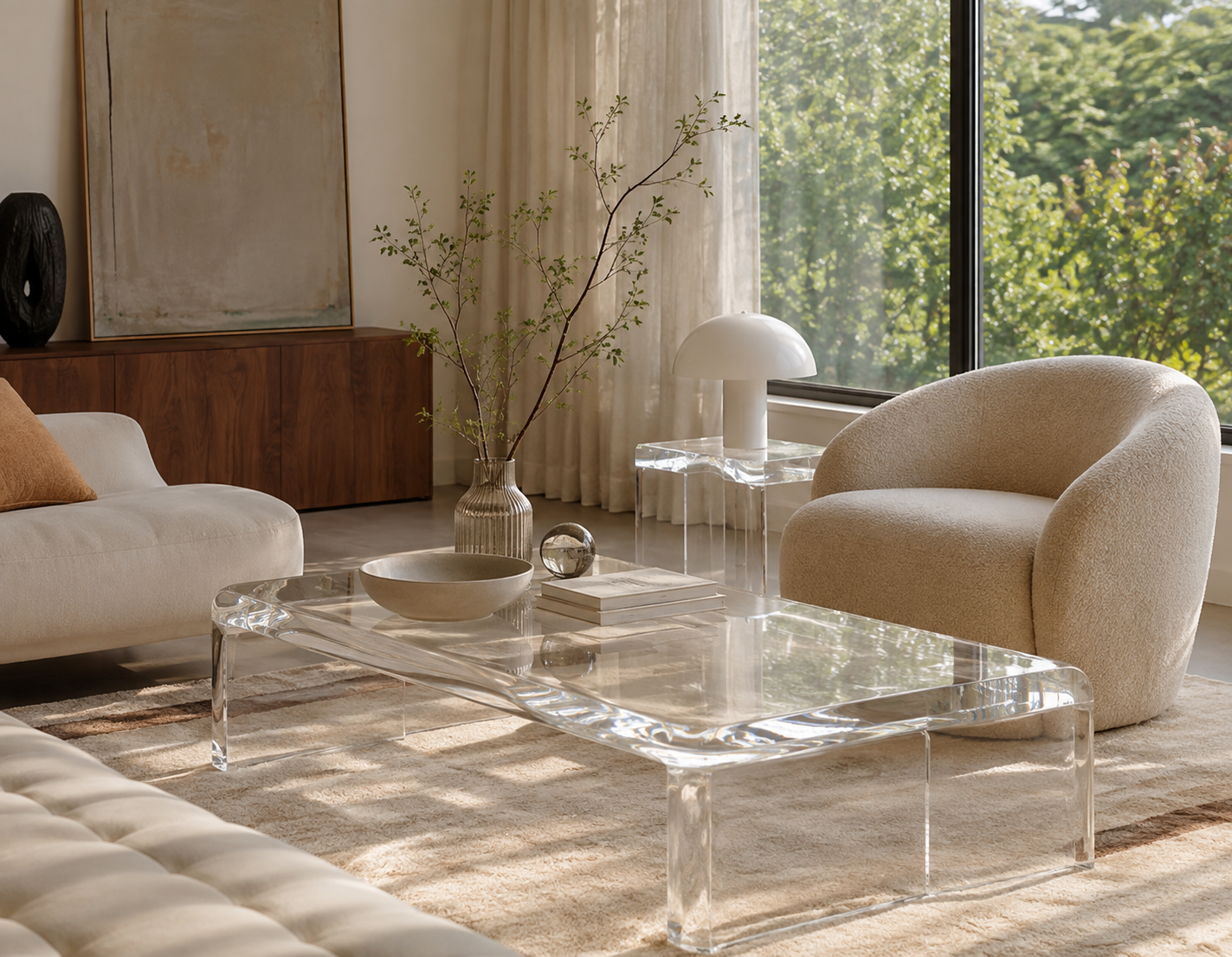
The Coffee Table Must Match the Room's Level of Formality
Some living rooms are highly formal.
Others are relaxed.
Some are architectural and minimal.
Others are layered and decorative.
A synthetic crystal coffee table can work in all of these environments, but the design needs to match the atmosphere.
A thick, sharply geometric table may feel perfectly suited to a luxury penthouse.
Place it in a soft, casual family room and it may appear too formal.
A curved crystal table may work beautifully in an elegant contemporary interior.
In a highly structured corporate lounge, the same shape may feel too relaxed.
The material is flexible.
The design language is not infinitely flexible.
This is why designers should distinguish between material suitability and form suitability.
Synthetic crystal may suit the room.
That does not mean every synthetic crystal design will.
Surrounding Materials Need to Create a Conversation
A successful interior rarely relies on one material.
The room is built through relationships.
Synthetic crystal often becomes more powerful when paired with contrasting surfaces.
Against boucle upholstery, it appears crisp.
Beside timber, it appears more contemporary.
Near stone, it feels lighter.
With leather, it can feel sophisticated.
Next to metal, it may become more architectural.
These combinations create dialogue.
But if every surrounding surface is similarly smooth, polished, and reflective, the room may lack depth.
The table then becomes one more glossy object in an already glossy environment.
In another room with richer textures, the exact same table may suddenly feel exceptional.
Contrast gives transparent furniture a reason to exist.
Too Much Transparency Can Be a Problem
One transparent piece can create relief.
Several transparent pieces can create continuity.
Too many can weaken the room.
If the coffee table, side tables, console, chairs, and decorative stands are all transparent, the space may lose grounding.
There may be too little material contrast.
The visual hierarchy can become unclear because the eye has fewer solid elements to organize the composition.
A statement synthetic crystal coffee table often works best when it is given a distinct role.
It does not need to be repeated everywhere.
Sometimes one transparent piece is more powerful than five.
Styling Changes Everything
The objects placed on the coffee table can completely change how the table feels.
A beautifully edited arrangement may enhance the transparency.
Too many small objects can make it look cluttered.
Because the table is clear, viewers may simultaneously see the rug beneath, objects on top, reflections on the surface, and furniture beyond it.
This creates multiple visual layers.
The styling therefore needs discipline.
A few carefully selected books, a sculptural bowl, or one strong decorative object may be enough.
If the synthetic crystal table already has a dramatic form, it may need even less decoration.
High-end transparent furniture often looks most luxurious when the styling allows the craftsmanship to remain visible.
A Beautiful Table Can Still Be the Wrong Table
This is an important point.
Furniture does not need to be badly designed to be wrong for a room.
A table can be beautifully made, perfectly polished, and visually distinctive and still fail in a particular interior.
This is not a criticism of the table.
It is a relationship problem.
The dimensions may be wrong.
The visual weight may be wrong.
The shape may compete with the architecture.
The lighting may create too many reflections.
The rug may introduce too much pattern.
The sofa may make the table appear too low or too small.
Professional interior design is largely about solving these relationships.
The most expensive object is not always the best object.
The most dramatic object is not always the strongest choice.
The right object is the one that improves the room as a whole.
Transparent Furniture Amplifies Good Decisions
One reason synthetic crystal furniture can look extraordinary in a well-designed room is that it amplifies the decisions around it.
If the rug is beautiful, the transparency reveals it.
If the floor is refined, the furniture preserves it.
If the lighting is carefully designed, the edges respond to it.
If the architecture is strong, sight lines remain open.
If the surrounding materials are thoughtfully selected, transparency creates contrast.
This is what makes the material so powerful.
But the opposite is also true.
If the surrounding composition is unresolved, transparent furniture can reveal that as well.
It does not hide poor relationships.
In some cases, it makes them more visible.
The Architecture Should Decide the Level of Presence
In some rooms, the coffee table should almost disappear.
In others, it should become sculptural.
The architecture can help determine which approach is appropriate.
A highly detailed room may benefit from a quieter transparent piece.
A minimalist room may need a more expressive synthetic crystal table to create interest.
A room with panoramic windows may require a design that preserves the view.
A large double-height interior may support a thicker and more substantial form.
Designers should resist choosing statement furniture based only on personal preference.
The room already contains information.
The furniture should respond to it.
Consider How the Room Is Actually Used
Visual success is only part of the equation.
A coffee table must function.
A beautiful transparent table may be unsuitable if it interrupts everyday circulation.
A very low table may look elegant but feel inconvenient for the users.
A large piece may photograph beautifully but leave too little space around the sofa.
A highly sculptural design may not provide enough usable surface.
This is why the same table can be perfect in a formal reception room and less suitable in a busy family living room.
The material can remain luxurious in both.
But the lifestyle is different.
Design is not only about appearance.
It is about how appearance and behavior work together.
The Best Transparent Tables Feel Inevitable
When a coffee table is truly right for a room, it often feels as though no other piece could have occupied that position.
The size seems natural.
The height relates to the sofa.
The shape responds to the architecture.
The rug remains visible.
The lighting reveals the material without overwhelming it.
The surrounding objects feel balanced.
The table does not look like an accessory added after the room was designed.
It looks integrated.
This sense of inevitability is one of the strongest indicators of good design.
Why Synthetic Crystal Works So Well When the Context Is Right
High-end synthetic crystal furniture offers designers a rare combination.
It can be physically substantial but visually light.
It can be highly crafted without appearing ornate.
It can create contrast without introducing a new color.
It can become a focal point without necessarily blocking sight lines.
It can interact with natural and artificial light in ways that opaque furniture cannot.
But these advantages only become fully visible when the surrounding room supports them.
The table needs the right scale.
The right lighting.
The right contrast.
The right negative space.
The right relationship with the sofa, rug, and architecture.
This is why context matters so much.
The material may be exceptional, but design is always relational.
Choosing the Right Table Means Reading the Entire Room
Before selecting a synthetic crystal coffee table, designers should step away from the product itself and study the room.
How large is the seating area?
Where does the eye naturally travel?
What material dominates the floor?
Is the rug quiet or expressive?
Are the sofas visually heavy or light?
Does the room already contain reflective surfaces?
Is the lighting warm, dramatic, or subtle?
Does the architecture need to remain visually dominant?
How much negative space surrounds the center of the room?
These questions often reveal whether the table should be simple, sculptural, thick, thin, large, compact, rectangular, round, or irregular.
The goal is not to find the most impressive table.
The goal is to find the table that makes the entire composition more convincing.
Good Design Is About Compatibility, Not Isolation
The reason the same transparent coffee table can look perfect in one room and completely wrong in another is simple: furniture does not create meaning by itself.
Context creates meaning.
A synthetic crystal coffee table may feel elegant in one environment because every surrounding choice supports its scale, transparency, and form.
Move the same table into another space and those relationships change.
The sofa changes the proportion.
The flooring changes the contrast.
The rug changes the pattern beneath it.
The lighting changes the reflections.
The architecture changes the hierarchy.
The table has not changed, but the visual system around it has.
This is why professional designers evaluate furniture as part of a composition rather than as an isolated object. The strongest interiors are not created by collecting beautiful pieces, but by understanding how those pieces affect one another, and when a synthetic crystal coffee table truly belongs in a room, the question is no longer whether the table looks beautiful, but why everything around it suddenly looks more intentional too.


