There is a noticeable difference between furniture that simply fits into a room and furniture that feels as though it was always meant to be there.
The first may be attractive. It may be expensive. It may even be beautifully made.
But the second feels integrated.
Its dimensions seem to respond naturally to the architecture. Its material works with the surrounding finishes. Its proportions make sense beside the sofa, wall, window, or artwork. It supports circulation rather than interrupting it. It reflects the character of the room instead of competing with it.
That difference is especially important with custom transparent furniture.
Pieces often described as acrylic furniture can already create a distinctive visual effect because of their clarity, lightness, and ability to preserve sight lines. But in high-end interiors, custom synthetic crystal furniture can go much further. When it is designed specifically for the room, it can become part of the architecture rather than simply another object placed inside it.
This is where customization becomes more than a matter of dimensions.
A truly successful custom piece is not just made to fit a space.
It is made to belong to it.

Custom Furniture Begins With the Room, Not the Product
One of the biggest mistakes in custom furniture design is starting with the object.
A client sees a table they like.
A designer chooses a reference image.
A manufacturer is asked to reproduce a similar form at a different size.
Technically, the result may be customized.
But it is not necessarily designed for the space.
True customization begins by studying the room before deciding what the furniture should become.
What are the dimensions?
Where are the windows?
Which direction does natural light enter?
What is the ceiling height?
Where are the main circulation paths?
What materials dominate the space?
Which architectural lines are most important?
What is the primary focal point?
How does the room function throughout the day?
These questions are not secondary.
They are the foundation of the design.
A custom synthetic crystal console created for a narrow entryway should respond to completely different conditions than one designed for a large hotel lobby.
A coffee table for a compact apartment should not simply be a smaller version of a table designed for a spacious villa.
The room should influence the object from the beginning.
Proportion Is More Important Than Size Alone
A piece can have the correct dimensions and still feel wrong.
This happens because size and proportion are not the same thing.
Size tells us whether the object physically fits.
Proportion tells us whether it looks right.
For example, a synthetic crystal coffee table may fit comfortably between a sofa and lounge chairs, but if it is too thin relative to a large sectional, it may feel visually weak.
A console may fit perfectly along a wall, but if its legs are too delicate for the scale of the architecture, it can appear temporary.
A dining table may provide enough seating, but if the base is too narrow, the entire piece may feel disconnected from the room.
Custom furniture should therefore be designed in relation to surrounding elements.
The width of the sofa matters.
The height of nearby seating matters.
The length of the wall matters.
The scale of artwork matters.
The ceiling height matters.
The piece should feel proportionally connected to these elements, not simply physically compatible with them.
Architectural Lines Should Influence the Furniture
One of the clearest ways to make custom furniture feel integrated is to connect it visually to the architecture.
Every room contains lines.
Horizontal lines appear in windows, wall panels, shelving, flooring, and ceiling details.
Vertical lines appear in columns, doorways, panels, and structural elements.
Curves may appear in arches, staircases, lighting, or wall forms.
Custom synthetic crystal furniture can respond to these architectural cues.
A long, clean console can reinforce the horizontal rhythm of a paneled wall.
A geometric coffee table can echo the proportions of ceiling details.
A curved table can soften a room dominated by rigid linear architecture.
A pedestal can align with a niche or artwork above it.
These connections do not need to be obvious.
In fact, the most successful ones are often subtle.
The viewer may not consciously notice that the table edge aligns with an architectural line, but the room will feel more coherent because of it.
This is one of the reasons custom furniture can appear more sophisticated than standard pieces.
It is responding to a visual language that already exists.
The Furniture Should Respect the Main Focal Point
Not every custom piece should become the focal point.
This is a critical design decision.
A room may already have a strong architectural feature such as a fireplace, panoramic window, sculptural staircase, artwork, or lighting installation.
If the furniture competes with that element, the room can lose hierarchy.
Synthetic crystal furniture is particularly useful in this situation because it can have presence without becoming visually heavy.
A custom crystal console beneath an important artwork can support the composition while allowing the artwork to remain dominant.
A transparent coffee table in front of a window can anchor the seating area without interrupting the view.
A dining table with a sculptural synthetic crystal base can feel distinctive while still allowing a dramatic chandelier to remain the primary focal point.
The goal is not always to make the furniture louder.
Sometimes the goal is to make the room stronger.
Transparency Must Be Designed, Not Assumed
Transparent materials are often treated as visually neutral.
They are not.
A transparent object still has scale.
It still has edges.
It still reflects light.
It still creates highlights.
It still changes the way the room is perceived.
This is especially true with synthetic crystal furniture.
Thickness can make a piece feel substantial.
Polished surfaces can increase reflection.
Curves can distort and redirect light.
Faceted forms can create more visual activity.
Because of this, the degree of transparency should be considered in relation to the room.
In a quiet minimalist space, a thicker and more sculptural synthetic crystal piece may create exactly the right level of interest.
In a room with patterned stone, mirrored surfaces, polished metal, and decorative lighting, a simpler form may be more appropriate.
Customization should therefore involve not only dimensions, but also visual intensity.
Material Relationships Matter
A custom piece feels integrated when its material has a meaningful relationship with the rest of the room.
Synthetic crystal works especially well because it can create contrast without introducing excessive color.
Against natural stone, it provides visual lightness.
Next to timber, it introduces clarity and contemporary precision.
Beside upholstered furniture, it creates contrast between softness and structure.
With metal, it can produce a more architectural character.
Near richly textured textiles, it can provide a visual pause.
These relationships should be considered during the design process.
A room already dominated by polished finishes may need a synthetic crystal piece with simpler geometry.
A room filled with matte surfaces may benefit from stronger reflectivity.
A warm interior may use transparency to prevent the space from becoming too visually heavy.
A cooler contemporary interior may rely on crystal to reinforce precision.
The material should participate in the palette, even when it has no strong color of its own.
The Floor Should Influence the Design
Transparent furniture makes the floor unusually important.
With opaque furniture, much of the flooring is hidden.
With synthetic crystal furniture, the floor remains visible through and around the piece.
This means the floor becomes part of the furniture composition.
A custom coffee table placed over a hand-knotted rug should be designed with that rug in mind.
A console on marble should consider the direction of the veining.
A transparent table on dark timber may require different proportions than the same table on pale stone.
A faceted base may look exciting over a simple floor but visually busy over highly patterned marble.
Designers should ask not only what the furniture looks like from the side, but what it reveals beneath it.
This is particularly important in luxury interiors where the flooring itself may be a significant design investment.
The View Through the Furniture Matters
One of the most unique aspects of transparent furniture is that the background becomes part of the object.
When you look through a synthetic crystal console, you may see a wall finish, artwork, curtain, or architectural detail.
When you look through a coffee table, you may see the rug, sofa base, flooring, or objects on the opposite side.
When you look through a dining table, you may see the chairs, floor, and surrounding architecture.
This means a custom piece should be designed from multiple viewpoints.
What is visible through it from the entrance?
What is visible from the sofa?
What does it overlap with from the dining area?
Does the transparent base align awkwardly with another object?
Does the furniture reveal something attractive or something visually distracting?
A piece that feels designed for the space takes these sight lines into account.
Circulation Is Part of the Design
Furniture that interrupts movement always feels added.
Furniture that supports movement feels integrated.
This is especially important in custom design because the entire purpose of customization is to respond to specific conditions.
A custom synthetic crystal coffee table may need rounded corners in a tight circulation zone.
A console may require reduced depth in a narrow hallway.
A dining table may need a more compact base to allow easier chair movement.
A pedestal may need to be positioned carefully so that it does not interrupt the path through a gallery-like space.
These are not compromises.
They are design decisions.
When a piece is truly made for the room, circulation should influence its form from the beginning.
Scale Should Respond to How the Space Is Used
A formal living room and a family living room may have similar dimensions but require very different furniture.
A hotel lobby and a private residence may both use large transparent tables, but the performance expectations are different.
A custom piece should reflect how the space is actually used.
How many people will interact with it?
Will it be used every day?
Is it primarily decorative?
Does it need to support drinks, books, objects, or dining?
Will children move around it?
Is it positioned in a high-traffic area?
Will it need frequent cleaning?
These functional considerations influence thickness, shape, dimensions, and placement.
A piece that is only visually customized but functionally generic may still feel disconnected from the room.
Good custom design solves both aesthetic and practical problems.
Furniture Height Has a Major Impact
Height is one of the most overlooked variables in custom furniture.
A coffee table that is slightly too high can feel awkward beside a low sofa.
A console that is too short may look visually weak against a tall wall.
A dining table may technically be functional but feel proportionally wrong in a room with unusually high ceilings.
Synthetic crystal furniture makes height particularly noticeable because the material often reveals more of the surrounding space.
The relationship between horizontal surfaces becomes clearer.
A custom design should therefore consider nearby seat heights, window sills, wall panels, artwork, and architectural details.
Sometimes adjusting the height by only a few centimeters can completely change the visual balance.
A Custom Piece Should Create the Right Amount of Presence
Custom does not automatically mean dramatic.
Some rooms need a statement piece.
Others need restraint.
This is one of the most important decisions in the process.
A synthetic crystal table can become highly sculptural through thickness, shape, and geometry.
But if the room already contains strong architecture or artwork, a quieter piece may be more appropriate.
In another interior, a simple transparent table may feel too anonymous.
The space may need a bold custom base, unusual curve, or stronger scale.
The correct level of presence depends on the role the furniture needs to play.
Customization should therefore answer a larger question:
How noticeable should this piece be?
Lighting Should Influence the Form
Synthetic crystal responds beautifully to light.
Natural daylight can create subtle highlights.
Warm artificial lighting can emphasize polished edges.
Directional light can reveal thickness and structure.
Reflections can change as the viewer moves around the room.
Because of this, lighting should be considered during the design process.
A custom console near a window may require a different form than one placed in a darker corridor.
A coffee table beneath a chandelier may need simpler geometry if the lighting already creates strong visual activity.
A pedestal designed to catch directional lighting can become almost jewel-like.
The furniture and lighting should work together.
When this relationship is planned, the piece feels integrated.
When it is accidental, the furniture can feel added afterward.
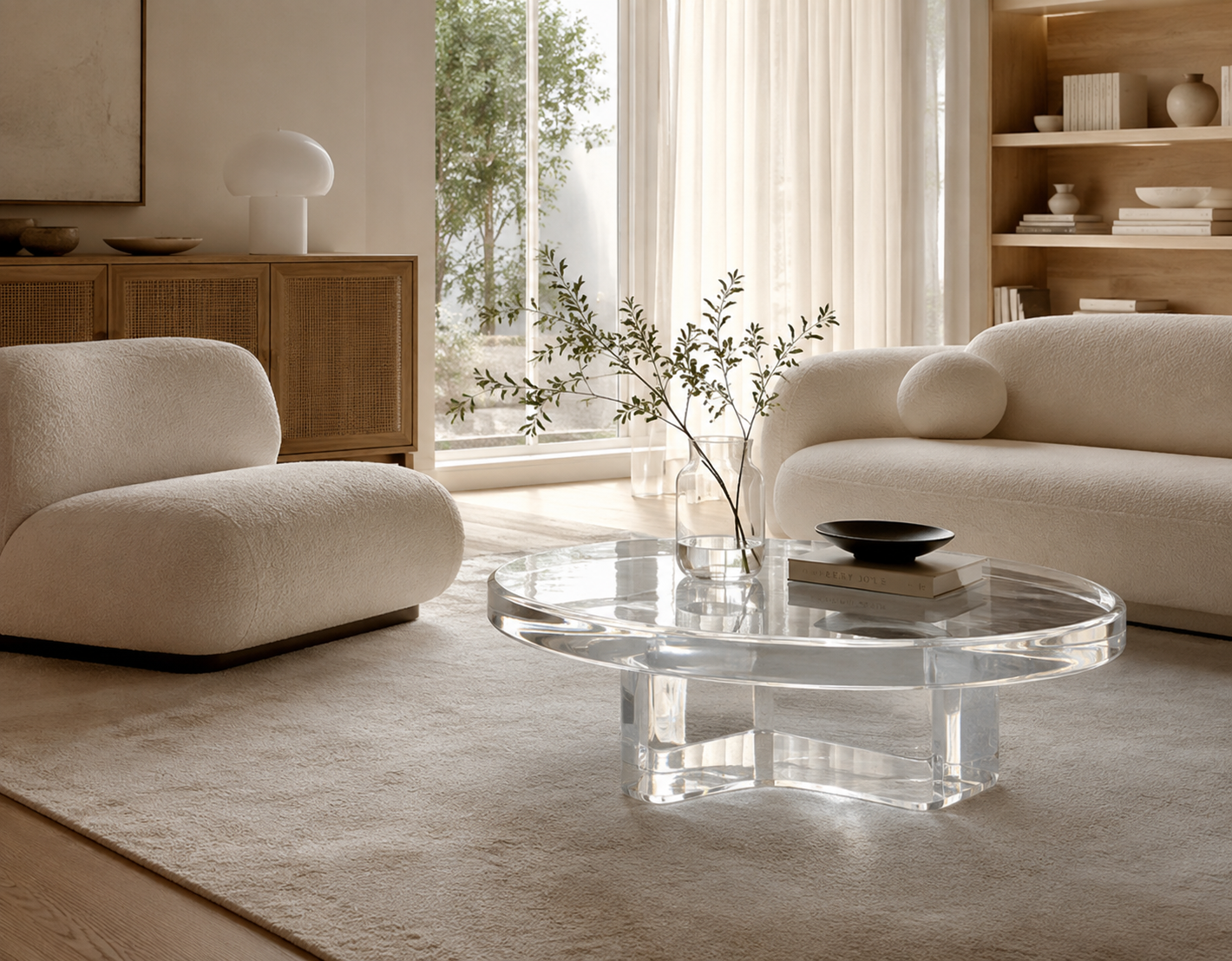
Customization Should Include Negative Space
Designers often focus on the dimensions of the object and forget the dimensions of the empty space around it.
But negative space is equally important.
How much room is left between the table and sofa?
How much space remains beside the console?
How much wall is visible around the pedestal?
How much breathing room exists between the furniture and artwork?
These gaps affect how the object is perceived.
A beautifully designed synthetic crystal piece can lose its impact if it is squeezed into a crowded area.
The same piece may look exceptional when given enough room to breathe.
Custom design should therefore include the surrounding empty space as part of the composition.
Edge Details Can Change the Character of the Piece
In high-end transparent furniture, details become highly visible.
Edges matter.
Thickness matters.
Corners matter.
Transitions matter.
A sharp geometric edge creates a different feeling from a softly rounded one.
A substantial crystal edge can create a strong architectural presence.
A thin profile may feel lighter and more delicate.
Rounded transitions can soften an otherwise rigid room.
Faceted details can introduce more reflection and visual energy.
Because synthetic crystal reveals rather than hides its construction, these decisions are especially important.
A custom piece should use edge treatment to reinforce the design language of the room.
Repetition Can Create Architectural Continuity
One way to make custom furniture feel integrated is to repeat certain proportions or details already present in the interior.
This does not mean copying the architecture literally.
It means creating subtle visual connections.
The thickness of a synthetic crystal table may echo the width of a wall panel.
The curve of a console may relate to an arched doorway.
The spacing of supports may respond to the rhythm of shelving.
The shape of a pedestal may repeat geometry used elsewhere in the room.
These small connections create continuity.
The furniture begins to feel less like a separate product and more like part of the overall design system.
Custom Does Not Mean Complicated
There is a common assumption that custom furniture needs to be visually complex.
It does not.
Some of the strongest custom pieces are extremely simple.
What makes them special is not ornament.
It is precision.
The exact length.
The exact height.
The exact thickness.
The exact radius.
The exact relationship with the surrounding architecture.
A simple synthetic crystal console made specifically for one wall can feel more luxurious than a much more elaborate piece that does not relate to the room.
Sophistication often comes from control rather than complexity.
The Piece Should Look Right From Every Important Angle
A standard piece may be designed mainly for a front-facing product photograph.
A custom piece should work in three dimensions.
This is especially important in open-plan interiors.
A coffee table may be visible from several rooms.
A console may be seen from the entrance and from the staircase.
A dining table may be viewed from above, from the side, and from across the room.
Synthetic crystal makes this even more important because its appearance changes according to angle and light.
A well-designed piece should remain balanced from all relevant viewpoints.
This is one of the strongest signs that the object was designed specifically for the environment.
Integration Also Depends on Styling
Even a perfectly designed custom piece can feel disconnected if it is styled poorly.
Transparent furniture requires particularly careful editing.
Too many decorative objects can hide the form.
Too few can make the piece feel unfinished.
The best styling usually supports the furniture rather than covering it.
A synthetic crystal console may need only a sculptural lamp and one strong object.
A coffee table may work with a small group of books and a single decorative piece.
A dining table may need almost nothing when the form itself is strong.
The styling should reinforce the role of the furniture within the room.
Good Custom Furniture Solves a Problem
The best custom pieces usually exist because standard furniture cannot solve the room properly.
Perhaps the wall is unusually long.
Perhaps the corridor is too narrow for standard depths.
Perhaps the sofa configuration requires a non-standard coffee table.
Perhaps a large rug needs to remain visible.
Perhaps the architecture contains a curve that standard furniture ignores.
Perhaps the client wants a substantial statement without introducing more visual weight.
These are genuine design problems.
Synthetic crystal can provide unique solutions because it combines physical structure with visual openness.
Customization becomes meaningful when it solves something specific.
A Truly Custom Piece Feels Difficult to Move Elsewhere
This is one of the simplest tests.
Imagine taking the furniture out of the room and placing it somewhere completely different.
Would it still feel equally correct?
If the answer is yes, the piece may be beautiful, but it may not be deeply connected to the original space.
A truly integrated custom piece often feels almost inseparable from its environment.
Its dimensions respond to a specific wall.
Its height relates to specific seating.
Its transparency reveals a specific rug.
Its geometry reflects specific architectural lines.
Its scale supports a specific room volume.
This does not mean the furniture cannot physically work elsewhere.
It means its strongest visual logic belongs to the space for which it was designed.
The Difference Between Custom-Made and Custom-Designed
These two ideas are not the same.
Custom-made means the furniture was produced according to specified measurements or features.
Custom-designed means those measurements and features were developed in response to the space.
The distinction is important.
A table can be custom-made at 160 centimeters instead of 140 centimeters.
But why 160?
Does that dimension relate to the sofa?
Does it align with the rug?
Does it improve circulation?
Does it support the architecture?
If not, the piece may be customized without being truly designed.
High-end synthetic crystal furniture reaches its full potential when customization is based on design logic rather than simple dimensional adjustment.
The Room and Furniture Should Feel Like One Decision
When custom furniture is successful, the viewer does not mentally separate the object from the room.
They do not think, “That table was added later.”
They experience the composition as a whole.
The table belongs with the rug.
The console belongs with the wall.
The pedestal belongs with the artwork.
The dining table belongs with the architecture.
This is the ultimate goal.
The furniture should not appear to be searching for a place in the room.
It should look as though the room was always waiting for exactly that piece.
Why Synthetic Crystal Is Especially Powerful for Custom Work
Synthetic crystal offers designers unusual freedom.
It can be substantial without becoming visually heavy.
It can be sculptural without blocking views.
It can interact with light without introducing another strong color.
It can reveal expensive floors and rugs rather than hiding them.
It can create modern contrast beside traditional materials.
It can support architecture while remaining visually open.
These qualities make it especially suitable for custom projects where the furniture needs to solve very specific visual and spatial problems.
But the material alone does not create integration.
The design decisions do.
Proportion matters.
Placement matters.
Lighting matters.
Sight lines matter.
Thickness matters.
The relationship with the architecture matters.
Customization is successful when all of these variables are considered together.
The Best Custom Furniture Feels Less Like Furniture
There is a point at which a custom piece stops feeling like a movable object and begins to feel almost architectural.
This is often where the strongest designs exist.
A synthetic crystal console may feel like an extension of the wall.
A coffee table may feel like the natural center of the seating plan.
A pedestal may feel integrated with an artwork.
A dining table may feel as though its proportions were derived directly from the room itself.
This does not happen by accident.
It happens when the furniture is designed from the same visual logic as the space.
The result is subtle but powerful.
The piece may still attract attention, but it does not feel separate.
It feels inevitable.
Final Thoughts
The difference between furniture that looks added afterward and furniture that feels designed for the space is rarely one dramatic feature.
It is the accumulation of many precise decisions.
The right scale.
The right proportion.
The right height.
The right material relationship.
The right amount of transparency.
The right connection to architectural lines.
The right response to lighting.
The right circulation.
The right negative space.
The right visual hierarchy.
When these elements work together, custom synthetic crystal furniture can do more than fill an empty area. It can strengthen the architecture, clarify the layout, reveal surrounding materials, and create a sense of visual continuity that standard furniture often cannot achieve.
The most successful custom piece does not ask the viewer to admire how perfectly it fits into the room; it makes them wonder whether the room was somehow designed around it from the very beginning.


