The future of high-end furniture will not be defined only by expensive materials.
It will be defined by materials that create new experiences.
For decades, luxury furniture relied heavily on familiar signals of value: rare hardwoods, natural marble, brass, bronze, leather, hand carving, and traditional craftsmanship. These materials remain important, but the premium market is changing rapidly.
Interior designers, architects, hospitality brands, property developers, and luxury homeowners are increasingly searching for something different.
They want materials that create identity.
They want furniture that interacts with architecture.
They want products that feel lighter, more sculptural, and more personalized.
They want spaces that photograph beautifully but also feel distinctive in real life.
They want materials that support both modern technology and refined craftsmanship.
Within this changing landscape, synthetic crystal acrylic furniture is becoming increasingly relevant.
High-quality acrylic offers a combination that few conventional furniture materials can provide: transparency, optical depth, sculptural flexibility, visual lightness, precision, and extensive customization.
For this reason, it should not be understood merely as an alternative to glass or plastic.
In high-end design, acrylic is becoming a material language of its own.
And that language is likely to become more important in the future.
1. High-End Design Is Moving Beyond Traditional Luxury
The definition of luxury is evolving.
In the past, luxury was often communicated through obvious material cost. A large marble table felt expensive because the stone itself carried value. A solid hardwood cabinet communicated craftsmanship through weight, grain, and construction. Brass detailing suggested richness. Leather communicated durability and tradition.
Today, premium customers still appreciate these materials, but they are no longer satisfied by material price alone.
The market has become more sophisticated.
Customers can access expensive products from thousands of suppliers. Luxury hotels can source marble from multiple countries. Designers can specify premium wood, metal, and stone from a vast global supply chain.
As a result, rarity alone is no longer enough.
The new question is not simply, “Is this material expensive?” The question is, “What does this material add to the experience?”
This shift creates opportunities for synthetic crystal acrylic.
Acrylic can create effects that traditional opaque materials cannot easily achieve.
It can appear substantial and weightless at the same time.
It can allow light to travel through a furniture structure.
It can reveal the flooring beneath a table.
It can preserve the visual continuity of an architectural wall.
It can create thick, sculptural forms without making the room feel visually crowded.
These characteristics make acrylic particularly relevant to contemporary luxury.
The most forward-looking interiors are increasingly based on contrast rather than ornament.
Heavy and light. Opaque and transparent. Natural and engineered. Soft and polished. Warm and cool.
Synthetic crystal acrylic fits naturally into this design vocabulary. It allows designers to create tension between materials while maintaining a refined visual balance.
That is why acrylic is gradually moving from a supporting material to a central design material.
2. Transparency Is Becoming More Valuable in Luxury Interiors
Modern luxury architecture increasingly emphasizes openness.
Large windows. Open-plan living. Long sightlines. Natural stone flooring. Integrated lighting. Minimal architectural interruption.
In this context, traditional heavy furniture can sometimes create a problem.
A large opaque table can interrupt the room. A solid console can visually block a decorative wall. A dark furniture base can make a carefully designed interior feel heavier.
Transparent acrylic behaves differently.
It occupies physical space without completely occupying visual space.
This distinction is extremely important.
A crystal-clear acrylic coffee table can provide the same function as a wooden or stone table, yet allow the rug below to remain visible.
A transparent console can sit in front of a textured wall without hiding the wall.
A clear dining table base can support a substantial top while preserving openness beneath it.
The furniture becomes part of the architecture rather than an obstacle to it.
This is one of the main reasons acrylic is likely to become increasingly important in future high-end design.
As architecture becomes more visually open, furniture needs to respond.
Transparency provides that response.
It allows designers to introduce objects without breaking the continuity of the space.
This creates a sense of calm.
It also creates the impression of greater space.
And spaciousness is strongly connected with luxury.
High-end interiors do not always need to be physically enormous. They need to feel generous.
Transparent furniture helps achieve this emotional effect.
.png)
3. Light Interaction Gives Acrylic a Future-Oriented Aesthetic
Acrylic is not only transparent.
It is highly responsive to light.
This is one of its most important design qualities.
When polished correctly, acrylic edges can capture highlights. Thick sections can create optical depth. Curved forms can bend and distort reflections. Tinted acrylic can introduce subtle color. Layered structures can create unusual visual effects.
This interaction means the furniture changes throughout the day.
Morning light may make a clear console almost disappear. Stronger afternoon sunlight may emphasize its edges. At night, architectural lighting may create bright reflections within the material.
This dynamic behavior gives acrylic a sense of life.
The object is never completely static.
That matters in future-oriented design.
As interiors become more integrated with lighting technology, materials that respond to illumination become increasingly valuable.
Designers are already using layered lighting to create atmosphere: indirect light, LED systems, decorative pendants, architectural spotlights, and backlighting.
Material selection will increasingly be influenced by how surfaces interact with these lighting systems.
Synthetic crystal acrylic is well positioned for this future.
Its transparency and polished surfaces allow it to participate actively in the lighting environment.
Furniture is no longer simply illuminated. It becomes part of the illumination experience.
This creates a sophisticated, almost jewelry-like effect.
And in high-end spaces, that type of visual transformation is extremely valuable.
4. Sculptural Freedom Makes Acrylic Ideal for Experimental Design
Future luxury furniture will become more sculptural.
Customers are increasingly interested in objects that feel unique.
Interior designers want focal points.
Architects want furniture that connects with the geometry of the building.
Luxury homeowners want pieces that do not look mass-produced.
Synthetic crystal acrylic supports this shift because it offers significant form flexibility.
It can be used in thick blocks, thin panels, geometric structures, curved profiles, layered forms, monolithic volumes, transparent supports, and complex visual compositions.
These possibilities allow designers to move beyond conventional furniture construction.
A dining table base can look like an abstract sculpture.
A coffee table can resemble carved crystal.
A console can appear almost architectural.
A chair can combine transparency with upholstery.
A bench can use bold curved geometry while maintaining visual lightness.
This sculptural potential is especially important because high-end furniture increasingly overlaps with collectible design.
The boundary between furniture and art is becoming less clear.
A premium table is expected not only to function. It may also need to create conversation.
A chair may need to contribute to the identity of the room.
A console may need to become a visual signature.
Synthetic crystal acrylic is well suited to this environment because transparency itself creates visual interest.
Even relatively simple forms can feel unusual when executed in thick, polished acrylic.
This gives designers a large creative range without relying entirely on decorative complexity.
5. Customization Will Become Even More Important
The future of high-end furniture is highly personalized.
Standardization works well in the mass market.
Luxury customers increasingly expect something different.
They want products that fit their architecture.
They want proportions that suit specific rooms.
They want furniture that reflects personal taste.
Hotels want pieces aligned with brand identity.
Boutiques want furniture designed around merchandising.
Interior designers want solutions for unique project conditions.
Synthetic crystal acrylic is particularly compatible with this demand.
Size can be customized. Thickness can be adjusted. Colors can be clear, tinted, frosted, or translucent. Forms can be geometric or curved. Edges can be treated differently. Other materials can be integrated.
This makes acrylic an excellent platform for bespoke furniture.
Acrylic can be combined with marble to create a contrast between transparency and natural weight. It can be paired with brass for a more glamorous aesthetic. Stainless steel can create a sharper architectural appearance. Wood can introduce warmth. Leather or velvet can provide softness. Glass can add another level of transparency.
These combinations allow designers to create highly specific visual identities.
This means one manufacturing capability can support very different design directions: minimalist, luxury residential, hospitality, retail, art-oriented, contemporary classic, and futuristic.
This versatility will become increasingly valuable as customers demand more personalization.
.png)
6. Acrylic Supports the Shift from Product to Project
One of the most important trends in high-end furniture is the movement from standardized product sales toward project-based collaboration.
Professional buyers often do not want a fixed catalogue item. They want solutions.
An architect may require a custom table with unusual dimensions. A luxury hotel may need multiple variations of the same concept. A retail brand may need transparent display furniture across an entire store. A designer may require a unique combination of acrylic, marble, and metal.
Manufacturers capable of responding to these requirements can occupy a much stronger market position.
Synthetic crystal acrylic provides an opportunity for this transition.
Because the material supports customization, it allows manufacturers to become more deeply involved in the design process.
The relationship changes.
Instead of simply producing furniture, the manufacturer can contribute material knowledge, structural recommendations, thickness guidance, finish selection, color suggestions, packaging solutions, and installation planning.
This turns the supplier into a technical and design partner.
That is a powerful shift.
High-end professionals value suppliers who reduce project risk.
They want companies that understand drawings. They want accurate communication. They want consistent finishing. They want the final object to match the design intention.
As premium acrylic manufacturers develop these capabilities, the material can become an entry point into higher-value projects.
Precision Craftsmanship Will Define Premium Acrylic
Acrylic is not automatically luxurious.
This point is critical.
The future growth of synthetic crystal acrylic furniture in high-end design will depend heavily on execution.
Transparency exposes imperfections. Poor polishing is visible. Inconsistent bonding is visible. Uneven edges are visible. Scratches are visible. Incorrect proportions are visible.
This makes craftsmanship extremely important.
Premium acrylic furniture requires discipline.
Material selection must be controlled. Cutting must be accurate. Edges must be finished carefully. Bonding must be clean. Surfaces must be protected. Assembly must be precise. Packaging must prevent damage.
When all of these elements are executed correctly, acrylic can create an exceptional luxury effect.
Its edges can appear luminous. Its thick sections can resemble crystal. Its joints can appear almost invisible. Its surfaces can create a sense of extreme precision.
This precision communicates value.
In fact, transparent furniture may communicate craftsmanship more directly than many opaque materials because there is less opportunity to hide construction details.
The quality is visible.
That visibility can become a major advantage for premium brands.
Acrylic and Traditional Luxury Materials Will Increasingly Coexist
Future high-end design does not require acrylic to replace marble, wood, metal, or leather.
The stronger trend is combination.
Acrylic is particularly powerful when used alongside traditional luxury materials.
Why?
Because contrast increases perception.
Heavy marble looks even more substantial beside clear acrylic. Warm wood feels more natural beside a polished transparent surface. Brass feels richer when combined with optical clarity. Soft upholstery becomes more tactile beside a hard acrylic structure.
This allows designers to create multi-layered material experiences.
Consider a marble dining top supported by crystal-clear acrylic bases. The marble communicates permanence. The acrylic communicates visual lightness. The combination produces an effect neither material could create alone.
A brass detail within a transparent acrylic console introduces warmth without overwhelming the piece.
An upholstered acrylic chair creates a contrast between invisible structure and visible comfort.
These combinations will become increasingly important because modern luxury is moving away from single-material decoration.
The future is about carefully curated relationships.
Synthetic crystal acrylic is valuable because it can connect many different material languages.
Visual Lightness Will Become a Key Luxury Value
High-end spaces increasingly aim to feel calm.
Furniture that is visually heavy can create pressure.
Furniture that appears lighter can create a sense of freedom.
Synthetic crystal acrylic is uniquely positioned here.
It can have real physical substance without appearing visually dense.
A thick acrylic leg may be extremely solid, yet the eye continues through it.
A large transparent table may occupy significant space, yet the room can still feel open.
This ability to separate physical scale from visual weight is highly valuable.
Future urban luxury interiors may particularly benefit from this.
Many premium residences are located in cities where floor area is expensive.
Owners may want substantial furniture but cannot afford to sacrifice visual openness.
Transparent furniture offers a solution.
It allows luxury through material presence without creating a crowded impression.
This makes acrylic relevant not only to large villas but also to high-end apartments and penthouses.
Luxury Retail and Hospitality Will Accelerate the Trend
Residential design is only one part of the opportunity.
Hotels, boutiques, private clubs, galleries, restaurants, spas, and luxury retail environments also need distinctive materials.
These spaces compete for attention.
They need to create memory.
A visitor may spend only a short time inside, so visual impact matters.
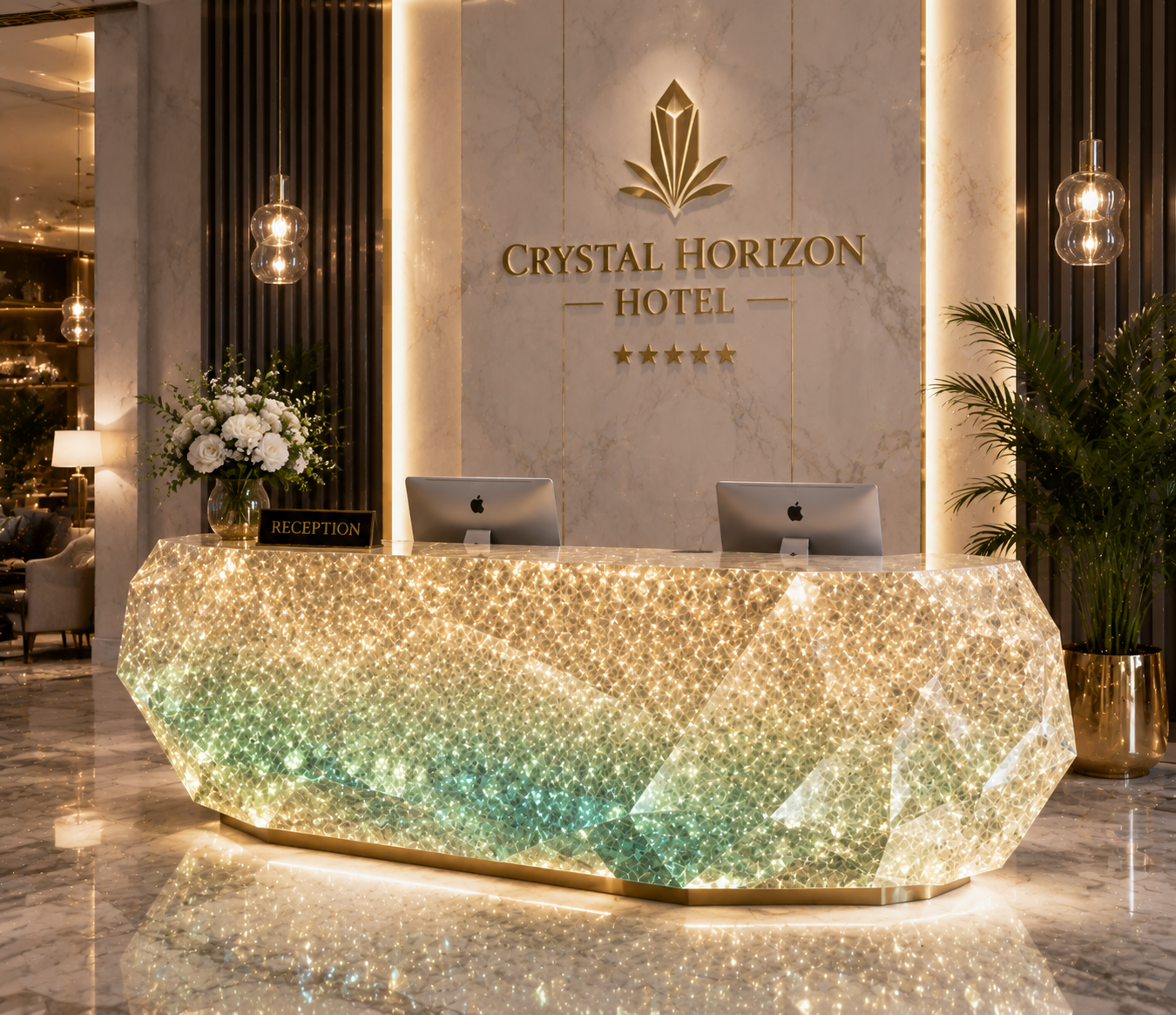
Synthetic crystal acrylic can help create memorable focal points such as reception desks, display tables, console furniture, sculptural benches, product pedestals, decorative shelving, and custom installations.
Because the material is transparent, it can support merchandise without visually competing with it.
This is especially valuable in luxury retail.
A transparent display structure can make products appear to float.
In hotels, a large acrylic table can create a contemporary centerpiece.
In galleries, clear furniture can provide function without distracting from artwork.
In clubs and restaurants, acrylic can create dramatic reflections under controlled lighting.
These applications will help push acrylic further into the premium design market.
Sustainability of Design Will Matter More Than Short-Term Trends
Future luxury will also be influenced by a growing desire for long-term design relevance.
High-end clients are becoming more cautious about furniture that feels fashionable for only a short period.
They want products with a strong identity but enough visual clarity to remain relevant.
Synthetic crystal acrylic can support this balance.
Transparency is visually distinctive, but it is also neutral.
Clear acrylic does not impose a dominant color.
It can work with changing interiors.
It can coexist with different materials.
A clear table may continue to work even when the rug, lighting, artwork, or surrounding upholstery changes.
This flexibility gives the material long-term design potential.
It can be expressive without becoming stylistically restrictive.
For high-end clients, this is valuable because premium furniture is often expected to remain in use for many years.
Digital Media Is Making Transparent Furniture More Visible
Another factor supporting the future of acrylic furniture is the influence of visual media.
Interior design is increasingly discovered through images and video: social platforms, digital magazines, hotel websites, architectural portfolios, and luxury real estate listings.
Transparent furniture performs strongly in these environments.
It creates unusual reflections. It preserves background detail. It responds to moving cameras. It can look different depending on perspective.
Videos are especially effective because viewers can see the furniture transform as the viewing angle changes.
This visual dynamism helps acrylic stand out in a crowded digital environment.
For furniture brands, this is commercially important.
Materials that create stronger visual content can generate greater attention. Attention supports recognition. Recognition supports positioning.
This does not mean acrylic should be chosen merely because it photographs well.
But its visual behavior aligns naturally with the way modern design is communicated.
The Future Market Will Reward Distinctive Material Languages
Furniture brands face increasing competition.
Designs can be copied quickly. Prices can be compared instantly. Suppliers can be sourced globally.
To build long-term value, brands need something recognizable.
A material language can provide this differentiation.
Synthetic crystal acrylic can become part of a brand's identity.
One company may specialize in thick monolithic acrylic structures. Another may focus on transparent curves. Another may combine acrylic with marble. Another may use tinted acrylic and metal. Another may build an entire collection around architectural transparency.
The goal is not simply to produce acrylic furniture.
The goal is to use acrylic consistently enough that customers recognize a design philosophy.
This creates memory.
And memory is a fundamental component of brand value.
The Material Is Becoming Part of a Broader Emotional Shift
Perhaps the most important trend is not technological.
It is emotional.
High-end customers increasingly want spaces that make them feel something.
Calm. Lightness. Surprise. Sophistication. Freedom. Curiosity. Confidence.
Materials are powerful tools for creating these emotions.
Synthetic crystal acrylic can produce a distinctive emotional response because it challenges normal expectations of furniture.
We expect furniture to be solid and visually present. Acrylic can be solid but visually transparent.
We expect thick furniture to feel heavy. Acrylic can be thick and visually light.
We expect a functional object to remain visually static. Acrylic changes with light and perspective.
These contradictions create interest.
They make people look again.
That moment of attention is valuable.
It turns furniture from background equipment into part of the experience.
Conclusion
Synthetic crystal acrylic furniture is becoming a material trend that high-end design cannot afford to ignore.
Its importance comes from more than transparency.
It responds to several major changes happening simultaneously in the premium market.
Luxury is moving from cost toward experience. Architecture is becoming more open. Furniture is becoming more sculptural. Customization is becoming more important. Lighting is becoming more integrated. Professional buyers are demanding project-based solutions. Brands are searching for stronger differentiation. Customers are looking for spaces with emotional identity.
Synthetic crystal acrylic sits at the intersection of all of these trends.
It can preserve visual openness. It can interact with light. It can support bold sculptural forms. It can be customized extensively. It can combine with marble, wood, metal, glass, leather, and textiles. It can demonstrate precision craftsmanship. It can help furniture manufacturers build a recognizable design language. It can work in luxury residences, hotels, boutiques, clubs, galleries, restaurants, and commercial interiors.
Most importantly, it can create an experience that traditional furniture materials do not easily reproduce.
The future of high-end design will not be about choosing between traditional materials and new materials.
It will be about understanding how different materials create different emotions, spatial effects, and identities.
In that future, synthetic crystal acrylic will not simply be a transparent option.
It will be a strategic design material.
A material for light.
A material for sculpture.
A material for customization.
A material for contemporary luxury.
And for designers and brands seeking to create spaces that feel more distinctive, memorable, and future-oriented, it is becoming increasingly difficult to ignore.
READ MORE:
- The Secret to an Expensive-Looking Interior: Why Designers Pair Transparent Furniture with Metal, Stone and Low-Saturation Colors
- Smoke Grey, Amber, Champagne or Clear? What Different Resin Furniture Colors Do to the Atmosphere of a Space
- From Material Presence to Premium Appeal: The Color Logic Behind Synthetic Crystal and High-End Resin Furniture
- Transparency Is Not Cheap: How Platinum Acrylic Furniture Elevates Interiors Through Color and Light
- How Can Commercial Spaces Avoid Looking Cheap? Start with the Color and Clarity of High-End Resin Furniture
- Why Can One Crystal-Grade Acrylic Furniture Piece Transform the Perceived Value of an Entire Space?
- Synthetic Crystal Acrylic Furniture: The Differentiated Answer the High-End Home Market Is Looking For
- From Transparent Aesthetics to Brand Elevation: How Synthetic Crystal Acrylic Furniture Enhances Product Positioning
- Synthetic Crystal Acrylic Furniture: Why High-End Clients Increasingly Value the Emotional Power of Material


