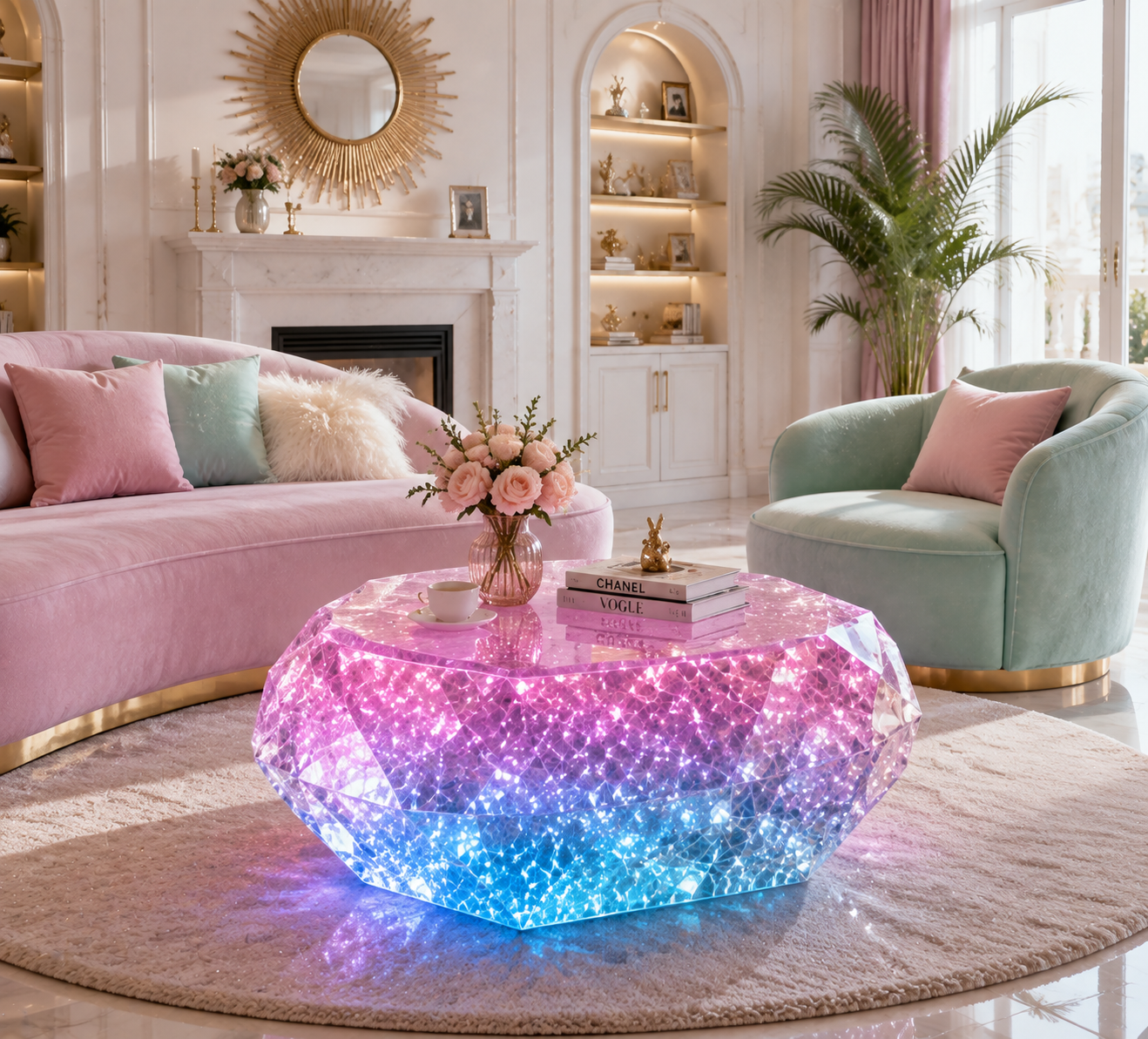
In the furniture market, materials are rarely valuable simply because of what they are. Their true commercial value comes from what designers, manufacturers, brands, and project owners are able to create with them.
Synthetic crystal acrylic furniture provides a clear example of this transformation.
For many years, acrylic was widely associated with signs, display products, decorative accessories, and basic transparent furniture. It was often understood primarily as a lightweight substitute for glass. In many markets, acrylic products competed mainly on price, thickness, transparency, and basic manufacturing capability.
That situation is changing.
In high-end residential, hospitality, retail, commercial, and art-oriented projects, acrylic is increasingly being treated as a premium design material rather than a simple transparent plastic. Its transparency, flexibility, optical characteristics, processing potential, and compatibility with other materials are giving designers new ways to create visually distinctive furniture.
As this transformation continues, the value of synthetic crystal acrylic furniture is moving through several stages. The first stage is visual differentiation. Acrylic attracts attention because it looks different. The second stage is design differentiation. Manufacturers begin using the material to create more complex, customized, and recognizable products. The third stage is value differentiation. Better craftsmanship, engineering, finishing, and project services increase the perceived and actual value of the furniture. The final stage is market competitiveness. Companies that understand how to develop acrylic as a complete design and manufacturing solution can move away from commodity competition and enter higher-value markets.
This is why the future of synthetic crystal acrylic furniture is not simply about producing more transparent tables or chairs. It is about transforming material advantages into design advantages, project advantages, brand advantages, and ultimately commercial advantages.
1. Visual Differentiation: Why Acrylic Furniture Creates Immediate Recognition
In a highly competitive furniture market, visual recognition has become increasingly important.
Consumers, designers, hotel operators, retailers, and developers are exposed to enormous numbers of furniture products every day. Traditional materials such as wood, metal, marble, fabric, leather, and glass remain essential, but they are also extremely common.
This creates a challenge. A new furniture product may be well made, but if it looks similar to hundreds of other products, it can be difficult to create immediate market recognition.
Synthetic crystal acrylic offers a different visual experience.
The most obvious characteristic is transparency. A transparent table, chair, console, bench, or shelving unit interacts with its environment in a completely different way from opaque furniture. Instead of visually blocking the space behind it, the furniture allows architecture, flooring, lighting, artwork, and surrounding materials to remain visible.
This gives acrylic furniture a light and almost floating appearance. In modern interiors, this effect can be extremely powerful.
A thick acrylic coffee table placed on a patterned rug allows the rug to remain visible. A transparent console placed against a marble wall does not conceal the stone surface. Acrylic chairs around a dining table can reduce visual congestion. A clear display pedestal in a boutique allows the merchandise to remain the main focus.
The material therefore creates differentiation without necessarily creating visual heaviness. This is an important distinction.
Some furniture attracts attention by being large, colorful, ornate, or dramatic. Acrylic can attract attention through the opposite strategy: clarity, simplicity, and optical subtlety.
Thickness is one of the most important elements in this visual language. A thin acrylic sheet can look functional and lightweight. A thick acrylic block, however, can create a completely different impression. Its edges capture light. Its internal depth becomes visible. Reflections appear within the material. Depending on the geometry, the object may resemble crystal, ice, or polished glass.
This is where the expression “synthetic crystal” becomes particularly relevant. The luxury effect does not come from transparency alone. It comes from the interaction between transparency, thickness, surface quality, edge polishing, proportion, and lighting.
High-quality edge polishing can transform an ordinary acrylic component into a visually refined element. Curved surfaces can create optical distortion. Beveled edges can increase reflection. Layered sections can produce depth and shadow.
Lighting further increases these effects. Under daylight, acrylic may appear clean and almost invisible. Under warm hotel lighting, polished edges may glow. Under retail spotlights, thick transparent surfaces may produce dramatic highlights. Integrated LED systems can turn acrylic furniture into an illuminated design object.
This makes the material particularly useful in environments where visual experience matters. Luxury boutiques, flagship stores, hotels, bars, restaurants, clubs, galleries, exhibitions, and premium residences all benefit from objects that can create a memorable atmosphere.
Visual differentiation is therefore the first level of value upgrade. At this stage, acrylic furniture is no longer chosen merely because it is transparent. It is chosen because it creates an aesthetic experience that conventional materials cannot reproduce in exactly the same way.
2. From Material to Design Language: Expanding the Creative Possibilities of Acrylic
Visual difference attracts attention, but long-term value depends on design.
If every acrylic manufacturer produces the same clear rectangular table, the material quickly becomes commoditized. Once products become visually similar, competition usually returns to price.
The greater opportunity lies in turning acrylic into a design language.
Acrylic offers significant processing flexibility. It can be cut into complex profiles, CNC-machined, drilled, polished, bent, bonded, engraved, frosted, colored, layered, and combined with other materials. Depending on the project, designers can use these capabilities to create furniture that would be difficult to produce using conventional glass alone.
Curved acrylic is particularly important. A single curve can completely change the character of a furniture piece. A transparent console with smoothly curved legs looks softer and more sculptural than a basic box construction. A chair formed with continuous transparent surfaces can appear almost fluid. Rounded side tables can interact beautifully with light.
Complex geometry adds another layer of opportunity. Acrylic can be used to create geometric bases, stepped structures, layered blocks, transparent columns, sculptural supports, and irregular artistic forms. When combined with digital design and precise machining, the material can support highly individualized furniture concepts.
Color further expands the design vocabulary. Although clear acrylic remains the most recognizable form, premium furniture can also use tinted, translucent, smoked, frosted, mirrored, fluorescent, or custom-colored acrylic.
These variations allow designers to create stronger relationships between furniture and interior themes. A smoked acrylic side table may complement a dark luxury hotel room. Amber acrylic can introduce warmth into a neutral interior. Colored transparent furniture can become a focal point in fashion retail. Frosted sections can create visual privacy while retaining a sense of lightness.
The material also combines well with other premium surfaces. A transparent acrylic table base can support a marble top. A console may combine acrylic with brass. Chairs may integrate upholstered seats. Shelving can use acrylic together with stainless steel. Decorative cabinets may combine wood veneers with clear acrylic doors.
These combinations create contrast. Heavy stone appears lighter when supported by transparent acrylic. Warm timber becomes more contemporary when paired with crystal-clear structural elements. Metal introduces precision while acrylic contributes optical softness.
For designers, this flexibility is valuable because high-end projects increasingly require unique identities. A luxury hotel does not want to look exactly like another hotel. A flagship boutique wants to express the character of its brand. A private villa owner may want furniture that cannot be found in ordinary retail stores.
Customization therefore becomes part of the commercial value. Acrylic furniture can be designed according to exact dimensions, architectural limitations, lighting conditions, product display requirements, and branding needs.
This creates a transition from selling products to delivering solutions. Instead of offering only a standard coffee table, a manufacturer can develop a custom collection for a hotel. Instead of selling a generic acrylic pedestal, the supplier can create display systems for a jewelry brand. Instead of producing a simple transparent console, the manufacturer can engineer a sculptural piece specifically for a luxury residence.
This shift is critical. The more closely the furniture is connected to the specific requirements of a project, the less easily it can be compared purely by price. Design therefore becomes the second level of value upgrade.
.png)
3. Value Upgrade Through Manufacturing and Craftsmanship
Acrylic itself does not automatically create luxury. Poor-quality acrylic furniture can look inexpensive very quickly.
Visible scratches, rough edges, cloudy joints, bubbles in bonded areas, inaccurate dimensions, uneven polishing, deformation, and weak structures can completely destroy the crystal-like appearance the material is supposed to achieve.
For this reason, craftsmanship is central to the premium positioning of synthetic crystal acrylic furniture.
The difference begins with material selection. Premium furniture requires acrylic with suitable optical clarity, dimensional stability, thickness consistency, and performance characteristics. Different applications may require different material grades and production methods.
Once the material is selected, cutting accuracy becomes important. Transparent materials reveal errors clearly. A slightly uneven edge may be much more obvious in clear acrylic than in painted timber. Accurate cutting and machining are therefore essential.
CNC processing can improve precision, particularly for complex forms, slots, holes, curves, and connections.
After machining, polishing determines much of the final appearance. A raw acrylic edge is usually not visually suitable for luxury furniture. It must be carefully finished to create clarity and smoothness.
Different polishing techniques can be used depending on the design and desired result. The goal is not merely to make the edge smooth, but to create visual continuity with the main surface.
Bonding is another highly sensitive process. In clear furniture, the joint is visible. This means adhesive application must be carefully controlled. Bubbles, excess adhesive, whitening, contamination, or misalignment may remain visible inside the completed piece.
High-end bonding requires clean environments, experienced technicians, accurate fixtures, appropriate adhesive systems, and careful curing.
Structural engineering is equally important. A table may look visually simple but still require detailed consideration of load distribution, span, thickness, joint position, support geometry, and long-term deformation.
A large acrylic dining table, for example, cannot be treated in the same way as a decorative display object. The structure must be appropriate for real-world use.
Manufacturers that understand both aesthetics and engineering are therefore better positioned in premium markets.
Quality control also contributes directly to commercial value. Luxury projects often require consistency across multiple units. A hotel may order dozens of side tables. A fashion chain may need identical fixtures for several stores. A developer may require matching pieces for multiple apartments.
In such cases, one beautiful prototype is not enough. Every unit must meet the same standards. Dimensions, transparency, polishing, bonding, color, assembly, and packaging all need controlled tolerances.
Packaging is especially important because acrylic surfaces can be damaged during transportation. A premium furniture product that arrives scratched has little value to the client, regardless of how well it was manufactured.
Protective films, foam, edge protection, reinforced cartons, wooden crates, and appropriate shipping procedures may all be necessary depending on the size and value of the furniture.
These details may not appear in glamorous product photography, but they determine whether a manufacturer can successfully serve professional projects.
This leads to an important conclusion. The market value of synthetic crystal acrylic furniture is not determined primarily by the cost of the raw acrylic sheet. It is determined by the complete chain of design, engineering, fabrication, finishing, quality control, packaging, logistics, and service.
Once manufacturers understand this, they can begin moving away from low-price competition.
4. Commercial Space and Brand Value: Turning Furniture into a Marketing Asset
Furniture has traditionally been understood as part of interior decoration. In modern commercial spaces, however, furniture can also function as a marketing asset.
Hotels, restaurants, boutiques, showrooms, beauty stores, jewelry shops, exhibition spaces, and premium offices increasingly invest in interiors that communicate a specific identity.
Customers do not experience these spaces through furniture alone. They experience the total environment. Lighting, materials, color, music, scent, architecture, product display, and furniture all work together to influence perception.
Synthetic crystal acrylic furniture can contribute strongly to this process because of its visual distinctiveness.
In a luxury fashion boutique, transparent display tables can communicate modernity and precision. In a jewelry store, crystal-like pedestals can reinforce associations with brilliance, transparency, and refinement. In a hotel lounge, sculptural acrylic tables can make the interior feel contemporary and artistic. In a beauty brand showroom, colored acrylic furniture can reinforce brand colors and create a highly photogenic environment.
This matters because commercial spaces are increasingly designed for digital visibility as well as physical use.
Customers take photographs. Influencers create videos. Visitors share interiors on social platforms. Hotel guests post room images. Retail customers photograph attractive displays. Restaurants are evaluated partly by how visually memorable the environment appears online.
Furniture therefore has a secondary function: it can generate content.
An unusual acrylic table, a glowing transparent bar, a sculptural display installation, or a colored acrylic chair may become a recognizable visual feature of the location.
This creates marketing value beyond the furniture's practical function. If customers repeatedly photograph and share the same distinctive interior element, that furniture becomes part of the brand identity.
This is one reason visually unusual furniture can justify a higher investment in commercial projects. The buyer is not only purchasing a table. The buyer may also be purchasing atmosphere, recognition, storytelling, differentiation, and shareability.
Customized acrylic furniture is especially useful in this context because it can incorporate brand-specific elements. Acrylic can be produced in special colors, engraved with logos, shaped around brand motifs, combined with lighting, or engineered as part of a larger display system.
For luxury retail, this level of customization can support product launches and seasonal campaigns. For hotels, signature furniture can help individual properties develop recognizable design identities. For restaurants and clubs, distinctive furniture can contribute to the atmosphere that attracts customers.
This is where acrylic furniture moves beyond interior decoration and begins contributing directly to brand equity. The value upgrade becomes commercial rather than purely aesthetic.
5. Market Competitiveness: How Acrylic Furniture Supports Higher-Value Business Models
For manufacturers, the most important question is how design advantages can become business advantages.
The traditional acrylic furniture market often involves significant price competition. If several suppliers offer similar products made from similar materials, buyers naturally compare price, lead time, and basic quality.
This makes margins difficult to protect.
A higher-value strategy requires differentiation that cannot be easily copied or directly compared.
Customization is one path. Project capability is another. Design development, engineering, prototyping, complex fabrication, multi-material integration, and reliable quality control all create barriers that separate advanced manufacturers from basic suppliers.
This changes the business model.
A manufacturer selling standard acrylic stools may compete against hundreds of alternatives. A manufacturer capable of designing and delivering a complete acrylic furniture package for a luxury hotel competes in a much smaller field.
The same applies to retail. Producing a generic display stand is relatively easy. Developing a custom fixture program for an international fashion brand requires communication, engineering, sampling, quality consistency, logistics coordination, and sometimes multi-location delivery.
These capabilities create competitive advantage.
High-end residential projects offer similar opportunities. Interior designers and private clients may require one-off furniture pieces with unusual dimensions or sculptural forms. Such orders can carry higher perceived value because they are not commodity products.
Luxury furniture buyers also tend to care more about details. They may evaluate edge finishing, transparency, proportion, joinery, packaging, and service in addition to price.
This allows skilled manufacturers to compete on quality rather than only cost.
Another important opportunity lies in project collaboration. Instead of waiting for designers to send finished drawings, an experienced acrylic furniture supplier can participate earlier in development.
The manufacturer may advise on thickness, structural feasibility, bending radius, connection details, weight, packaging, and installation.
This technical input improves project outcomes and increases the supplier's importance. The relationship becomes consultative.
Once a manufacturer becomes a trusted technical partner, it is more difficult for the customer to replace that supplier solely to save a small amount of money.
This strengthens customer loyalty. It also creates repeat business.
Hotels need future renovations. Retail brands open new stores. Design firms work on multiple projects. Developers build additional properties. A supplier that performs well on one high-end project may therefore gain access to future opportunities.
This demonstrates why market competitiveness is not only about product appearance. It is about building capabilities that clients value over time.
.png)
6. Building Long-Term Competitive Advantage in the Acrylic Furniture Market
The final stage of value upgrading is long-term competitive advantage.
Visual novelty alone is not enough. A trend can attract attention for a few years, but sustainable growth requires a deeper foundation.
For synthetic crystal acrylic furniture manufacturers, that foundation can be built around several capabilities.
The first is material expertise. Manufacturers should understand different acrylic types, thicknesses, optical characteristics, forming behavior, bonding requirements, and environmental limitations.
This knowledge helps prevent design problems and improves product reliability.
The second is manufacturing technology. Precision cutting, CNC machining, polishing, bending, bonding, engraving, assembly, and inspection must be developed to consistent standards.
Automation may improve repeatability, but skilled manual craftsmanship remains important for many premium products.
The third is design capability. Companies that only manufacture customer drawings may remain dependent on external creativity. Manufacturers that develop their own collections, design concepts, construction methods, and recognizable visual language can create intellectual and commercial value.
Originality matters. If a company constantly copies popular designs, competitors can easily copy the same products. A recognizable design identity is much harder to replace.
The fourth capability is engineering. Large or complex acrylic furniture requires more than appearance. Companies need to understand structural behavior, connection methods, load distribution, stability, and long-term use.
Strong engineering allows manufacturers to accept more challenging projects.
The fifth capability is project management. High-end clients expect accurate communication, drawings, samples, deadlines, inspection, packaging, documentation, and shipping coordination.
Even excellent craftsmanship can lose value if project management is unreliable.
The sixth capability is service. Commercial buyers value fast responses, technical advice, customization support, problem solving, and after-sales assistance.
Service is particularly important in international projects where clients may not be able to visit the factory frequently.
Prototypes also play an important role. Because transparent materials react strongly to light and scale, a digital rendering cannot always communicate the final appearance accurately.
Samples and prototypes allow clients to evaluate thickness, color, edge treatment, bonding quality, and optical effect before mass production.
This reduces project risk.
Logistics should also be treated as part of product development. Large acrylic furniture may require special packaging because transparent polished surfaces are vulnerable to scratches. Some items may need partial assembly. Others may require installation instructions or specialized handling.
The ability to deliver the product safely is part of the value proposition.
Sustainability considerations are becoming increasingly important as well. Commercial clients increasingly ask about material life cycle, durability, repair, reuse, recycling, packaging waste, and production efficiency.
Manufacturers that improve these areas may strengthen their position in future project markets.
Ultimately, the strongest competitive advantage comes from combining all these elements.
Acrylic alone is not the advantage. Design alone is not the advantage. Manufacturing alone is not the advantage.
The advantage is the ability to connect material, design, engineering, craftsmanship, service, and branding into one complete solution.
Conclusion: The Real Value of Synthetic Crystal Acrylic Furniture
The evolution of synthetic crystal acrylic furniture reflects a broader change in the furniture industry.
Markets are becoming more visually competitive. Clients want more customization. Designers want materials that support creativity. Commercial spaces need memorable identities. Luxury buyers expect higher levels of craftsmanship. Manufacturers need stronger differentiation to avoid constant price competition.
Synthetic crystal acrylic furniture sits at the intersection of these trends.
Its transparency creates immediate visual distinction. Its processing flexibility supports customized forms. Its optical qualities make it suitable for artistic and luxury applications. Its compatibility with other materials expands its design potential. Its use in hotels, boutiques, residences, showrooms, restaurants, and commercial environments creates opportunities far beyond basic furniture retail.
However, the material reaches its highest value only when manufacturers move beyond simple production.
A basic acrylic product competes as a commodity. A carefully engineered, precisely polished, custom-designed acrylic furniture piece can compete as a premium design object. A complete custom furniture program supported by engineering, project management, reliable delivery, and brand-specific design can become a strategic commercial solution.
This is the real value upgrade.
The journey begins with visual differentiation, but it does not end there.
Visual differentiation attracts attention. Design differentiation creates identity. Manufacturing quality creates trust. Customization creates relevance. Project capability creates customer dependence. Brand recognition creates long-term market power.
When these advantages are combined, synthetic crystal acrylic furniture can move from being a niche transparent furniture category to becoming a powerful tool for premium interior design and commercial differentiation.
For manufacturers, this means the future is not simply about producing more acrylic furniture. It is about producing better ideas, better details, better experiences, and better solutions.
For architects and interior designers, it means acrylic can be considered not merely as a substitute for glass, but as a creative material with its own visual and structural possibilities.
For hotels, retailers, restaurants, developers, and luxury brands, it means furniture can contribute directly to customer experience and brand positioning.
And for the market as a whole, it means the value of synthetic crystal acrylic furniture is shifting from material value toward design value, craftsmanship value, project value, and brand value.
That shift is what ultimately transforms visual differentiation into genuine market competitiveness.
READ MORE:
- Why Do Some Materials Communicate Value at First Sight, Even in Equally High-End Furniture?
- What Counts as a "Good Material" to Hotel, Villa, and Private Club Clients? The Standards Are Completely Different
- Why Are Clients Willing to Pay for "Transparency"? The Visual Value of Synthetic Crystal Furniture in High-End Interiors
- Natural Stone, Glass, or Synthetic Crystal? How to Choose the Right Material for High-End Furniture
- The Designer's Eye for "Luxury": Why Furniture Materials Influence the Quality of a Space More Than Form
- Synthetic Crystal Acrylic Furniture: A New Trend Connecting Design Aesthetics with Commercial Value
- Why Future Furniture Brands Need to Rethink the Premium Power of Materials
- Synthetic Crystal Acrylic Furniture: Creating Memorable High-End Spaces Through Unique Transparency
- Synthetic Crystal Acrylic Furniture: Why More High-End Projects Are Paying Attention to This Material


