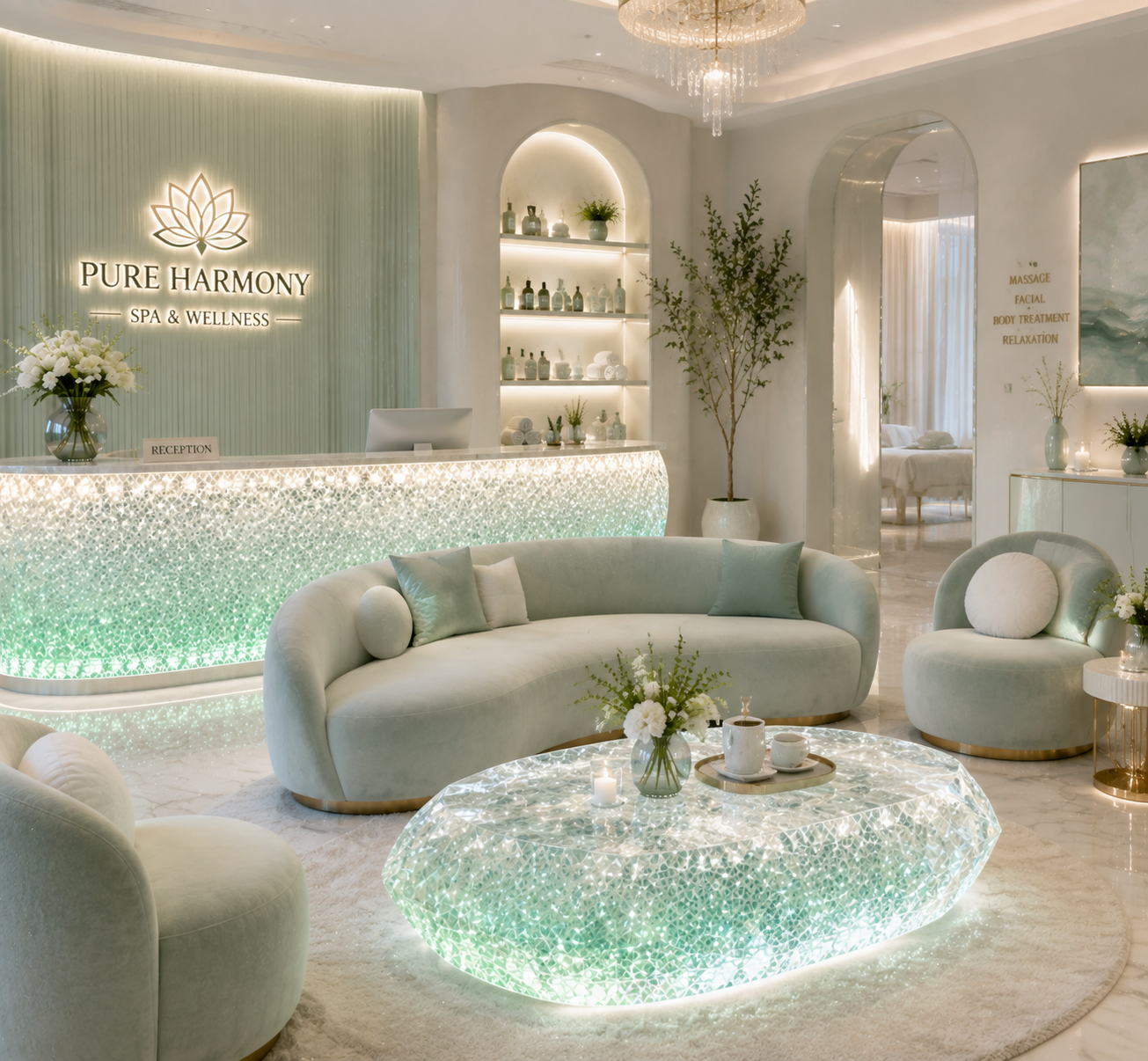
In luxury interior design, the most successful spaces are often remembered not because they contain the greatest number of expensive materials, but because they create one or two visual moments that remain in the visitor's mind.
A dramatic staircase, a sculptural light fixture, an unusual piece of furniture, a perfectly framed view, or a unique interaction between material and light can become the defining memory of an interior.
This is one reason synthetic crystal acrylic furniture is attracting increasing attention in high-end residential, hospitality, retail, and commercial projects.
Its value does not come from transparency alone.
The real attraction lies in the way transparency changes the relationship between furniture and space. A traditional piece of furniture usually occupies a clear visual volume. It creates boundaries, blocks views, and adds mass to the room. Transparent acrylic behaves differently. It can provide the same functional presence while allowing architecture, light, flooring, artwork, and surrounding furniture to remain visible.
At the same time, acrylic can also become highly expressive.
When designers use thick material, polished edges, curves, unusual geometry, color, lighting, and precision fabrication, the furniture can appear almost sculptural. A table may look like a block of ice. A console may seem to float. A chair can appear to disappear from certain angles and become luminous from others.
This ability to be both visually quiet and visually unforgettable is what makes synthetic crystal acrylic particularly interesting for high-end spaces.
It gives designers an opportunity to create a memory point without necessarily creating visual clutter.
1. Transparency as a New Luxury Design Language
Luxury design is changing.
For decades, premium interiors were often defined through visible material richness: dark timber, polished marble, carved details, brass decoration, heavy upholstery, elaborate patterns, and substantial furniture.
These elements still have an important place in luxury design, but contemporary projects increasingly explore another interpretation of sophistication.
Today, luxury can also mean openness. It can mean restraint, visual breathing room, natural light, architectural clarity, and carefully selected objects rather than excessive decoration.
Transparent acrylic fits naturally into this new language.
Unlike opaque materials, acrylic allows the eye to continue through the furniture. This creates a sense of lightness even when the piece itself is physically substantial.
Consider a thick transparent acrylic coffee table. Its dimensions may be similar to those of a solid wood or stone table, yet it does not occupy the room in the same visual way. The floor remains visible through it. The carpet remains part of the composition. Light continues across the room.
This makes the furniture feel less intrusive.
In high-end interiors, that quality can be extremely valuable.
Designers often invest heavily in architectural surfaces. A floor may use rare stone. A wall may feature artistic plaster. A window may frame a city skyline or coastal view. Furniture should not necessarily cover those features.
Transparent acrylic can provide function while allowing the architectural investment to remain visible.
The material also interacts strongly with light. Polished acrylic edges can catch illumination and appear brighter than the surrounding surfaces. Thick transparent sections produce optical depth. Curves bend reflections. Layered components can create subtle distortions.
These effects change throughout the day.
Morning light may create clean highlights. Afternoon sun may produce brighter reflections. At night, warm interior lighting can make polished edges glow.
This changing character gives acrylic a quality that static opaque materials do not always provide.
It becomes part of the atmosphere.
Transparency therefore functions as more than an aesthetic feature. It becomes a design language based on clarity, lightness, reflection, and spatial continuity.
For modern luxury interiors, this language feels especially relevant.
2. Creating a Strong Spatial Memory Through Optical Effects
A memorable interior needs visual identity.
In hospitality, retail, and premium residential design, this identity is often created through carefully selected focal points.
Synthetic crystal acrylic furniture can become one of those focal points because of its optical behavior.
The first important factor is thickness.
Thin clear acrylic can look simple and practical. Thick acrylic creates a much more dramatic impression.
When a material becomes thicker, its edges become visually important. Light enters the surface, moves through the material, and reflects along polished edges. The furniture gains depth.
Depending on the design, it may resemble crystal, ice, or glass sculpture.
This is one of the reasons thick acrylic furniture can create a stronger sense of luxury than lightweight transparent products.
Curves add another level of visual interest.
A flat transparent panel is clear and minimal.
A curved transparent form changes continuously depending on the viewing angle.
Reflections move across the surface. Background objects appear slightly distorted. Light bends around the geometry.
This creates movement even though the furniture itself is static.
Designers can also use layering.
Multiple acrylic components placed at different depths can create shadows, overlapping reflections, and a three-dimensional optical effect.
Beveled edges can intensify highlights.
Frosted areas can contrast with fully transparent sections.
Tinted acrylic can introduce subtle color while preserving transparency.
Lighting can transform the furniture even further.
Integrated LED lighting, concealed light sources, or carefully positioned spotlights can make acrylic appear almost luminous.
In a hotel lobby, a sculptural acrylic console can become more dramatic after sunset.
In a boutique, illuminated acrylic display furniture can draw attention to products.
In a private residence, a transparent dining table can reflect decorative lighting and become part of the evening atmosphere.
These effects make acrylic useful for creating what may be called a spatial memory point.
A memory point is an element that visitors remember after leaving the space.
It may not be the largest object. It may not even be the most expensive. But it creates a strong visual impression.
This is particularly important in commercial environments.
Luxury hotels compete not only on comfort but also on experience. Restaurants compete on atmosphere. Fashion boutiques compete on identity. Showrooms compete on presentation.
A distinctive acrylic furniture piece can become part of the visual signature that separates one location from another.
.png)
3. Making Architecture More Visible Instead of Covering It
One of the most unusual characteristics of transparent furniture is that it can create a strong design presence while simultaneously revealing the architecture behind it.
This is particularly useful in expensive interiors where architectural finishes deserve to remain visible.
Imagine a luxury living room with a dramatic marble floor. A large opaque coffee table may cover a significant portion of the stone pattern. A transparent acrylic table allows the marble to remain part of the visual composition.
The same principle applies to rugs.
A hand-knotted carpet may be one of the most valuable decorative elements in a room. Transparent furniture can provide practical surface area without hiding the pattern.
Panoramic windows are another example.
In apartments, penthouses, resorts, and hillside villas, views are often one of the most valuable features of the property.
Furniture placement can easily interrupt those views.
Transparent chairs, benches, and consoles reduce visual obstruction.
The result is a more continuous relationship between interior and exterior.
This benefit becomes even more important in compact luxury spaces.
High-end does not always mean large.
In major cities, luxury apartments may have extremely high property values while still having limited floor area.
Designers must therefore create a premium environment without making the room feel crowded.
Transparent furniture helps visually reduce density.
A clear console in an entryway occupies less perceived space than a solid cabinet.
A transparent desk in a bedroom feels lighter than a dark timber workstation.
Acrylic dining chairs can make a small dining area feel more open.
This does not increase the physical dimensions of the room, but it changes perception.
Sight lines remain longer.
More surfaces remain visible.
The architecture feels less fragmented.
This is especially useful in minimalist and gallery-style interiors, where designers want furniture to coexist with art, sculpture, or strong architectural forms.
Acrylic becomes almost like an invisible support system.
It provides function without competing unnecessarily for attention.
This quality is difficult to achieve with many traditional furniture materials.
4. From Invisible Function to Sculptural Statement
One of the most interesting contradictions of acrylic furniture is that it can either disappear or dominate.
A simple transparent side table may almost vanish inside a room.
A thick sculptural acrylic table may become the most noticeable object in the same room.
This dual character gives designers extraordinary flexibility.
For projects that require restraint, acrylic can be minimal.
Straight lines, clear surfaces, thin profiles, and simple construction allow furniture to remain visually quiet.
For projects that require drama, the same material can become highly expressive.
Designers can increase thickness. They can introduce curves. They can use complex geometry. They can add color. They can integrate lighting. They can combine acrylic with marble, brass, stainless steel, timber, leather, fabric, or other materials.
The result moves beyond conventional transparent furniture.
A dining table may use massive clear acrylic bases supporting a stone top.
A console may use curved transparent supports with brass details.
A bench may combine a thick acrylic frame with upholstered seating.
A shelving system may alternate clear and colored sections.
A reception desk may integrate illuminated acrylic elements.
These combinations create contrast.
Stone feels heavier and more dramatic beside transparent acrylic. Metal appears sharper. Wood feels warmer. Fabric feels softer.
The acrylic becomes a visual connector between materials.
This is why high-end acrylic furniture can function almost like sculpture.
It does not simply occupy space. It changes how surrounding materials are perceived.
Custom design further strengthens this effect.
Standard furniture is designed for broad markets.
Custom furniture can respond directly to architecture.
A table can be designed around a specific rug. A console can follow the curve of a wall. A bench can fit beneath a panoramic window. A retail display can reflect the geometry of a brand logo.
This relationship between furniture and place makes the object feel more intentional.
It becomes part of the interior concept rather than an item added after the architecture is completed.
For premium projects, this level of integration is increasingly important.
5. Strengthening Hospitality, Retail, and Luxury Brand Identity
High-end commercial spaces are not only designed to function well.
They are designed to communicate.
A hotel communicates a lifestyle. A boutique communicates a brand. A restaurant communicates an atmosphere. A showroom communicates product positioning.
Furniture plays an important role in this communication.
Synthetic crystal acrylic furniture is particularly useful because it creates a distinctive visual identity without requiring excessive decoration.
In luxury retail, transparent display tables can make products appear more prominent.
The furniture supports the merchandise rather than competing with it.
This can be particularly effective for jewelry, cosmetics, fashion accessories, premium electronics, and design products.
In hotels, acrylic furniture can create a contemporary and refined atmosphere.
Lobby tables, side tables, consoles, benches, and decorative installations can become recognizable features.
Boutique hotels especially benefit from unique furniture because they often compete through personality rather than scale.
Restaurants and bars can also use acrylic strategically.
Colored transparent furniture can create a fashionable atmosphere.
Illuminated acrylic can support evening environments.
Sculptural pieces can help create areas that guests naturally photograph.
This connects to an important change in commercial interior design: spaces are now experienced both physically and digitally.
Guests photograph hotel lobbies. Customers share restaurant interiors. Visitors create videos inside stores. Designers post completed projects online.
A memorable furniture piece can therefore become part of the marketing value of a space.
This does not mean every project should be designed purely for social media.
However, visual recognizability has real commercial importance.
When people repeatedly associate a particular interior element with a brand or location, that element contributes to identity.
Custom acrylic furniture can strengthen this effect.
Manufacturers can produce special colors. Forms can reference a brand's visual language. Logos can be engraved. Lighting can be integrated. Display systems can be created around product dimensions.
Furniture can therefore become part of the branding system rather than simply part of the decoration.
This is particularly valuable for companies that want physical spaces to feel unique and difficult to imitate.
.png)
6. What Determines the Premium Quality of Crystal Acrylic Furniture
The visual potential of acrylic is extremely high, but the material is unforgiving.
Transparency reveals quality. It also reveals mistakes.
This is why premium acrylic furniture depends heavily on manufacturing craftsmanship.
Material quality is the first consideration.
High-end furniture requires acrylic with excellent clarity, consistent thickness, suitable color stability, and appropriate structural properties.
Poor-quality material may appear cloudy, slightly colored, or visually inconsistent.
Thickness must also be selected carefully.
Very thick acrylic can create impressive optical depth, but structural design should determine the correct specification.
Tables, chairs, benches, and shelves experience different loads.
The material must be engineered for actual use.
Cutting and machining accuracy are equally important.
Because surfaces are transparent, imperfect edges are easy to see.
CNC machining, accurate drilling, controlled cutting, and precise tolerances help create a clean final result.
Polishing is one of the most visible indicators of quality.
The edge of premium acrylic furniture should appear smooth, clear, and refined.
Poor polishing can make the material look inexpensive even when the raw acrylic is good.
Bonding requires similar precision.
Transparent joints leave very little room for error.
Bubbles, cloudy adhesive, excess glue, misalignment, or contamination may remain permanently visible.
Experienced fabrication teams therefore pay close attention to joint design, fixtures, adhesive systems, cleanliness, and curing.
Structural engineering is another critical factor.
Acrylic may look delicate, but furniture must remain stable and functional.
Large tables require careful load distribution. Shelving must resist deformation. Chairs and benches must be engineered around repeated use.
Premium quality therefore involves more than appearance.
It involves the connection between aesthetics and performance.
Packaging and transportation are also part of the product.
A perfectly polished table can be damaged by careless shipping.
Protective films, foam, corner protection, reinforced packaging, and sometimes wooden crates are necessary for high-value pieces.
Installation must also be considered.
Large transparent furniture can be heavy despite its visual lightness.
Access routes, elevators, door dimensions, assembly methods, and site protection may need to be planned before delivery.
Maintenance is relatively straightforward, but correct care is important.
Soft cleaning materials and suitable acrylic-safe cleaning products should be used.
Abrasive cloths or aggressive chemicals can damage surfaces.
For hotels, restaurants, and commercial environments, staff should receive clear maintenance instructions.
These details determine whether acrylic furniture continues to look premium after installation.
Conclusion: Transparency as a Memorable Luxury Experience
Synthetic crystal acrylic furniture represents more than a material trend.
It reflects a broader change in how high-end interiors are designed.
Modern luxury is increasingly about experience rather than decoration alone.
Designers are looking for ways to make spaces feel open but distinctive, refined but memorable, visually light but emotionally strong.
Transparent acrylic offers a rare combination of these qualities.
It allows architecture to remain visible. It reduces visual mass. It interacts with light. It creates optical depth. It can disappear quietly into a room or become a powerful sculptural centerpiece.
This flexibility gives it a unique position in premium interiors.
For luxury residences, it can preserve views, flooring, artwork, and spatial openness.
For hotels, it can create signature furniture that guests remember.
For retail environments, it can support products while strengthening brand identity.
For restaurants and showrooms, it can create visually distinctive moments that encourage recognition and sharing.
For designers, it provides a material capable of supporting both minimalism and experimentation.
For manufacturers, it creates opportunities to move beyond simple transparent furniture toward highly customized, engineered, and artistic products.
But the difference between ordinary acrylic furniture and premium synthetic crystal acrylic furniture is determined by execution.
Material clarity matters. Thickness matters. Proportion matters. Machining matters. Polishing matters. Bonding matters. Engineering matters. Packaging and installation matter.
When all of these details are carefully controlled, the furniture begins to communicate something beyond transparency.
It communicates precision. It communicates craftsmanship. It communicates modernity.
And most importantly, it creates a visual impression that can remain in the memory long after a visitor leaves the space.
That is the real value of synthetic crystal acrylic furniture in high-end interior design.
It does not simply fill a room.
It allows the room to remain visible while giving people something unforgettable to remember.
READ MORE:
- Why Do Some Materials Communicate Value at First Sight, Even in Equally High-End Furniture?
- What Counts as a "Good Material" to Hotel, Villa, and Private Club Clients? The Standards Are Completely Different
- Why Are Clients Willing to Pay for "Transparency"? The Visual Value of Synthetic Crystal Furniture in High-End Interiors
- Natural Stone, Glass, or Synthetic Crystal? How to Choose the Right Material for High-End Furniture
- The Designer's Eye for "Luxury": Why Furniture Materials Influence the Quality of a Space More Than Form
- Synthetic Crystal Acrylic Furniture: A New Trend Connecting Design Aesthetics with Commercial Value
- Why Future Furniture Brands Need to Rethink the Premium Power of Materials
- From Visual Differentiation to Market Competitiveness: The Value Upgrade of Synthetic Crystal Acrylic Furniture
- Synthetic Crystal Acrylic Furniture: Why More High-End Projects Are Paying Attention to This Material


