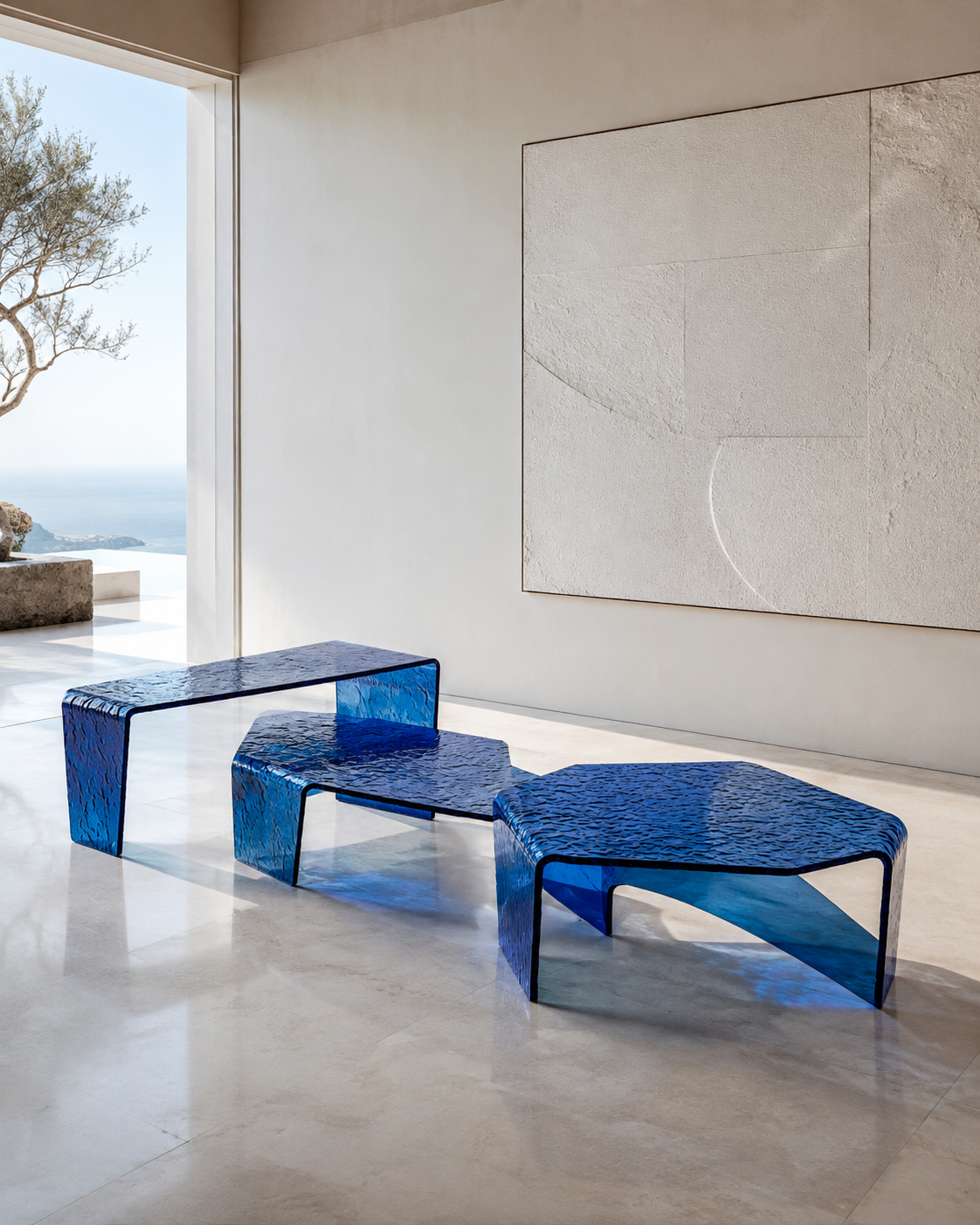
The furniture industry is entering a period in which design and business value are becoming more closely connected than ever before.
In the past, furniture companies could often compete through relatively straightforward advantages: material cost, production scale, craftsmanship, distribution, or price. Today, these factors still matter, but they are no longer enough to guarantee a strong position in premium markets.
Customers are more visually sophisticated.
Architects and interior designers are searching for materials that can create distinctive environments.
Hotels and retailers increasingly treat furniture as part of a larger brand experience.
Luxury residential clients want spaces that feel personal rather than standardized.
At the same time, manufacturers are under growing pressure to avoid pure price competition.
Within this changing environment, synthetic crystal acrylic furniture is emerging as an interesting category because it connects two areas that are often treated separately: design aesthetics and commercial value.
Its appeal begins with appearance.
Transparent acrylic can create a sense of lightness, clarity, and optical depth that is difficult to reproduce with traditional opaque furniture materials.
But its value does not stop there.
When combined with custom design, precise manufacturing, high-quality polishing, structural engineering, mixed materials, and project-specific services, acrylic furniture can become a premium product with stronger market differentiation.
This transformation is important.
The future opportunity is not simply to sell acrylic tables, chairs, consoles, or display units.
The greater opportunity is to use acrylic as a platform for creating unique design experiences, customized project solutions, stronger brand identity, and higher commercial value.
That is why synthetic crystal acrylic furniture deserves attention not only as a design trend, but also as a strategic business trend.
1. From Material Innovation to a New Aesthetic Language
Every major furniture material communicates something.
Wood communicates warmth, craftsmanship, and natural character.
Stone communicates permanence, weight, and architectural luxury.
Metal often communicates precision, technology, or industrial refinement.
Leather communicates comfort, tactility, and tradition.
Synthetic crystal acrylic communicates something very different.
It communicates transparency.
It communicates light.
It communicates visual lightness.
It can also communicate modernity, experimentation, and sculptural clarity.
These qualities are becoming increasingly relevant in contemporary interior design.
Many premium spaces are moving away from excessive visual weight.
Instead of filling rooms with heavy furniture and decorative objects, designers increasingly emphasize openness, sight lines, natural light, carefully controlled materials, and a smaller number of stronger visual statements.
Transparent acrylic fits naturally into this approach.
A clear acrylic coffee table, for example, occupies physical space but does not visually block the floor beneath it.
A transparent console allows a decorative wall to remain visible.
Acrylic chairs around a dining table can make a seating arrangement feel lighter.
Display furniture made from crystal-clear acrylic can support products without competing with them.
This creates an unusual design advantage.
The furniture is present, but it does not always appear visually heavy.
That balance can be difficult to achieve with opaque materials.
The optical behavior of acrylic also contributes to its appeal.
High-quality polished edges can catch and reflect light.
Thick sections create depth.
Curved forms distort reflections in subtle ways.
Transparent surfaces can interact with surrounding colors.
Under different lighting conditions, the same furniture piece can appear almost invisible from one angle and highly luminous from another.
This gives acrylic a changing visual character.
The material does not simply sit in the room.
It participates in the lighting and spatial experience.
This is one reason synthetic crystal acrylic furniture is increasingly being considered for high-end interiors.
It offers designers a material language based on transparency rather than mass.
That language is especially useful in modern luxury projects where visual clarity is becoming as important as material richness.
2. Turning Transparency into Spatial and Emotional Value
The strongest design materials do more than look attractive.
They change how people experience a space.
Transparent acrylic has this ability because it changes the relationship between furniture, architecture, and light.
One of its most practical advantages is the reduction of visual density.
A room may contain exactly the same number of furniture pieces, but transparent elements can make it feel less crowded.
This is valuable in compact urban apartments, hotel suites, restaurants, boutiques, and galleries.
The physical dimensions remain unchanged, yet the perception of space becomes different.
Sight lines remain more open.
Flooring remains visible.
Architectural surfaces continue uninterrupted.
Views through windows are less obstructed.
This is particularly important in high-value interiors where the architecture itself may be a major investment.
Consider a luxury residence with a dramatic marble floor.
A heavy opaque coffee table may cover a large portion of the stone.
A clear acrylic table allows the marble pattern to remain visible.
The furniture performs its function while preserving the visual value of the floor.
The same applies to carpets, decorative walls, artwork, and panoramic views.
Transparent furniture can support the interior rather than cover it.
But the value is not only spatial.
There is also an emotional dimension.
Crystal-like transparency can create associations with purity, precision, elegance, and lightness.
Thick polished acrylic can feel luxurious because of its optical depth.
A sculptural transparent table can create a sense of surprise.
A glowing edge under warm lighting can make the material feel almost luminous.
These responses may be subtle, but they influence how people remember a room.
This is important because high-end interior design increasingly focuses on experience.
A memorable space is often more valuable than a merely expensive one.
Hotels want guests to remember the lobby.
Restaurants want customers to remember the atmosphere.
Retail brands want visitors to remember the store.
Private clients want homes that feel distinctive.
If a furniture piece contributes to that memory, its value goes beyond function.
It becomes part of the emotional identity of the space.
This is where design aesthetics begin to connect directly with commercial value.
A memorable environment can strengthen brand perception.
It can encourage photography and social sharing.
It can improve customer experience.
It can help a project feel more exclusive.
The furniture therefore becomes part of the value creation process.
.png)
3. Customization as the Bridge Between Design and Premium Pricing
Acrylic furniture becomes far more commercially interesting when customization is introduced.
Standard transparent furniture can be attractive, but it is often easy to compare.
If multiple suppliers offer similar tables with similar dimensions and similar thicknesses, the buyer may naturally focus on price.
Customization changes this dynamic.
Acrylic can be cut, machined, bent, bonded, engraved, frosted, tinted, layered, and combined with other materials.
These capabilities make it suitable for project-specific design.
A designer may request a curved console that follows the geometry of an entrance.
A luxury retailer may need display pedestals in custom sizes and brand colors.
A hotel may require bedside tables designed specifically for room dimensions.
A private residence may need a sculptural dining table with a custom acrylic base and stone top.
Once the product is designed around the project, direct comparison becomes more difficult.
The furniture is no longer a generic item.
It becomes part of the architectural solution.
This creates stronger premium potential.
The customer is not only paying for material.
The customer is paying for design adaptation.
The customer is paying for technical development.
The customer may also be paying for sampling, prototyping, structural analysis, color matching, logistics, installation planning, and project management.
These layers create value that cannot be measured simply by the cost of the acrylic sheet.
Customization also allows designers to combine acrylic with other luxury materials.
Transparent acrylic and marble create contrast between visual lightness and physical weight.
Acrylic and brass can produce a refined contemporary look.
Acrylic and leather combine transparency with softness.
Acrylic and timber create a balance between modernity and warmth.
Integrated lighting adds another dimension.
These combinations make the material more flexible and more relevant to diverse project styles.
For manufacturers, this creates an important business opportunity.
Instead of competing as a commodity supplier, a company can compete as a design and project partner.
That changes the conversation with the buyer.
The question is no longer simply, “How much does this table cost?”
The question becomes, “Can you create this specific design for this specific space?”
That shift is strategically important.
It moves competition away from price and toward capability.
4. Craftsmanship and Engineering Create Real Commercial Value
The premium potential of acrylic depends heavily on execution.
Raw material alone does not create luxury.
Poor manufacturing can quickly destroy the visual value of a transparent product.
Acrylic is especially demanding because it reveals imperfections.
Scratches are visible.
Rough edges are visible.
Cloudy joints are visible.
Misalignment is visible.
Bubbles in bonded areas are visible.
Incorrect polishing can reduce clarity.
Poor structural design can lead to instability or deformation.
For this reason, high-end acrylic furniture requires strong craftsmanship.
The first step is material selection.
Premium applications require acrylic with appropriate optical clarity, dimensional stability, thickness consistency, and performance characteristics.
Then comes machining.
Cutting must be accurate.
Holes, grooves, curves, and connection details must be controlled carefully.
CNC equipment can improve precision, but machinery alone does not guarantee quality.
Process knowledge remains essential.
Polishing is particularly important.
A well-polished acrylic edge can appear almost like crystal.
A poorly finished edge can make the same material look inexpensive.
This difference has a direct impact on perceived value.
Bonding is another critical stage.
Transparent furniture often requires joints that remain visually clean.
Excess adhesive, bubbles, contamination, or cloudy bonding can reduce the premium effect immediately.
The production environment, adhesive choice, fixture accuracy, and technician experience all matter.
Bending and forming also require control.
Incorrect temperatures or processes can create distortion, stress, or inconsistent curves.
For complex furniture, engineering becomes equally important.
A large dining table may require careful consideration of span, thickness, load distribution, support geometry, and long-term performance.
Acrylic may look visually light, but structural requirements remain real.
The furniture must perform safely in actual use.
This is where commercial value becomes strongly connected to manufacturing capability.
A supplier that can reliably produce simple acrylic accessories competes in one market.
A supplier that can engineer large, sculptural, high-precision acrylic furniture competes in another.
The second market usually involves fewer competitors and higher project value.
Quality consistency matters as well.
Hotels, retail chains, and commercial projects may order multiple units.
Every piece must maintain similar dimensions, clarity, color, polishing, bonding, and assembly quality.
A beautiful prototype is not enough.
Repeatability creates trust.
Trust creates repeat orders.
Repeat orders create commercial strength.
This is why craftsmanship should be understood as part of the business model, not simply part of production.
Better craftsmanship increases perceived value.
Better engineering reduces project risk.
Better quality control increases client confidence.
Together, these factors support stronger pricing power.
5. Commercial Applications: From Luxury Interiors to Brand Experiences
Synthetic crystal acrylic furniture has commercial potential because it can serve many different environments.
Luxury residential projects are one area.
Transparent furniture can preserve openness in living rooms, dining areas, bedrooms, and entrance spaces.
It can also become a sculptural focal point in highly customized interiors.
Hospitality is another important market.
Hotels need furniture that contributes to atmosphere.
Lobby tables, consoles, side tables, benches, decorative installations, and bar elements can all become part of the visual identity of the property.
Boutique hotels are especially suitable because they often compete through distinctive design.
Retail environments offer another strong opportunity.
Transparent display furniture can support products without visually dominating them.
This is useful for jewelry, cosmetics, fashion accessories, watches, premium electronics, and luxury lifestyle products.
The furniture can also be customized around brand colors, logos, lighting systems, and display requirements.
Restaurants and clubs can use acrylic to create visually memorable interiors.
Tinted transparent furniture can support dramatic color schemes.
Illuminated acrylic can contribute to nighttime atmosphere.
Sculptural pieces can create recognizable photo locations.
Showrooms and exhibitions can use acrylic to create displays that feel contemporary and precise.
Corporate reception areas can use the material to communicate innovation and modernity.
These applications reveal an important shift.
Furniture is no longer only an operational object.
It is increasingly part of the brand experience.
A hotel lobby table may become recognizable in photographs.
A retail display may become associated with a particular luxury brand.
A restaurant's colored acrylic furniture may become part of its visual identity.
A showroom installation may help communicate technical innovation.
This creates marketing value.
The furniture becomes part of the story the customer experiences.
It may also become part of the story customers share online.
This is increasingly important because commercial interiors are now designed for both physical and digital audiences.
People take photographs.
They create videos.
They share interior details.
They review hotels and restaurants with images.
Designers publish completed projects.
Brands use physical spaces in campaigns.
Materials that create strong visual effects therefore have commercial relevance beyond decoration.
Acrylic is particularly effective because transparency and reflection photograph differently under changing light.
Thick clear edges can appear luminous.
Tinted acrylic can create dramatic visual accents.
Curved surfaces produce unusual reflections.
These characteristics help furniture stand out in images without necessarily making the physical space feel heavy.
For brands, this can be extremely valuable.
The furniture contributes simultaneously to function, experience, identity, and marketing.
.png)
6. The Future Opportunity: Building a Business Model Around Material Value
The long-term opportunity for synthetic crystal acrylic furniture lies in building a complete business model around material value.
Selling a basic acrylic product is easy to understand.
Selling a material-driven design solution is more complex, but also more defensible.
The strongest companies will combine several capabilities.
First, they need material expertise.
They must understand different acrylic grades, thicknesses, optical effects, forming behavior, structural limitations, maintenance requirements, and finishing methods.
Second, they need design capability.
The company should know how to use transparency, curves, thickness, color, and mixed materials to create distinctive products.
Third, they need manufacturing capability.
Polishing, machining, bonding, bending, assembly, and quality control must reach a consistent standard.
Fourth, engineering matters.
Furniture must be visually attractive and structurally appropriate.
Fifth, customization becomes essential.
High-end clients often require dimensions, colors, finishes, and configurations that cannot be supplied from a standard catalog.
Sixth, project management creates additional value.
Professional clients need drawings, prototypes, approval samples, schedules, inspections, packaging plans, logistics coordination, and installation information.
Finally, branding brings all of these capabilities together.
If a manufacturer develops a recognizable design language around acrylic, it becomes less replaceable.
Customers begin to associate the company with a particular level of clarity, craftsmanship, form, and customization.
This creates long-term differentiation.
The goal should not be to become the cheapest supplier of transparent furniture.
The goal should be to become a trusted specialist in a distinctive material category.
That position is much stronger.
It creates opportunities for repeat projects.
It attracts designers who need technical collaboration.
It helps manufacturers enter hotels, retail, luxury residential, and other premium markets.
It also creates room for higher margins because the customer is buying more than a physical object.
The customer is buying expertise.
The customer is buying design.
The customer is buying reliability.
The customer is buying a result.
This is the commercial logic behind material value.
Conclusion: Where Aesthetics and Business Value Meet
Synthetic crystal acrylic furniture represents a broader shift in the furniture industry.
The market is moving away from a simple equation in which material cost determines product value.
The future will belong increasingly to brands and manufacturers that understand how to transform materials into design systems, customer experiences, and commercial advantages.
Acrylic is well positioned in this environment.
Its transparency creates visual distinction.
Its optical depth creates a sense of refinement.
Its lightness in visual perception supports open interiors.
Its processing flexibility supports customization.
Its compatibility with stone, metal, leather, wood, and lighting expands its design potential.
Its use in hospitality, retail, residential, restaurant, showroom, and commercial projects creates a wide range of business opportunities.
But none of these advantages are automatic.
The material must be interpreted carefully.
Design must be intentional.
Polishing must be precise.
Bonding must be controlled.
Structures must be engineered.
Packaging must protect the finish.
Service must support the project.
When all of these elements are combined, synthetic crystal acrylic furniture becomes more than a transparent product.
It becomes a bridge between design aesthetics and commercial value.
For designers, it offers creative freedom.
For architects, it preserves spatial clarity.
For brands, it creates recognizable visual identity.
For hotels and retailers, it enhances customer experience.
For manufacturers, it creates an opportunity to move beyond commodity competition.
This is why the category has significant future potential.
The most successful companies will not simply ask how to manufacture acrylic furniture more efficiently.
They will ask how to create more value through the material.
How can transparency become a signature?
How can craftsmanship become part of the brand?
How can customization increase project relevance?
How can engineering reduce risk?
How can furniture contribute to the commercial identity of a space?
How can material expertise become a long-term competitive advantage?
These questions point toward the next stage of the market.
The future of synthetic crystal acrylic furniture will not be defined only by what the material looks like.
It will be defined by how effectively that material connects beauty, experience, technology, craftsmanship, branding, and business.
That connection is what makes synthetic crystal acrylic furniture more than a design trend.
It makes it a new commercial opportunity for the premium furniture industry.
READ MORE:
- Why Do Some Materials Communicate Value at First Sight, Even in Equally High-End Furniture?
- What Counts as a "Good Material" to Hotel, Villa, and Private Club Clients? The Standards Are Completely Different
- Why Are Clients Willing to Pay for "Transparency"? The Visual Value of Synthetic Crystal Furniture in High-End Interiors
- Natural Stone, Glass, or Synthetic Crystal? How to Choose the Right Material for High-End Furniture
- The Designer's Eye for "Luxury": Why Furniture Materials Influence the Quality of a Space More Than Form
- Why Future Furniture Brands Need to Rethink the Premium Power of Materials
- Synthetic Crystal Acrylic Furniture: Creating Memorable High-End Spaces Through Unique Transparency
- From Visual Differentiation to Market Competitiveness: The Value Upgrade of Synthetic Crystal Acrylic Furniture
- Synthetic Crystal Acrylic Furniture: Why More High-End Projects Are Paying Attention to This Material


