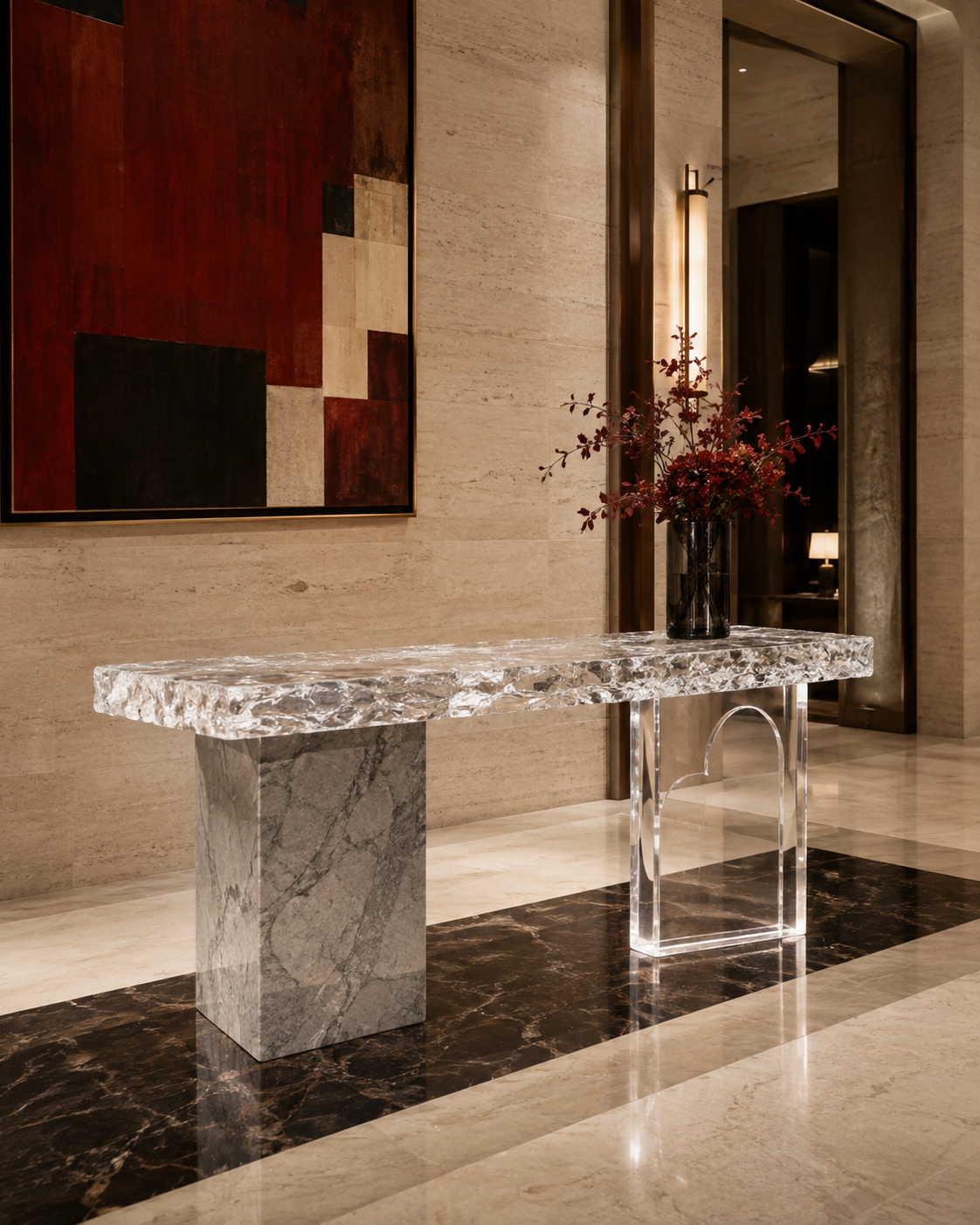
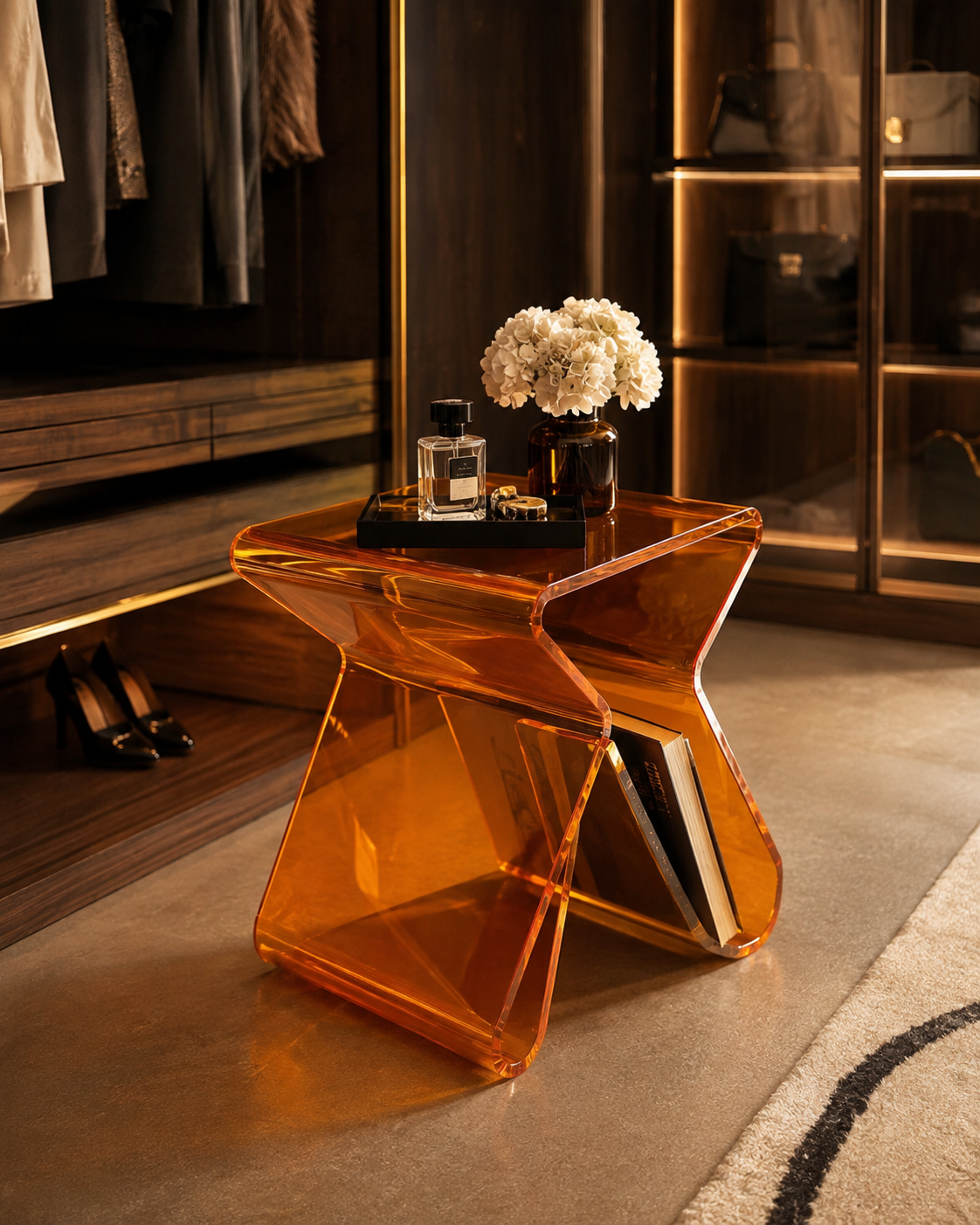
When people describe an interior as “luxurious,” they often point first to the silhouette of a sofa, the curve of a chair, or the proportions of a table. Designers, however, tend to look deeper. A sophisticated shape can attract attention, but it is usually the material—its transparency, depth, reflection, texture, weight, edge treatment, and interaction with light—that determines whether a piece actually feels refined.
This distinction matters increasingly in contemporary interiors. Luxury is no longer limited to marble, solid wood, brass, or leather. Synthetic crystal, high-end resin, and premium high-clarity acrylic—sometimes commercially positioned as platinum acrylic—are giving designers new ways to create visual depth, apparent weightlessness, jewel-like surfaces, and sculptural furniture without overwhelming a room.
The reason is simple: form tells us what an object is, while material strongly influences how we experience it.
1. The Human Eye Reads Material Before It Fully Understands Design
A furniture silhouette can be understood almost instantly: rectangular table, curved chair, cylindrical pedestal. Yet our perception does not stop at geometry. The brain is continuously interpreting whether a surface appears glossy, matte, rough, polished, transparent, translucent, soft, hard, natural, or artificial.
Research into material perception helps explain why this matters. Experimental studies indexed by the U.S. National Institutes of Health have shown that people can make judgments about surface qualities such as gloss and roughness from visual information alone. One fMRI study found that visual cues suggesting surface structure can even engage areas associated with somatosensory processing, demonstrating how closely seeing a material is connected to anticipating how it might feel.
For interior designers, this has an important practical consequence. A complicated form made from an inexpensive-looking, cloudy, thin, or poorly finished material can still appear ordinary. By contrast, a very simple cube, console, or side table can look exceptionally sophisticated when the material has optical depth, precise polishing, controlled transparency, and beautifully finished edges.
This is particularly visible in transparent furniture. Consider two clear side tables with almost identical dimensions. One is produced from thin, slightly hazy material with visible bonding marks; the other uses thick, optically clear acrylic with carefully polished edges and nearly invisible joints. Their shapes may be almost identical, yet they create completely different perceptions of value.
The same principle applies to synthetic crystal furniture and cast-resin pieces. A minimalist resin console does not require dramatic ornament if the casting creates depth, controlled color transitions, or a convincing stone-like or crystal-like visual effect. The material itself becomes the decoration.
This is why designers frequently begin by asking not only, “What shape should this object be?” but, “What should this object feel like in the room?” Material answers the second question far more powerfully.
2. Luxury Is Closely Connected to the Way a Material Handles Light
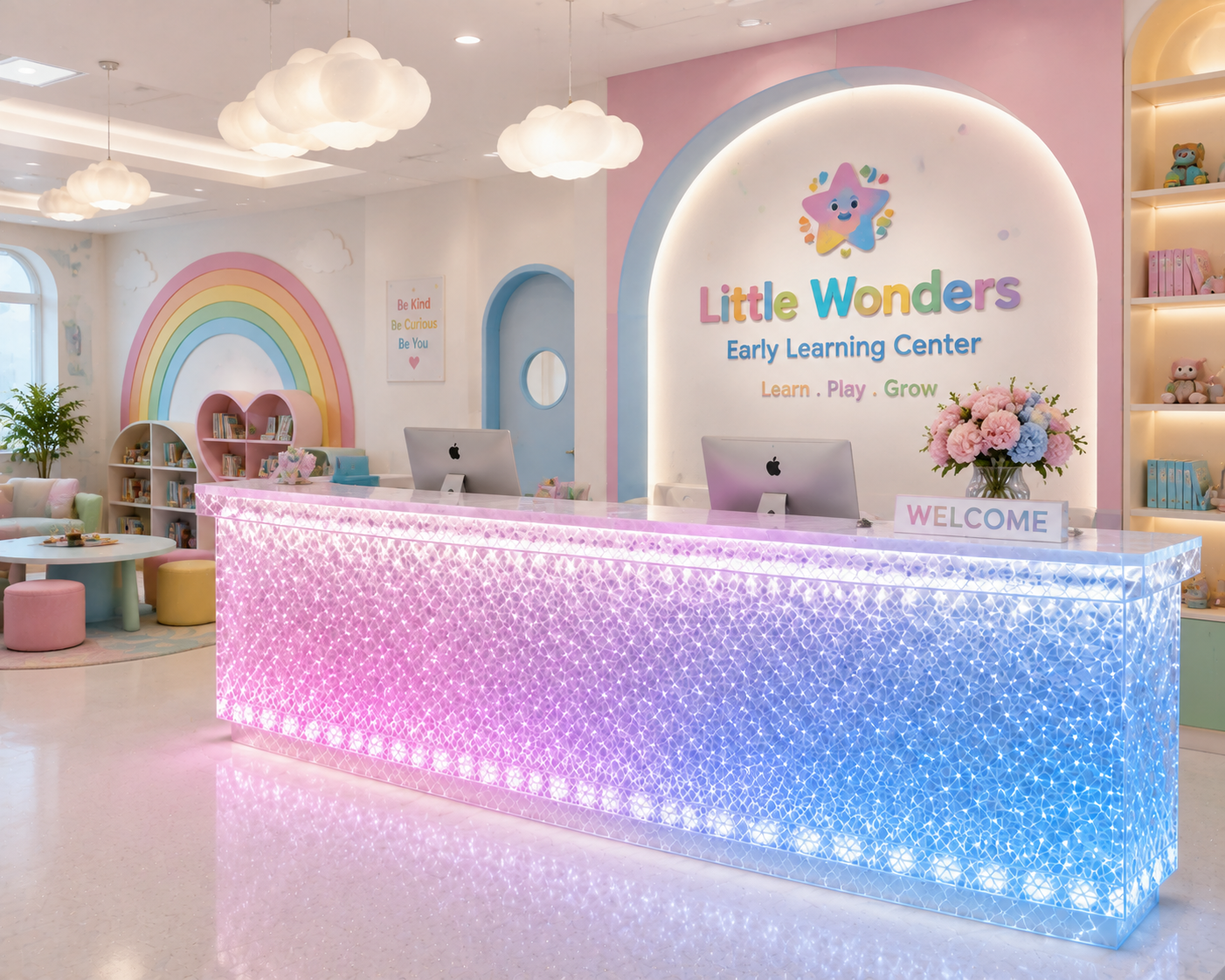
Light is one of the strongest reasons materials can affect spatial quality more profoundly than shape. Furniture occupies physical space, but its material determines what happens when light reaches that space: whether light is absorbed, reflected, scattered, transmitted, refracted, or visually trapped inside the object.
High-clarity acrylic demonstrates this particularly well. A technical sheet for PLEXIGLAS Optical 0Z024 reports 92% light transmittance at a thickness of 3 mm, a refractive index of 1.49, and haze below 1% for that specific optical-grade PMMA product. The manufacturer also reports 91% transmission through a 150 mm light path. These figures are product-specific rather than universal specifications for all acrylic, but they illustrate the optical potential of carefully engineered PMMA.
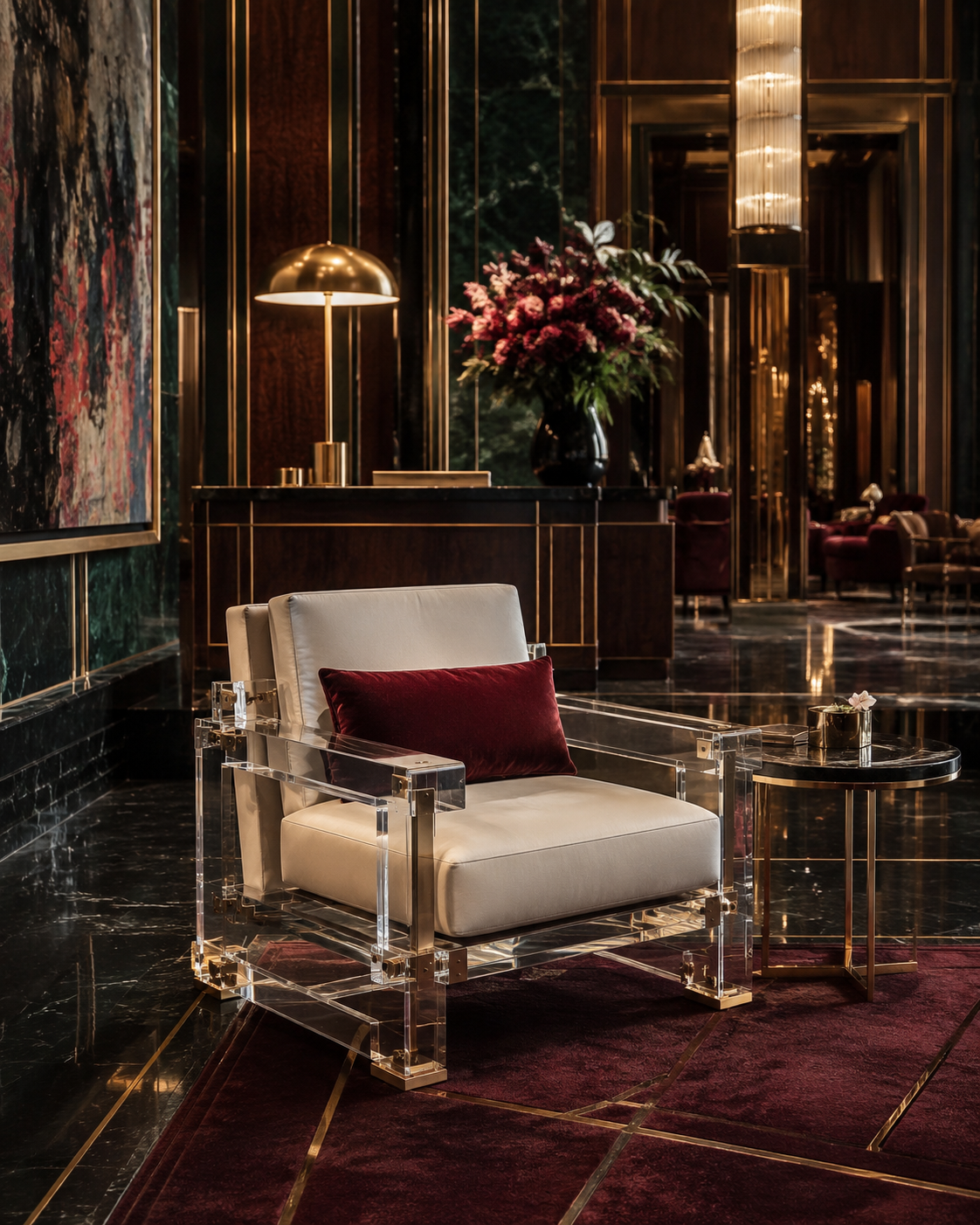
For a designer, those numbers translate into something much more emotional. A thick transparent acrylic console can catch daylight along its edges while allowing the surrounding architecture to remain visible. A platinum-acrylic coffee table can appear almost absent from one direction and brilliantly luminous from another. Synthetic crystal furniture can create a different effect again, using internal depth and crystal-like reflections to make a solid object appear visually layered rather than simply heavy.
High-end resin expands the vocabulary even further because transparency does not have to be perfect. Controlled translucency, pigmentation, inclusions, gradients, clouding, bubbles used intentionally, and hand-finished surfaces can create depth that resembles stone, ice, minerals, or colored glass.
Architectural Digest highlighted this potential when reporting on the Pompei resin furniture collection shown during Milan Design Week. The designers used layered resin and hand finishing to create surfaces recalling materials such as porphyry, quartz, marble, and onyx.
This is an important distinction between “transparent furniture” and sophisticated transparent-material furniture. The objective is not simply to see through an object. The objective is to control light.
When that control is successful, a table changes throughout the day. Morning sunlight creates one edge color, indirect afternoon light creates another, and artificial evening lighting can make the same material appear almost illuminated from within. A fixed furniture form therefore produces multiple visual experiences because the material remains responsive to its environment.
That responsiveness is one of the reasons material-rich furniture often feels more luxurious than an equally complex shape made from a visually flat surface.
3. Material Changes the Visual Weight of Furniture—and Therefore the Entire Room
A designer does not evaluate furniture only as an isolated product. Every piece contributes to the visual weight of the whole interior.
Place a conventional opaque coffee table in the center of a compact living room and the eye immediately registers its mass. Replace it with a thick clear acrylic or synthetic-crystal table of exactly the same dimensions and the physical footprint remains unchanged, but the perceived footprint can become dramatically lighter.
Architectural Digest has specifically recommended clear acrylic and glass furniture as a method of reducing perceived visual clutter in smaller rooms, noting that transparent furniture allows flooring, color, and surrounding design elements to remain visible through the object.
This is why high-quality transparent furniture is useful far beyond minimalist interiors. In a richly decorated room containing patterned stone, art, textured rugs, decorative wall panels, or statement lighting, an optically clear acrylic console can provide function without adding another opaque block. In luxury retail, a synthetic crystal pedestal can support a product while allowing the display environment to remain visually continuous. In hospitality spaces, resin side tables can introduce color without the heaviness of solid stone.
Material therefore allows designers to manipulate apparent mass independently of actual dimensions.
This is especially valuable in high-end projects because luxury interiors often contain expensive architectural finishes that should remain visible. A designer who has carefully selected book-matched marble flooring or a hand-finished wall does not necessarily want a large opaque table hiding it. A transparent or translucent furniture piece can occupy the room functionally while preserving sightlines.
The opposite can also be intentional. A deeply pigmented resin table with substantial thickness may be deliberately chosen to anchor a very light room. A smoky acrylic console can create visual contrast without becoming completely solid. Synthetic crystal can introduce the perceived weight of a precious object while still transmitting light.
In other words, designers are not simply choosing between “heavy” and “light” furniture forms. They are using material to fine-tune how much visual territory each object occupies.
That ability has a major influence on whether an interior feels crowded, balanced, calm, dramatic, or refined.
4. High-End Furniture Reveals Its Quality Through Thickness, Edges, Joints, and Finishing
Luxury furniture is often judged at a distance, but it is confirmed at close range.
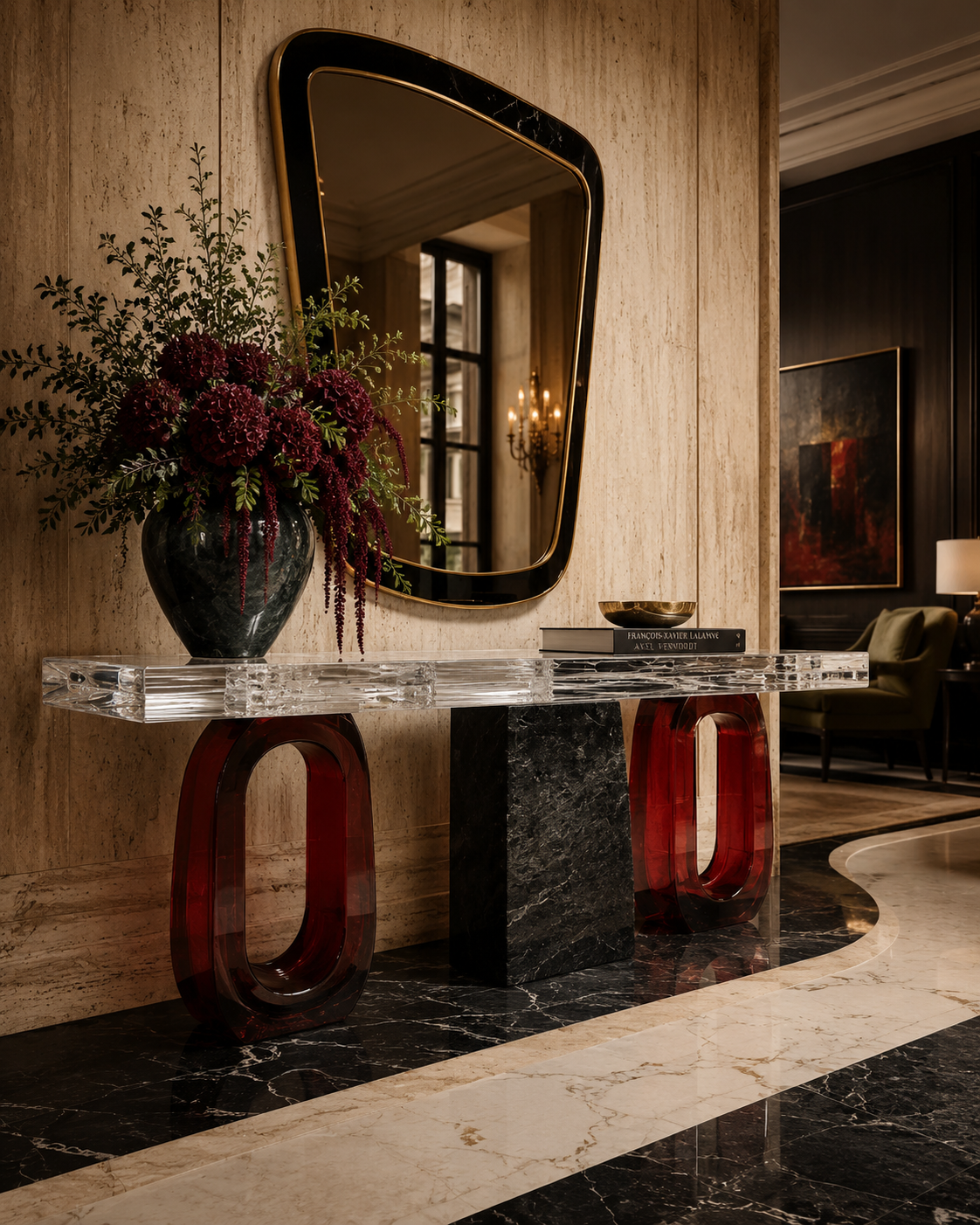
This is where materials become unforgiving. Transparent acrylic, synthetic crystal, and clear resin expose details that opaque furniture can hide. Edge polishing, internal clarity, joints, casting consistency, color control, scratches, machining marks, bubbles, bonding lines, and surface flatness can all become visible.
That is why an apparently simple transparent table may demand considerable manufacturing precision. With conventional opaque furniture, a coating or veneer can conceal parts of the underlying construction. With high-clarity material, the material itself is both structure and finish.
The history of important furniture design repeatedly shows this relationship between materials and manufacturing technology. The Victoria and Albert Museum describes how designers in the Space Age exploited newly available plastics to create furniture that earlier materials could not easily achieve. David Colwell’s transparent Contour Chair, for example, was produced by forming heated acrylic, while developments in plastics also helped designers create new one-piece and highly sculptural furniture forms.
But manufacturing capability alone does not produce luxury. Precision does.
For platinum-acrylic furniture, the difference may be visible in the clarity of a thick section, the consistency of an edge polish, the accuracy of mitred joints, or how discreetly separate components are bonded. For high-end resin furniture, quality may appear through controlled casting, intentional rather than accidental inclusions, consistent pigmentation, careful sanding, and a hand-finished surface. For synthetic crystal furniture, optical uniformity, depth, edge treatment, and the way the material responds to directional light become part of the perceived craftsmanship.
There is also a useful lesson here for furniture brands: unusual shapes are easier to copy visually than exceptional material execution.
A competitor can reproduce the approximate dimensions of a waterfall console from photographs. Reproducing the same transparency, polish, color depth, seamless construction, consistency, and tactile finish is much more difficult. Material processing therefore becomes part of the product’s differentiation.
This is one reason a restrained design executed exceptionally well can communicate more sophistication than a complicated design produced with average materials. The luxury is not necessarily in adding more design. Sometimes it is in removing everything that would distract from the quality of the material.
5. Engineered Materials Are No Longer the Opposite of Luxury—they Are Part of Design History
There is still a persistent assumption that “natural material” automatically means premium while “synthetic material” means inexpensive. Design history does not support such a simple distinction.
The Museum of Modern Art records that Plexiglas entered the market in the 1930s and documents early experimental furniture using the material. The Victoria and Albert Museum likewise shows how plastic technologies transformed furniture design during the twentieth century.
Perhaps one of the clearest examples is Shiro Kuramata’s Miss Blanche Chair from 1988, now in MoMA’s collection. The chair is made from acrylic resin, aluminum, and synthetic flowers. Kuramata painstakingly suspended artificial roses inside the transparent resin body, turning the material itself into the conceptual center of the furniture rather than treating resin as a cheaper substitute for something else.
That distinction is fundamental to contemporary high-end furniture.
Premium resin should not try to apologize for not being marble. Acrylic does not need to imitate glass. Synthetic crystal does not need to disguise itself as natural rock crystal. Their strongest applications come from characteristics that belong to the materials themselves: unusually thick transparent sections, suspended objects, color gradients, seamless volumes, luminous edges, sculptural casting, and combinations of transparency and color that would be difficult to achieve with traditional furniture materials.
Architectural Digest has also documented resin furniture as a collectible, made-to-order category in which hand finishing and one-of-a-kind variation can contribute to higher pricing.
For designers, therefore, the important question is not whether a material is natural or engineered. It is whether the material is being used intelligently.
A poorly selected piece of expensive stone can look ostentatious. A beautifully proportioned block of high-end resin with extraordinary depth can look like contemporary sculpture. A generic clear plastic sheet may feel commercial, while a substantial, flawlessly finished high-clarity acrylic table can become the visual equivalent of architectural glass.
Material sophistication comes from intention, engineering, workmanship, and context—not simply from the geological origin of the raw material.
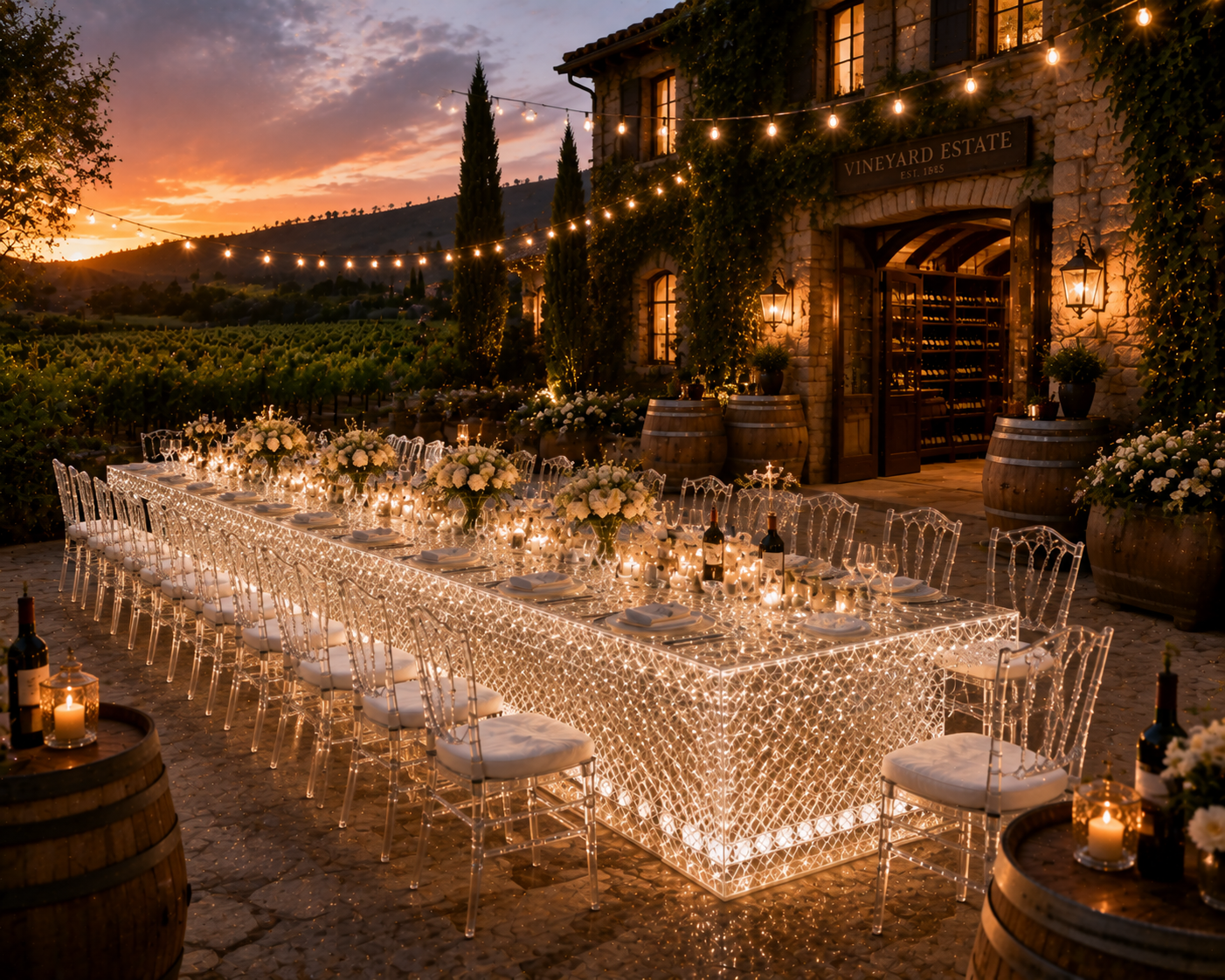
6. True Material Luxury Must Continue to Perform After the Photograph Is Taken
A dramatic furniture piece can create a powerful image, but professional designers must think beyond the installation photograph. The material has to survive actual living.
This is where the definition of luxury becomes more demanding. A high-end piece should be evaluated not only by transparency, color, or shape but also by maintenance requirements, surface durability, structural suitability, aging, repairability, and the chemicals or coatings involved in its manufacture.
Acrylic provides a useful example. Architectural Digest’s care guidance notes that acrylic can be scratched by abrasive contact and that unsuitable cleaners can cause clouding; appropriate cleaning and maintenance are therefore part of preserving the visual quality of premium acrylic furniture.
This does not make acrylic unsuitable for luxury furniture. It means that luxury specification requires understanding the material rather than selecting it only for appearance. The same logic applies to resin and synthetic crystal. Designers need accurate information about the particular formulation, intended environment, heat exposure, UV conditions, structural loading, surface treatment, cleaning method, and long-term appearance of the actual product being specified.
Increasingly, professional projects also examine what materials contribute to the indoor environment. The U.S. Environmental Protection Agency lists building materials and furnishings among potential sources of volatile organic compounds. The U.S. Green Building Council’s LEED Interior Design + Construction framework explicitly includes furniture within its materials scope and incorporates low-emitting-material strategies into indoor environmental quality considerations.
For manufacturers of high-end resin, synthetic crystal, and platinum-acrylic furniture, this creates an opportunity. Premium positioning should not stop at words such as “luxury,” “crystal clear,” or “handmade.” International architects, interior designers, hospitality buyers, and project specifiers increasingly benefit from precise technical information: material composition where appropriate, dimensions and tolerances, cleaning instructions, load recommendations, environmental or emissions documentation where applicable, packaging standards, and performance test data relevant to the intended market.
That documentation strengthens the same quality perception that begins with the material itself.
Ultimately, designers recognize “high-end” furniture because every layer communicates consistency. The material looks intentional from across the room. It rewards inspection from thirty centimeters away. It interacts beautifully with daylight. Its thickness feels appropriate to its scale. Its joints do not interrupt the idea. Its surface feels considered. And its performance supports the visual promise over time.
Form gives furniture its outline. Material gives it presence.
That is why a simple synthetic crystal table, an exceptionally cast resin console, or a precisely polished platinum-acrylic pedestal can transform a room more profoundly than an elaborate silhouette made from an ordinary surface. In sophisticated interiors, the most convincing luxury is often not the shape that demands attention—it is the material that makes people want to look twice.
READ MORE:
- Why Do Some Materials Communicate Value at First Sight, Even in Equally High-End Furniture?
- What Counts as a "Good Material" to Hotel, Villa, and Private Club Clients? The Standards Are Completely Different
- Why Are Clients Willing to Pay for "Transparency"? The Visual Value of Synthetic Crystal Furniture in High-End Interiors
- Natural Stone, Glass, or Synthetic Crystal? How to Choose the Right Material for High-End Furniture
- Synthetic Crystal Acrylic Furniture: A New Trend Connecting Design Aesthetics with Commercial Value
- Why Future Furniture Brands Need to Rethink the Premium Power of Materials
- Synthetic Crystal Acrylic Furniture: Creating Memorable High-End Spaces Through Unique Transparency
- From Visual Differentiation to Market Competitiveness: The Value Upgrade of Synthetic Crystal Acrylic Furniture
- Synthetic Crystal Acrylic Furniture: Why More High-End Projects Are Paying Attention to This Material


