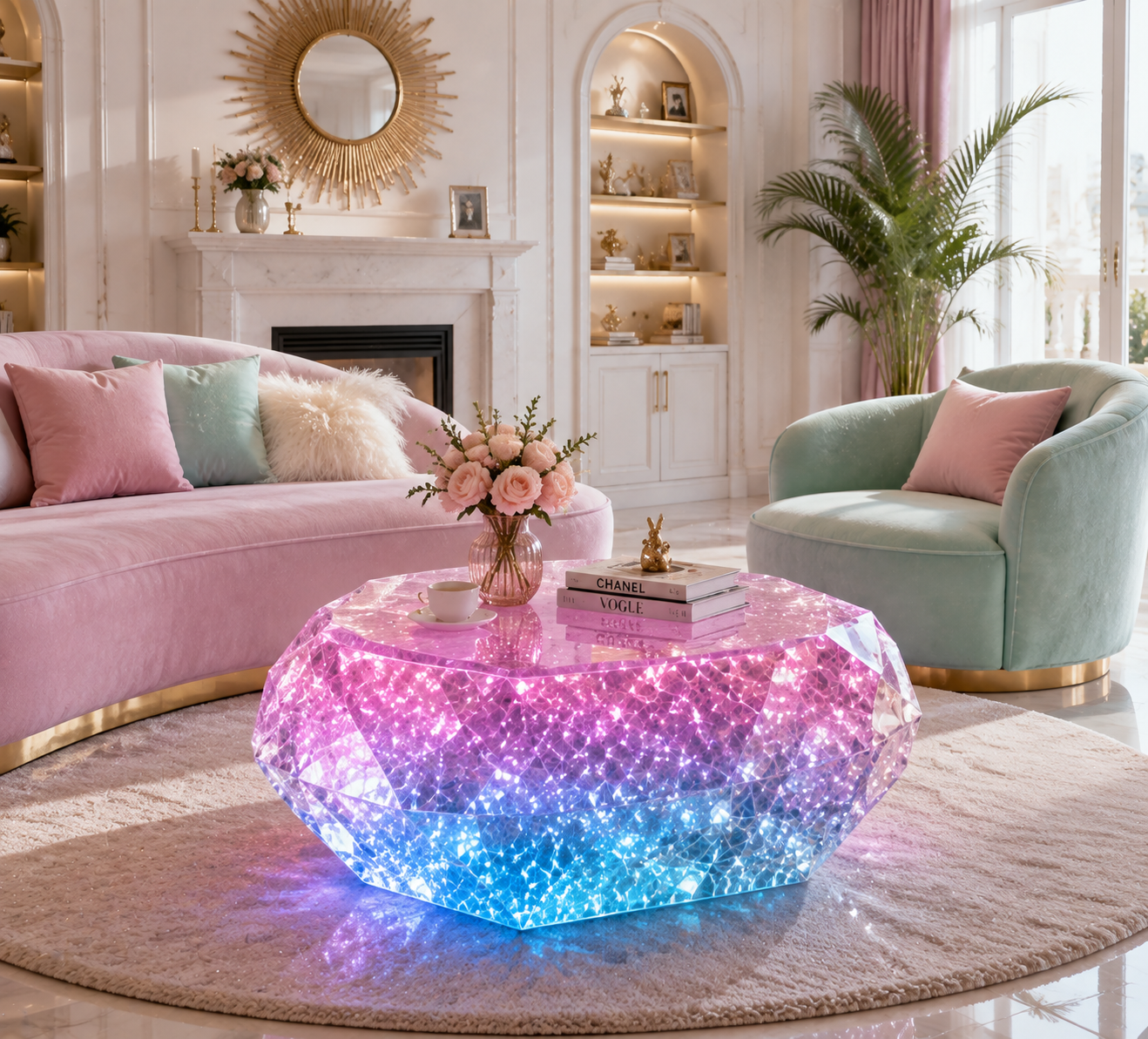
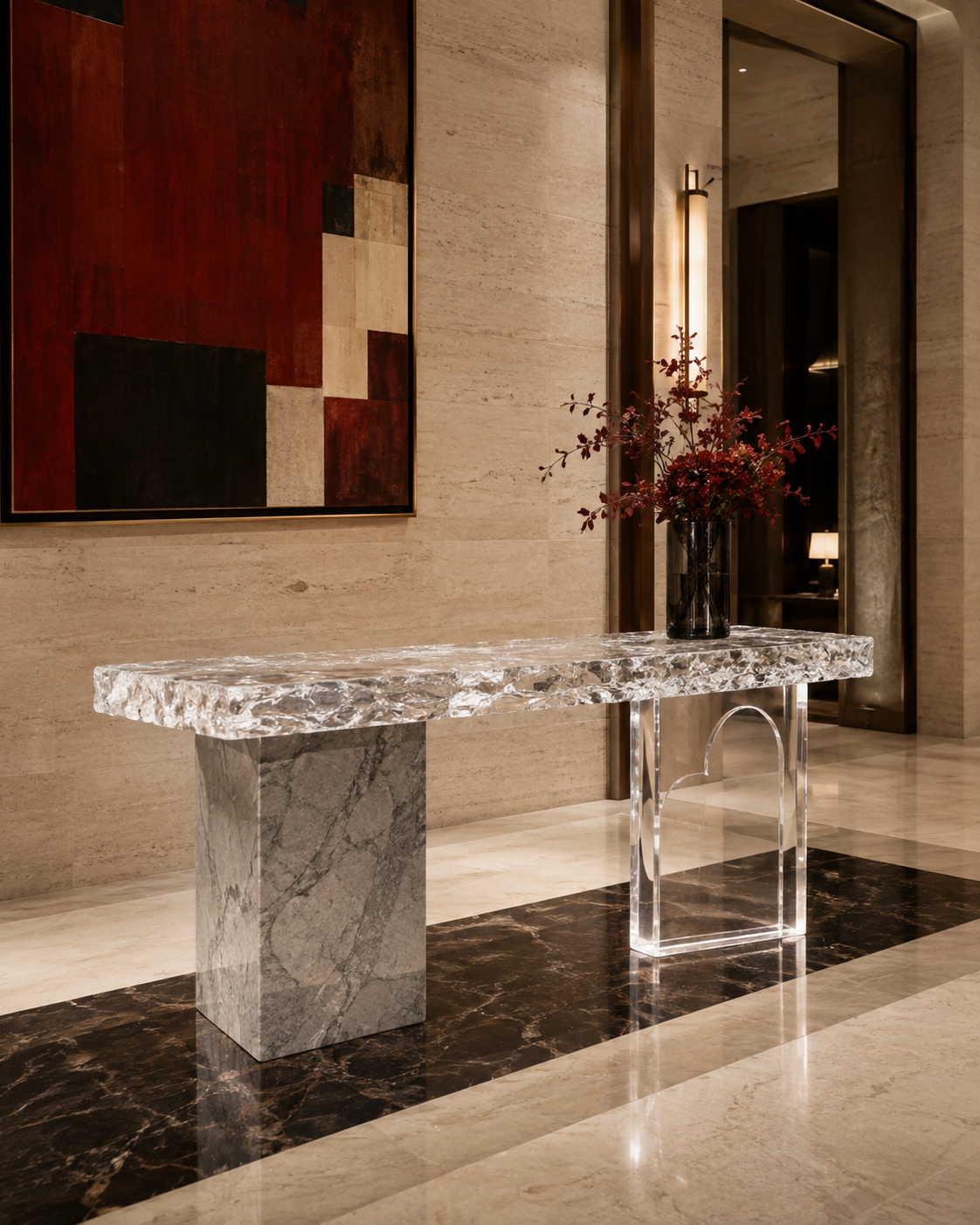
Material selection is one of the most consequential decisions in high-end furniture design. A coffee table may have perfect proportions, a console may follow the latest architectural language, and a pedestal may be beautifully detailed, but the material ultimately determines how the object interacts with light, how heavy it feels in a room, how it ages, how difficult it is to manufacture and transport, and how convincingly it communicates luxury.
For decades, natural stone and glass have been default choices for premium interiors. Marble communicates permanence and individuality; glass offers transparency and visual lightness. Today, however, designers have a much broader material palette. Synthetic crystal, high-end cast resin, and premium high-clarity acrylic—sometimes marketed in luxury furniture as platinum acrylic—can produce substantial transparent volumes, sculptural forms, controlled colors, embedded effects, and seamless surfaces that are difficult to achieve with traditional materials.
The important question, therefore, is no longer simply, “Which material is more expensive?” It is: Which material creates the right visual, functional, and commercial result for this particular piece of furniture?
1. Start With the Design Experience, Not With a Hierarchy of “Luxury” Materials
A common mistake in furniture specification is assuming that materials can be ranked on a simple scale: natural stone at the top, glass somewhere in the middle, and synthetic materials below them. Contemporary design does not work that way.
Luxury today is increasingly defined by appropriateness, execution, originality, and material expression. A poorly selected marble table can feel visually heavy or conventional, while an exceptionally manufactured synthetic-crystal console can look closer to an art installation than ordinary furniture.
The Museum of Modern Art provides an important historical example. Shiro Kuramata’s 1988 Miss Blanche Chair, now in MoMA’s collection, was made from acrylic resin, aluminum, and synthetic flowers. Kuramata embedded artificial roses inside transparent acrylic resin, making the transparency of the material—not expensive decoration—the central design idea. MoMA describes the chair as an icon of postmodern design.
That example illustrates a principle relevant to contemporary furniture manufacturers: an engineered material is not automatically a substitute for a natural one. Used intelligently, it enables a completely different design language.
Imagine a luxury hotel lobby. A marble console may communicate architectural permanence and connect beautifully with stone flooring. A low-iron glass console may nearly disappear visually, allowing artwork behind it to dominate. A thick synthetic-crystal console, by contrast, can become a luminous sculptural object, while a colored resin table can introduce gradients, suspended textures, or stone-inspired depth.
None is universally “better.”
For designers, the first decision should therefore concern emotional intent. Should the furniture feel monumental or weightless? Geological or futuristic? Quiet or theatrical? Perfectly transparent or intentionally translucent? Should every piece be naturally different, or must ten tables installed across a hospitality project look nearly identical?
Once those questions are answered, material selection becomes considerably more rational.
2. Natural Stone Is Unmatched for Geological Character—but Its Natural Variability Must Be Part of the Design
Natural stone remains one of the strongest materials for communicating permanence. Marble, granite, quartzite, travertine, and onyx offer something manufactured materials cannot literally reproduce: geological history.
Every slab contains natural variation. For a one-off dining table or statement console, that uniqueness can be precisely what a designer wants. Veining can become part of the composition, and dramatic book-matched stone can turn furniture into architecture.
But the same variation that creates exclusivity can complicate larger projects.
When a luxury residence requires one marble table, the designer can personally select a slab. When a hotel requires 40 side tables, maintaining consistent color, vein direction, pattern distribution, thickness, and replacement availability becomes more difficult. Natural variation is not a defect, but it has to be accepted as part of the specification.
Maintenance also depends strongly on the particular stone. The Natural Stone Institute emphasizes that proper care begins with understanding a stone’s geological classification and composition. It also notes that sealing does not make stone completely stain-proof; it makes it more resistant to staining. The Institute specifically warns against using vinegar on calcareous stones such as marble, limestone, and travertine.
Different stones also behave differently. According to the Natural Stone Institute, granite varieties in the referenced category have water-absorption rates ranging roughly from 0.05% to 0.40% by weight, while other stone families may require different approaches to staining, sealing, and care.
This matters when choosing furniture for restaurants, bars, bathrooms, hospitality environments, or family homes where wine, coffee, cosmetics, oils, and cleaning products are part of daily use.
Natural stone is therefore particularly convincing when authenticity, permanence, natural variation, and architectural mass are central to the concept. It becomes less automatically advantageous when the project requires extreme optical clarity, highly repeatable coloration, complex seamless forms, controlled translucency, or furniture that must visually occupy very little space.
That is where glass, synthetic crystal, resin, and premium acrylic begin to offer a different kind of luxury.
3. Glass Delivers Exceptional Optical Precision, but Weight and Safety Influence Furniture Design
Glass has an enduring place in luxury furniture because its visual language is exceptionally clean. It works particularly well for tabletops, shelves, display cabinets, consoles, and pieces where designers want transparency without introducing color or obvious texture.
Modern low-iron glass can achieve impressive optical performance. Vitro Architectural Glass reports visible-light transmittance greater than 91% for its 6 mm Starphire ultra-clear glass. Its technical data lists a density of approximately 2.51 g/cm³.
The attraction is obvious: glass can appear crisp, architectural, and almost immaterial.
Yet specifying glass furniture requires more than choosing a thickness and polishing the edges. Safety becomes an engineering issue. The National Glass Association states that fully tempered glass has approximately four times the breakage strength of annealed glass of the same thickness, while heat-strengthened glass has approximately twice the breakage strength. It also references ASTM C1048 and relevant ANSI/CPSC safety standards for appropriate applications.
For furniture specifically, the NGA notes that glass can add elegance and functionality but can break through accidental impact and therefore requires appropriate attention to minimizing injury risk. Its technical guidance also references ASTM F2813 for glass used as horizontal surfaces in desks and tables, under which applicable glass is specified as tempered or laminated.
Weight becomes increasingly important as designers move toward thicker, more sculptural furniture.
This is where transparent polymers can behave very differently. PLEXIGLAS technical documentation lists PMMA density at approximately 1.19 g/cm³, compared with approximately 2.51 g/cm³ for the low-iron soda-lime glass data cited above. On density alone, that makes the PMMA example roughly 53% lighter than the glass example at equal volume.
For a thin tabletop, the difference may be manageable. For a thick transparent pedestal, massive waterfall console, or sculptural block table, it can significantly affect handling, structural design, installation, packaging, freight, and what visual proportions are practical.
Glass is consequently an excellent choice when surface hardness, familiar transparency, thin architectural planes, and traditional glazing aesthetics are priorities. It becomes more restrictive when the concept calls for very thick transparent volumes, deeply sculpted sections, embedded decorative elements, or extensive three-dimensional machining.
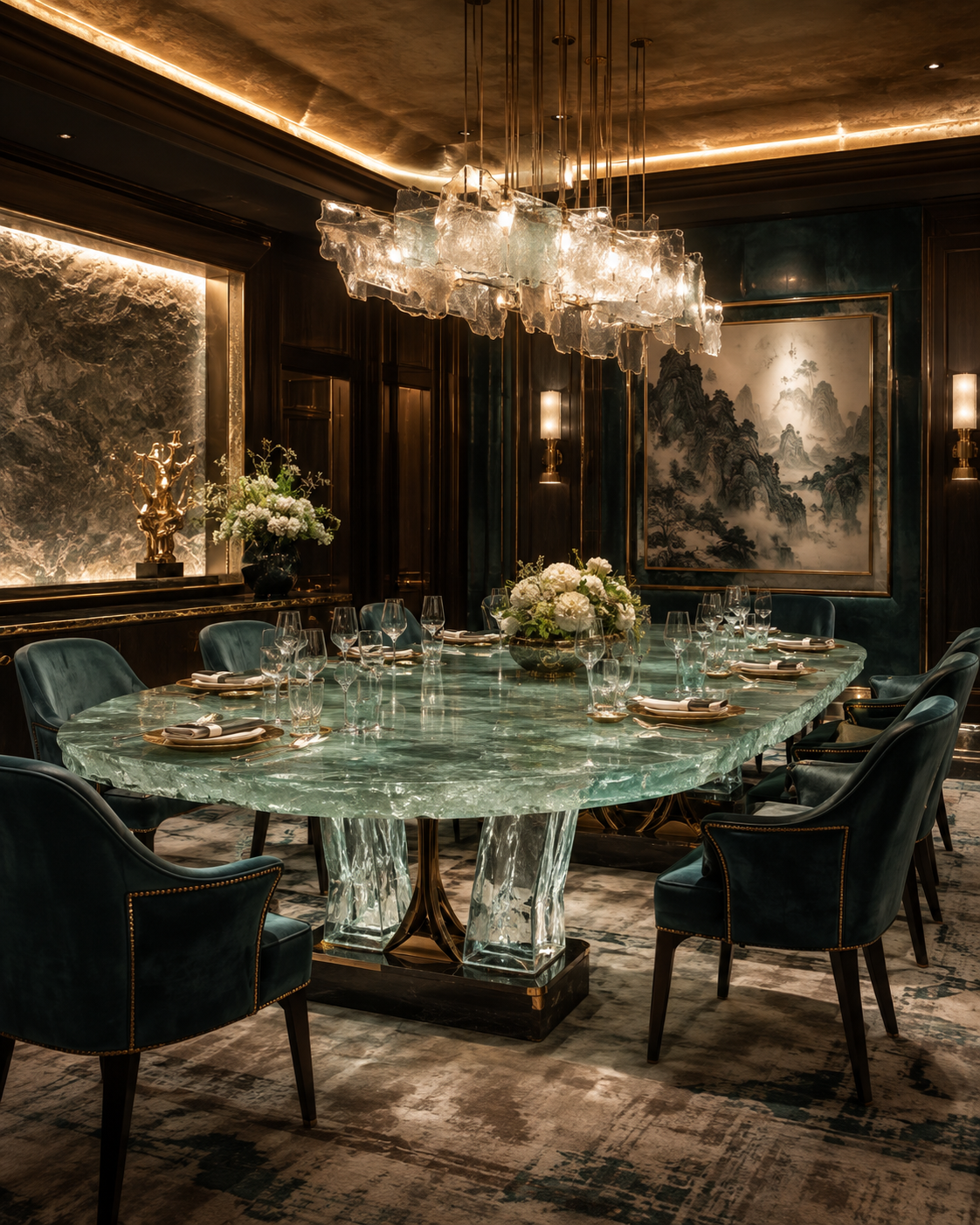
4. Synthetic Crystal and High-End Resin Offer Something Stone and Glass Cannot: Controlled Depth
Synthetic crystal and premium cast resin become particularly interesting when the designer wants the material itself to create an artistic effect.
The term “synthetic crystal” can describe different proprietary crystal-look polymer or resin systems depending on the manufacturer, so professional specifications should always identify the actual formulation and relevant performance data. What matters from a design perspective is the ability of high-quality cast materials to create optical depth while allowing much greater control over color, translucency, inclusions, gradients, texture, and form.
Consider a luxury side table inspired by a block of ice. Creating it in natural stone immediately changes the concept because the object becomes opaque. Making it entirely from conventional glass may require complex fabrication and substantial weight. Casting it in a carefully formulated transparent or translucent resin system allows the designer to control internal clouding, bubbles, color, layers, or embedded decorative details.
This is not merely a theoretical design approach. Kuramata’s Miss Blanche Chair demonstrates how acrylic resin can suspend decorative objects within a transparent structural body, something that became integral to the identity of the chair itself.
For contemporary furniture, the same principle can be applied in more restrained ways. A synthetic-crystal coffee table can use controlled internal refraction rather than applied ornament. A high-end resin console can move from transparent champagne to amber through its thickness. A pedestal can contain mineral-like textures, metallic fragments, botanical elements, or artistic inclusions. Resin can also be formulated and finished to create interpretations of ice, alabaster, onyx, or other visually complex materials without pretending to be natural stone.
The commercial advantage is equally important. Controlled manufacturing can make it easier to develop coordinated collections in which dining tables, consoles, side tables, benches, and pedestals share a consistent color language. This can be particularly valuable in hotels, boutiques, restaurants, luxury retail environments, and large residential projects.
However, “resin” by itself is not a guarantee of quality. Formulation, casting technique, curing, UV behavior, color stability, surface hardness, polishing, bonding, thickness, and quality control all influence the final product. Designers purchasing high-end resin or synthetic-crystal furniture should therefore ask for technical information rather than relying only on attractive photographs.
The difference between commodity resin furniture and luxury resin furniture often lies less in the word “resin” than in the quality of engineering and finishing behind it.
5. Platinum Acrylic Is Particularly Effective When Designers Want Transparency Without the Visual and Physical Heaviness of Glass
Premium acrylic deserves separate consideration because it occupies an unusual position between visual transparency and manufacturing flexibility.
“Platinum acrylic” is not a universal scientific material classification, so when the term is used commercially it should ideally be supported by specifications for the particular premium-grade acrylic being supplied. In high-end furniture, it generally refers to carefully selected high-clarity acrylic combined with precise fabrication, bonding, polishing, and quality control.
Optically, high-quality PMMA can compete strongly in transparent applications. PLEXIGLAS documentation states that colorless products can provide light transmission of up to 92%, depending on product type and design. Its data also lists PMMA density around 1.19 g/cm³.
That combination is extremely useful for furniture.
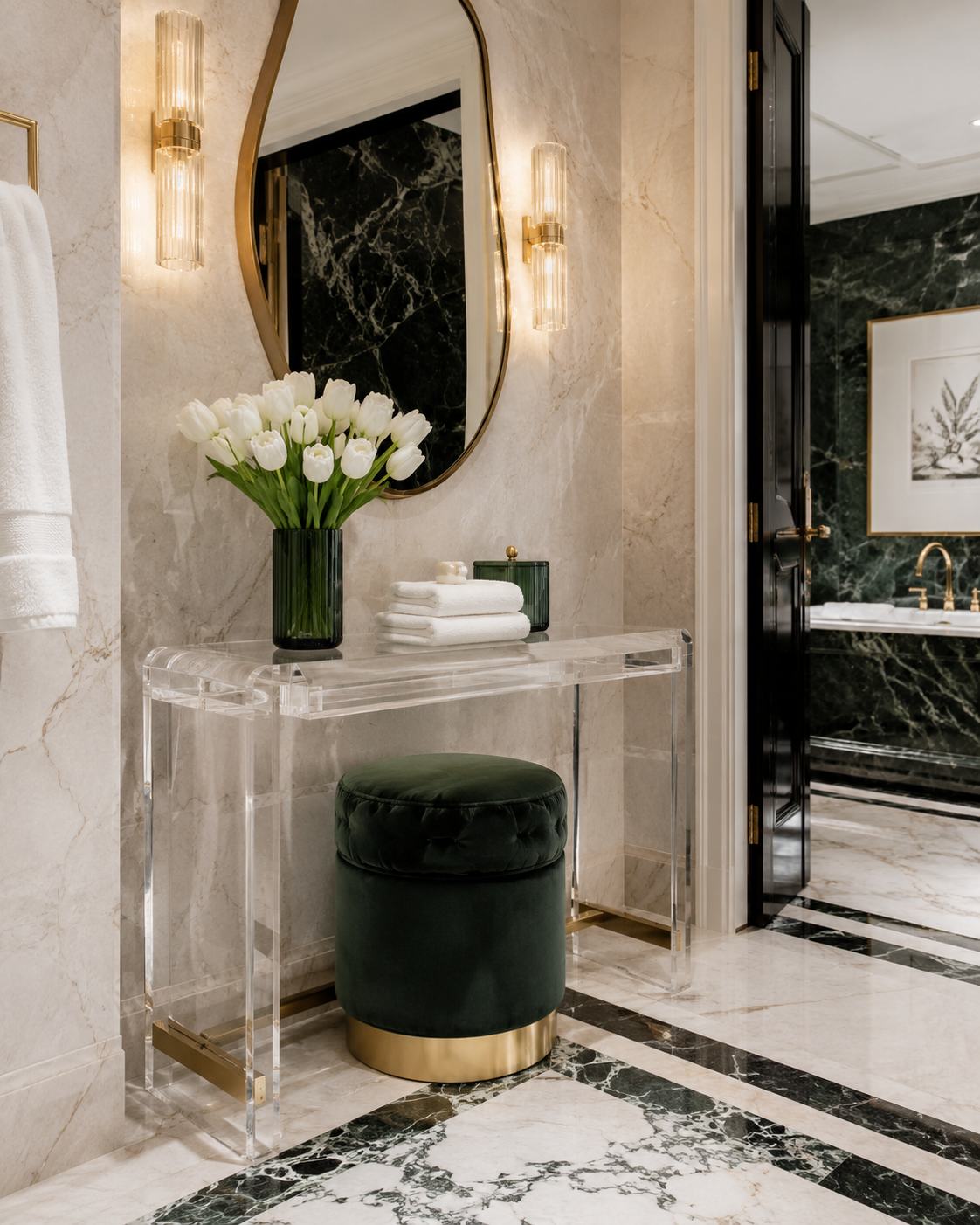
A substantial platinum-acrylic coffee table can look like a massive transparent object without imposing the same weight that an equally sized volume of glass would create. A thick acrylic console can preserve views of a marble wall or patterned floor behind it. Transparent pedestals can support sculptures or luxury products while visually receding from the display. Dining-table bases can be given substantial dimensions without making the room appear crowded.
Fabrication flexibility also influences design possibilities. PLEXIGLAS publishes processing guidance covering drilling and other fabrication techniques, while its product documentation includes solid sheets in a wide range of thicknesses and applications extending into furniture, shopfitting, exhibition construction, and interior design.
The trade-off is that acrylic surfaces require appropriate care. Designers should not select any transparent polymer on optical appearance alone. Scratch resistance, chemical compatibility, cleaning instructions, edge quality, bonding technique, exposure conditions, and long-term performance should be evaluated for the actual grade and application.
When executed properly, however, platinum acrylic does something extremely valuable in contemporary interiors: it provides physical presence without equivalent visual heaviness.
That makes it especially relevant to luxury apartments, galleries, boutiques, hotel suites, dressing rooms, high-end retail displays, and interiors where the architecture itself should remain visible through the furniture.
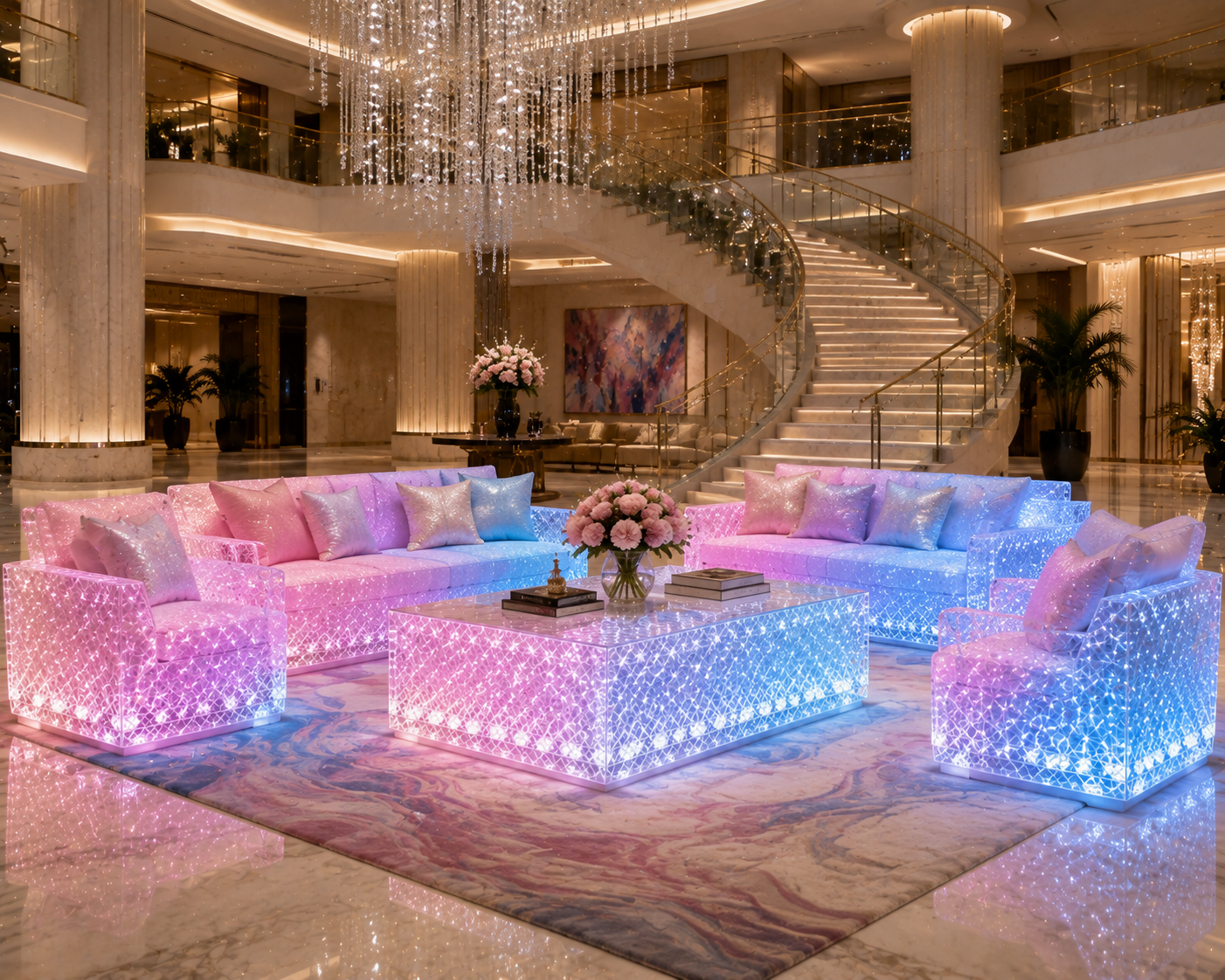
6. The Best Material Is the One That Solves the Entire Project—not Just the Product Photograph
For professional designers and buyers, the final decision should rarely be “stone versus glass versus synthetic material” in isolation. It should be based on the complete life of the furniture.
For a permanent statement dining table in a large residence, where natural variation and geological character are central to the concept, a distinctive marble or quartzite may be difficult to surpass.
For a thin, precise tabletop where conventional transparency, hardness, and architectural neutrality matter, properly specified safety glass can be the logical solution.
For a sculptural lobby table requiring controlled color, unusual thickness, translucency, or internal decorative effects, high-end cast resin or synthetic crystal may offer substantially more creative freedom.
For a visually weightless console, transparent pedestal, or thick clear coffee table that needs substantial volume without the equivalent mass of glass, premium high-clarity or platinum acrylic can become the more intelligent material.
Sometimes the strongest answer is a combination. A natural-stone tabletop can sit on transparent acrylic legs, preserving the richness of marble while reducing visual weight beneath it. A synthetic-crystal base can be combined with metal detailing. A high-end resin pedestal can incorporate brass or stainless steel. Transparent acrylic can be paired with stone so that one material provides geological character while the other provides optical lightness.
High-end specification should also consider documentation. Indoor material choices increasingly involve questions beyond appearance. The U.S. Environmental Protection Agency’s Indoor AirPlus guidance emphasizes low-emission materials as part of indoor air-quality strategies and explains that volatile organic compounds can be emitted from certain solids and liquids. Although its specific building-product requirements do not automatically apply to every furniture product, the broader lesson for manufacturers and specifiers is important: material composition, coatings, adhesives, finishes, and relevant emissions documentation should be understood rather than assumed.
Natural stone has also moved toward greater transparency in environmental documentation. The Natural Stone Institute has published industry-wide Environmental Product Declarations and Health Product Declaration resources so architects can evaluate stone using documented life-cycle and material information.
Premium synthetic-material manufacturers should be prepared for the same level of scrutiny.
For an international furniture buyer, therefore, the strongest supplier is not simply the one who can produce a beautiful sample. It is the one who can explain exactly what material is being used, how it is fabricated, what tolerances are achievable, how it should be maintained, how color consistency is controlled, how large pieces are packaged and installed, and which technical data can support the specification.
Ultimately, natural stone, glass, synthetic crystal, high-end resin, and platinum acrylic should not be viewed as competitors fighting for a single definition of luxury.
They express different kinds of luxury.
Stone offers natural history and permanence. Glass offers precision and familiar transparency. Synthetic crystal offers optical depth and sculptural possibility. High-end resin offers artistic freedom and controlled coloration. Platinum acrylic offers clarity, substantial volume, design flexibility, and visual lightness.
The most sophisticated furniture projects begin when designers stop asking, “Which material is the most luxurious?”
The better question is:
“Which material allows this piece of furniture—and this space—to become something the others cannot?”
READ MORE:
Why Do Some Materials Communicate Value at First Sight, Even in Equally High-End Furniture?
Synthetic Crystal Acrylic Furniture: A New Trend Connecting Design Aesthetics with Commercial Value
Why Future Furniture Brands Need to Rethink the Premium Power of Materials
Synthetic Crystal Acrylic Furniture: Creating Memorable High-End Spaces Through Unique Transparency


