In high-end furniture, suppliers often describe materials with the same vocabulary: premium, luxurious, durable, crystal-clear, handcrafted, exclusive. The problem is that different clients do not interpret “good material” in the same way.
A five-star hotel purchasing 80 side tables, a villa owner commissioning one statement console, and a private club renovating its members’ lounge may all have substantial budgets. Yet their priorities can be radically different. The hotel operator thinks about maintenance, consistency, replacement, housekeeping, safety, and lifecycle cost. The villa client may care more about rarity, visual impact, personalization, and how the material feels inside one highly individual home. A private club, meanwhile, often needs materials that communicate exclusivity while also supporting repeated social use and creating memorable communal spaces.
This difference has major implications for manufacturers of synthetic crystal, high-end resin, platinum-grade acrylic, natural stone, glass, metal, and other luxury furniture materials. The question is not simply whether a material is expensive or beautiful.
The real question is: beautiful for whom, durable under what conditions, and valuable in what type of project?
1. Hotels Define a Good Material Through Performance, Repeatability, and Operational Cost
A hotel designer may fall in love with a material visually, but the operator eventually asks a different set of questions: Can it survive repeated use? Can housekeeping clean it efficiently? Can dozens or hundreds of pieces be made consistently? Can a damaged table be replaced three years later without the replacement looking completely different? Can the product be installed, maintained, and eventually refurbished without disrupting operations?
That is why hotel furniture specification is fundamentally different from buying furniture for a private home.
HVS, one of the best-known global hospitality advisory organizations, describes hotel interior designers as being responsible not only for creating memorable guest experiences but also for integrating brand requirements, preparing furniture, fixtures and equipment specifications and budgets, and coordinating purchasing. HVS also emphasizes that hotel planning must account for practical day-to-day operating requirements.
The economics behind these decisions are substantial. HVS’s 2026 U.S. Hotel Development Cost Survey reported a median development cost of approximately $213,000 per room across the properties surveyed. That figure covers far more than furniture, but it demonstrates the scale at which owners evaluate hotel investment decisions. FF&E is not decorative spending isolated from the business model; it forms part of a much larger capital strategy.
This explains why material consistency can sometimes matter more to a hotel than absolute uniqueness.
Imagine a luxury hotel ordering 120 bedside tables. Natural onyx may look spectacular, but its color and veining can vary significantly between slabs. That variation may be desirable in a boutique project, yet a hotel brand seeking a consistent guest-room identity may prefer a controlled resin or synthetic-crystal material whose color, translucency, and visual effects can be reproduced within agreed tolerances.
High-end resin can therefore become attractive not merely because it looks sophisticated but because a manufacturer can potentially develop a project-specific color and repeat it across consoles, nightstands, coffee tables, decorative panels, and pedestals. The exact performance, color tolerance, UV behavior, and cleaning requirements still need to be confirmed for the actual formulation.
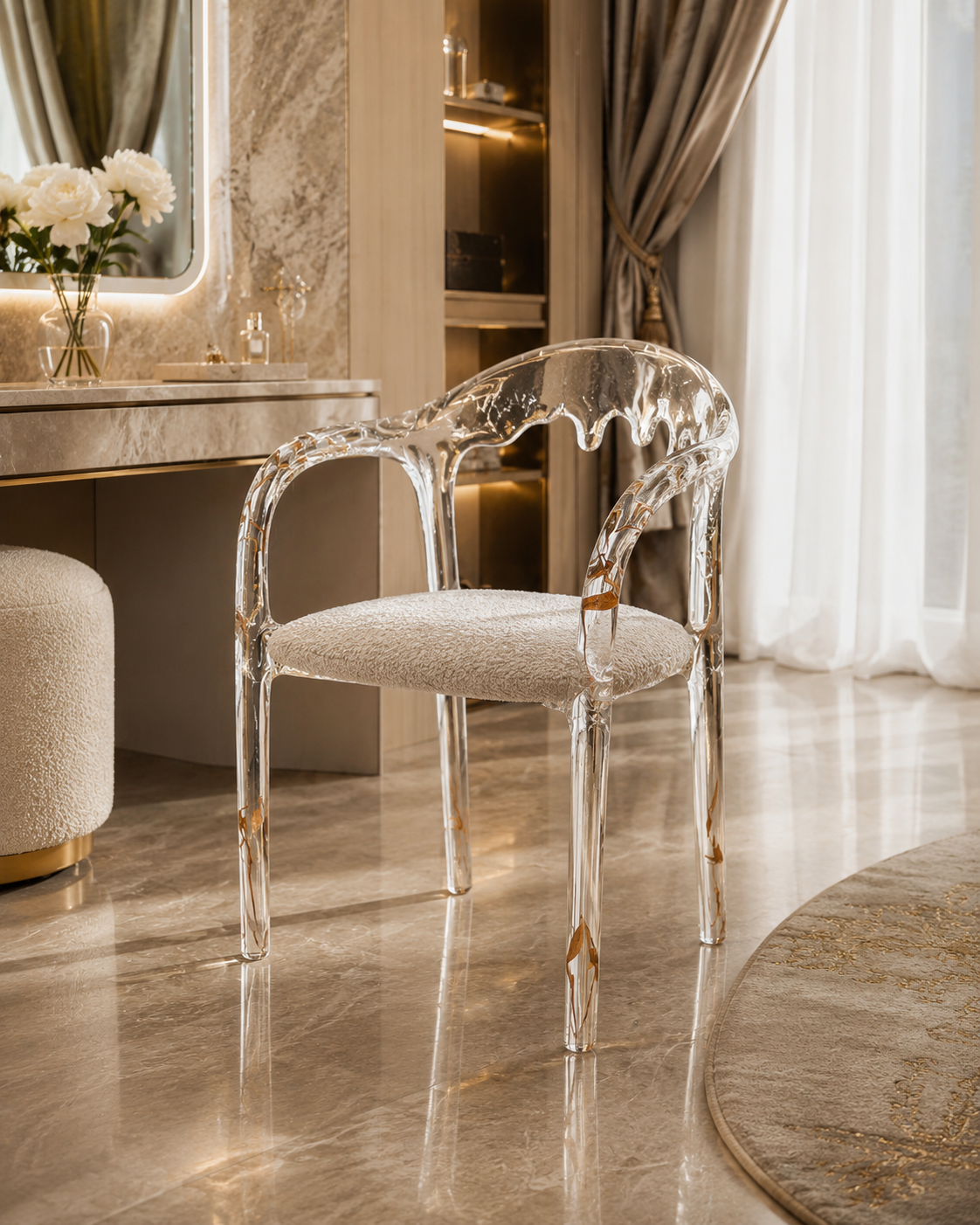
Premium high-clarity acrylic can solve another hotel problem: substantial visual presence without unnecessarily increasing visual congestion. In lobbies and suites where designers want the architecture, flooring, rugs, or artwork to remain visible, a transparent platinum-acrylic console or coffee table can provide function while visually receding into the space.
For a hotel client, then, the best material is often not the rarest one. It is the material that balances luxury appearance with repeatability, maintenance, documentation, replacement capability, and operational logic.

2. Villa Clients Often Judge Materials by Individuality, Emotional Value, and the Ability to Personalize
A private villa operates according to almost the opposite logic.
There may be only one dining table, one entrance console, or one sculptural coffee table. The owner does not necessarily need 50 identical pieces. In many cases, being impossible to replicate is part of the appeal.
This changes the definition of quality.
Architectural Digest’s coverage of high-end residential projects repeatedly demonstrates how luxury homes are built around the tastes, collections, histories, and habits of individual owners rather than a universal design formula. In a 2026 Yellowstone Club residence designed by Charles & Co., for example, the design process incorporated rare European midcentury furniture from the homeowner’s personal collection together with custom millwork and highly specific material choices. The result was deliberately personal rather than standardized.
That distinction is critical for furniture suppliers.
A villa owner may be willing to wait longer for a hand-cast resin dining table if the color has been developed exclusively for the residence. A client may prefer one synthetic-crystal console with an unusual internal pattern to twenty perfectly standardized pieces. A thick platinum-acrylic coffee table can be customized to align precisely with the proportions of a living room, while a resin pedestal may incorporate a controlled gradient that echoes a piece of artwork.
Natural materials remain extremely powerful in this environment. A single marble slab with extraordinary veining can become the reason an entire table exists. But engineered materials create a different type of exclusivity because the designer is not restricted to what geology provides.
With high-end resin or synthetic crystal, designers can explore transparency, translucency, color saturation, layered effects, embedded elements, mineral-like textures, or substantial sculptural volumes. Instead of selecting a material from an existing slab inventory, the designer may participate in defining the appearance of the material itself.
That creative freedom can be especially important when the villa already contains expensive natural materials. If floors, bathrooms, and walls are heavily finished in travertine, marble, oak, or bronze, adding another conventional stone coffee table may simply create more visual mass. A transparent synthetic-crystal or platinum-acrylic table can introduce contrast and allow surrounding materials to remain visible.
The villa client is therefore often buying something more emotional than standardized performance.
For this customer, a “good material” may mean a material that feels personal, cannot be found in every other house, works with a specific art collection, and makes the owner feel that the furniture belongs only in this home.
3. Private Clubs Need Materials That Turn Shared Spaces Into Memorable Social Experiences
A private club is neither a hotel nor a private residence.
Its interiors have to withstand repeated use, but they also have to communicate membership. A good clubhouse cannot simply be practical. Members need to feel that the environment is special enough to justify returning to it—and, at the premium end of the market, special enough to reinforce the emotional value of belonging.
The Club Management Association of America provided a revealing example in a 2026 clubhouse-renovation case. During construction, the club created a temporary dining venue because management considered the larger risk to be losing the club’s “social heartbeat.” The temporary environment allowed members to continue meeting, dining, and maintaining social routines, while helping protect food-and-beverage revenue.
That tells furniture designers something important: in a club, furniture participates in social behavior.
A lobby console in a hotel may primarily help establish a visual identity. A console in a private club entrance may also become part of the ritual of arrival. A bar table is not merely a horizontal surface; it participates in repeated meetings among members. A coffee table in a members’ lounge may be seen and touched by the same people hundreds of times.
The material therefore has to work at two distances.
From across the room, it must create atmosphere. At arm’s length, it must continue to feel convincing.
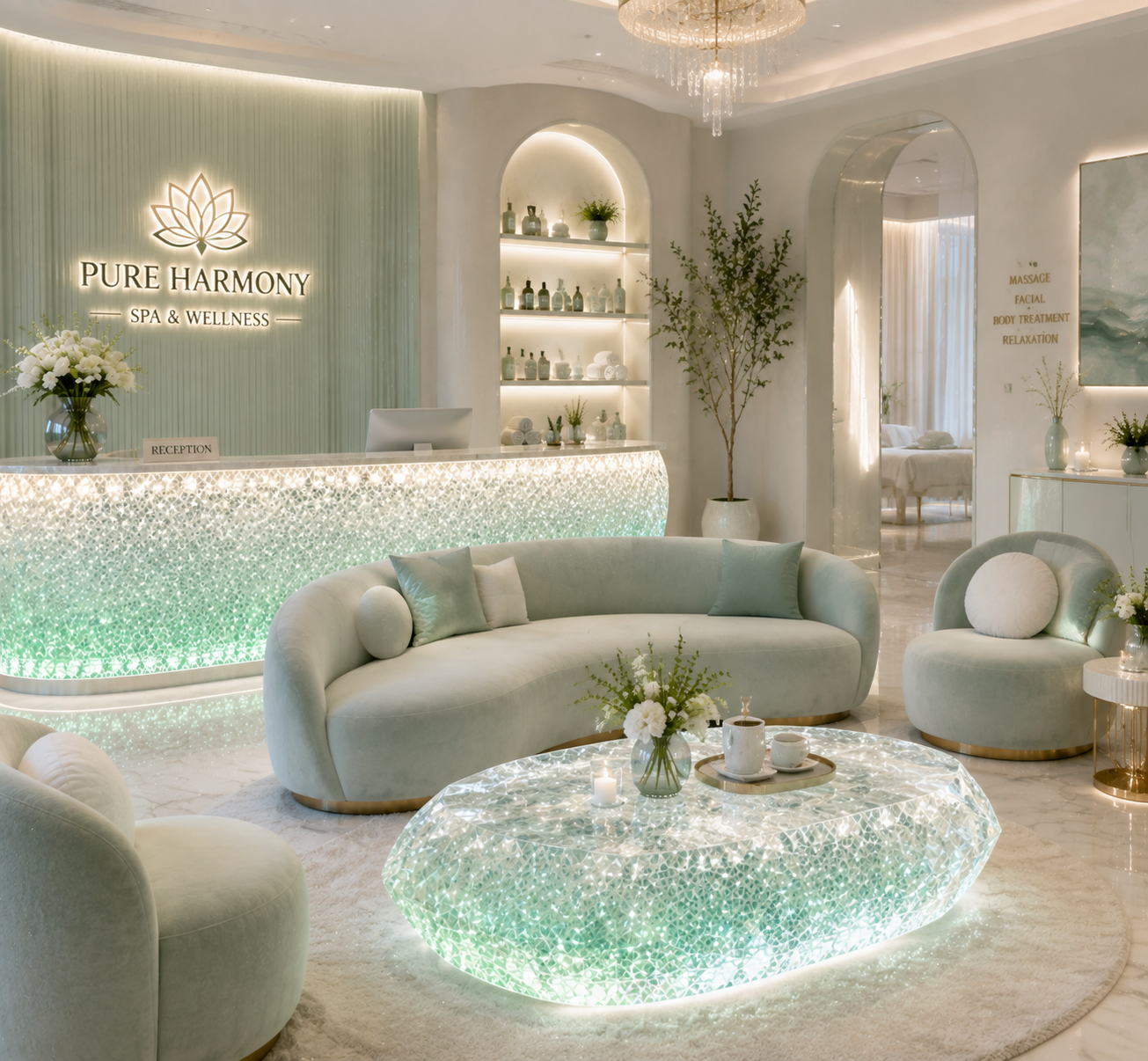
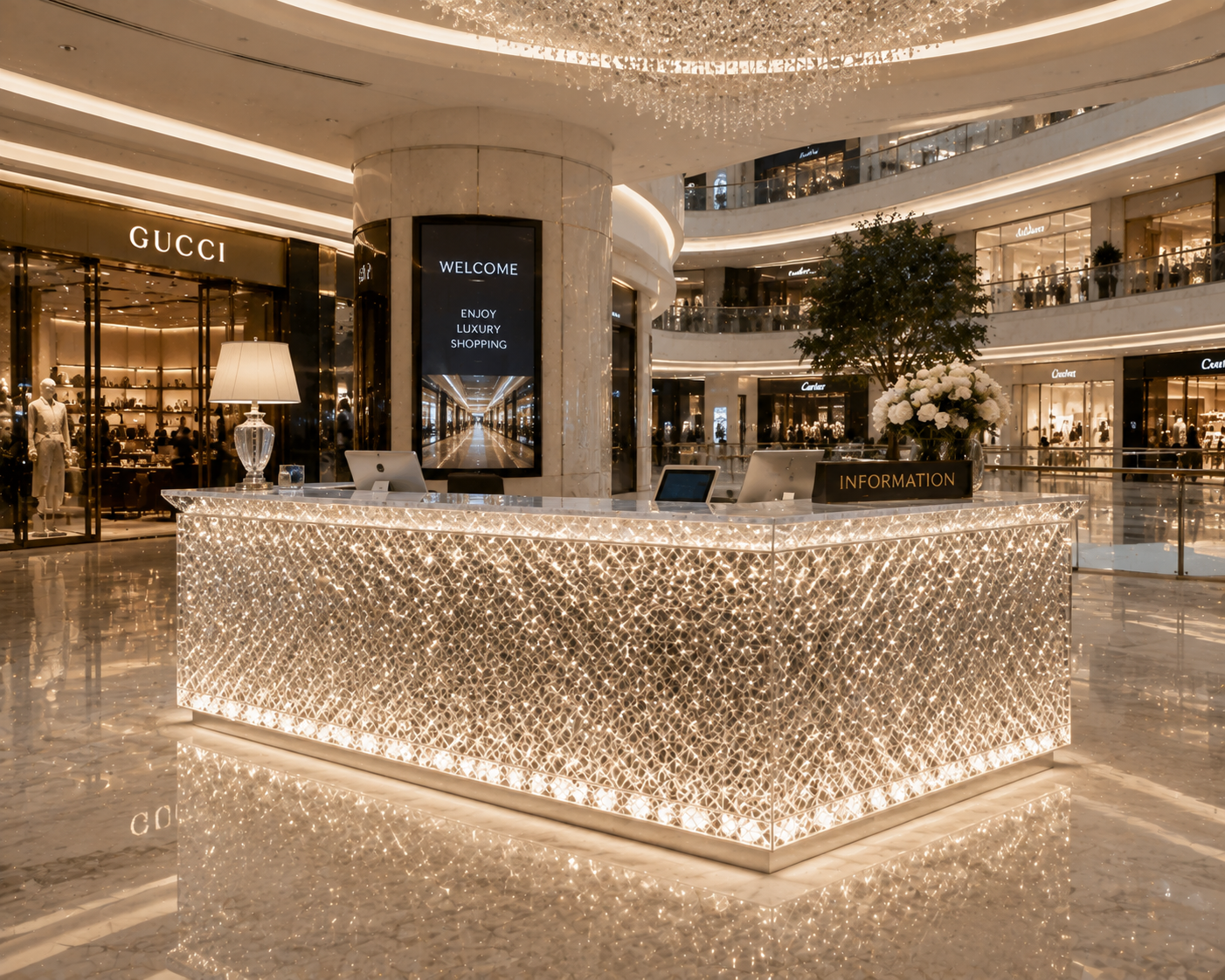
This is where synthetic crystal and high-end resin can be particularly effective when used selectively. A large translucent resin table under carefully designed lighting can become an identifying feature of the lounge. A synthetic-crystal reception desk or console can produce a jewel-like impression without relying on conventional decorative ornament. Platinum acrylic can work in spaces where designers want substantial furniture forms but do not want to block sightlines between seating groups.
Club Benchmarking’s work with private clubs also emphasizes long-term capital planning, including evaluation of assets, future replacement costs, and projected useful life. In one 2026 case study, a club used a 20-year forward-looking view of capital requirements as part of its strategic planning.
So although a club values spectacle, it cannot ignore longevity.
The strongest club materials therefore sit between the hotel and villa definitions of luxury: more distinctive than standardized hospitality furniture, but more operationally robust than a purely decorative residential collectible.
4. The Same Transparent Material Can Solve Three Completely Different Problems
This is where material selection becomes especially interesting.
Consider a clear platinum-acrylic table. The physical material may be essentially the same across three projects, yet the reason each client chooses it may be completely different.
In a hotel suite, the designer may specify it because transparent furniture reduces perceived visual mass. The room already contains a bed, lounge chair, minibar, cabinetry, desk, lighting, and luggage. A transparent coffee table performs its function without creating another opaque block in the center of a limited floor plan.
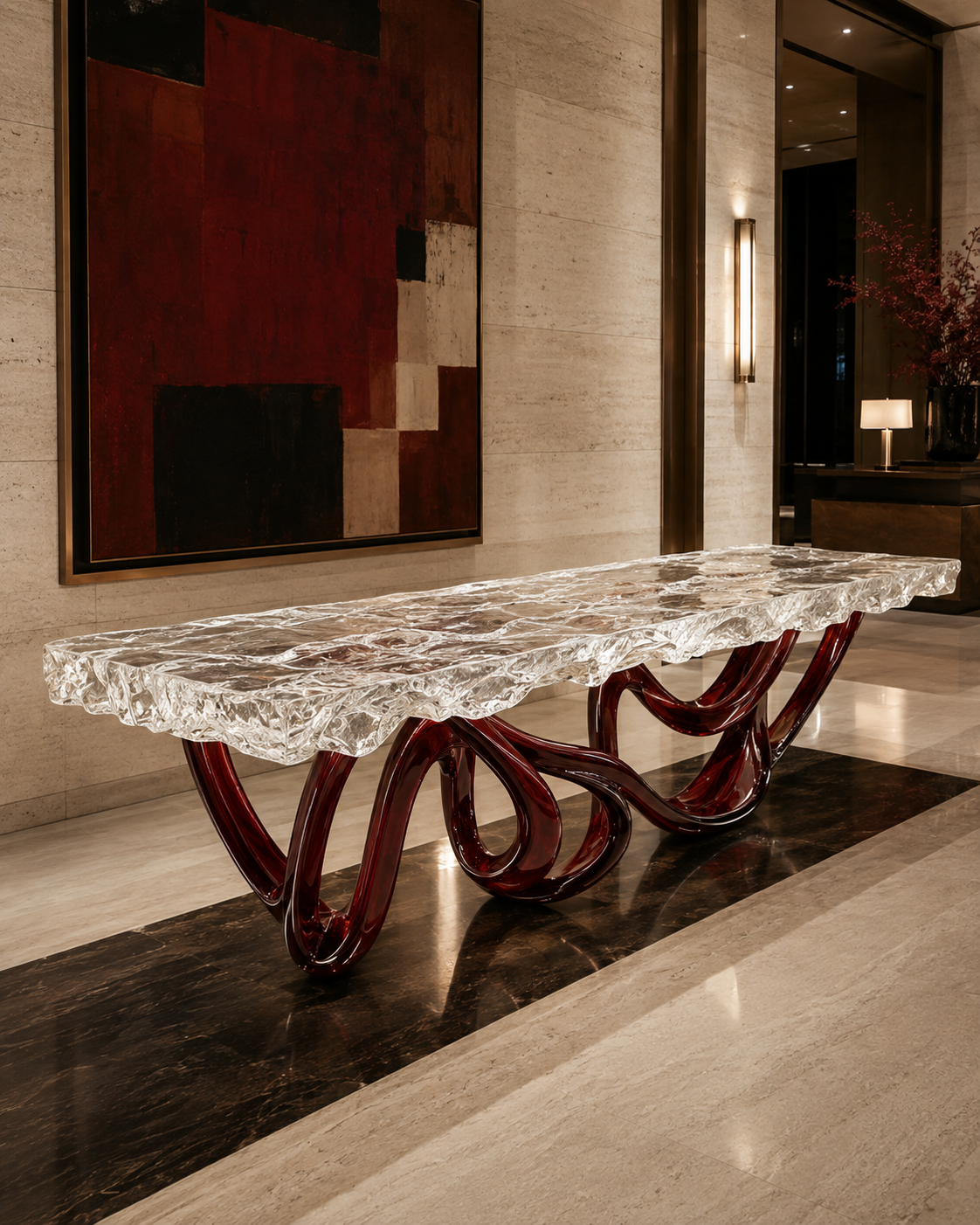
In a villa, the same material might be selected because a 100-mm-thick transparent table produces a sculptural effect while allowing a custom rug or stone floor underneath to remain visible. The value is not efficiency but the visual contradiction: the object appears substantial and almost weightless at the same time.
In a club, an acrylic console might be edge-lit or combined with metal, resin, or stone to create an evening atmosphere near a bar or entrance.
The optical properties of PMMA help explain why designers can use acrylic this way. For one specific optical-grade PLEXIGLAS PMMA product, Röhm reports approximately 92% light transmittance at 3 mm thickness, density of 1.19 g/cm³, and haze below 1%. The manufacturer also describes the product as roughly half the weight of glass. These figures are grade-specific rather than universal values for every acrylic product, but they demonstrate the optical and physical potential available in high-quality PMMA.
Synthetic crystal and resin create similar opportunities in different ways. Perfect transparency may not even be the objective. A designer may deliberately introduce champagne color, smoky translucency, cloudy depth, suspended texture, or a mineral-like internal structure.
The lesson for manufacturers is important: do not sell a material only through specifications such as transparency, thickness, hardness, or weight.
Sell what the specification allows the designer to achieve.
“High transparency” means very little by itself. “Allows a small hotel suite to feel visually larger” is a design benefit.
“Custom resin color” is a manufacturing feature. “Lets a villa designer match a table to a specific artwork or stone palette” is a client benefit.
“Thick synthetic crystal” describes construction. “Creates an illuminated centerpiece that members remember when they enter the club” describes value.
A material becomes premium when technical capability is translated into spatial experience.
5. Hotels Fear Maintenance Problems, Villa Owners Fear Ordinary Design, and Clubs Fear Losing Relevance
One of the clearest ways to understand the three markets is to ask what each customer is trying to avoid.
Hotels fear operational problems.
A material that photographs beautifully but scratches easily under the intended use, reacts badly to housekeeping chemicals, is impossible to repair, or takes months to replace can become a poor commercial decision. Marriott’s published maintenance job requirements illustrate how routine hotel operations include cleaning, inspecting, touching up, and maintaining guest-room furniture and public areas. Furniture lives inside an ongoing maintenance system.
Villa owners often fear something different: spending a large amount of money and ending up with an interior that feels generic.
This is why customization matters so much. The ability to alter dimensions, color, transparency, edge profile, internal effect, or combinations of materials can be more persuasive than simply offering a more expensive standard product.
Private clubs face another challenge: remaining relevant to existing and future members. CMAA’s renovation examples repeatedly focus on preserving member engagement and improving how people gather and use club spaces. That means materials need to contribute to identity without turning the clubhouse into a fragile showroom.
These concerns should directly influence how synthetic-crystal, resin, and acrylic furniture is developed and presented.
For hotel applications, a supplier should be ready to discuss cleaning protocols, tolerances, consistency between batches, packaging, installation, replacement procedures, and project schedules.
For villas, the conversation can focus more heavily on bespoke dimensions, unique color development, special casting effects, combinations with metal or stone, and one-off statement pieces.
For clubs, the most convincing proposition often combines both: memorable custom design supported by commercial-grade thinking.
Indoor environmental quality is also becoming part of professional specification. The U.S. Environmental Protection Agency notes that building materials and furnishings can be sources of volatile organic compounds and reports that studies have found levels of several organic pollutants averaging two to five times higher indoors than outdoors.
The U.S. Green Building Council similarly addresses low-emitting materials as a way of reducing indoor VOC exposure in LEED projects.
For high-end resin and synthetic-material manufacturers, this means vague claims such as “eco-friendly” are increasingly less persuasive than actual documentation. Where applicable, professional buyers may want formulation information, emissions testing, relevant certifications, cleaning guidance, performance data, and traceable specifications.
Luxury is becoming more technical.
6. A Truly Premium Material Supplier Should Speak Three Different Languages to Three Different Clients
For manufacturers, perhaps the biggest mistake is presenting the same selling points to every high-end customer.
Suppose a company produces a synthetic-crystal coffee table with exceptional optical depth, a high-end resin console available in custom colors, and a thick platinum-acrylic dining-table base.
To a hotel purchasing team, leading with “exclusive artistic craftsmanship” may not be enough. The stronger conversation is about repeatability, quality control, project quantities, production consistency, installation, maintenance, packaging, replacement availability, technical documentation, and how the furniture helps create a premium appearance without becoming an operational burden.
That mindset aligns with the wider direction of hospitality procurement. The American Hotel & Lodging Association’s sustainability program identifies responsible sourcing as one of its four central areas, alongside energy efficiency, water conservation, and waste reduction. In 2026, AHLA also highlighted hospitality design awards that assess projects using verified sustainability information relating to products and materials, including health and wellness, responsible sourcing, waste reduction, and other performance considerations.
To the villa designer or homeowner, the language should change.
Do not begin with how many identical units the factory can manufacture. Begin with what can be customized. Show how synthetic crystal can interact with natural light. Demonstrate what happens when resin thickness increases. Explain how champagne, amber, smoke, ice-blue, or completely custom colors behave at different depths. Show how a platinum-acrylic base can make a marble tabletop appear to float. Give the designer a material vocabulary rather than simply a catalogue.
To a private club, combine both conversations.
Show the memorable piece first: perhaps a large synthetic-crystal communal table, an illuminated translucent-resin bar feature, a sculptural resin console, or a substantial clear acrylic centerpiece. Then demonstrate that the manufacturer understands repeated use, maintenance, production engineering, delivery, and long-term replacement.
This is ultimately why the phrase “high-end material” has no universal meaning.
A hotel sees quality through consistency, durability, maintenance, brand fit, and return on capital.
A villa client sees quality through individuality, craftsmanship, emotional resonance, and the freedom to create something personal.
A private club sees quality through atmosphere, member experience, exclusivity, durability, and the ability of a space to remain socially relevant.
Natural stone may be perfect for one of those objectives. Glass may be ideal for another. Synthetic crystal may create an optical effect that neither can provide. High-end resin may offer the color and sculptural freedom a designer needs. Platinum acrylic may deliver substantial transparent furniture with a lighter visual presence than conventional opaque materials.
The most successful furniture manufacturers therefore do not ask only:
“How can we prove that our material is good?”
They ask something more commercially intelligent:
“What does ‘good material’ mean to this particular client?”
Once that question is answered, material stops being a commodity.
It becomes a solution.

READ MORE:
- Why Do Some Materials Communicate Value at First Sight, Even in Equally High-End Furniture?
- Why Are Clients Willing to Pay for "Transparency"? The Visual Value of Synthetic Crystal Furniture in High-End Interiors
- Natural Stone, Glass, or Synthetic Crystal? How to Choose the Right Material for High-End Furniture
- The Designer's Eye for "Luxury": Why Furniture Materials Influence the Quality of a Space More Than Form
- Synthetic Crystal Acrylic Furniture: A New Trend Connecting Design Aesthetics with Commercial Value
- Why Future Furniture Brands Need to Rethink the Premium Power of Materials
- Synthetic Crystal Acrylic Furniture: Creating Memorable High-End Spaces Through Unique Transparency
- From Visual Differentiation to Market Competitiveness: The Value Upgrade of Synthetic Crystal Acrylic Furniture
- Synthetic Crystal Acrylic Furniture: Why More High-End Projects Are Paying Attention to This Material


