In luxury interiors, clients do not always pay more because a piece of furniture contains more material, more decoration, or a more complicated shape. Sometimes they pay precisely for the opposite effect: the ability of a substantial object to almost disappear.
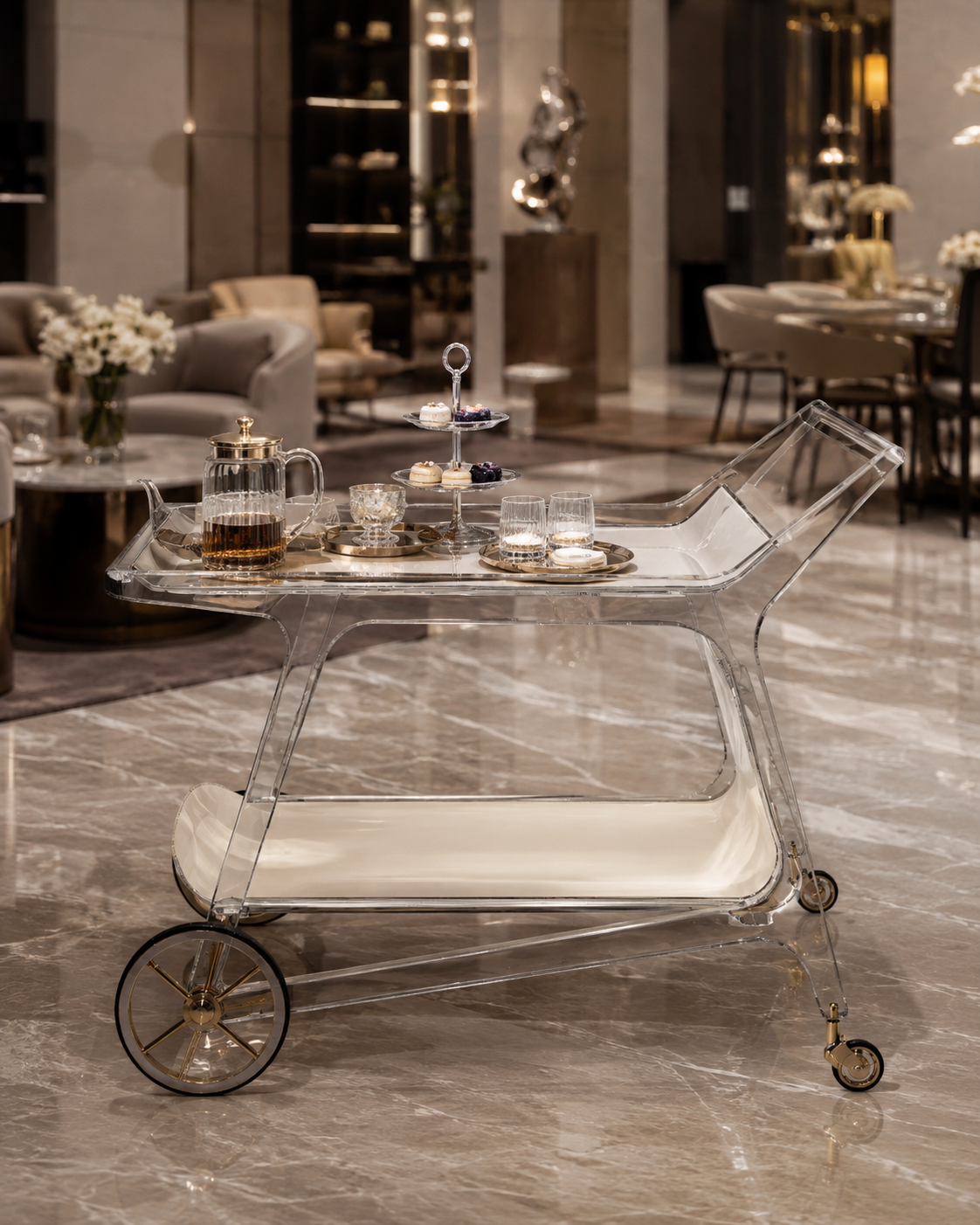
A transparent coffee table may occupy the same physical dimensions as a marble one, yet the room can feel completely different. A clear console can stand in front of an important wall finish without visually covering it. A synthetic crystal pedestal can support an art object while becoming part of the lighting composition. A platinum acrylic dining-table base can be physically substantial yet allow the floor, rug, and architecture behind it to remain visible.
This is what designers often describe as visual lightness, clarity, or a sense of “floating.” For luxury clients, however, transparency becomes valuable only when it goes beyond simply being see-through. Optical depth, color purity, edge treatment, reflection, refraction, thickness, surface quality, and interaction with light determine whether transparent furniture feels ordinary or extraordinary.
Understanding this distinction explains why high-quality synthetic crystal, premium resin, and platinum-grade acrylic furniture can command attention—and why clients are sometimes willing to pay significantly more for an apparently simple transparent object.
1. Transparency Changes How Much Space Furniture Appears to Occupy
Every piece of furniture occupies two kinds of space: physical space and visual space.
A solid marble coffee table and a clear synthetic-crystal coffee table may both measure 1,200 × 700 × 400 mm. Physically, their footprints are almost identical. Visually, however, they can behave very differently.
An opaque table interrupts sightlines. The eye encounters its surface, sides, legs, color, and mass before continuing toward the floor and surrounding architecture. A transparent table allows many of those visual signals to continue through the object. The furniture still exists physically, but its apparent mass is reduced.
Architectural Digest has repeatedly recommended acrylic and other clear furniture for precisely this reason. In its discussion of small interiors, the publication notes that clear furniture can reduce visual clutter because flooring, color, and other design elements remain visible through the piece. In another residential project, a designer explained that a small acrylic table was custom-made specifically so that it could visually “float” in a room without introducing more clutter.
This principle is not limited to small apartments.
In a luxury villa with an expensive hand-knotted rug, a large opaque coffee table can conceal one of the room's most important surfaces. A platinum acrylic or synthetic crystal table allows that rug to remain part of the composition.
In a hotel lobby with book-matched stone flooring, transparent furniture can provide seating-area functionality without fragmenting the floor pattern. In a private club, a clear console positioned behind a sofa can provide lighting and display space while preserving longer views across the lounge.
For luxury retail, the logic becomes even more obvious. A transparent pedestal can physically support a handbag, watch, jewelry object, sculpture, or collectible without competing visually with the product.
Clients are therefore not paying merely for “clear furniture.” They are paying for the ability to add function without adding equivalent visual weight.
That is a powerful design advantage because floor area in premium real estate is expensive, and every visual obstruction changes how that area is perceived.
2. What Clients Really Buy Is the Behavior of Light
Transparency alone does not create luxury. Light does.
When designers evaluate a transparent material, they are looking at what happens as light enters, leaves, reflects from, or travels through it. This is why two nominally clear materials can create very different impressions.
Scientific research into material perception shows that the human visual system uses cues such as specular highlights, surface reflectance, translucency, and transparency to make rapid judgments about what materials are like. Large-scale research on optical material properties has demonstrated that people visually distinguish characteristics including gloss, transparency, and translucency rather than simply recognizing an object's outline.
For furniture designers, this helps explain why optical quality is so important.
High-quality PMMA provides a useful technical benchmark. Röhm states that clear PLEXIGLAS products can achieve visible-light transmission of up to 92%, while technical data for specific grades lists a refractive index around 1.49. These figures are product-specific and should not be assumed for every acrylic formulation, but they demonstrate why carefully selected PMMA can produce exceptional optical clarity.
Ultra-clear glass performs strongly as well. Vitro's technical data for 6-mm Starphire low-iron glass reports visible-light transmission above 91%.
Yet luxury transparent furniture is not a competition to achieve the highest transmission percentage.
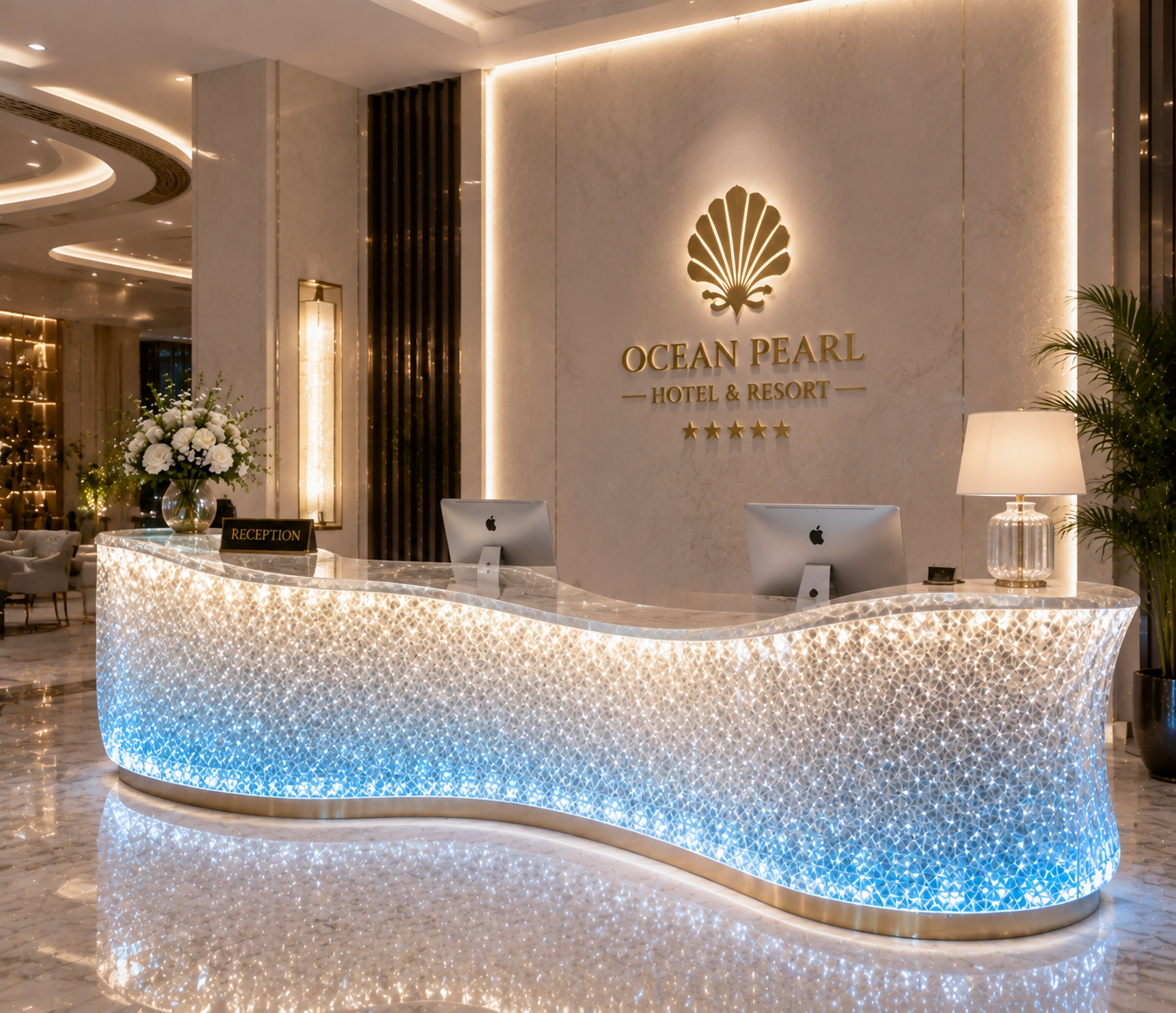
Synthetic crystal and high-end resin can become more interesting precisely when designers move away from perfect invisibility. A champagne-colored crystal table can concentrate color along thick edges. A smoky resin console can transition from transparent to translucent as its depth changes. A cast synthetic-crystal pedestal can create internal reflections that make the material appear deeper than its physical dimensions suggest.
Under daylight, these pieces may appear restrained. Under directional evening lighting, edges can brighten, internal planes become visible, and shadows acquire color.
The furniture effectively participates in the lighting design.
That is what separates a basic transparent object from a visually valuable one. The client is not purchasing emptiness. The client is purchasing a material capable of transforming light into atmosphere.
3. The Luxury of Transparent Furniture Comes From the Paradox of “Mass Without Heaviness”
Some of the most compelling high-end transparent furniture depends on contradiction.
The object looks massive, yet the room does not feel heavy.
A 100-mm-thick synthetic crystal coffee table communicates solidity through its dimensions. A substantial platinum acrylic console may resemble a monolithic block. But because the eye can continue through the furniture, the perceived weight is completely different from an equivalent volume of stone, timber, or metal.
Material density also affects what manufacturers can realistically produce and install. Röhm technical documentation gives PMMA a density of approximately 1.19 g/cm³. By comparison, Vitro lists approximately 2.51 g/cm³ for Starphire low-iron glass. At equal volume, that specific PMMA comparison is therefore roughly 53% lighter than the glass.
This does not mean acrylic should automatically replace glass; glass has different surface, structural, fabrication, and safety characteristics. It does explain why thick transparent furniture can become particularly interesting in acrylic-based construction.
Consider a large luxury console designed to look like a single transparent architectural beam. Producing the visual concept in very thick glass introduces substantial weight and requires careful engineering and handling. A high-quality acrylic construction can make different proportions practical while retaining considerable clarity.
The effect can be particularly powerful when transparent material is combined with opaque material.
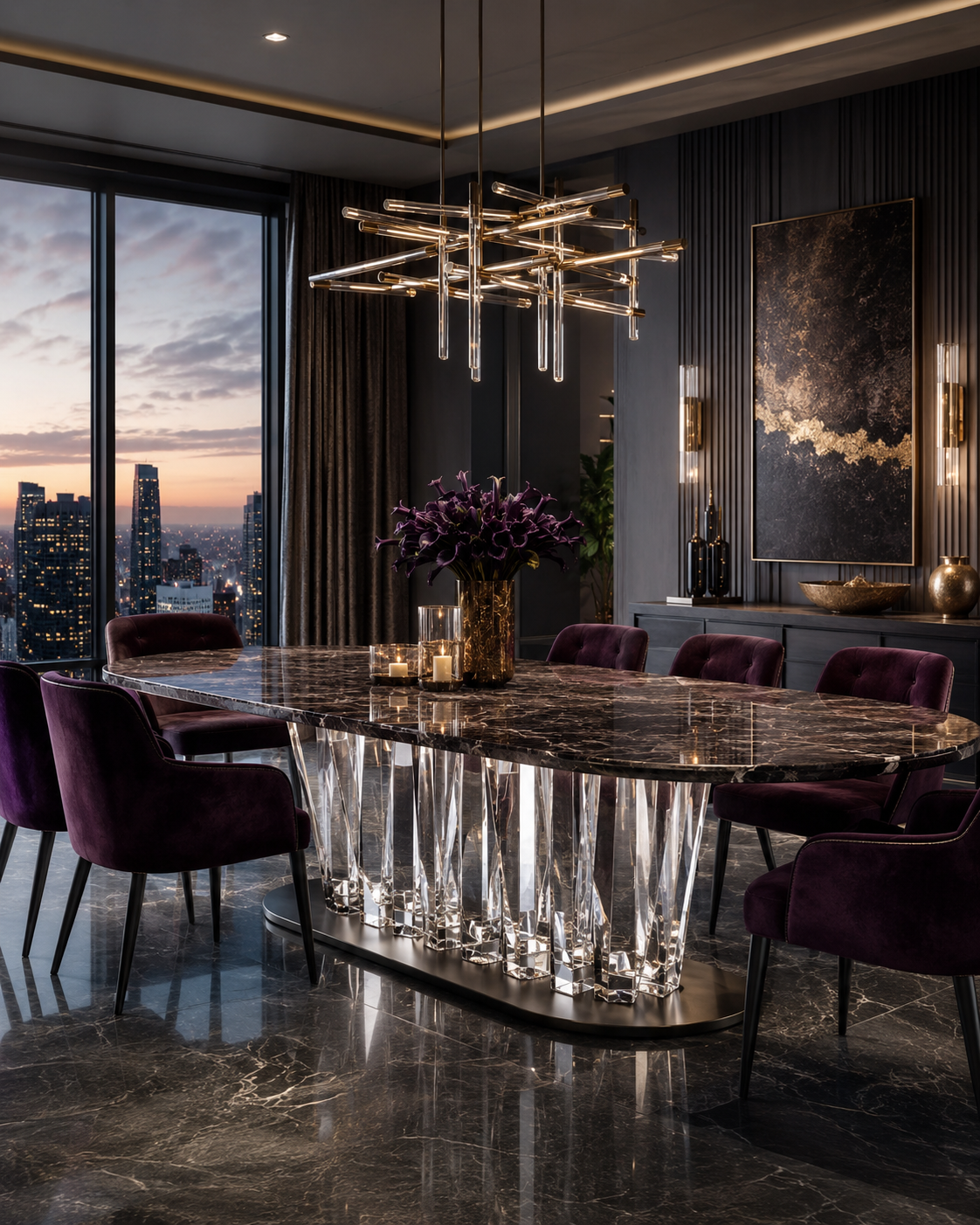
A marble dining top placed over substantial clear platinum acrylic legs appears almost to float. A bronze or stainless-steel element embedded into transparent resin can seem suspended in space. A synthetic crystal base beneath a solid tabletop can give the furniture physical authority without turning the lower half of the room into a visual barrier.
This combination of presence and absence is difficult to achieve with conventional opaque furniture.
It also explains why increasing thickness does not necessarily make transparent furniture feel heavier. In many designs, extra thickness can increase perceived value by creating stronger edges, greater optical depth, and more dramatic interaction with light—without introducing the same visual mass that an equally thick stone form would create.
For high-end clients, that apparent impossibility is part of the luxury.
4. Synthetic Crystal and High-End Resin Turn Transparency Into a Creative Material, Not Just an Invisible One
The most important development in transparent furniture is the move from transparency as neutrality to transparency as expression.
Glass has long been used when designers want a material to visually recede. Synthetic crystal and premium resin allow designers to ask a different question: what if transparency itself becomes the decorative feature?
Design history provides a famous example. Shiro Kuramata's 1988 Miss Blanche Chair, held in the Museum of Modern Art's collection, uses acrylic resin with artificial roses suspended within the transparent body. MoMA identifies the chair as an icon of postmodern design and highlights Kuramata's exploration of transparency through different materials.
The importance of Miss Blanche is not that every resin table should contain flowers. It demonstrates that transparency can carry an idea.
Contemporary resin designers have continued exploring this potential. Architectural Digest has reported on collectible resin furniture that uses pigmentation, translucency, casting, layering, and hand finishing to explore light, color, and depth. Its coverage of the Pompei collection, for example, describes layered resin furniture whose surfaces recalled materials including quartz, porphyry, marble, and onyx. The publication also noted that made-to-order resin furniture can command higher prices because of its customized and collectible character.
For a manufacturer of synthetic crystal and high-end resin furniture, this is where customization becomes commercially valuable.
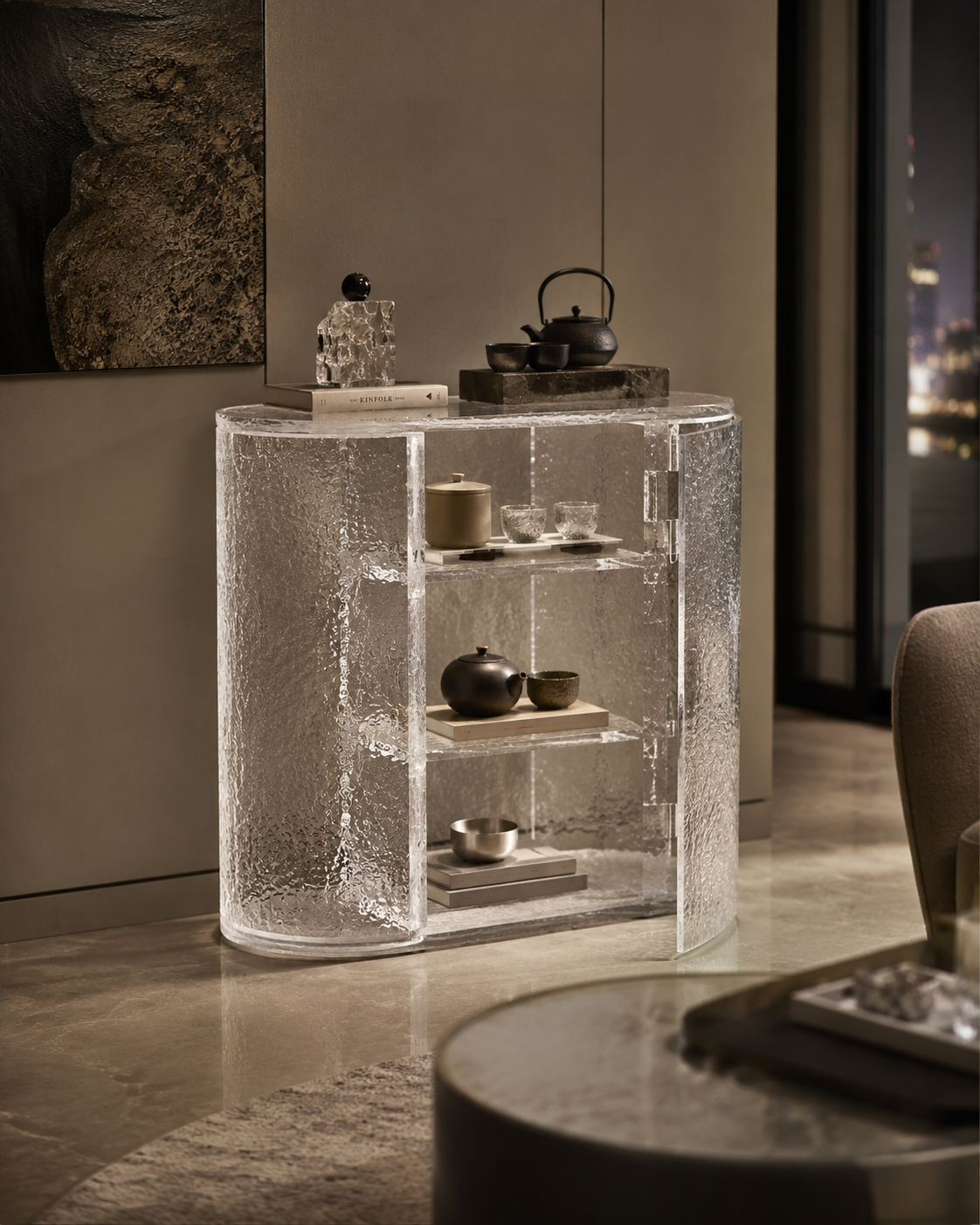
A designer can specify an ice-clear console for a minimalist villa, an amber resin side table for a hospitality lounge, a deep burgundy translucent pedestal for a fashion boutique, or a synthetic-crystal coffee table with controlled clouding designed to resemble frozen water.
Color can be developed through the body rather than simply applied to the surface. Internal effects can create depth. Decorative or metallic elements can appear suspended. Thickness can change the intensity of color.
The result is furniture whose visual value cannot be understood from shape alone.
A rectangular resin table may have the simplest geometry imaginable, yet it can still become the most memorable object in the room because the material changes every time the viewer moves around it.
5. Different High-End Clients Pay for Transparency for Different Reasons
The commercial value of transparent furniture becomes clearer when viewed through actual project types.
A hotel may choose a platinum acrylic side table because a guest room already contains a bed, desk, lounge chair, luggage bench, minibar, and multiple lighting elements. The transparent table performs a function without making the room appear more crowded.
A villa owner may buy a much larger synthetic-crystal coffee table for almost the opposite reason. The goal is not to make the furniture disappear completely. The owner wants a sculptural centerpiece—but one that does not hide an expensive rug, polished stone floor, or panoramic architecture.
A private club may use translucent resin near a bar because warm lighting passing through amber or burgundy material can reinforce the evening atmosphere. A luxury retailer may prefer crystal-clear pedestals because products appear almost unsupported.
In each case, the client pays for “transparency,” but the commercial benefit is different: spatial efficiency, visual continuity, drama, product focus, or atmosphere.
Material choice must still account for practical performance.
For example, glass furniture requires appropriate safety specification. The National Glass Association notes that ASTM F2813 addresses glass used as horizontal surfaces in desks and tables and specifies tempered or laminated safety glass complying with ANSI Z97.1 for covered applications.
Acrylic requires its own care considerations. Architectural Digest's guidance on acrylic furniture notes the importance of avoiding unsuitable cleaning methods and abrasives that can scratch or cloud the material.
Synthetic crystal and resin products likewise vary considerably by formulation. UV resistance, heat behavior, scratch resistance, structural properties, cleaning compatibility, color stability, and repair methods should be documented for the actual product rather than assumed from the generic word “resin.”
Sophisticated clients are therefore not paying for transparency in isolation.
They are paying for transparent performance appropriate to a specific environment.
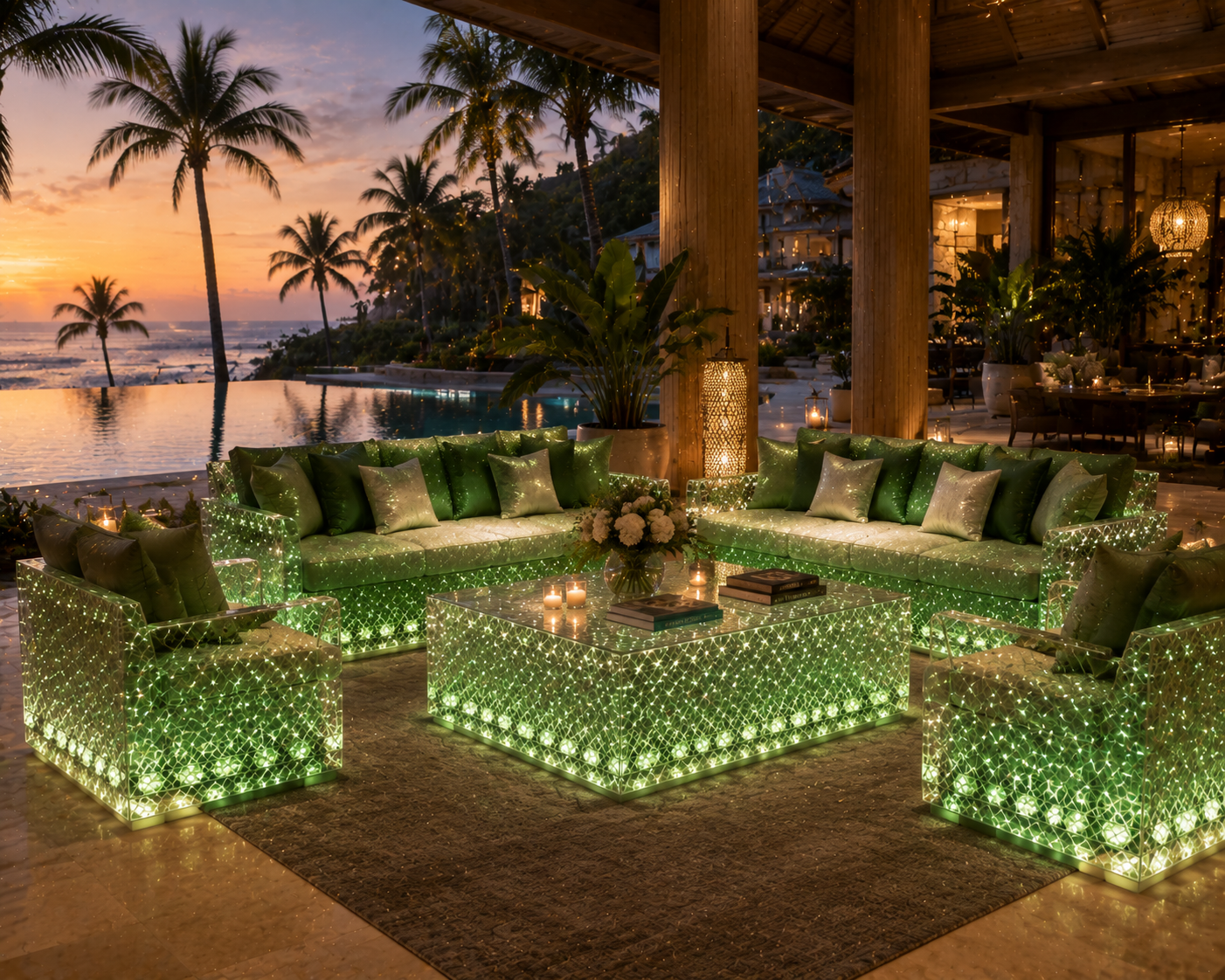
6. In Luxury Furniture, Clarity Makes Manufacturing Quality More Visible—not Less
There is one final reason premium transparent furniture can justify a higher price: transparency is unforgiving.
Opaque materials can conceal part of their construction. Transparent materials reveal it.
A poorly polished edge becomes visible. An uncontrolled bonding line becomes visible. Surface scratches become visible. Internal contamination may become visible. Unintentional bubbles or color variation can become visible. If several transparent components are joined together, the accuracy of those joints influences the entire visual impression.
As a result, the simplest-looking transparent furniture often depends heavily on manufacturing discipline.
For platinum acrylic furniture, quality may be communicated through optical clarity, substantial thickness, color neutrality, precision machining, edge polishing, accurate mitres, discreet bonding, and consistency between components.
For synthetic crystal, the premium impression may depend on internal depth, intentional refraction, controlled inclusions, consistent casting, polished surfaces, and the absence—or deliberate artistic use—of bubbles and irregularities.
For high-end resin, quality can lie in color development, casting control, curing, sanding, polishing, surface uniformity, and the ability to reproduce a designer-approved reference sample.
This is why transparent furniture should never be sold using photographs alone. Professional architects, interior designers, hospitality buyers, and furniture dealers benefit from physical samples, finish references, technical specifications, cleaning guidance, dimensional tolerances, and clear explanations of which visual variations are intentional.
“Platinum acrylic,” like “synthetic crystal,” is not itself a universal scientific material classification. Responsible premium positioning should therefore explain the actual material system being supplied and provide performance information relevant to the application.
When those details are executed well, transparent furniture achieves something few other materials can accomplish.
It can occupy space without closing it.
It can become a centerpiece without visually dominating everything around it.
It can reveal expensive floors, rugs, artwork, and architectural finishes instead of hiding them.
It can transform daylight into changing reflections and turn artificial lighting into atmosphere.
And it can make an extremely simple form feel sophisticated because the visual experience comes from the material itself.
That is ultimately why clients are willing to pay for “transparency.”
They are not paying for the absence of color.
They are paying for space, light, depth, visual freedom, craftsmanship, and the illusion that a solid object can almost escape its own physical weight.
In high-end interiors, that illusion has very real value.
READ MORE:
- Why Do Some Materials Communicate Value at First Sight, Even in Equally High-End Furniture?
- What Counts as a "Good Material" to Hotel, Villa, and Private Club Clients? The Standards Are Completely Different
- Natural Stone, Glass, or Synthetic Crystal? How to Choose the Right Material for High-End Furniture
- The Designer's Eye for "Luxury": Why Furniture Materials Influence the Quality of a Space More Than Form
- Synthetic Crystal Acrylic Furniture: A New Trend Connecting Design Aesthetics with Commercial Value
- Why Future Furniture Brands Need to Rethink the Premium Power of Materials
- Synthetic Crystal Acrylic Furniture: Creating Memorable High-End Spaces Through Unique Transparency
- From Visual Differentiation to Market Competitiveness: The Value Upgrade of Synthetic Crystal Acrylic Furniture
- Synthetic Crystal Acrylic Furniture: Why More High-End Projects Are Paying Attention to This Material


