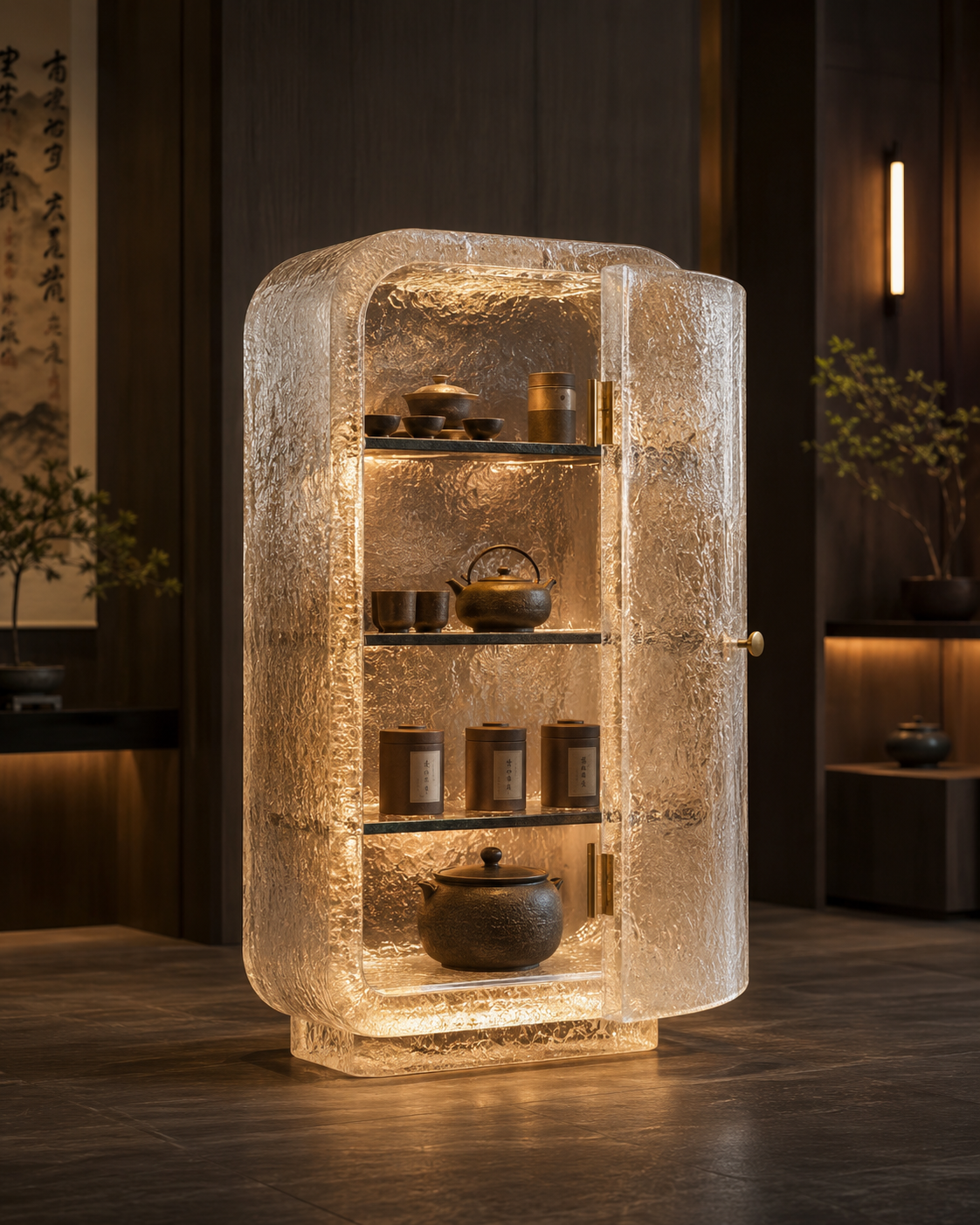
Furniture has traditionally been understood through function.
A table provides a surface. A chair provides seating. A cabinet provides storage. A console fills an architectural gap while offering display space.
For manufacturers, this functional definition has shaped the industry for generations. Materials such as wood, metal, stone, glass, leather, and fabric have been selected primarily according to structural requirements, durability, cost, and decorative appearance.
But contemporary high-end interior design is changing the role of furniture.
Furniture is no longer expected merely to occupy a room and perform a function. In luxury residences, hotels, retail environments, galleries, restaurants, clubs, showrooms, and branded commercial spaces, furniture is increasingly becoming part of the architecture itself.
It influences light.
It organizes movement.
It controls visual weight.
It creates reflections.
It frames views.
It establishes atmosphere.
And in some projects, furniture becomes an artwork within the space.
This transformation creates an important opportunity for synthetic crystal acrylic.
With its high transparency, optical depth, polished surface, flexibility of fabrication, and ability to interact with other materials, acrylic can move far beyond the category of “transparent furniture.”
It can become a spatial medium.
For furniture manufacturers, designers, architects, and luxury brands, this means that synthetic crystal acrylic opens an entirely new field of possibilities.
The question is no longer simply, “What furniture can be made from acrylic?”
The more interesting question is:
What kind of space can be created with acrylic?
1. From Furniture Material to Spatial Design Language
Every material communicates something.
Solid wood often communicates warmth, tradition, craftsmanship, and permanence.
Marble communicates natural luxury, weight, and architectural strength.
Metal can suggest precision, technology, industrial refinement, or glamour depending on its finish.
Glass communicates transparency and modernity.
Synthetic crystal acrylic occupies an unusual position because it can express several qualities at the same time.
It can look visually light while remaining physically substantial.
It can feel modern without appearing cold.
It can disappear into the architecture while simultaneously attracting attention through reflection and refraction.
This duality gives acrylic a unique role in contemporary interior design.
In the past, acrylic was often treated as a substitute material. It was selected because it could imitate some of the transparency of glass while offering easier fabrication.
Today, this understanding is becoming increasingly outdated.
High-quality acrylic furniture is not valuable because it imitates glass.
Its real value comes from characteristics that belong specifically to acrylic.
Thick acrylic sections create visual depth that is difficult to achieve with conventional furniture materials.
Polished edges capture light and can appear almost illuminated.
Large transparent structures can maintain physical volume without introducing the same visual heaviness as wood or stone.
Curved surfaces can create continuous forms that would be difficult or expensive to manufacture using glass.
Acrylic can therefore become a design language rather than simply a construction material.
Consider a luxury hotel lobby.
A traditional console table may be manufactured from wood or metal and positioned against a decorative wall.
It functions as furniture.
A large synthetic crystal acrylic console, however, can produce a different relationship with the space.
Because the wall remains visible through the table, the furniture does not cover the architecture.
If the acrylic is thick and polished, its edges catch light and create subtle optical distortions.
The console exists simultaneously as a practical surface, a transparent volume, and a visual effect.
This is the beginning of spatial art.
The same principle can be applied to coffee tables, benches, dining tables, display stands, shelving systems, reception furniture, partitions, pedestals, and decorative installations.
Instead of asking designers to choose between furniture and decoration, acrylic allows the two categories to merge.
This is particularly relevant to modern luxury design.
Luxury today increasingly depends on atmosphere rather than decoration alone.
Clients do not simply purchase expensive materials. They purchase an experience.
They want a residence to feel calm.
A hotel lobby should feel memorable.
A retail store should communicate brand identity.
A restaurant should create emotional atmosphere.
A gallery should direct attention toward artwork.
Furniture contributes to all of these goals.
Synthetic crystal acrylic gives designers another method of controlling this experience because it occupies physical space without necessarily creating visual blockage.
This characteristic allows acrylic objects to become more closely integrated with architecture.
In this sense, acrylic is not simply placed inside a space.
It participates in the creation of the space.
2. Transparency, Light, and the Creation of Spatial Depth
One of the most important characteristics of synthetic crystal acrylic is its relationship with light.
Most conventional furniture absorbs or blocks light.
A wooden cabinet creates a solid visual mass.
A stone table produces strong shadows.
A fabric sofa interrupts lines of sight.
Transparent acrylic behaves differently.
Light can travel through the material.
It can reflect from polished surfaces.
It can concentrate along edges.
It can create layers of transparency when multiple acrylic elements overlap.
These characteristics allow designers to use furniture as part of the lighting composition of an interior.
During the daytime, natural light can pass through transparent tables, chairs, or partitions.
This helps maintain brightness and spatial continuity.
Near large windows, acrylic furniture preserves views that might otherwise be interrupted by opaque objects.
In a luxury apartment overlooking a city skyline, for example, a transparent console can provide function without blocking the architectural connection between the interior and the exterior.
At night, the same furniture changes character.
Directional lighting can produce highlights along polished edges.
Warm ambient light can create soft reflections inside thick acrylic sections.
Colored lighting can transform clear material into a dynamic visual element.
This means acrylic furniture can have different identities at different times of day.
Few traditional furniture materials provide this level of visual transformation.
Light also affects the perception of depth.
When looking through thick polished acrylic, the viewer may see subtle refraction, reflections, and layered images.
This creates a visual depth that extends beyond the physical dimensions of the object.
A simple block-shaped side table can therefore become more visually complex than its geometry suggests.
Designers can use this characteristic intentionally.
For example, several transparent acrylic pedestals positioned at different heights can create a layered installation.
Objects placed on the pedestals appear to float.
Reflections overlap.
The floor remains visible.
Light moves through the composition.
The installation feels lighter than a conventional solid display system, even though it may occupy a similar amount of physical space.
This is particularly useful in luxury retail.
Premium fashion, jewelry, cosmetics, watches, accessories, and collectible objects require display environments that enhance products without distracting from them.
Transparent acrylic allows the support structure to visually recede.
The merchandise becomes the focus.
At the same time, the crystal-like quality of the material reinforces the perception of precision and value.
Lighting can further enhance this effect.
Integrated LED systems can illuminate acrylic edges.
Light sources can be hidden beneath or behind transparent structures.
Acrylic panels can guide or diffuse light depending on their thickness, surface treatment, and geometry.
This creates opportunities for furniture manufacturers to collaborate more closely with lighting designers.
A table is no longer just a table.
It can also become a lighting feature.
A display plinth can become a luminous object.
A reception counter can become a transparent architectural installation.
A partition can organize movement while simultaneously creating reflected light.
These applications demonstrate an important shift.
The value of synthetic crystal acrylic is not limited to what the material looks like.
Its value lies in what it allows designers to do with the surrounding environment.
_(1).png)
3. Breaking the Boundaries of Traditional Furniture Forms
Traditional furniture manufacturing is strongly influenced by material limitations.
Wood is usually cut, joined, carved, laminated, or bent within certain structural constraints.
Stone is heavy and requires significant support.
Glass offers transparency but introduces limitations related to cutting, tempering, bending, edge treatment, and impact resistance.
Metal offers excellent structural possibilities but remains visually opaque.
Synthetic crystal acrylic provides a different combination of properties.
It can be cut.
It can be CNC machined.
It can be polished.
It can be heat formed.
It can be bonded.
It can be drilled.
It can be engraved.
It can be combined in different thicknesses.
This versatility significantly expands the vocabulary available to furniture designers.
A traditional table is usually understood as a horizontal surface supported by legs or a base.
Acrylic allows designers to rethink this structure.
The support may become part of the visual composition.
A continuous curved acrylic sheet can form both the top and sides.
Thick transparent blocks can support a floating surface.
Geometric acrylic sections can intersect to create sculptural bases.
Transparent layers can create the illusion that furniture is suspended.
The distinction between structure and decoration begins to disappear.
Chairs offer similar possibilities.
A conventional chair clearly separates legs, seat, back, and supporting frame.
An acrylic chair can be designed as a continuous transparent form.
It may combine a sculptural acrylic shell with leather upholstery.
It may use thick transparent side structures with a floating upholstered seat.
It may incorporate metal details inside transparent components.
These possibilities allow designers to create furniture that is difficult to categorize using traditional typologies.
The same applies to shelving.
A traditional bookcase creates a strong grid on a wall.
An acrylic shelving system can preserve the visibility of wall materials behind it.
Objects appear suspended.
The shelves become less dominant.
This can be extremely valuable when the background itself is important.
Imagine a luxury residence with a highly patterned natural stone wall.
An opaque cabinet would cover a significant portion of that stone.
Transparent shelving allows the stone to remain part of the visual composition.
Furniture and architecture can occupy the same visual layer.
This ability to preserve background materials is one of acrylic's strongest advantages in bespoke interior projects.
It allows furniture to become less visually territorial.
Instead of claiming a section of the room for itself, the furniture can share that visual territory with architecture, art, flooring, lighting, or decorative surfaces.
For designers, this creates enormous freedom.
For manufacturers, however, it also introduces new technical challenges.
Simple transparent furniture is easy to imagine but difficult to execute at a genuinely high level.
Any imperfection can become visible.
Poor bonding can immediately reduce the perceived quality.
Scratches are easy to detect.
Inconsistent polishing becomes obvious under strong light.
Incorrect proportions can make a transparent object appear cheap rather than refined.
This means high-end acrylic furniture requires precision.
The transparency that makes the material beautiful also exposes manufacturing quality.
Edges must be properly finished.
Connections must be carefully designed.
Surfaces must remain clean.
Structural calculations must account for load and long-term performance.
The manufacturing process therefore becomes part of the design.
This is another reason premium acrylic furniture can move closer to art.
It requires not only fabrication, but disciplined craftsmanship.
4. The Fusion of Acrylic with Metal, Stone, Wood, and Upholstery
One of the most exciting directions in contemporary acrylic furniture is material combination.
Transparent furniture does not need to be completely transparent.
In many cases, acrylic becomes even more powerful when combined with contrasting materials.
The contrast between transparency and solidity creates visual tension.
This tension can make furniture feel more sophisticated.
Acrylic and Metal
Metal and acrylic create a natural partnership.
Polished stainless steel, brushed stainless steel, brass, bronze, chrome, and blackened metal can all be combined with transparent acrylic.
Metal introduces precision and structural definition.
Acrylic introduces lightness.
A transparent console with polished metal connectors can feel architectural.
An acrylic chair with brass details can combine contemporary transparency with traditional luxury.
A display table with stainless steel elements can communicate technological refinement.
Because the two materials respond differently to light, their combination creates visual complexity.
Metal reflects from its surface.
Acrylic reflects and transmits.
The resulting furniture changes as the viewer moves around it.
Acrylic and Stone
Stone introduces weight, texture, and natural variation.
Acrylic creates almost the opposite effect.
This makes the combination highly expressive.
A marble tabletop supported by transparent acrylic legs can appear to float.
A stone block integrated into an acrylic console can look suspended inside a crystal structure.
Natural stone shelves can be paired with clear acrylic supports to reduce visual heaviness.
This contrast is especially effective in luxury interiors.
The stone communicates permanence.
The acrylic communicates lightness.
Together they create balance.
Acrylic and Wood
Wood brings warmth to acrylic.
This can be particularly useful in residential environments where completely transparent furniture might otherwise appear too cold.
A clear acrylic table with a natural wood insert can combine contemporary clarity with organic warmth.
Transparent chair structures can support wooden seats.
Acrylic shelving can be integrated into timber cabinetry.
The result creates a dialogue between traditional craftsmanship and modern material technology.
Acrylic and Upholstery
Seating furniture provides another important opportunity.
Acrylic chair frames can be combined with leather, velvet, bouclé, woven fabric, or other premium upholstery.
The transparent frame reduces visual weight while the textile adds comfort and softness.
This combination is highly suitable for luxury dining chairs, accent chairs, benches, dressing stools, and hotel seating.
In many cases, the acrylic becomes almost invisible.
The upholstered seat appears to float inside the room.
This visual illusion gives conventional furniture types a new character.
Acrylic and Decorative Inserts
Acrylic can also be used as a transparent container for other visual elements.
Designers can experiment with decorative films, fabrics, metallic components, pigments, lighting, natural materials, or sculptural inserts.
This approach transforms acrylic from a surface material into a three-dimensional framing device.
Objects can appear suspended within transparent forms.
Layers can be built inside the material composition.
This creates opportunities for highly customized furniture.
For luxury brands, it also allows furniture to carry distinctive visual signatures.
A hotel group could develop a specific acrylic-and-metal language.
A fashion brand could integrate color or pattern into transparent retail fixtures.
A residential designer could create one-of-a-kind furniture pieces that repeat architectural materials found elsewhere in the house.
The possibilities extend far beyond clear tables and chairs.
5. From Functional Furniture to Sculptural Installations
Perhaps the most important change created by synthetic crystal acrylic is the disappearance of the traditional boundary between furniture and art.
Historically, furniture and sculpture have been treated as separate categories.
Furniture must function.
Sculpture may exist purely for visual expression.
Contemporary design increasingly combines these two ideas.
A coffee table can function as a usable surface while also acting as the visual centerpiece of a room.
A reception desk can perform an operational role while becoming an architectural landmark.
A retail display can hold merchandise while simultaneously creating a branded installation.
Acrylic is particularly well suited to this hybrid category.
Its transparency allows designers to create large volumes without overwhelming the environment.
Imagine a massive sculptural table made entirely from dark wood.
Its visual presence would be strong.
The same volume executed in clear acrylic could remain dramatic while appearing significantly lighter.
This gives designers permission to explore larger and more unusual forms.
Scale becomes less threatening.
Acrylic can therefore support furniture that behaves like installation art.
In a hotel lobby, several oversized acrylic blocks could form both seating and sculpture.
In a retail environment, transparent platforms could create a floating landscape for products.
In a gallery, acrylic benches could disappear visually while still organizing visitor movement.
In a luxury residence, a sculptural transparent staircase-side console could become part of the architectural composition.
These objects are functional, but their value does not come from function alone.
They create atmosphere.
This distinction is important for manufacturers.
Traditional manufacturing often focuses on producing repeatable products.
Spatial art requires a project-based mentality.
Every interior may require different dimensions.
Different thicknesses.
Different structural solutions.
Different combinations of materials.
Different lighting conditions.
Different installation methods.
The furniture manufacturer therefore becomes more than a factory.
The manufacturer becomes a technical partner in the design process.
This can involve reviewing drawings with architects.
Testing acrylic thickness.
Developing bonding methods.
Solving structural challenges.
Coordinating with metal fabricators.
Integrating electrical components.
Developing packaging for oversized transparent pieces.
Planning installation in restricted spaces.
The closer furniture moves toward architectural installation, the more collaboration becomes necessary.
This represents a major opportunity for specialized acrylic manufacturers.
Companies that can combine engineering, craftsmanship, design interpretation, and project management can move beyond price competition.
They are no longer selling only acrylic products.
They are selling technical realization.
That is a very different position in the market.
_(1).png)
6. New Opportunities for Custom Furniture Manufacturers and Designers
The evolution from furniture manufacturing to spatial art creates new opportunities across several premium markets.
Luxury Residential Projects
High-net-worth residential clients increasingly seek customized interiors.
They do not want their homes to look identical to retail showrooms.
They want furniture that fits specific architecture, collections, lifestyles, and personal tastes.
Synthetic crystal acrylic is well suited to this demand.
Custom coffee tables can be designed around a particular sofa arrangement.
Transparent consoles can match architectural dimensions.
Display pedestals can be created for art collections.
Dining tables can combine acrylic bases with custom stone tops.
Acrylic furniture can therefore participate in highly personalized interior schemes.
Hospitality
Hotels need memorable visual experiences.
A guest may forget the specification of a chair, but they often remember a dramatic lobby, a distinctive bar, or an unusual suite.
Acrylic can help create these memorable moments.
Transparent reception desks, sculptural lobby tables, illuminated partitions, bar elements, and decorative furniture can become visual signatures.
For boutique hotels especially, distinctive design can be part of the brand itself.
This creates opportunities for bespoke manufacturers capable of producing small quantities of high-value pieces.
Luxury Retail
Retail is becoming increasingly experiential.
Physical stores must offer something that digital shopping cannot provide.
Interior design therefore plays a greater role.
Brands use materials, lighting, furniture, and installations to create immersive environments.
Acrylic is highly suitable for this application because it can support merchandise without visually dominating it.
It can also be customized according to brand colors, geometry, lighting concepts, and display strategies.
For furniture manufacturers, luxury retail offers recurring project opportunities.
Brands regularly open new stores, redesign existing locations, launch temporary exhibitions, and create seasonal installations.
This creates demand for flexible custom production.
Galleries and Cultural Spaces
Museums, exhibitions, art fairs, and galleries require display systems that respect the visual importance of objects.
Transparent acrylic is frequently suitable for these applications.
It can create pedestals, protective enclosures, benches, display platforms, and interpretive structures.
The challenge is precision.
In these environments, furniture must often appear almost invisible.
This requires excellent workmanship.
Restaurants, Clubs, and Entertainment Spaces
Hospitality venues often use dramatic lighting and strong visual concepts.
Acrylic works particularly well in these settings.
Transparent bar furniture can interact with colored lighting.
Acrylic tables can reflect decorative illumination.
Integrated LED elements can transform furniture throughout the evening.
Curved acrylic structures can create futuristic or glamorous environments.
Here, furniture becomes part of the entertainment experience.
Corporate and Branded Interiors
Corporate spaces are also becoming more expressive.
Reception areas, showrooms, experience centers, and executive offices increasingly communicate brand identity through interior design.
Custom acrylic furniture can support this objective.
A transparent reception desk can incorporate branding.
Acrylic display installations can present products.
Meeting tables can combine clear bases with high-end materials.
Sculptural furniture can create memorable visitor experiences.
For manufacturers, these projects require a shift in thinking.
Success will increasingly depend not only on manufacturing capacity, but also on design understanding.
Clients may arrive with conceptual drawings rather than production-ready plans.
Manufacturers must be able to interpret these concepts and propose technically realistic solutions.
This creates a new role for the factory.
It becomes part of the creative process.
Conclusion: Acrylic Is Expanding the Definition of Furniture
Synthetic crystal acrylic is changing the way designers and manufacturers think about furniture.
Its importance does not come simply from transparency.
It comes from the interaction between transparency, structure, light, material contrast, craftsmanship, and spatial experience.
Acrylic can make large furniture feel visually lighter.
It can preserve architectural views.
It can interact with lighting.
It can create optical depth.
It can combine with stone, metal, wood, and upholstery.
It can support unusual geometries.
It can transform display furniture into branded installations.
It can turn a functional object into a sculptural centerpiece.
Most importantly, it allows furniture to participate more actively in the creation of space.
This represents a fundamental change.
The traditional furniture industry asks:
What should we manufacture?
The emerging custom design industry asks:
What experience should this object create?
The first question focuses on products.
The second focuses on space, emotion, and identity.
For synthetic crystal acrylic manufacturers, this shift creates enormous potential.
Companies that continue to treat acrylic simply as a transparent sheet material may remain limited to conventional furniture and display products.
Companies that understand its architectural and artistic possibilities can enter a very different market.
They can collaborate with interior designers.
They can work with architects.
They can serve luxury residential projects.
They can create installations for hotels.
They can manufacture display systems for global brands.
They can develop sculptural furniture for galleries, restaurants, clubs, and experience centers.
They can move from supplying products to realizing ideas.
That transformation is where the greatest opportunity lies.
Synthetic crystal acrylic does not need to replace wood, stone, glass, metal, or upholstery.
Its future may be even more interesting when it interacts with them.
Transparency can frame solid materials.
Light can animate furniture.
Furniture can become architecture.
Manufacturing can become craftsmanship.
And craftsmanship can become spatial art.
This is the new possibility created by synthetic crystal acrylic.
READ MORE:
- How Can a Design Rendering Become Reality? The Critical Role of Synthetic Crystal Furniture in Connecting Design and Construction
- The Material Selection Challenge in High-End Interior Design: Why Transparent Crystal Furniture Is Becoming a New Choice for Designers
- From Sample Approval to Mass Production: How Synthetic Crystal Furniture Can Make Project Delivery Smoother
- How to Avoid Repeated Material Revisions in Hotel and Commercial Space Projects
- Why More High-End Projects Are Building Unified Material Selection Standards: A New Solution with Synthetic Crystal Furniture
- Synthetic Crystal Acrylic Furniture: A New Breakthrough for High-End Brand Differentiation
- Why Are More Designers Seeing Synthetic Crystal Acrylic as a Material of the Future?
- Synthetic Crystal Acrylic Furniture: How Can Products Gain Stronger Visual Competitiveness?
- Synthetic Crystal Acrylic Furniture: Why Do High-End Spaces Increasingly Need a Sense of “Light Luxury Transparency”?


