In today’s furniture market, quality alone is no longer enough.
A product may be well manufactured, structurally reliable, and functionally useful, yet still struggle to attract attention if it does not create a memorable visual impression.
This is particularly true in the premium furniture market.
Interior designers, hotel developers, luxury retailers, architects, property developers, and high-end residential clients are surrounded by an enormous number of furniture choices. They see countless coffee tables, chairs, consoles, benches, side tables, display pedestals, and decorative furniture pieces every year.
As a result, one important question is becoming increasingly significant:
Why should a designer remember one product instead of another?
Visual competitiveness provides part of the answer.
For synthetic crystal acrylic furniture, this creates a major opportunity.
High-quality acrylic already possesses several characteristics that naturally attract attention: transparency, optical depth, polished edges, light reflection, visual lightness, and strong compatibility with other premium materials.
However, simply making furniture transparent does not automatically make it competitive.
As acrylic furniture becomes more common, manufacturers and designers must go further.
They must transform transparency into identity.
They must use proportion, geometry, material contrast, craftsmanship, lighting, and customization to create products that are recognizable, distinctive, and difficult to replace.
The future of premium synthetic crystal acrylic furniture will not be determined only by who can manufacture clear tables or chairs.
It will increasingly depend on who can create products with stronger visual personality.
1. Visual Competition Has Become a Core Part of Furniture Value
Furniture has always had both functional and decorative value.
However, in the contemporary premium market, visual value has become more commercially important.
A luxury hotel does not simply purchase a lobby table because guests need somewhere to place an object.
The hotel chooses a table because it contributes to the atmosphere of the lobby.
A fashion boutique does not select a display pedestal only because it can support merchandise.
The pedestal must also reinforce the identity of the brand.
A designer working on a luxury residence does not select a coffee table only according to dimensions.
The table must relate to the sofa, carpet, architecture, artwork, lighting, and overall visual concept.
In all of these situations, furniture is part of a larger experience.
This means visual competitiveness affects purchasing decisions.
A product that looks ordinary may be technically acceptable but commercially weak.
A product that creates immediate recognition can become a focal point within a project.
This distinction is especially important for custom and premium furniture manufacturers.
Mass-market furniture often competes through price, convenience, distribution, and standard functionality.
High-end furniture competes differently.
It competes through design.
It competes through materials.
It competes through craftsmanship.
It competes through exclusivity.
And increasingly, it competes through visual memorability.
Synthetic crystal acrylic has a strong natural advantage in this environment because it does not behave visually like traditional opaque furniture.
A wooden table blocks the view behind it.
A stone base creates visual weight.
A conventional metal frame produces a defined structural silhouette.
Transparent acrylic can occupy the same physical volume while creating a completely different perception.
The eye sees through it.
The floor continues beneath it.
The wall remains visible.
Light enters the material.
Edges glow under illumination.
Reflections change according to viewing angle.
This allows acrylic furniture to create a strong impression without necessarily using decorative complexity.
That is important.
Visual competitiveness does not always mean making a product louder.
Sometimes, the most powerful product in a room is the one that looks unusually simple.
A thick transparent acrylic coffee table with perfect proportions and highly polished edges may be visually stronger than a heavily decorated table because the material itself creates the experience.
The product looks effortless.
But behind that apparent simplicity is precision.
In premium furniture, simplicity often magnifies quality.
Every proportion becomes visible.
Every connection matters.
Every edge matters.
Every surface matters.
This means synthetic crystal acrylic furniture has the potential to compete not through ornament, but through controlled visual clarity.
2. Transparency as a Tool for Creating Stronger Visual Impact
Transparency is the most recognizable characteristic of acrylic furniture, but its real design potential is deeper than simple visibility.
A transparent object changes how people perceive space.
When furniture is opaque, the viewer sees the external surface.
When furniture is transparent, the viewer sees the external surface, internal depth, background, reflections, and surrounding environment simultaneously.
This creates multiple visual layers.
Acrylic therefore behaves differently from many conventional furniture materials.
Consider a transparent acrylic side table.
At first glance, the geometry may appear simple.
But as a person walks around it, reflections shift.
The floor pattern moves visually through the object.
Light catches different edges.
Nearby colors influence the appearance of the acrylic.
The table does not have one fixed visual identity.
It interacts with its surroundings.
This gives designers an opportunity to create products that remain visually interesting without excessive decoration.
Optical Depth
Thick acrylic is especially effective.
A thin clear panel may appear functional and lightweight.
A thick polished acrylic section can look far more substantial and luxurious.
The difference is not simply structural.
Thickness creates optical depth.
Light travels through a larger volume of material.
Edges become more pronounced.
Refraction becomes more noticeable.
The object begins to resemble a solid block of synthetic crystal rather than a transparent sheet.
This is one of the most important ways to improve visual competitiveness.
Manufacturers that rely only on thin acrylic panels may produce practical furniture, but they often miss the sculptural potential of the material.
Premium products can use thickness as a design feature.
A thick coffee table base can become the centerpiece of the product.
A substantial acrylic chair arm can look like a polished crystal element.
A thick console support can create a strong visual anchor while remaining transparent.
Reflection
Reflection also contributes to visual impact.
Highly polished acrylic surfaces interact with natural light, spotlights, decorative fixtures, windows, and surrounding materials.
This makes the furniture visually dynamic.
A product may appear understated in soft daylight and more dramatic under focused evening illumination.
This transformation is valuable in hospitality and retail environments.
Hotel lobbies and boutiques often use sophisticated lighting systems.
Furniture that responds to lighting can become part of the overall design composition.
Refraction
Refraction adds another level of complexity.
When light passes through thick acrylic, the surrounding environment can appear subtly shifted or distorted.
Designers can use geometry to enhance this effect.
Faceted forms, angled edges, layered transparent components, and overlapping structures can create interesting optical experiences.
The result is furniture that attracts attention not because it is excessively decorated, but because the eye continues to discover different visual effects.
Transparency and Negative Space
Another powerful strategy is the use of negative space.
Traditional furniture often focuses on the visible material.
Acrylic furniture can make the empty space inside or around the object equally important.
A console with a transparent geometric frame may appear to draw shapes in the air.
Acrylic table legs can visually disappear, making the tabletop seem suspended.
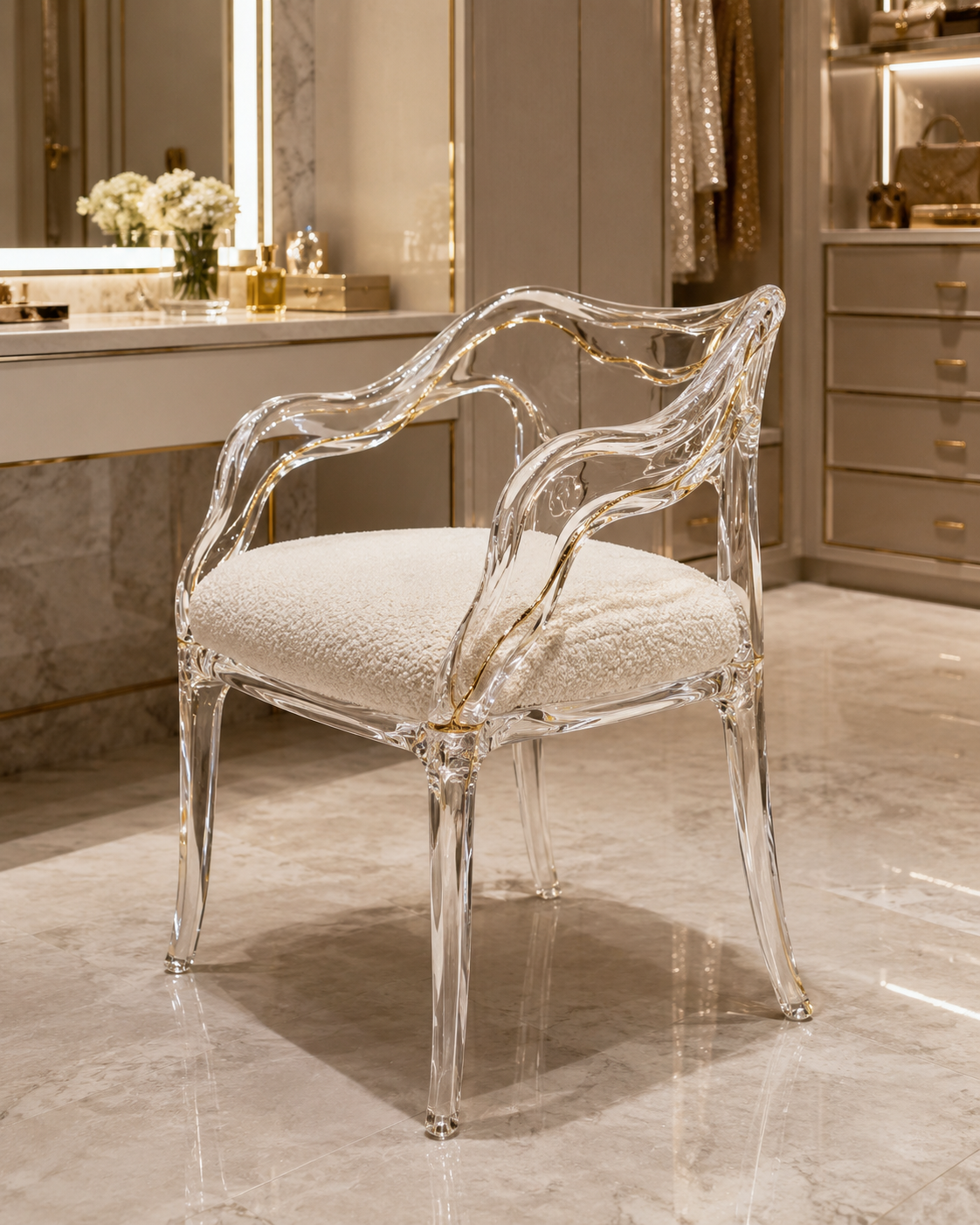
A chair can create the impression that the upholstered seat is floating.
These effects increase visual interest while maintaining elegance.
For high-end spaces, this balance is highly desirable.
The furniture can be memorable without making the room feel crowded.
_(1).png)
3. Using Form, Proportion, and Thickness to Build Product Identity
Material alone does not create a strong product.
Two manufacturers can use similar acrylic and produce completely different levels of visual quality.
The difference often comes from form and proportion.
This is where design discipline becomes essential.
Proportion Creates Perceived Value
People may not consciously analyze proportion, but they react to it immediately.
A table that is too thin may look inexpensive.
A base that is too heavy may make transparent furniture feel awkward.
A chair with incorrect visual balance can appear unstable even when it is structurally safe.
Premium products require careful proportion.
Thickness must relate to scale.
The size of the furniture must relate to the visual weight of the acrylic.
Transparent materials can support unusually substantial dimensions because they do not create the same visual heaviness as opaque materials.
This creates an opportunity.
Designers can exaggerate certain elements.
An oversized transparent leg may look sculptural rather than bulky.
A thick acrylic slab can create a dramatic edge while still allowing light to pass through.
A substantial base can make a dining table feel luxurious without visually closing the room.
These proportions can become recognizable signatures.
Geometry Creates Identity
Many inexpensive acrylic products use basic rectangular construction because it is efficient.
There is nothing inherently wrong with simple geometry.
However, if every product uses the same rectangular panels and straightforward joints, it becomes difficult to build differentiation.
Premium acrylic furniture can explore more distinctive geometry.
Soft curves can create a fluid aesthetic.
Faceted surfaces can produce stronger refraction.
Interlocking acrylic blocks can create architectural forms.
Asymmetrical bases can introduce tension.
Layered structures can generate depth.
Rounded edges can soften a large volume.
One-piece bent forms can create visual continuity.
The goal is not complexity for its own sake.
The goal is recognition.
A successful furniture collection should develop a visual language.
When someone sees the product, they should be able to connect it with a particular design philosophy or brand.
Edge Design Matters
Edges are extremely important in transparent furniture.
With opaque furniture, edge construction can sometimes disappear visually.
With acrylic, edges are often highlighted by light.
This makes edge treatment part of the design.
A sharp polished edge creates precision.
A wide bevel creates additional reflections.
A rounded edge creates softness.
A faceted edge can produce a jewelry-like effect.
A manufacturer can use edge treatments to differentiate products without changing the basic structure dramatically.
This is especially useful when developing collections.
A repeated bevel angle or edge profile can become a signature detail across tables, consoles, benches, and display pieces.
Connections Should Be Designed, Not Hidden Poorly
Transparent furniture also exposes construction.
This creates both a challenge and an opportunity.
Weak joints, bubbles, visible adhesive, scratches, and inconsistent polishing immediately reduce the perceived value of the product.
Customers may not understand the manufacturing process, but they recognize poor finishing.
In contrast, precise connections reinforce the impression of quality.
Some designs should aim to make joints nearly invisible.
Other designs can intentionally celebrate connections by combining acrylic with metal components.
A polished brass connector, for example, can become a decorative accent.
A stainless steel joint can provide an architectural character.
The important principle is intention.
Nothing should look accidental.
4. Combining Acrylic with Premium Materials for Greater Contrast
One of the most effective ways to improve the visual competitiveness of synthetic crystal acrylic furniture is through material contrast.
Acrylic is visually light, smooth, transparent, and technologically refined.
When combined with materials that possess opposite characteristics, both materials become more noticeable.
Acrylic and Marble
Marble is heavy, opaque, natural, textured, and visually permanent.
Acrylic is transparent, light, smooth, and visually fluid.
The contrast is powerful.
A marble tabletop supported by thick transparent acrylic legs can appear to float.
The stone becomes visually more dramatic because the support is less visible.
At the same time, the acrylic gains luxury associations from the natural stone.
This combination is particularly suitable for console tables, dining tables, side tables, and display furniture.
Designers can select marble according to the desired mood.
White marble creates brightness.
Dark marble increases drama.
Strong natural veining creates artistic contrast with the clarity of acrylic.
Acrylic and Metal
Metal can introduce structure, color, reflection, and precision.
Brass brings warmth and luxury.
Polished stainless steel creates a clean contemporary effect.
Black metal provides graphic contrast.
Bronze can introduce sophistication.
Metal components can be used in legs, joints, decorative inserts, frames, handles, or structural supports.
The visual relationship between acrylic and metal can be especially effective because both materials respond strongly to light.
The metal reflects at the surface.
The acrylic transmits and refracts.
This creates visual movement as the viewer changes position.
Acrylic and Wood
Wood can prevent transparent furniture from feeling too cold or technical.
Natural grain introduces organic detail.
Warm timber tones create contrast with the optical clarity of acrylic.
A wood cabinet supported by transparent acrylic legs can appear lighter.
A wooden tabletop on an acrylic base can combine familiarity with contemporary design.
Transparent shelves can be integrated into timber systems.
These combinations are useful in luxury residences, where designers often want modernity without sacrificing warmth.
Acrylic and Upholstery
Transparent frames combined with upholstery create some of the strongest visual opportunities in seating.
Imagine a dining chair with substantial clear acrylic side frames and a soft upholstered seat.
The transparent structure reduces visual mass.
The fabric appears suspended.
If a high-quality textile, velvet, leather, or bouclé is used, the contrast between softness and clarity creates an immediate premium effect.
Color can also become more powerful.
A deep blue cushion looks more dramatic when surrounded by transparency.
A neutral cream seat creates quiet elegance.
A vivid red upholstered element can appear almost like an artwork floating inside the structure.
Acrylic and Lighting
Lighting may be one of the most underused combinations.
LED systems can be integrated into acrylic bases, shelves, pedestals, and decorative structures.
The goal should not always be obvious illumination.
Subtle edge lighting can be more sophisticated.
A concealed light source can create a glow through thick acrylic.
Acrylic can also interact with ambient lighting without containing any electrical system.
For furniture manufacturers working with hotels, bars, luxury retail stores, exhibitions, and entertainment spaces, this interaction with lighting can create highly distinctive products.
The strongest designs often use contrast deliberately.
Hard and soft.
Transparent and solid.
Warm and cool.
Natural and synthetic.
Heavy and light.
When these contrasts are carefully controlled, furniture becomes more visually memorable.
5. Creating Signature Products Instead of Generic Transparent Furniture
As acrylic furniture becomes more widely available, one challenge becomes unavoidable:
Transparency itself is no longer enough to create differentiation.
If ten manufacturers produce similar transparent coffee tables, the market will compare them according to price.
This creates a weak competitive position.
The solution is to develop signature products.
A signature product has an identifiable idea.
It may use a particular geometry.
A particular thickness.
A distinctive combination of materials.
An unusual structural solution.
A recognizable edge treatment.
A repeated proportion.
A specific color system.
A sculptural concept.
The most important point is that the product should not feel interchangeable.
Develop a Design Language
Strong furniture brands usually have a visual language.
A collection may be recognized by curved forms.
Another may focus on architectural geometry.
Another may use oversized transparent volumes.
Another may combine clear acrylic with metal in a consistent way.
This language creates continuity across multiple products.
A coffee table, console, bench, and side table do not need to look identical.
They should feel related.
For manufacturers, this approach creates a major advantage.
Instead of selling isolated products, they can present a collection.
Collections are easier for designers to specify because they demonstrate a complete design direction.
Use Customization Strategically
Customization can also strengthen competitiveness.
However, customization should not mean that every product begins from zero.
The strongest approach combines a recognizable base design with flexible options.
Clients may choose dimensions.
They may choose acrylic thickness.
They may select metal finishes.
They may select stone.
They may specify upholstery.
They may request tinted acrylic.
They may adjust proportions for a particular project.
This creates exclusivity while maintaining manufacturing efficiency.
For luxury projects, this flexibility is extremely valuable.
Interior designers often find products they like but need changes to fit a specific space.
A manufacturer capable of modifying dimensions and materials while preserving the original design identity becomes a stronger project partner.
Avoid Competing Only on Transparency
The phrase “acrylic furniture” can describe an enormous range of products.
Some are simple and inexpensive.
Others require high-level engineering and finishing.
Manufacturers seeking premium positioning must communicate the difference.
The product should show it visually.
Thickness, clarity, polished edges, precise bonding, complex geometry, mixed materials, and custom craftsmanship can all help separate premium synthetic crystal acrylic furniture from generic transparent furniture.
Photography also matters.
Acrylic is difficult to photograph well.
Poor photography can make an expensive product look ordinary.
Professional product images should demonstrate edge clarity, material thickness, reflection, and spatial context.
Lifestyle photography is especially important.
A transparent table photographed alone against a white background may show the shape, but not the full spatial effect.
Placed in a luxury interior, the product can demonstrate how it interacts with rugs, stone, artwork, lighting, and architecture.
Visual competitiveness must therefore continue beyond manufacturing.
It must also influence presentation and marketing.
_(1).png)
6. Turning Visual Advantage into Commercial Competitiveness
Strong visual design becomes most valuable when it creates commercial opportunity.
Synthetic crystal acrylic furniture can use visual differentiation to enter markets where design matters more than low price.
Interior Designers
Interior designers constantly search for products that help distinguish their projects.
If an acrylic furniture manufacturer offers original designs, custom dimensions, sophisticated material combinations, and reliable technical execution, the company becomes more useful to designers.
The relationship changes.
Instead of asking, “How much does this table cost?”
The discussion becomes, “Can this concept be adapted for our project?”
That is a much stronger commercial position.
Luxury Hotels
Hotels need furniture that contributes to memorable guest experiences.
Lobbies, suites, restaurants, bars, lounges, and VIP spaces offer opportunities for statement acrylic furniture.
A visually distinctive table or installation may become part of the identity of the space.
Hotels also require customization.
Dimensions, materials, durability, and installation conditions often differ from standard retail furniture.
Manufacturers capable of combining design with project execution can develop long-term relationships with hospitality clients.
Luxury Retail
Retail brands need environments that photograph well and attract attention both offline and online.
A visually distinctive acrylic installation can become part of social media content, campaign imagery, or customer experience.
Transparent display furniture is particularly valuable because it supports products without overwhelming them.
For fashion, cosmetics, jewelry, watches, and accessories, this is a significant advantage.
High-End Residential Projects
Luxury homeowners increasingly look for unique pieces.
They may prefer furniture that cannot be found in ordinary retail stores.
Custom synthetic crystal acrylic furniture can satisfy this demand.
Statement coffee tables, dining tables, consoles, benches, and display systems can be designed around a particular residence.
The visual lightness of acrylic is also useful in premium apartments where valuable floor materials, carpets, artworks, and views should remain visible.
Showrooms and Brand Experience Centers
Corporate showrooms and experience centers represent another growing opportunity.
Companies want physical spaces that communicate innovation.
Acrylic can create a technological, contemporary, and premium atmosphere.
Transparent display platforms, illuminated furniture, sculptural reception elements, and customized installations can reinforce brand identity.
Social Media and Digital Marketing
Visual competitiveness also matters online.
Furniture purchasing is increasingly influenced by images.
Designers save references.
Architects create digital mood boards.
Clients discover products through social media.
A visually distinctive acrylic product is more likely to be remembered, saved, shared, and discussed.
This gives visual design a direct marketing value.
A generic product requires advertising to create attention.
A strong product can generate part of that attention through its design.
This is one reason investment in product development is increasingly important.
The manufacturer is not simply improving appearance.
It is creating a more marketable object.
Conclusion: Stronger Visual Identity Creates Stronger Market Position
Synthetic crystal acrylic already has one major advantage over many conventional furniture materials:
It naturally attracts the eye.
Transparency, optical depth, reflection, refraction, polished edges, and interaction with light give the material a distinctive visual character.
But the future of acrylic furniture will depend on how intelligently these characteristics are used.
Simply producing another transparent table is not enough.
Manufacturers need to think about proportion.
They need to think about geometry.
They need to think about thickness.
They need to think about edge details.
They need to think about material combinations.
They need to think about lighting.
They need to think about collections.
They need to think about customization.
Most importantly, they need to think about identity.
The strongest product is not necessarily the most complicated product.
It is the product that communicates a clear idea.
A thick synthetic crystal acrylic table may express sculptural simplicity.
A transparent chair combined with leather may express light luxury.
An acrylic-and-marble console may express the contrast between visual weightlessness and natural solidity.
An illuminated acrylic retail display may communicate technology and innovation.
A geometric acrylic installation may transform furniture into spatial art.
Each of these approaches gives the product a reason to be remembered.
And memory matters.
When designers compare dozens of suppliers, memorable products are more likely to enter project discussions.
When luxury hotels search for distinctive furniture, unique products have greater specification potential.
When brands create retail environments, visually powerful furniture can become part of the customer experience.
When homeowners want exclusive interiors, signature furniture can provide differentiation.
This is how visual competitiveness becomes commercial competitiveness.
For synthetic crystal acrylic furniture manufacturers, the opportunity is therefore much larger than simply producing transparent furniture.
The goal should be to transform material advantages into design advantages.
Then transform design advantages into brand advantages.
And finally transform brand advantages into stronger project opportunities.
In the premium market, the difference between a product and a signature product is often not the material itself.
It is the way that material is imagined, engineered, refined, and presented.
Synthetic crystal acrylic provides the transparency.
Design provides the identity.
Craftsmanship provides the quality.
And together, they can create furniture with much stronger visual competitiveness.
READ MORE:
How to Avoid Repeated Material Revisions in Hotel and Commercial Space Projects
Synthetic Crystal Acrylic Furniture: A New Breakthrough for High-End Brand Differentiation
Why Are More Designers Seeing Synthetic Crystal Acrylic as a Material of the Future?
From Furniture Manufacturing to Spatial Art: New Possibilities Created by Synthetic Crystal Acrylic


