For high-end furniture brands, one of the most difficult questions today is no longer simply how to make a better product.
The more important question is:
How can a brand create products that are immediately recognizable and difficult to replace?
The premium furniture market has become increasingly competitive.
Customers can choose from countless marble tables, metal-framed chairs, wooden cabinets, upholstered seating collections, glass coffee tables, sculptural consoles, and custom-made interior pieces.
Manufacturing quality remains essential, but quality alone is becoming less effective as a source of differentiation.
Many factories can manufacture accurately.
Many suppliers can provide premium materials.
Many brands can produce minimalist forms.
Many companies can offer customization.
This means high-end brands need a stronger visual and material identity.
They need a reason for designers, architects, hotels, retailers, developers, and luxury residential clients to remember their products.
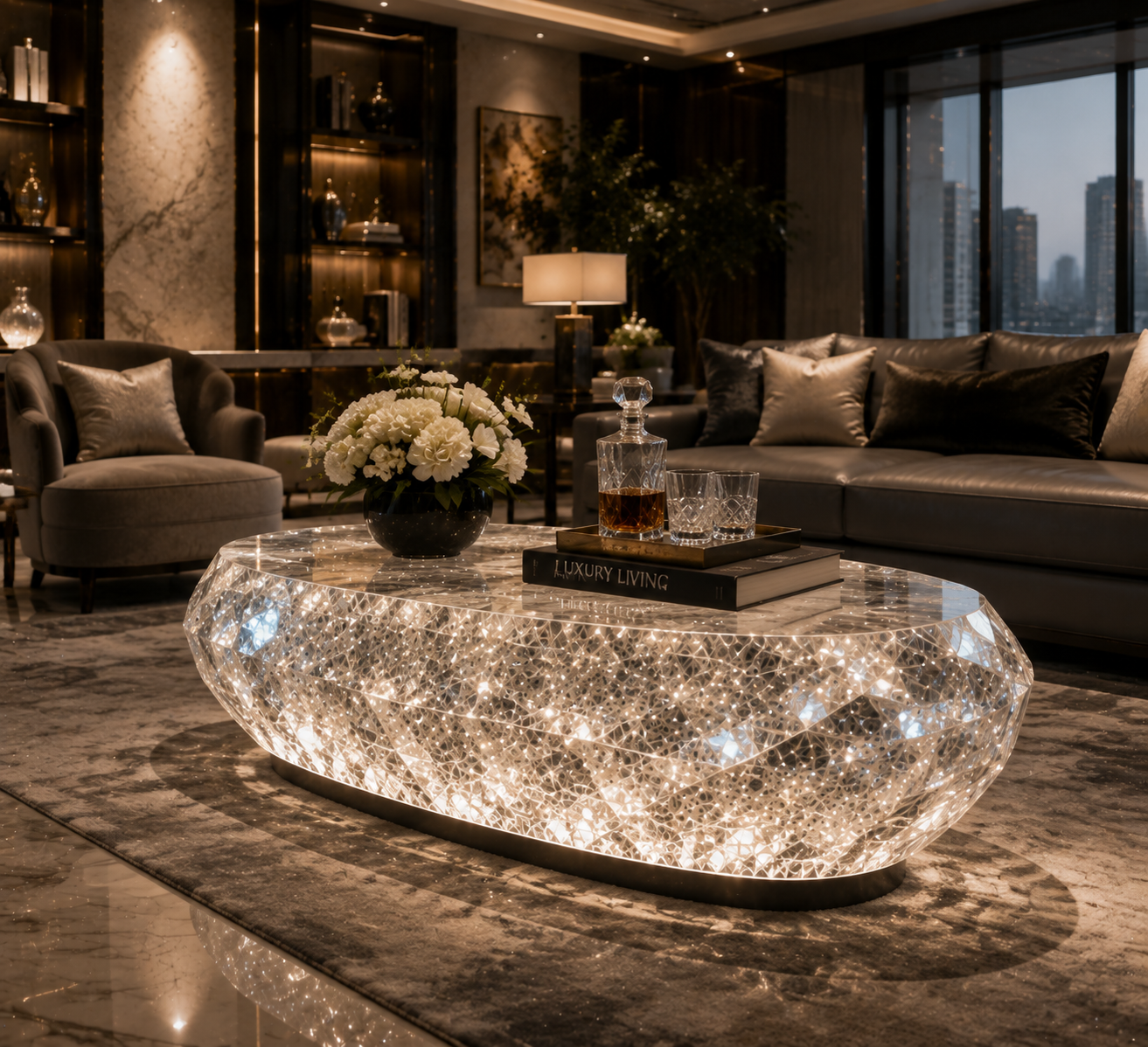
This is where synthetic crystal acrylic furniture creates an important opportunity.
High-quality acrylic has a visual character that is fundamentally different from most traditional furniture materials.
It is transparent but substantial.
It can look almost weightless while occupying significant physical volume.
It can reflect, refract, transmit, and interact with light.
It can be polished into crystal-like surfaces.
It can be combined with marble, metal, timber, leather, textiles, and lighting.
It can become furniture, display, sculpture, or architecture.
Most importantly, it can help a brand build a visual language that is difficult to confuse with ordinary furniture.
For high-end brands searching for a new point of differentiation, synthetic crystal acrylic is therefore more than a material choice.
It can become a branding strategy.
1. Why Differentiation Has Become a Strategic Challenge for High-End Furniture Brands
Luxury furniture has traditionally differentiated itself through several familiar elements.
One brand may emphasize handcrafted wood.
Another may focus on marble.
Another may use polished metal.
Another may compete through upholstery craftsmanship.
Another may emphasize famous designers.
All of these approaches remain effective, but the market has become increasingly crowded.
Many products now share similar design languages.
Minimalist forms are common.
Rounded furniture is common.
Marble surfaces are common.
Brushed brass details are common.
Neutral upholstery is common.
Sculptural furniture has also become widely available.
As visual trends spread quickly through social media, exhibitions, design platforms, and global supply chains, distinctive ideas can become familiar very quickly.
This creates a problem for brands.
A product can be beautiful but still feel interchangeable.
A coffee table may look luxurious, but if ten other suppliers offer something visually similar, the client begins to compare price, delivery time, or production convenience.
That weakens brand power.
Strong differentiation changes the conversation.
Instead of asking:
“How much does this table cost?”
A designer begins to ask:
“Can we specify this brand because this visual effect is important to the project?”
That difference is extremely valuable.
For premium brands, differentiation should therefore happen at several levels.
There is material differentiation.
There is design differentiation.
There is craftsmanship differentiation.
There is service differentiation.
There is also experience differentiation.
Synthetic crystal acrylic can contribute to all five.
First, the material itself is visually distinctive.
Second, it can support forms that differ from conventional wooden or metal furniture.
Third, transparent construction exposes craftsmanship, making precision part of perceived quality.
Fourth, acrylic can be customized in dimension, thickness, geometry, combination, and finish.
Finally, it creates unique spatial effects through transparency and light.
This last point is particularly important.
High-end furniture is no longer judged only as an isolated object.
It is judged according to how it transforms a space.
A luxury furniture brand that understands this can compete at a higher level.
Instead of selling a table, it sells spatial clarity.
Instead of selling a console, it sells visual lightness.
Instead of selling a display pedestal, it sells a floating product presentation.
Instead of selling an acrylic chair, it sells the visual effect of upholstery suspended in space.
This changes the meaning of the product.
It becomes more difficult to compare directly with ordinary alternatives.
And that is the foundation of strong differentiation.
2. Synthetic Crystal Acrylic as a Recognizable Brand Material
Some of the strongest luxury brands are closely associated with particular materials or details.
When customers repeatedly see the same material language, it becomes part of brand identity.
Synthetic crystal acrylic offers strong potential in this area because its visual behavior is immediately recognizable.
Transparency Creates Instant Distinction
Most furniture is opaque.
Wood blocks the view behind it.
Stone creates a solid visual mass.
Metal defines clear structural lines.
Upholstery occupies visual volume.
Synthetic crystal acrylic works differently.
It allows the surrounding interior to remain visible.
This creates a sense of openness.
A large furniture piece can be physically substantial without visually dominating the space.
For a premium brand, this quality can become a recognizable signature.
Imagine a collection in which thick transparent acrylic structures consistently support marble, timber, or upholstered elements.
Across coffee tables, dining tables, benches, consoles, and chairs, the brand develops a repeated visual principle:
solid luxury materials appearing to float through transparent structure.
That is more powerful than producing unrelated products.
It creates a system.
Optical Depth Adds Luxury
Transparency alone is not enough.
Thin acrylic can look practical and simple.
Thick, highly polished synthetic crystal acrylic creates a different impression.
Thickness produces optical depth.
The material begins to behave more like a transparent volume than a clear surface.
Light enters the object.
Edges become luminous.
Background objects appear subtly displaced through refraction.
Internal reflections create visual layers.
This effect can make even a simple geometric form feel complex.
For high-end furniture brands, this is extremely useful.
Luxury does not always require ornament.
A thick transparent block can communicate value through precision, material volume, and optical quality.
The object feels substantial.
At the same time, it remains visually light.
This contradiction creates interest.
Acrylic Changes With the Environment
Another advantage is that acrylic is not visually static.
A wooden surface has a relatively stable appearance.
Acrylic responds constantly to its surroundings.
In daylight, it may appear almost invisible.
Under spotlights, polished edges become more pronounced.
Near colored materials, the transparent surfaces pick up reflections.
In a darker interior, the acrylic may look more mysterious.
Near bright windows, it can almost disappear into the architecture.
This means the furniture changes depending on where it is used.
For a brand, this creates a valuable relationship between product and space.
The product is not simply placed into an interior.
It participates in that interior.
This is especially attractive to interior designers because it allows one furniture piece to adapt visually to different projects while maintaining its core identity.
Transparency Can Become a Brand Code
The strongest approach is not to use acrylic randomly.
A brand should define how the material appears across its collection.
Perhaps the brand always uses unusually thick acrylic.
Perhaps it uses faceted edges.
Perhaps it combines transparent acrylic with warm brushed brass.
Perhaps acrylic is always paired with natural stone.
Perhaps its chairs use clear side structures with floating upholstered cushions.
Perhaps its consoles use oversized transparent architectural bases.
Once repeated consistently, these details become a brand code.
Customers begin to recognize the style before reading the name.
That is the goal of material differentiation.
.png)
3. Building Signature Products Through Form, Thickness, and Craftsmanship
A premium material does not automatically create a premium product.
The way synthetic crystal acrylic is designed and manufactured determines whether the final result feels sophisticated or ordinary.
This makes form, proportion, thickness, and finishing essential to brand differentiation.
Thickness as a Design Language
Thickness is one of the most important variables in acrylic furniture.
Thin transparent panels may be appropriate for certain applications, but they rarely create the same visual authority as thick acrylic.
Large sections create a stronger crystal-like effect.
A thick acrylic table leg can become a sculptural element.
A massive console side panel can look architectural.
A substantial chair arm can become a jewelry-like detail.
For a high-end brand, thickness can therefore become a recognizable visual signature.
It also communicates investment.
The customer can immediately see that the object is not designed as a lightweight commodity.
Proportion Determines Perceived Quality
Transparent materials are surprisingly sensitive to proportion.
Because the eye sees through the furniture, every line becomes important.
If the legs are too narrow, the product may look weak.
If the base is too large, the product may feel visually awkward.
If the acrylic thickness does not relate correctly to the scale of the object, the product can lose sophistication.
High-end furniture therefore requires careful visual balance.
The strongest designs often exaggerate one proportion intentionally.
An oversized clear support may create drama.
A wide transparent edge may highlight optical depth.
A very simple top may contrast with a complex acrylic base.
These deliberate decisions make the furniture memorable.
Geometry Creates Recognition
Generic furniture usually depends on familiar shapes.
Rectangular tables.
Straight legs.
Standard panels.
Conventional frames.
For brands seeking differentiation, acrylic provides an opportunity to move beyond these expectations.
Curved forms can create fluidity.
Angled structures can create architectural tension.
Faceted surfaces can strengthen refraction.
Layered clear sections can create depth.
Interlocking volumes can produce sculptural effects.
Continuous bent forms can make an object appear as though it has been created from one uninterrupted transparent ribbon.
The goal is not unnecessary complexity.
A complicated product is not automatically a better product.
The objective is to develop geometry that feels intentional and recognizable.
Edge Treatment Can Become a Signature
Transparent furniture gives unusual importance to edges.
Light naturally collects around polished boundaries.
This means an edge can become a major visual feature.
A sharp polished edge suggests precision.
A broad bevel produces stronger reflection.
A rounded edge feels softer and more approachable.
A faceted edge can create a crystal or jewelry effect.
A luxury furniture brand can use a consistent edge treatment across an entire collection.
The detail may be subtle, but repetition creates identity.
Craftsmanship Is Highly Visible
Acrylic has another important characteristic:
It exposes mistakes.
Poor bonding can be seen.
Scratches become visible.
Bubbles in joints reduce perceived value.
Cloudy polishing looks inexpensive.
Inconsistent edges become obvious.
For low-cost production, this can be a challenge.
For premium brands, however, it creates an opportunity.
Excellent craftsmanship becomes visible.
When a joint appears almost seamless, the customer notices precision even if they do not understand the production technique.
When a thick edge is perfectly polished, the material appears more valuable.
When transparent surfaces remain optically clean, the furniture communicates manufacturing discipline.
In this sense, transparency becomes proof of quality.
The brand cannot hide behind paint or surface decoration.
The craftsmanship is exposed.
That makes high-level execution a competitive advantage.
4. Creating Premium Material Contrast Through Hybrid Design
Synthetic crystal acrylic does not need to compete with traditional luxury materials.
Its strongest role may be to transform them.
By combining acrylic with marble, metal, wood, leather, and upholstery, designers can create strong visual contrasts that make each material feel more expressive.
Acrylic and Marble
Few combinations communicate “weight versus weightlessness” as effectively as marble and clear acrylic.
Marble is dense.
Natural.
Opaque.
Permanent.
Acrylic is transparent.
Visually light.
Technological.
Fluid.
When a heavy marble top sits on transparent acrylic legs, the stone appears to float.
This visual illusion immediately differentiates the furniture from a conventional marble table.
For a premium brand, the combination can become extremely recognizable.
White marble and clear acrylic create brightness and softness.
Dark marble and acrylic create drama.
Highly veined stone creates artistic contrast.
The transparent base allows more attention to remain on the natural pattern of the stone.
Acrylic and Metal
Metal creates another type of contrast.
Polished stainless steel can create a highly contemporary appearance.
Brass introduces warmth.
Bronze adds depth.
Blackened metal produces graphic tension.
Acrylic can make these metallic details appear sharper because the surrounding material is visually quiet.
The metal becomes a highlight.
Brands can use a specific metal finish consistently across an acrylic collection to strengthen identity.
For example, clear synthetic crystal acrylic combined with warm satin brass can immediately communicate a specific luxury language.
Clear acrylic combined with mirror-finished stainless steel creates something more futuristic.
The material choice becomes part of brand positioning.
Acrylic and Wood
Wood introduces warmth and natural character.
This is valuable because fully transparent furniture can sometimes feel too technical for residential environments.
A timber top supported by acrylic can appear lighter than a conventional wooden table.
A wooden cabinet with clear acrylic legs can look suspended above the floor.
Natural grain becomes more visible because transparent elements do not compete with it.
This combination is especially effective for brands that want to balance contemporary design with warmth.
Acrylic and Leather
Leather works particularly well with clear acrylic seating.
The transparent frame makes the upholstered section appear to float.
This immediately changes the visual identity of a chair or bench.
The furniture can look lighter while retaining comfort.
High-quality leather also adds tactile richness.
The contrast between a warm, soft surface and a cool, transparent frame creates a strong premium impression.
Acrylic and Textiles
Velvet, bouclé, woven fabrics, and other upholstery materials can create similarly strong effects.
Because the frame visually recedes, color becomes more powerful.
A cream upholstered seat appears elegant.
Deep green can become dramatic.
A saturated blue cushion may look like a colored object floating in space.
This makes acrylic valuable for brands that want to create multiple color collections while preserving a consistent structural identity.
Hybrid Design Increases Exclusivity
The more intelligently materials are combined, the more difficult the furniture becomes to compare directly with generic alternatives.
A basic acrylic table can be copied easily.
A well-engineered combination of custom acrylic thickness, specific stone, unique metal detailing, proprietary edge treatment, and distinctive proportions is far more difficult to reproduce convincingly.
This is where material design becomes intellectual property in a practical sense.
The differentiation is not based on one component.
It is based on the entire system.
5. From Furniture Products to Brand Spaces and Visual Experiences
One of the biggest opportunities for high-end furniture brands is to stop thinking only in terms of individual products.
Luxury brands increasingly compete through spaces.
Hotels create branded environments.
Fashion companies create retail experiences.
Jewelry brands create immersive boutiques.
Developers create signature residences.
Companies build experience centers.
Restaurants and clubs use interiors as part of their identity.
Furniture plays an important role in all of these spaces.
Synthetic crystal acrylic is particularly valuable because it can move beyond traditional furniture categories.
Luxury Hotels
In a hotel, acrylic can appear as coffee tables, reception elements, lobby benches, decorative pedestals, room dividers, bar features, or sculptural installations.
When several of these elements share the same material language, the space becomes more coherent.
A hotel may remember the supplier not because it provided one table, but because it helped create a visual atmosphere.
That creates a deeper commercial relationship.
Luxury Retail
Retail is even more strongly connected to visual identity.
Furniture must support merchandise without competing with it.
Transparent acrylic is ideal because it can visually recede while still creating structure.
Clear display tables can make products appear suspended.
Transparent pedestals can create floating presentations.
Acrylic shelving can preserve visibility of wall graphics and branded interiors.
If a brand develops distinctive acrylic display systems, the furniture can become part of retail identity.
This opens opportunities beyond traditional home furniture.
High-End Residential Projects
Luxury residences increasingly use bespoke furniture.
Homeowners and designers want pieces that cannot easily be found in ordinary retail stores.
Synthetic crystal acrylic can satisfy this demand.
A custom console can align exactly with architectural dimensions.
A coffee table can be designed around a specific sofa.
A display system can support an art collection.
A dining table can combine a selected stone slab with a custom acrylic base.
For premium furniture brands, this means greater opportunity for personalization.
Galleries and Art Spaces
Acrylic also works naturally in galleries because of its visual neutrality.
Transparent structures can support artwork while minimizing visual interference.
Benches, pedestals, display cases, and partitions can all be designed to appear light.
For brands interested in moving closer to collectible design or art furniture, these environments can strengthen positioning.
Brand Showrooms
A company showroom should not merely display products.
It should demonstrate a world.
Synthetic crystal acrylic can help create this world.
Instead of showing isolated tables and chairs, the brand can create complete scenarios where transparency, lighting, material contrast, and architecture work together.
This makes the customer understand the potential of the product more quickly.
It also makes the brand more memorable.
Furniture as Content
Today, interiors are constantly photographed.
Designers share projects.
Hotels publish lobby images.
Restaurants appear on social platforms.
Retail installations become campaign photography.
This means furniture exists both physically and digitally.
Distinctive acrylic furniture can perform particularly well in this environment because transparency, reflection, light, and floating effects create strong visual content.
For a brand, this creates additional value.
A visually powerful product can generate attention beyond the physical showroom.
It can become an image people save.
It can become a reference for designers.
It can become part of a mood board.
It can circulate through digital design culture.
Strong material identity therefore becomes a marketing asset.
6. Turning Material Innovation into Long-Term Brand Competitiveness
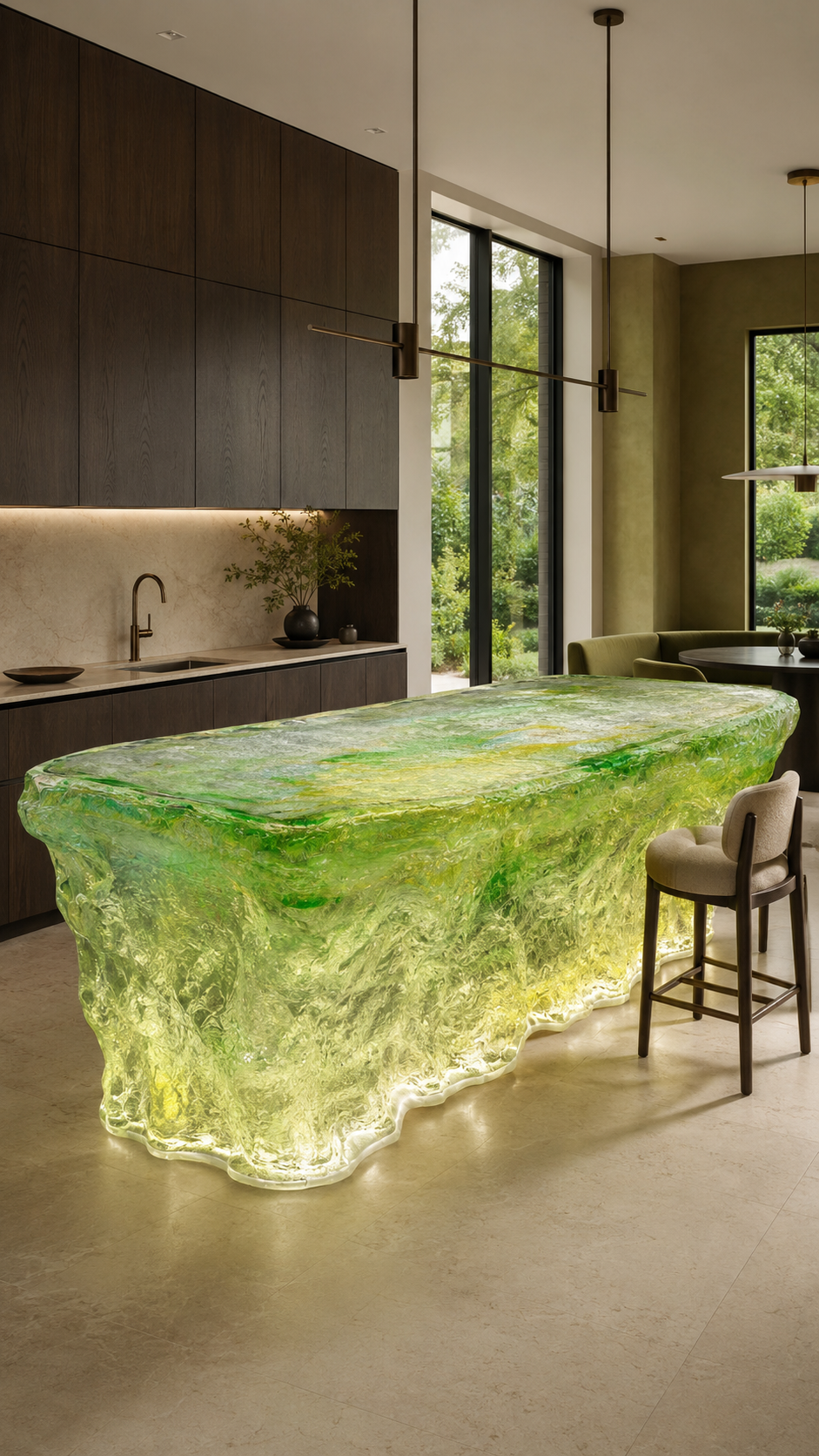
Using synthetic crystal acrylic once does not create differentiation.
Long-term brand value requires a system.
The material must become part of a broader strategy.
Build Collections, Not Isolated Products
A collection creates stronger recognition than individual pieces.
A brand might develop one acrylic language across:
coffee tables
consoles
dining tables
side tables
chairs
benches
display pedestals
shelving
reception furniture
The products should not be identical.
They should share design DNA.
This may include a particular acrylic thickness, edge profile, metal detail, stone relationship, curve, or structural principle.
Repeated across multiple products, the visual system becomes recognizable.
Create Signature Products
Every high-end brand benefits from having products that immediately represent its identity.
A signature acrylic dining table can become one such piece.
A sculptural console can become another.
A distinctive transparent chair may act as a visual icon.
Signature pieces help customers understand the brand quickly.
They also provide memorable products for photography, exhibitions, showrooms, and design presentations.
Make Customization Part of the Brand
Luxury clients often require modification.
Dimensions change.
Stone changes.
Metal finishes change.
Fabric changes.
Acrylic thickness may change.
The best brands do not treat customization as a problem.
They integrate it into the business model.
Synthetic crystal acrylic is well suited to this approach.
A brand can maintain its signature design while adjusting practical details for specific projects.
This creates a valuable balance:
recognizable identity + project flexibility.
Work More Closely With Designers
Brands that want to enter higher-value projects should move beyond the role of simple product supplier.
Interior designers and architects often need technical support.
They may have a concept but not a manufacturing solution.
A strong acrylic furniture manufacturer can help with:
structural feasibility,
material thickness,
joint design,
polishing,
metal integration,
stone support,
installation,
packaging,
and dimensional optimization.
This turns the brand into a technical design partner.
That relationship is more valuable than competing only through catalog products.
Protect Quality Positioning
Premium acrylic furniture cannot rely on visual concept alone.
The execution must support the brand promise.
Poorly polished edges can destroy luxury positioning.
Visible adhesive can reduce trust.
Scratches can damage the first impression.
Weak packaging can create installation problems.
Inconsistent production can make custom projects risky.
For this reason, craftsmanship, inspection, packaging, and project management must all be treated as part of the brand.
A premium material requires a premium process.
Use Material Innovation to Escape Price Competition
This may be the most important commercial advantage.
The more generic a product becomes, the easier it is for customers to compare price.
The more distinctive a product becomes, the harder direct comparison becomes.
A standard transparent side table may be compared with dozens of suppliers.
A sculptural synthetic crystal acrylic side table with proprietary geometry, custom thickness, polished faceted edges, and a recognizable metal detail occupies a different category.
The client is no longer purchasing only acrylic.
They are purchasing design.
This is how material innovation can protect margin and strengthen positioning.
Conclusion: Differentiation Begins When Material Becomes Identity
High-end furniture brands face a difficult market.
Good manufacturing is expected.
Premium materials are widely available.
Minimalist aesthetics are common.
Customization is no longer unusual.
This means brands need deeper forms of differentiation.
Synthetic crystal acrylic provides one possible breakthrough.
Its strength comes not simply from transparency.
Its strength comes from the combination of transparency, optical depth, light, geometry, craftsmanship, material contrast, and spatial interaction.
Used strategically, acrylic can help a brand create furniture that is immediately recognizable.
A thick transparent base can become a signature.
A floating marble surface can become a visual code.
A clear frame with upholstered seating can define an entire collection.
A faceted polished edge can become a repeated detail.
Acrylic display furniture can extend the same identity into luxury retail.
Sculptural transparent installations can bring the brand into hotels, galleries, and experience spaces.
The possibilities expand when the material is treated not as a substitute for glass, but as a creative platform.
This requires a change in thinking.
The question should not be:
“How can we make an acrylic version of this furniture?”
The better question is:
“What can acrylic allow this brand to create that other materials cannot express in the same way?”
That question leads to differentiation.
It leads to new proportions.
New structures.
New material combinations.
New spatial relationships.
New product categories.
And potentially, new markets.
For premium furniture brands, the goal is not simply to use a special material.
The goal is to transform that material into a recognizable design identity.
When customers can see a product and immediately understand which design philosophy it belongs to, the brand has created real visual equity.
When designers specify the product because its material effect is essential to the project, the brand has created stronger commercial value.
When a manufacturer can translate that visual identity into custom residences, hotels, retail stores, galleries, and branded commercial spaces, the brand has moved beyond product supply.
It has become part of the design process.
That is where synthetic crystal acrylic offers its most important opportunity.
Transparency becomes identity.
Craftsmanship becomes credibility.
Customization becomes service.
Spatial experience becomes marketing.
And material innovation becomes long-term brand competitiveness.
For high-end furniture brands searching for a new breakthrough in differentiation, synthetic crystal acrylic may therefore be much more than a design trend.
It can become a new strategic language for the brand itself.
READ MORE:
- How Can a Design Rendering Become Reality? The Critical Role of Synthetic Crystal Furniture in Connecting Design and Construction
- The Material Selection Challenge in High-End Interior Design: Why Transparent Crystal Furniture Is Becoming a New Choice for Designers
- From Sample Approval to Mass Production: How Synthetic Crystal Furniture Can Make Project Delivery Smoother
- How to Avoid Repeated Material Revisions in Hotel and Commercial Space Projects
- Why More High-End Projects Are Building Unified Material Selection Standards: A New Solution with Synthetic Crystal Furniture
- Why Are More Designers Seeing Synthetic Crystal Acrylic as a Material of the Future?
- Synthetic Crystal Acrylic Furniture: How Can Products Gain Stronger Visual Competitiveness?
- From Furniture Manufacturing to Spatial Art: New Possibilities Created by Synthetic Crystal Acrylic
- Synthetic Crystal Acrylic Furniture: Why Do High-End Spaces Increasingly Need a Sense of “Light Luxury Transparency”?


