For years, material selection in luxury hotels, premium residences, flagship retail stores and high-end commercial spaces was often treated as a largely creative exercise. Designers chose materials project by project, owners approved samples, and suppliers were expected to reproduce the desired effect during production. That approach is becoming increasingly difficult to manage as premium developments become larger, more international and more dependent on consistent brand experiences.
The scale of the market helps explain the change. Lodging Econometrics reported that, at the end of 2025, the global luxury hotel construction pipeline had reached a record 1,328 projects and 252,544 rooms, while the upper-upscale pipeline reached 1,883 projects and 391,391 rooms. China and the United States alone represented 62% of projects in the total global hotel pipeline. For developers, hotel groups, designers and procurement companies managing this level of expansion, material selection can no longer depend entirely on one-off decisions. It increasingly needs to become a repeatable system.
This is where a unified material selection standard becomes strategically important—and where engineered decorative materials such as synthetic crystal, premium resin and high-grade PMMA acrylic can offer a new solution.
1. High-End Projects Are Moving from “Selecting Beautiful Materials” to Building Repeatable Material Systems
A single luxury residence may be able to tolerate a highly customized procurement process. A hotel group developing dozens of properties, a luxury retailer opening stores across several countries, or a developer building multiple premium residential towers faces a completely different challenge.
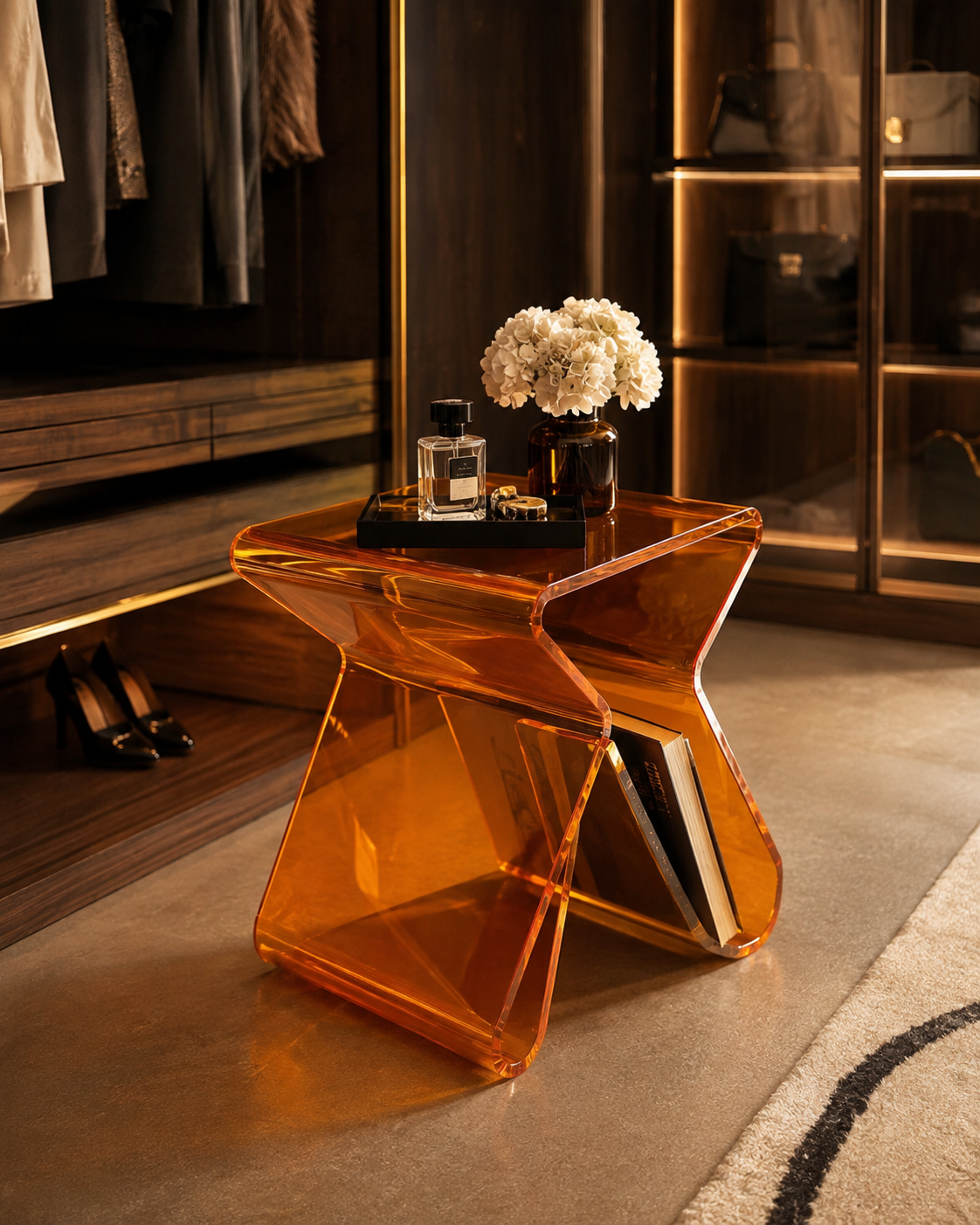
The first project may approve a beautiful transparent console table. The second project needs the same color, optical effect and proportions. The tenth project may be produced six months later by another production team. Replacement furniture might be required three years after completion. If every decision has to be restarted from the beginning, design consistency becomes expensive to maintain.
This explains why material standards are becoming part of brand management rather than simply purchasing procedures. A material library can establish the approved appearance, performance range, dimensions, finish, fabrication process, acceptable tolerances, documentation requirements and supplier responsibilities before individual projects begin.
The underlying management principle is familiar well beyond furniture. ISO describes ISO 9001 quality-management systems as requiring organizations to identify processes, understand customer needs, define responsibilities, control variation and errors, use performance data and continuously improve systems. Although ISO 9001 is not a furniture specification, the philosophy explains why repeatable processes matter when quality must be delivered repeatedly rather than once.
For luxury projects, therefore, standardization does not necessarily mean making every interior identical. It means creating a controlled material vocabulary. Designers can still change forms, dimensions, combinations and spatial compositions while relying on a previously verified family of materials.
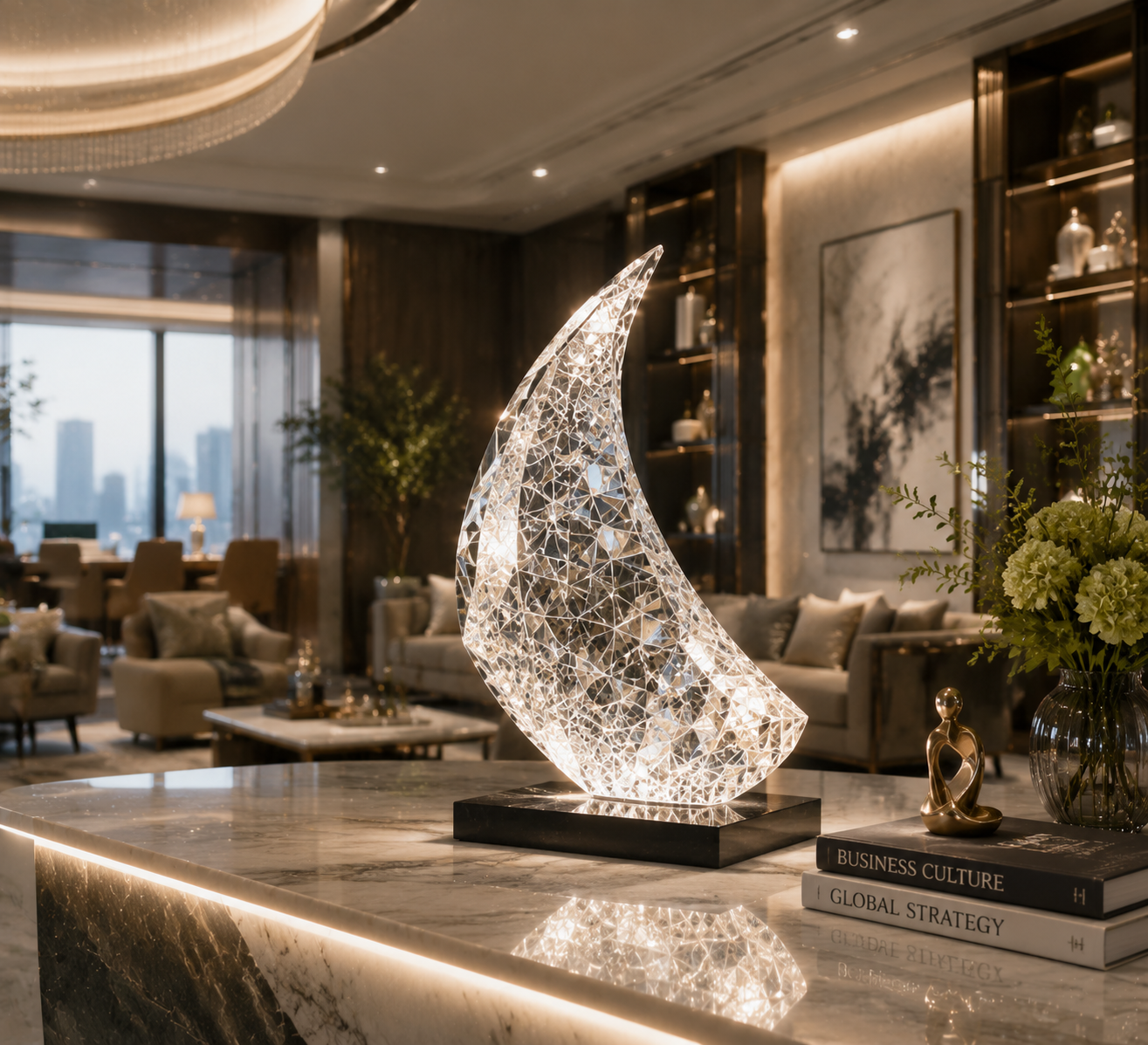
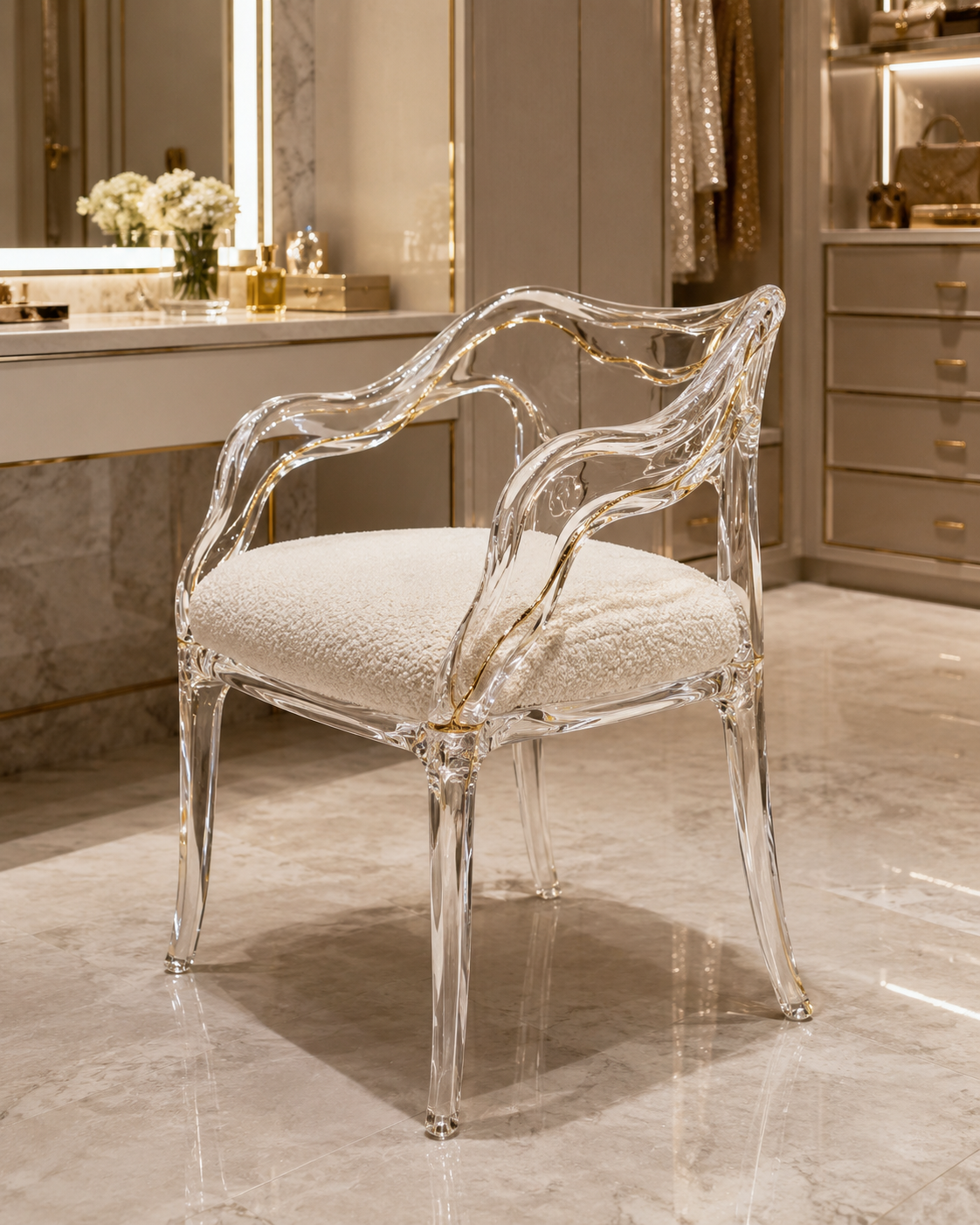
Synthetic crystal dining tables, resin side tables, transparent consoles, acrylic benches, sculptural pedestals and decorative furniture can consequently become part of a project platform rather than isolated custom objects. Once their critical characteristics have been defined, they can be adapted across guestrooms, suites, lobbies, retail environments and private residences while maintaining a recognizable visual language.
2. Unified Standards Reduce a Hidden Cost in Luxury Projects: Uncertainty
High-end projects frequently focus on visible costs—the quoted furniture price, tooling charge, shipping cost or installation budget. One of the largest risks, however, is uncertainty.
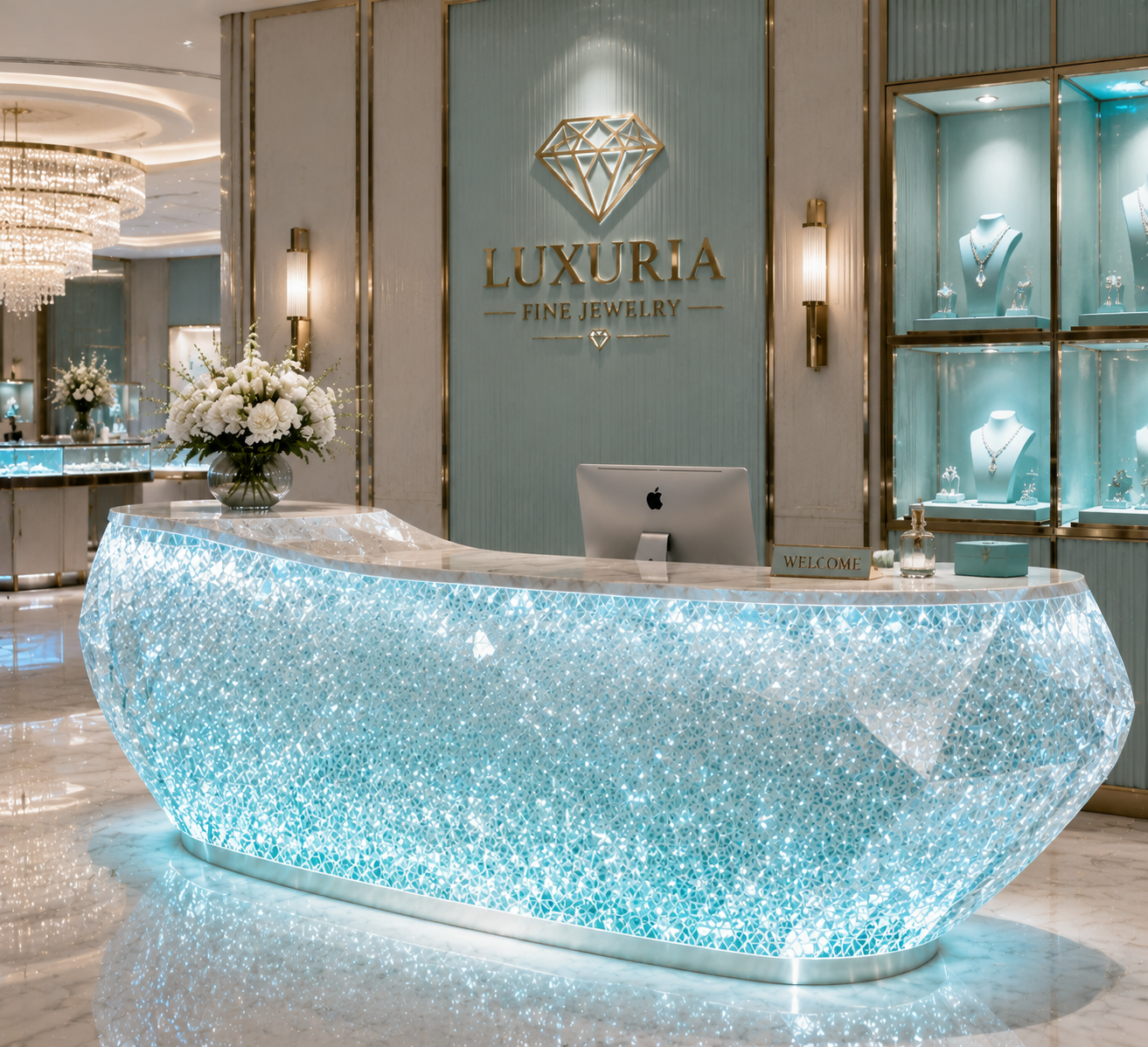
A sample may look correct but differ from production. A transparent component can appear more yellow than expected under architectural lighting. A resin table may arrive with inconsistent pigmentation. An acrylic component may have a different edge finish from the approved mock-up. Dimensions may technically fit the drawing but create problems when furniture is coordinated with stone, metalwork or lighting.
When specifications, approvals and project information are inconsistent, corrections multiply.
Research commissioned by Autodesk and conducted with FMI surveyed more than 3,900 construction professionals and estimated that poor-quality project data could have cost the global construction industry approximately $1.85 trillion in 2020. The research also estimated that decisions based on bad data accounted for 14% of construction rework. This does not mean material selection alone causes those losses, but it demonstrates the financial importance of accurate, standardized and accessible project information.
A serious furniture specification therefore needs to communicate much more than “clear resin table” or “transparent acrylic console.”
For a synthetic crystal or premium resin collection, an effective standard can define the approved master sample, color range, transparency or translucency, internal visual effect, surface finish, edge treatment, dimensions, cleaning expectations and acceptable visual variation. For premium PMMA acrylic, the specification can additionally establish requirements for optical appearance, haze, thickness, fabrication, joining and polishing.
The advantage is straightforward: the designer knows what will be delivered, procurement teams know what they are purchasing, factories know what constitutes an acceptable product, and owners have a reference when ordering replacements.
That is particularly valuable in luxury projects because quality is often judged by details that are difficult to describe after something has already gone wrong. A unified standard moves those conversations from the construction site to the specification stage.
3. Modern Material Standards Are Expanding Beyond Appearance to Health, Performance and Documentation
Another reason standardized selection is gaining importance is that sophisticated projects increasingly ask not only, “Does this look luxurious?” but also, “What documentation supports this material?”
Major green-building and furniture frameworks illustrate the direction of travel.
The U.S. Green Building Council’s guidance on low-emitting materials encourages project teams to research and specify low- or non-emitting finishes and furniture and to obtain relevant documentation such as safety information, certificates and test reports during procurement rather than after installation.
The International WELL Building Institute similarly addresses furniture and furnishings in areas including VOC emissions, material safety, cleanability, material transparency and surface design. In other words, interior products are increasingly considered part of the performance of the indoor environment rather than merely decoration.
The furniture industry itself is moving in the same direction. In 2025, ANSI approved the revised ANSI/BIFMA e3-2024 Furniture Sustainability Standard. BIFMA states that the revised framework establishes increasingly demanding levels and maintains alignment with major systems including LEED, WELL and the International Living Future Institute.
This creates an important opportunity for manufacturers of synthetic crystal, high-end resin and acrylic furniture.
The strongest supplier is no longer simply the company capable of producing an impressive sample. It is the company capable of turning that sample into a controlled specification supported by appropriate manufacturing records, material information and testing relevant to the intended application.
The exact documentation required will vary by project, country and material formulation. A hotel lobby table, residential dining table and retail display fixture may have different performance or regulatory requirements. The important principle is therefore not to make unsupported claims such as “zero VOC,” “UV-proof” or “100% scratch resistant.” Instead, high-end suppliers should build a technical file around the actual product and provide verified information wherever the project requires it.
In premium procurement, credibility itself has become a material characteristic.
4. Synthetic Crystal, Premium Resin and Platinum Acrylic Offer Something Traditional Materials Cannot Easily Replicate
Standardization becomes especially interesting when applied to transparent and translucent furniture because these materials can create a strong visual identity without making a room feel physically heavy.
Premium acrylic is a good example. ASTM D4802, the active standard specification covering PMMA acrylic sheet, identifies testable characteristics including luminous transmittance, haze, water absorption, tensile properties, impact performance, abrasion resistance, coating adhesion and chemical resistance. That makes acrylic more than a vague decorative category: important properties can be defined and measured.
Optically, quality PMMA can also deliver exceptional transparency. ACRYLITE states that colorless acrylic sheet can achieve approximately 92% visible-light transmission, while PLEXIGLAS reports transmission of up to 92% for clear grades. Actual results depend on product type, thickness and finish, but the figures help explain why premium acrylic has remained relevant to designers working with visually lightweight furniture and architectural elements.
Architectural Digest has likewise documented acrylic’s continued use in contemporary furniture, noting its ability to appear visually light while allowing light and surrounding finishes to remain visible through the object.
Engineered resin opens another design territory. Instead of simply imitating glass, resin can use pigmentation, casting depth, inclusions, gradients and controlled translucency to create furniture that behaves almost like a three-dimensional color field. Wallpaper has repeatedly documented resin within collectible design, including the work of designers producing jewel-like transparent pieces, and its 2026 coverage of Draga & Aurel again highlighted colored resin as a central material in contemporary collectible furniture.
Industrial material development shows that resin technology can also move beyond purely artistic fabrication. Covestro, for example, has demonstrated an aliphatic polyurethane-based solid-surface system for furniture that can be reaction-injection-molded into complex seamless forms. The case is not directly equivalent to every high-end resin product, but it demonstrates how engineered resin systems can combine design freedom with repeatable manufacturing processes.
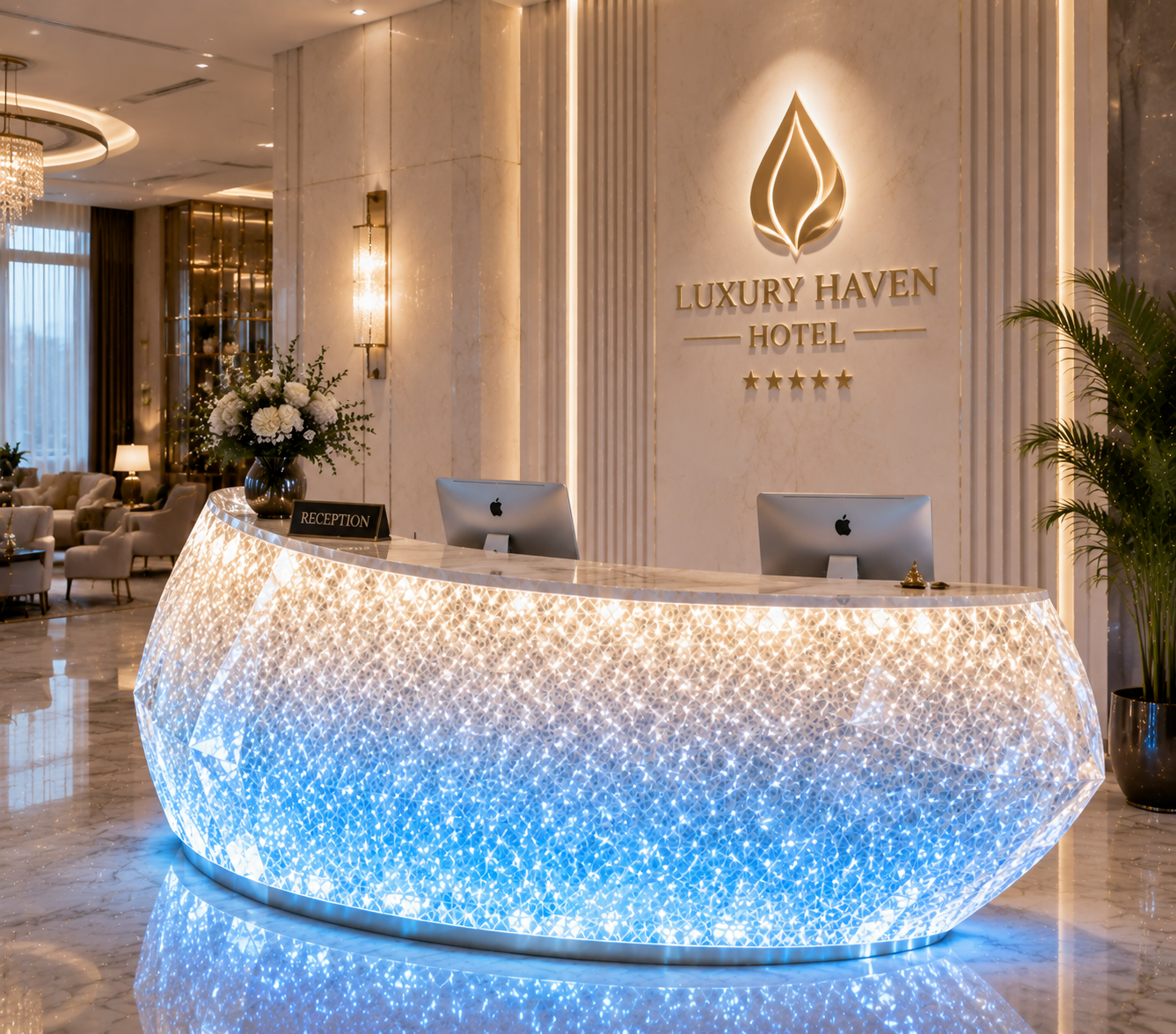
Synthetic crystal furniture sits particularly well within this category. By controlling clarity, refraction-like visual depth, color, inclusions and sculptural mass, a manufacturer can create the visual impression of crystal while developing forms that would be impractical or extremely costly in natural stone or conventional glass.
Premium PMMA-based “Platinum Acrylic” collections can serve a different role: cleaner optical geometry, polished transparent volumes and minimalist structures. High-end resin can offer color, texture and artistic depth. Synthetic crystal can provide a more jewel-like visual identity. Used together, these materials create a broader design language rather than competing as substitutes for one another.
5. Standardization Does Not Eliminate Customization—It Makes Customization Scalable
There is a common concern in luxury design that standardization will make projects repetitive. In practice, the opposite can happen when the system is designed correctly.
Without standards, every custom piece starts close to zero. Materials must be reselected, colors reconfirmed, construction methods debated, samples remade and production risks reassessed. The project may be highly customized, but a large amount of creative time is consumed solving technical questions that have already been solved elsewhere.
With an approved material platform, customization can concentrate on what the client actually sees.
A hotel group might approve three families of synthetic crystal finishes, several resin colors and a premium acrylic specification. Designers can then create different coffee tables, dining tables, consoles, nightstands, benches, display units or sculptural pieces using those families. The geometry changes; the underlying material intelligence remains stable.
This logic is already visible in advanced manufacturing. McKinsey notes that scalable construction approaches depend on repeatability, planning and controlled manufacturing, and reports that modular construction can reduce manpower requirements and substantially shorten schedules when it is correctly designed and implemented at scale. Furniture is not the same as modular building construction, but the broader operational lesson is relevant: repetition creates value when variation is intentionally designed rather than accidentally introduced.
For luxury brands, this approach is particularly powerful. The goal is not to make every property identical. The goal is to make every property unmistakably part of the same brand universe.
A recognizable resin color, a distinctive synthetic-crystal edge detail or a particular transparent acrylic construction can become as identifiable as a signature metal finish or stone palette. Material standardization then becomes a tool for brand memory.
6. The New Solution Is a Material Platform That Connects Design Ambition with Project Control
The most useful way to think about the future of high-end furniture procurement is not as a catalogue of fixed products, but as a controlled material platform.
A developer or design practice can approve a master synthetic-crystal sample, a family of premium resin finishes and a defined PMMA acrylic grade, then establish how those materials should be fabricated, inspected, documented, packaged and reproduced. Furniture forms can evolve from project to project while the critical quality standards remain consistent.
For PMMA components, relevant properties can be linked to recognized test methods such as those addressed by ASTM D4802. For furniture sustainability and material-health objectives, procurement teams can review the applicable BIFMA, LEED and WELL requirements. For resin and synthetic-crystal products, project-specific testing can be established according to formulation, application and local regulations rather than relying on generic marketing statements.
This changes the conversation between designers and manufacturers.
Instead of asking a factory, “Can you make something similar to this picture?”, the project team can say, “This is our approved material, this is the visual benchmark, these are the performance expectations, and this is how every future piece should relate to the standard.”
That difference is significant.
As luxury hospitality, premium residential development and global retail continue to scale, high-end projects need suppliers capable of delivering creativity and control at the same time. The record global pipeline of luxury and upper-upscale hotels provides a clear example of why repeatability is becoming commercially important.
Synthetic crystal, high-end resin and premium acrylic furniture are well positioned for this environment because their value extends beyond transparency. Properly engineered and specified, they can provide controllable color, optical depth, sculptural freedom and a distinctive identity that can be reproduced across different furniture categories and projects.
The next competitive advantage in luxury interiors may therefore be less about discovering another unusual material and more about learning how to turn distinctive materials into reliable systems.
For owners, this means greater consistency. For designers, it means more freedom within known boundaries. For procurement teams, it means clearer evaluation and fewer ambiguous substitutions. For manufacturers, it creates the opportunity to move beyond being a furniture supplier and become a long-term material partner.
That is the real promise of a unified selection standard—and one reason synthetic crystal furniture, advanced resin and premium acrylic are becoming increasingly relevant to the next generation of high-end projects.
READ MORE:
- How Can a Design Rendering Become Reality? The Critical Role of Synthetic Crystal Furniture in Connecting Design and Construction
- The Material Selection Challenge in High-End Interior Design: Why Transparent Crystal Furniture Is Becoming a New Choice for Designers
- From Sample Approval to Mass Production: How Synthetic Crystal Furniture Can Make Project Delivery Smoother
- How to Avoid Repeated Material Revisions in Hotel and Commercial Space Projects
- Synthetic Crystal Acrylic Furniture: A New Breakthrough for High-End Brand Differentiation
- Why Are More Designers Seeing Synthetic Crystal Acrylic as a Material of the Future?
- Synthetic Crystal Acrylic Furniture: How Can Products Gain Stronger Visual Competitiveness?
- From Furniture Manufacturing to Spatial Art: New Possibilities Created by Synthetic Crystal Acrylic
- Synthetic Crystal Acrylic Furniture: Why Do High-End Spaces Increasingly Need a Sense of “Light Luxury Transparency”?


