

In hotel and commercial interior projects, one of the most expensive problems is often not choosing the wrong material at the beginning. It is changing the material repeatedly after the design, quotation, sampling, mock-up or even production process has already started.
A designer may approve a transparent table based on a rendering, only to discover that the real material looks too yellow under warm lighting. A hotel owner may approve a resin finish, while the procurement team later finds that the supplier cannot maintain the same color across a large production batch. A project may specify an acrylic console for a lobby, but after the sample arrives, questions emerge about scratches, cleaning, edge quality or structural dimensions. The result is another sample, another approval meeting and another revised quotation.
At the scale of modern hospitality development, these decisions matter. Lodging Econometrics reported that the global hotel construction pipeline reached an all-time high of 15,922 projects and more than 2.43 million rooms at the end of 2025. Luxury hotel projects alone reached a record 1,328 projects, while renovation and conversion projects also reached record levels.
For owners, designers, procurement companies and furniture manufacturers, the question is therefore no longer simply, “Which material looks best?” The more important question is: How can a project make the right material decision early enough that it does not need to be made again and again?
For materials such as synthetic crystal, high-end resin, premium PMMA acrylic and Platinum Acrylic furniture, the answer lies in turning subjective material selection into a controlled project process.
1. Define the Performance Requirements Before Discussing Colors and Finishes
The first reason materials are repeatedly revised is surprisingly simple: many project teams begin by discussing appearance before agreeing on what the material actually needs to do.
A designer sees a transparent blue side table and asks for something similar. The supplier prepares a sample. Then operations asks whether the surface can tolerate daily cleaning. Procurement asks whether the color can remain consistent across 200 pieces. The contractor asks about weight and installation. The owner asks whether replacements can be produced two years later.
Each question is reasonable, but if those questions appear only after sampling, every new requirement can send the project back to the beginning.
The better approach is to establish performance requirements before selecting the final visual effect. The intended location, expected traffic, dimensions, cleaning method, exposure to sunlight, acceptable visual variation, production quantity and replacement requirements should all influence the specification.
This principle is consistent with ISO’s quality-management approach. ISO describes ISO 9001 as a framework built around customer focus, process management, evidence-based decision-making and continual improvement, with the objective of achieving more consistent and predictable outcomes.
The same logic applies to furniture specification.
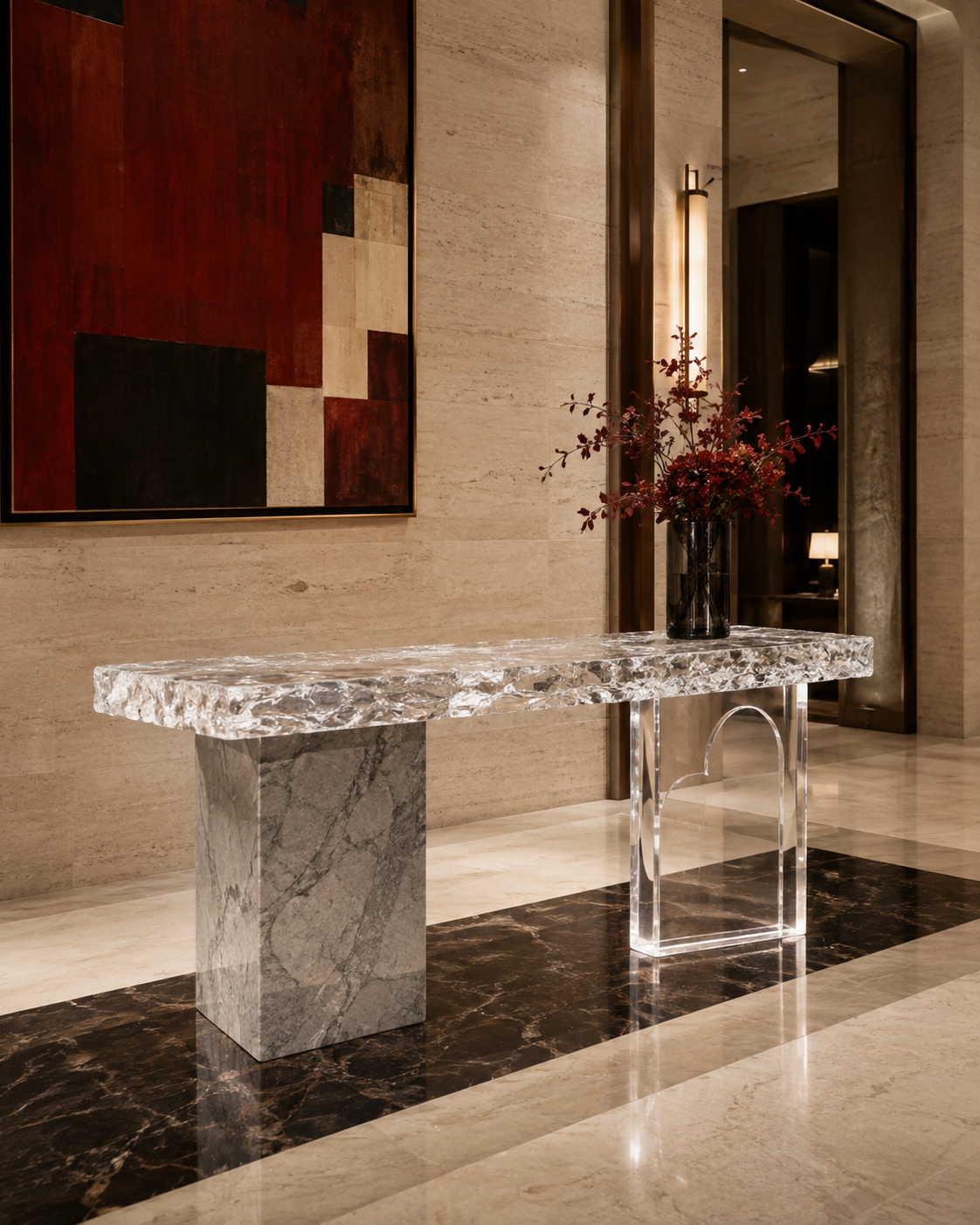
For example, a synthetic crystal console used behind a reception desk may prioritize optical depth, sculptural form and color consistency. A resin dining table in a restaurant may require greater attention to surface maintenance, stain exposure and cleaning chemicals. A Platinum Acrylic display table in a luxury retail store may depend heavily on transparency, polished edge quality and dimensional precision.
These are three transparent or translucent furniture applications, but they should not automatically use the same specification.
The objective is therefore not to ask the supplier for “the clearest acrylic” or “the best resin.” The objective is to define what success means for that particular installation. Once performance conditions are clear, material choices become narrower and more rational, dramatically reducing the possibility that an attractive sample will later be rejected for practical reasons.

2. Create One Approval Standard Instead of Allowing Every Stakeholder to Approve Differently
Repeated revisions also occur because hotel and commercial projects rarely have only one decision-maker.
An interior designer may focus on color and visual proportion. The hotel brand may focus on standards and guest experience. Procurement may focus on budget, production capacity and lead time. The contractor may care about dimensions, installation and coordination with other trades. Operations may care about cleaning, maintenance and replacement.
When each stakeholder evaluates the material at a different stage, approval can become circular.
The solution is to create one controlled approval standard that combines the requirements of all relevant parties. Instead of approving only a small color chip, the project should establish an approved physical reference that represents the final material as accurately as possible.
For synthetic crystal or cast resin furniture, that reference can define transparency, color depth, inclusions, internal texture, surface gloss, edge treatment and acceptable handcrafted variation. For Platinum Acrylic furniture, it can establish the exact color, clarity, thickness, polished-edge appearance, joining method and fabrication quality expected from production.
The importance of standardized project information is supported by wider construction-industry research. Autodesk and FMI surveyed more than 3,900 construction professionals and estimated that inaccurate, incomplete, inconsistent or inaccessible project data could have cost the global construction industry $1.85 trillion in 2020. The study also estimated that decisions made using bad data accounted for 14% of construction rework. Respondents with stronger data strategies reported benefits including fewer delays, fewer budget overruns, less rework and fewer change orders.
Material approvals are a small part of the entire construction-information system, but the lesson is highly relevant: if different teams are working from different samples, drawings, color codes or revision numbers, disagreement is almost inevitable.
For high-end furniture, an approved “golden sample” should therefore become the physical authority for production. Once the owner, designer and procurement team sign off on it, photographs alone should not replace it, and new production should not quietly follow a later unapproved sample.
When everybody approves the same reference, the question changes from “Do you like this material?” to “Does this production piece match the approved standard?”
That is a much easier question to answer.
3. Specify Measurable Material Properties Instead of Depending Only on Visual Descriptions
Terms such as “crystal clear,” “high transparency,” “premium acrylic,” “luxury resin” and “high gloss” sound useful in a design presentation, but they are weak purchasing specifications.
Two products can both be described as clear acrylic while producing noticeably different visual results. Two transparent resin samples can use the same color name but show different saturation, haze or internal effects. Even within one furniture piece, polishing quality can make the edges appear very different from the main surface.
This is why material selection should combine subjective approval with measurable criteria.
ASTM D4802, the standard specification covering PMMA acrylic sheet, identifies properties that can be evaluated through established test methods, including luminous transmittance, haze, water absorption, tensile properties, impact performance, abrasion resistance, coating adhesion and chemical resistance.
The practical implication is important. When premium acrylic or Platinum Acrylic furniture is used in a hotel lobby, luxury retail store or high-end commercial interior, buyers do not have to rely entirely on photographs or marketing descriptions. Relevant properties can be incorporated into the technical review when the project requires them.
Transparency provides a simple example. ACRYLITE states that its colorless acrylic sheet can achieve approximately 92% visible-light transmission under specified conditions. That number should not be automatically applied to every acrylic product, thickness or color, but it demonstrates how a vague concept such as “clear” can become a measurable optical property.
The same discipline should be used with resin and synthetic crystal products.
Because formulations and manufacturing processes differ, a responsible supplier should not claim that every resin product is automatically UV-resistant, scratch-proof, non-yellowing or suitable for every chemical cleaner. Those characteristics should be supported by the actual formulation, testing and intended application.
This distinction is particularly important for high-end projects. A professional specification does not promise unlimited performance. It defines the expected performance and provides evidence appropriate to the project.
Once the material is described in measurable terms, supplier substitutions also become easier to evaluate. Instead of comparing two products because both are called “high-end acrylic,” the project team can compare optical appearance, thickness tolerance, surface quality, fabrication capability and other relevant criteria.
Objective specifications reduce subjective arguments—and subjective arguments are one of the main causes of repeated material changes.
4. Build a Small Approved Material Library Instead of Starting from Zero on Every Furniture Piece
High-end hotels and commercial interiors usually require variety. A lobby table should not necessarily look identical to a guestroom side table, restaurant dining table, boutique display pedestal or executive lounge console.
But variety does not require every piece to use a completely different material.
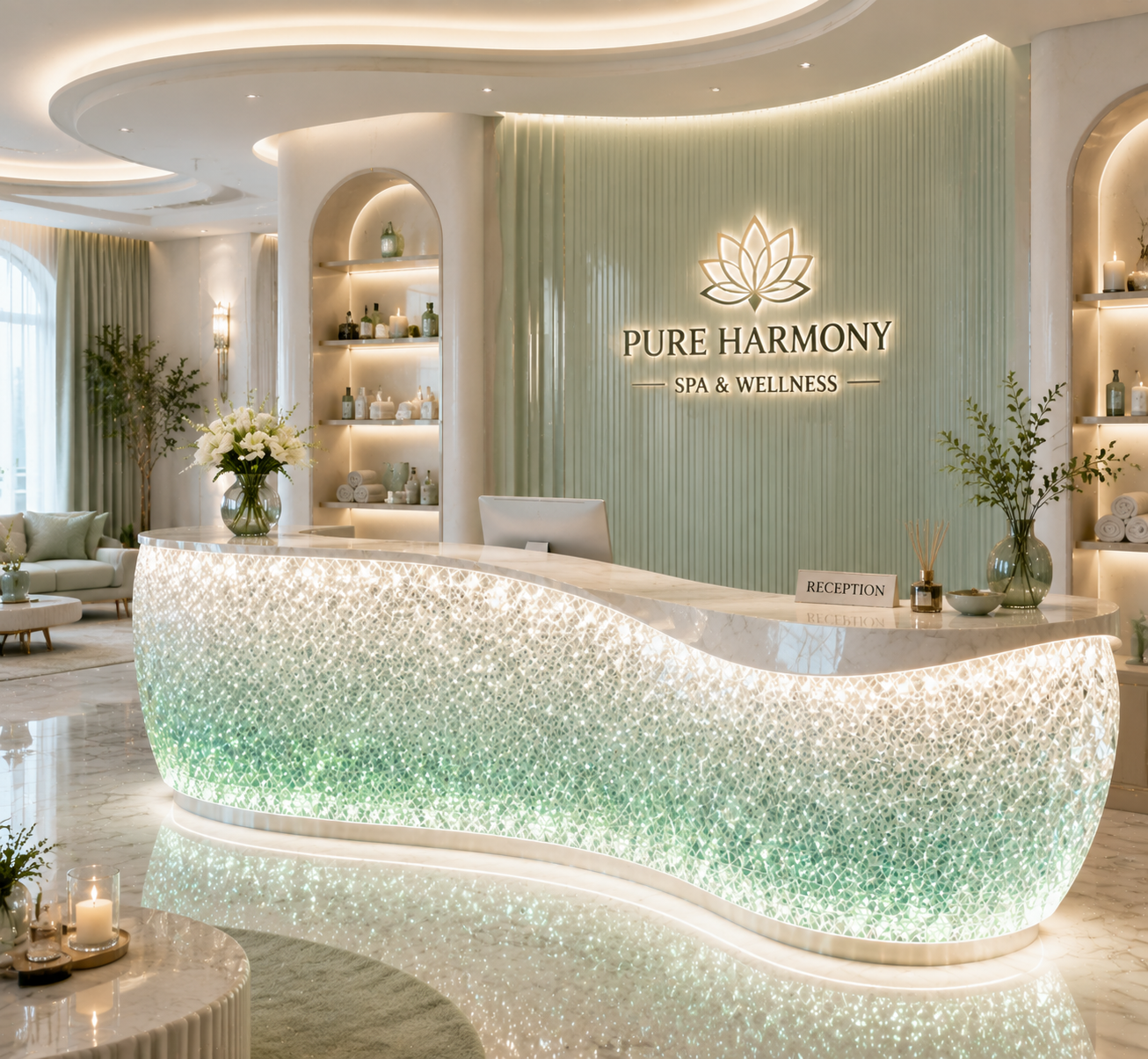
One of the most effective ways to reduce revisions is to develop a controlled material family early in the project. The designer might approve several synthetic crystal effects, a small group of resin colors and one or two premium acrylic specifications. Those materials can then be translated into different furniture forms throughout the project.
For example, the same champagne-toned synthetic crystal language could appear in a lobby console, sculptural side table and VIP-suite coffee table. A translucent amber high-end resin could be used for restaurant tables and decorative pedestals. Clear or smoked Platinum Acrylic could be used for retail display tables, benches or minimalist console structures.
The result is visual continuity without repetition.
This approach also reflects the direction of professional furniture standards. ANSI/BIFMA e3-2024, the Furniture Sustainability Standard, explicitly recognizes issues such as material inputs, manufacturing processes, supply-chain considerations and potential batch-to-batch variation.
Batch variation is especially relevant to cast and decorative materials. In natural stone, variation is expected because the source material is natural. In engineered resin or synthetic crystal, the advantage is the possibility of greater control—but that control still depends on formulation records, manufacturing procedures, master samples and quality inspection.
Engineered resin technology also demonstrates how material development can support more repeatable furniture production. Covestro, for example, has documented an aliphatic polyurethane-based system used to produce complex seamless furniture forms through reaction injection molding, illustrating how engineered resin systems can combine design freedom with controlled manufacturing.
A material library therefore becomes more than a mood board. It becomes a project tool.
When a new table is designed, the team no longer asks, “What material should we use?” Instead, it asks, “Which approved material from the project library best expresses this design?”
Eliminating that first question from dozens or hundreds of furniture items can save a significant amount of approval time.
5. Test Materials at the Scale and Under the Lighting in Which They Will Actually Be Seen
A material sample can be technically correct and still fail after installation.
This is particularly common with transparent, translucent and reflective materials because their appearance depends heavily on scale, surrounding colors and lighting conditions.
A 100 mm resin sample may appear subtle in a sample room but become dramatically darker when cast into a thick table leg. A transparent acrylic edge that looks almost invisible in daylight may glow under an integrated LED. A smoke-gray synthetic crystal table may look elegant in a bright showroom but become visually heavy in a hotel lobby illuminated mainly by warm 2700K decorative lighting.
Therefore, approval should move progressively from a small material sample to a furniture-scale mock-up whenever the visual risk justifies it.
Lighting should be part of the evaluation because transparent materials interact with their surroundings rather than simply displaying a fixed surface color. The background floor, wall finish, metal details and nearby light sources can change the perceived color and depth of a synthetic crystal or resin piece.
This is also why a rendered image should never be treated as the final material reference.
The digital rendering is valuable for communicating design intent, but production approval should ultimately rely on physical material evidence. For large or visually important pieces—such as a hotel lobby communal table, reception console, luxury retail display table or sculptural resin bench—a prototype or representative production section can reveal issues that a small chip cannot.
Health and environmental requirements should also be reviewed at this stage rather than after the order has been placed. The U.S. Green Building Council’s guidance on low-emitting materials encourages project teams to specify products against recognized compliance thresholds and to collect relevant product documentation during procurement.
Similarly, the International WELL Building Institute addresses furniture and furnishings in areas including VOC emissions, material safety, cleanability and material transparency.
This does not mean every synthetic crystal, resin or acrylic table automatically satisfies a green-building requirement. It means the applicable documentation needs to be considered before final approval.
A material that looks perfect but cannot satisfy a project’s technical or documentation requirements is not truly approved.
6. Freeze the Specification Before Production—and Treat Every Later Change as a Controlled Decision
The final step in preventing endless revisions is knowing when material selection must stop.
Luxury projects naturally evolve, and some changes are unavoidable. The danger arises when changes continue without a formal decision process. A designer asks for the resin to become “slightly warmer.” Someone sees a new transparent acrylic option at a trade show. The owner requests a different tint after production material has already been ordered.
Each individual change may appear small, but every material change can affect sampling, cost, production scheduling, tooling, packaging, installation coordination and future replacement stock.
A project therefore needs a defined specification-freeze point.
At that point, the approved sample, shop drawings, dimensions, finish codes, material formulation or grade, hardware interfaces and relevant performance documentation should be treated as the production baseline. Any later change should be evaluated not only for appearance but also for cost, lead time and impact on previously approved elements.
This is consistent with ISO’s broader emphasis on controlled processes and evidence-based decision-making. Predictability improves when requirements and responsibilities are clear rather than continually reinterpreted.
The principle becomes even more important when hotel brands or commercial developers operate multiple properties. Lodging Econometrics reported that 3,777 hotel renovation and conversion projects totaling more than 540,000 rooms were in the global pipeline at the end of 2025. For groups operating across many locations, the ability to reproduce an approved material is therefore not simply a manufacturing convenience; it can become part of long-term procurement and brand consistency.
This is where synthetic crystal, high-end resin and Platinum Acrylic furniture can provide a strong project advantage when they are developed as controlled material systems rather than one-off decorative products.
A synthetic crystal dining table can be reproduced from a documented color and visual standard. A resin console can be linked to an approved formulation and master sample. A premium acrylic furniture collection can use a defined PMMA grade, thickness, tint and edge-finishing specification. Future replacements or new project phases can then reference an established standard instead of restarting the selection process.
Ultimately, avoiding material revisions is not about limiting creativity.
It is about making the important creative decisions at the right time.
The most efficient hotel and commercial projects separate exploration from execution. During design, teams explore materials freely. During development, they test appearance and performance. During approval, they establish a physical and technical reference. Once production begins, that reference becomes controlled.
When this process is followed, material selection stops being an endless series of opinions and becomes a professional decision system.
For owners, that means fewer unexpected changes. For designers, it protects the original design intent. For procurement teams, it creates clearer comparisons between suppliers. For furniture manufacturers, it makes production more predictable. And for hotel guests or commercial-space users, it ultimately delivers what the project intended from the beginning: a coherent interior in which every material looks deliberate, consistent and appropriate to its environment.
For suppliers of synthetic crystal, premium resin and Platinum Acrylic furniture, that is also where the greatest value lies—not simply in offering an unusual material, but in helping designers and project teams turn an unusual material into a reliable, repeatable and project-ready solution.
READ MORE:
- How Can a Design Rendering Become Reality? The Critical Role of Synthetic Crystal Furniture in Connecting Design and Construction
- The Material Selection Challenge in High-End Interior Design: Why Transparent Crystal Furniture Is Becoming a New Choice for Designers
- From Sample Approval to Mass Production: How Synthetic Crystal Furniture Can Make Project Delivery Smoother
- Why More High-End Projects Are Building Unified Material Selection Standards: A New Solution with Synthetic Crystal Furniture
- Synthetic Crystal Acrylic Furniture: A New Breakthrough for High-End Brand Differentiation
- Why Are More Designers Seeing Synthetic Crystal Acrylic as a Material of the Future?
- Synthetic Crystal Acrylic Furniture: How Can Products Gain Stronger Visual Competitiveness?
- From Furniture Manufacturing to Spatial Art: New Possibilities Created by Synthetic Crystal Acrylic
- Synthetic Crystal Acrylic Furniture: Why Do High-End Spaces Increasingly Need a Sense of “Light Luxury Transparency”?


