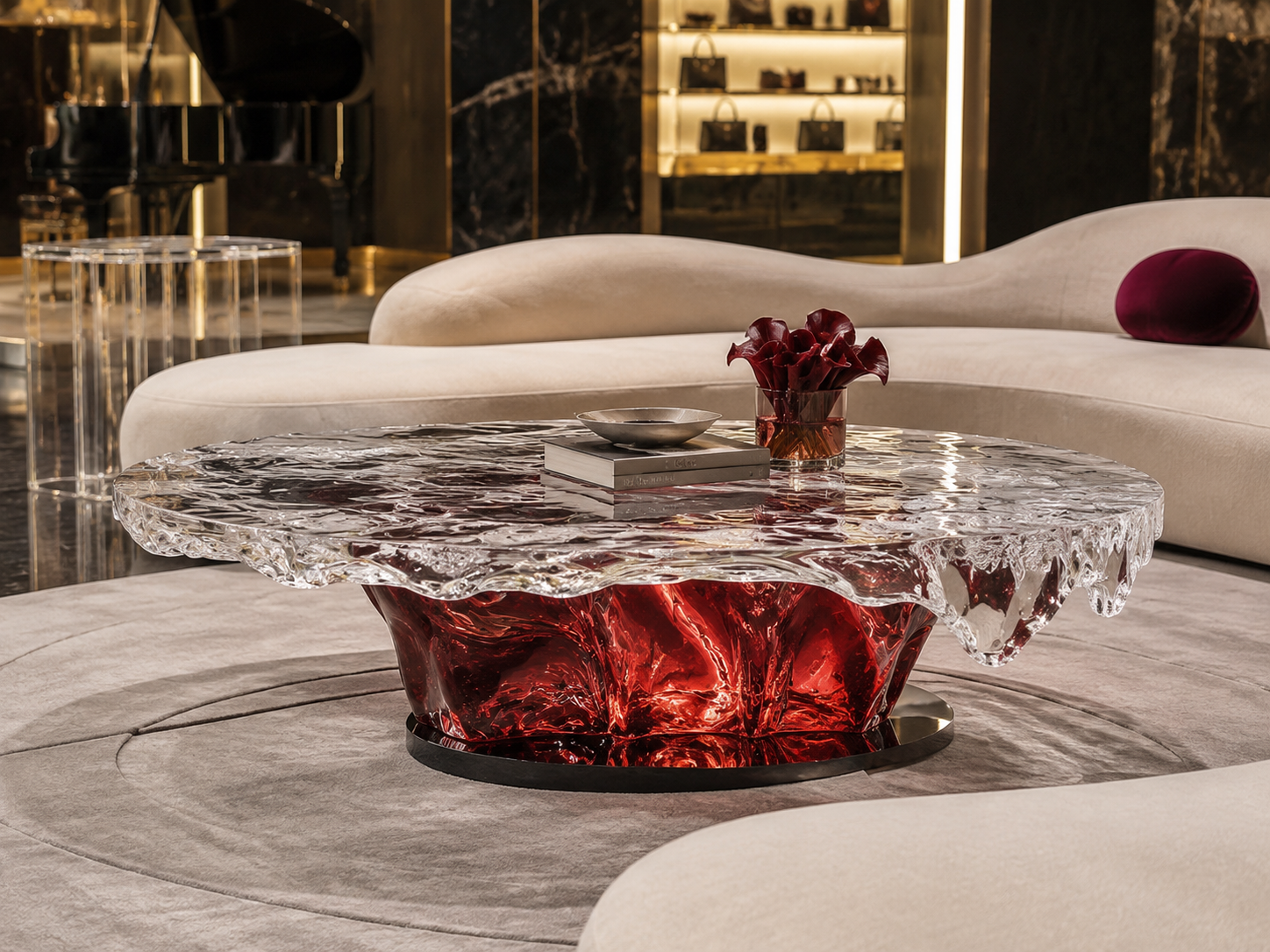
Transparent furniture is one of the most visually demanding categories in modern interior design.
At first glance, two transparent tables may appear almost identical. Both may use clear materials. Both may have simple geometric forms. Both may be described as modern, luxurious, or minimalist.
Yet place them in the same room, and the difference can be immediate.
One looks refined, architectural, and sophisticated.
The other looks lightweight, ordinary, or even inexpensive.
Why?
The answer usually has far less to do with transparency itself than with the details behind it.
Material quality, optical clarity, thickness, proportion, edge polishing, joint treatment, surface finishing, structural engineering, craftsmanship, and even lighting can dramatically change how transparent furniture is perceived.
This is especially important in the world of high-end synthetic crystal furniture, where every surface is visible and almost every manufacturing decision becomes part of the final design.
Unlike opaque furniture, transparent furniture has very little ability to hide imperfections. Poor construction, inconsistent polishing, weak proportions, or careless bonding are not covered by veneer, paint, leather, or upholstery.
Everything is exposed.
That is exactly why exceptional transparent furniture can feel so luxurious when it is executed properly.
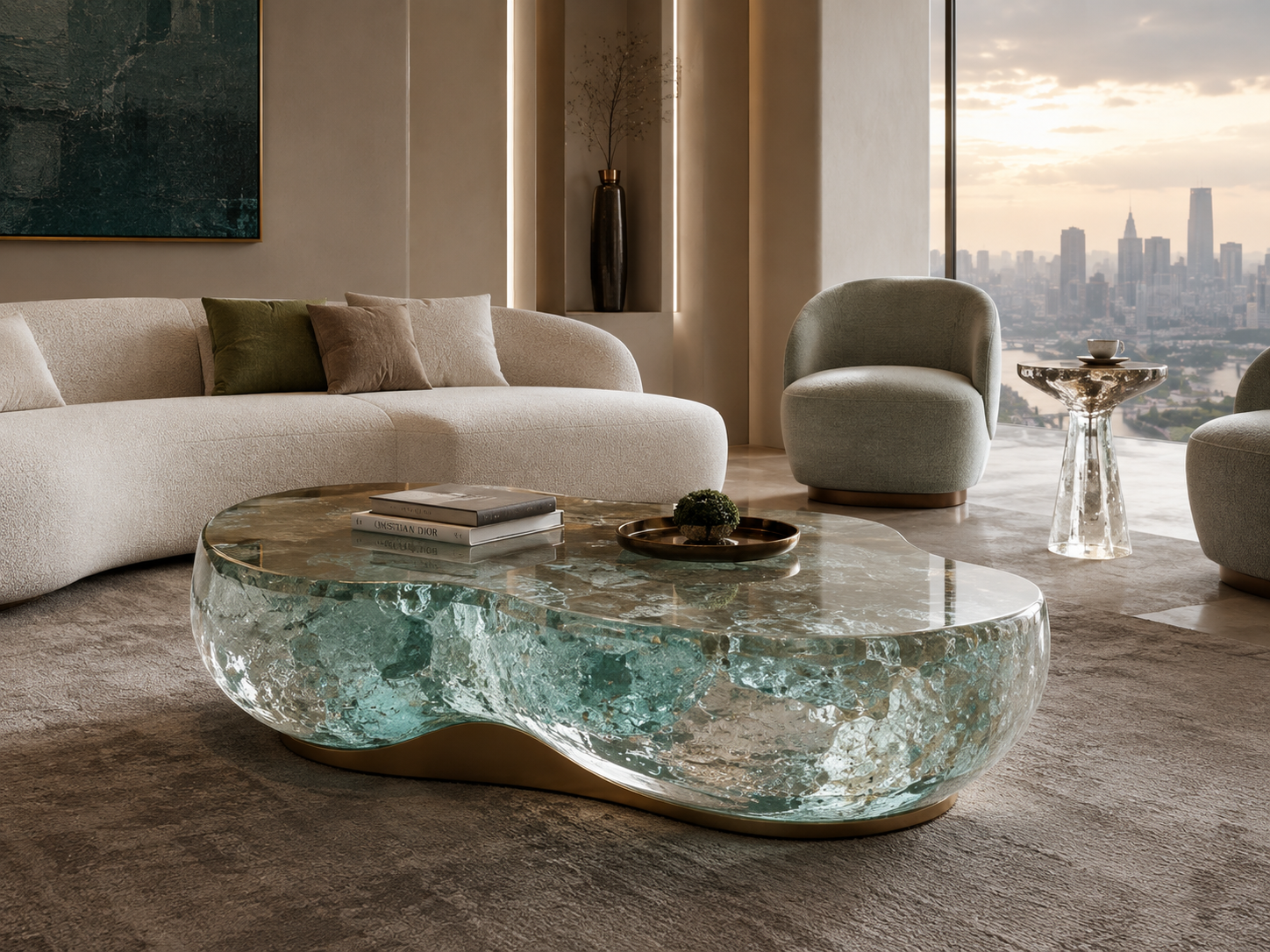
Transparency Magnifies Quality
One of the most important characteristics of transparent furniture is also one of its biggest challenges: visual honesty.
With wood furniture, a manufacturer can conceal certain structural details inside the frame.
With upholstered furniture, many connections are hidden beneath fabric.
With painted furniture, surface coatings can visually unify different components.
Transparent synthetic crystal furniture works differently.
The viewer can see through it.
This means clarity, internal connections, thickness, machining marks, surface consistency, and edge quality all become visible parts of the design.
A slightly rough edge that might be insignificant on an opaque material can immediately reduce the perceived quality of a transparent table.
A poorly aligned connection can interrupt the visual purity of the entire piece.
A cloudy surface can make premium furniture feel commercial.
The material does not forgive carelessness.
For this reason, the difference between high-end and ordinary transparent furniture is often found in details that are invisible in product specifications but immediately visible in the finished object.
Optical Clarity Is One of the First Signs of Quality
When people evaluate transparent furniture, they may not consciously think about optical clarity, but they notice it instantly.
Premium synthetic crystal should create a clean, controlled visual experience.
The material should appear clear rather than hazy. Light should pass through it smoothly. Surfaces should feel visually consistent from different angles.
Lower-quality transparent materials may contain slight cloudiness, visual distortion, inconsistent coloration, or impurities that become more obvious in thicker sections.
These imperfections can dramatically influence perception.
Luxury buyers often respond to clarity in the same way they respond to well-polished natural stone or high-quality glass. The eye recognizes refinement even when the viewer cannot identify the technical reason.
This is why material selection is fundamental.
A beautifully designed piece cannot achieve a premium appearance if the underlying synthetic crystal lacks consistency.
Thickness Changes the Entire Visual Character
Thickness is one of the most underestimated factors in transparent furniture.
Two tables can have almost identical dimensions but feel completely different simply because of the thickness of their structural components.
Thin transparent panels can create an elegant, light appearance, but if they are too thin for the scale of the piece, they may also feel visually weak.
By contrast, thicker synthetic crystal can create depth, weight, and architectural presence.
This does not mean thicker is always better.
The key is proportion.
A large console with delicate legs may appear unstable even if it is technically strong enough. A small side table with extremely heavy sections may feel awkward or visually clumsy.
High-end furniture is defined by balance.
The thickness of each component should relate to the overall scale, shape, intended use, and visual concept.
When these proportions are carefully controlled, transparent furniture can feel substantial without becoming heavy.
That balance is one of the signatures of luxury design.
Edge Polishing Can Instantly Reveal Craftsmanship
Edges are among the most visible indicators of manufacturing quality.
In high-end synthetic crystal furniture, the edge should not look like a raw cut.
It should feel intentional.
Careful polishing can transform a transparent panel into something almost jewel-like. Light interacts with the edge differently from the main surface, creating subtle highlights and emphasizing the material thickness.
Poorly finished edges create the opposite effect.
Visible machining lines, inconsistent polish, roughness, or cloudy areas can immediately make an otherwise attractive piece appear inexpensive.
This is particularly noticeable on thick material.
The thicker the synthetic crystal, the more visually important the edge becomes.
In some statement furniture pieces, the edge is not a secondary detail at all. It becomes one of the main visual features.
That is why polishing should be treated as part of the design rather than a final manufacturing step.
Joint Quality Determines Whether a Piece Looks Seamless or Assembled
Transparent furniture has a unique problem: joints cannot easily disappear.
In opaque furniture, screws, brackets, reinforcement structures, and adhesives can often be concealed.
With transparent materials, the relationship between components is visible.
This means bonding and assembly require exceptional precision.
When joints are carefully executed, multiple parts can appear visually unified.
When they are not, bubbles, excess adhesive, uneven alignment, discoloration, or visible gaps can become distracting.
These small details are especially damaging in minimalist designs because there are fewer elements competing for attention.
A transparent coffee table made from only a few panels may look extremely simple, but achieving that simplicity requires very precise fabrication.
The cleaner the design, the more important the construction quality becomes.
This is one of the hidden paradoxes of luxury transparent furniture: the easiest pieces to understand visually are often among the hardest to manufacture beautifully.
Proportion Matters More Than Decoration
Luxury furniture does not necessarily need elaborate ornamentation.
In fact, some of the most expensive-looking transparent furniture is extremely minimal.
What makes it successful is proportion.
The relationship between height, width, thickness, spacing, and negative space determines whether a piece feels sophisticated or generic.
A few millimeters can sometimes change the visual balance of a design.
Legs that are slightly too narrow may make a table look unstable.
A tabletop that is too thick for the base may appear heavy.
Supports positioned incorrectly can disrupt visual rhythm.
Professional designers spend considerable time refining these relationships because luxury is often communicated through restraint and precision rather than decoration.
Transparent furniture makes proportion even more important because the eye sees the entire structure at once.
Nothing interrupts the silhouette.
The geometry becomes the design.
Cheap-Looking Transparent Furniture Often Tries Too Hard
Another common mistake is excessive visual complexity.
Because transparent materials can appear minimal, some furniture designs attempt to create value through unnecessary curves, decorative details, multiple colors, or complicated combinations.
The result can easily become visually confusing.
Premium design often does the opposite.
It removes what is unnecessary.
A simple synthetic crystal console with perfect proportions and flawless finishing may feel significantly more luxurious than an elaborate design containing too many decorative features.
This principle reflects a broader truth in luxury interiors.
Value is not always created by adding more.
Sometimes it is created by knowing exactly what to remove.
Surface Quality Changes How Light Behaves
Large transparent surfaces reveal manufacturing quality immediately.
Scratches, polishing inconsistency, waves, haze, and other imperfections can become highly visible under strong lighting.
This matters because synthetic crystal furniture is often installed in environments with carefully designed illumination.
Hotel lobbies may use spotlights.
Luxury boutiques may have high-intensity display lighting.
Residential interiors may contain large windows and strong natural light.
These conditions expose surface quality.
A premium surface should interact with light cleanly and predictably.
If reflections become distorted or uneven because of poor finishing, the furniture may lose its sense of refinement.
The relationship between surface quality and lighting is one of the reasons transparent furniture should be evaluated in real environments, not only through basic catalog photographs.
Color Tone Can Influence Perceived Luxury
Not all transparent materials appear perfectly neutral.
Some may contain subtle undertones that become more noticeable at greater thicknesses.
This can influence how the furniture interacts with surrounding finishes.
In high-end interiors, color relationships are carefully controlled.
Stone, flooring, wall treatments, upholstery, metal finishes, and lighting temperature all contribute to the overall atmosphere.
If a transparent furniture piece introduces an unexpected tint, it may feel visually disconnected from the rest of the space.
Premium synthetic crystal should therefore be selected with attention to optical consistency and color behavior.
For designers working on highly controlled interiors, even subtle differences can matter.
Structural Engineering Should Be Invisible
Luxury furniture should feel effortless.
The viewer should not immediately think about how the piece is supported.
But achieving that simplicity may require significant engineering.
Transparent furniture often creates the illusion of lightness, yet it still needs to support real loads and withstand everyday use.
Poorly engineered furniture may require awkward braces, oversized supports, or visible reinforcement that damages the visual concept.
Well-engineered synthetic crystal furniture integrates strength into the form.
The structural solution supports the design rather than competing with it.
This is especially important for large dining tables, consoles, display structures, benches, and custom commercial furniture.
The technical challenge increases as the visual design becomes more minimal.
Good engineering disappears.
Bad engineering becomes the first thing people notice.
Manufacturing Precision Is a Luxury Feature
High-end furniture is often distinguished by precision.
Edges align exactly.
Surfaces meet cleanly.
Components are symmetrical where symmetry is required.
Dimensions feel controlled.
There is no visual tension between parts that should appear unified.
This level of precision can be difficult to achieve with large synthetic crystal components, particularly when designs involve thick material, unusual geometry, or customized dimensions.
Advanced equipment is important, but machinery alone is not enough.
Experienced craftsmanship remains essential.
Operators must understand how the material behaves during cutting, machining, polishing, bonding, and assembly.
Manufacturing tolerance is not simply a technical concern.
It directly affects the perceived value of the finished furniture.
Lighting Can Make Premium Furniture Look Extraordinary
Lighting plays a powerful role in the perception of transparent furniture.
The same synthetic crystal table can look dramatically different in two environments.
Under flat, uncontrolled lighting, its optical qualities may be understated.
Under carefully positioned architectural lighting, polished edges, thick sections, and transparent surfaces can produce depth and reflection.
This is why interior designers often consider transparent furniture together with lighting rather than treating them as separate elements.
A directional light can emphasize the edge of a console.
Ambient lighting can create subtle reflections across a table.
Natural daylight can reveal the transparency of a large furniture piece while preserving visual openness.
Even shadows become part of the composition.
Luxury furniture is not experienced in isolation.
It is experienced through its relationship with the surrounding environment.
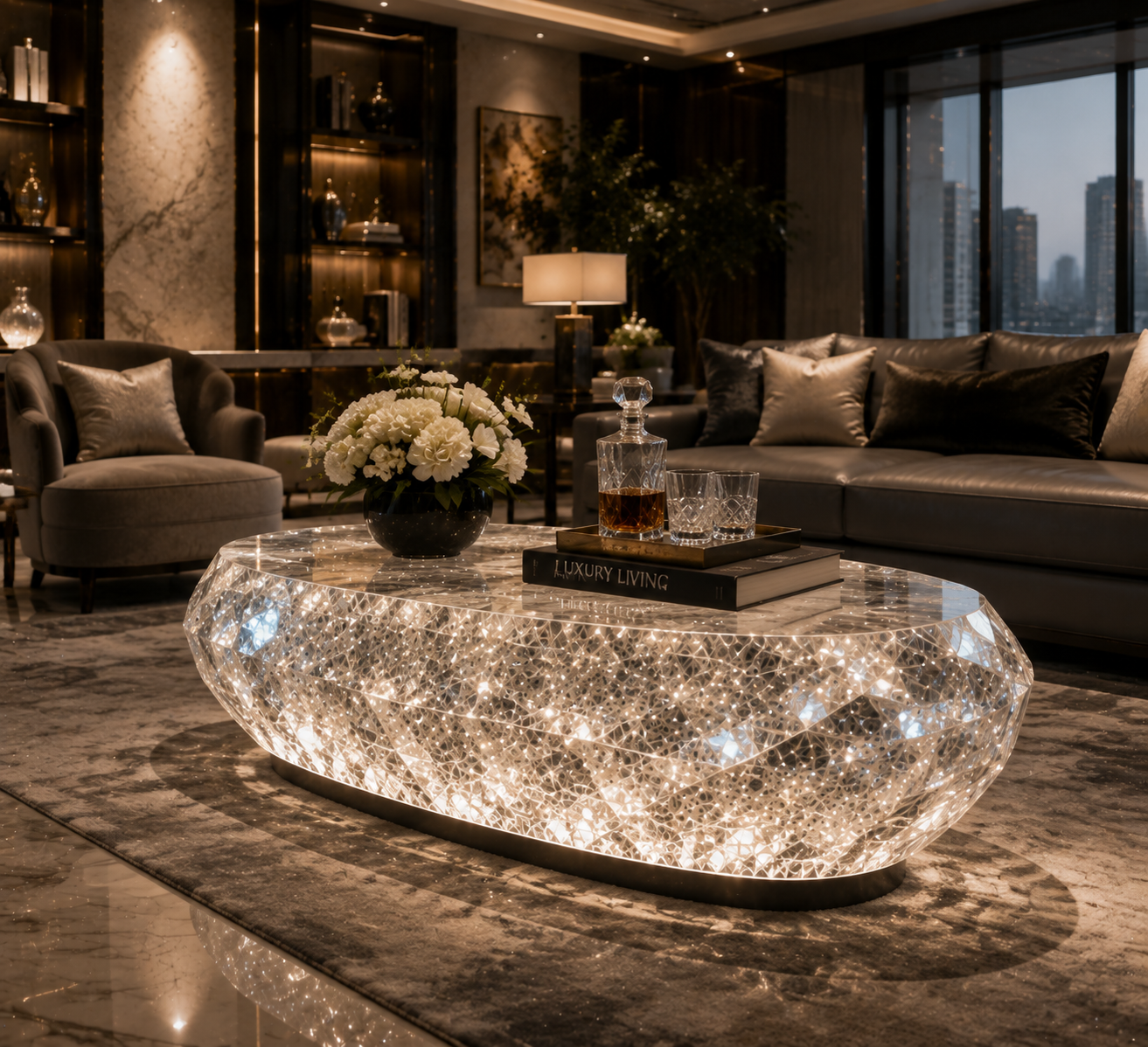
Scale Influences Whether Furniture Feels Premium
Scale is another important hidden factor.
Luxury interiors often contain larger architectural volumes than ordinary residential spaces. Furniture that appears substantial in a showroom may look undersized once installed in a large villa, hotel lobby, or flagship store.
Transparent furniture presents a particularly interesting challenge because transparency already reduces perceived visual weight.
A piece may therefore need greater physical scale to achieve the desired presence.
Designers frequently compensate through thickness, width, height, or sculptural geometry.
When scale is appropriate, synthetic crystal furniture can anchor a large interior without making it feel crowded.
When scale is incorrect, even high-quality furniture can appear insignificant.
Premium design always considers the relationship between object and environment.
The Surrounding Materials Affect Perceived Value
Furniture does not exist in isolation.
A transparent table placed beside inexpensive finishes may feel very different from the same table positioned against natural stone, textured plaster, premium upholstery, or carefully detailed metalwork.
Material contrast can strengthen the perception of synthetic crystal.
Transparent surfaces work particularly well beside materials with strong texture.
Stone provides weight.
Wood provides warmth.
Metal provides precision.
Leather and textiles provide softness.
Synthetic crystal introduces clarity and visual lightness.
The contrast between these materials can create a more sophisticated environment than using any one of them alone.
This is why high-end designers often use synthetic crystal as part of a broader material composition rather than as a standalone decorative effect.
Minimalism Requires Better Quality, Not Less Quality
There is a common misunderstanding that minimalist furniture should be easier to manufacture because it contains fewer elements.
In reality, minimalism increases the importance of every detail.
When a synthetic crystal table consists of only three or four major components, each component becomes visually critical.
There is nowhere for imperfections to hide.
A tiny misalignment becomes noticeable.
A poorly polished edge attracts attention.
An incorrect proportion affects the entire silhouette.
Luxury minimalism depends on precision.
The simplicity is visual, not technical.
This is one reason premium transparent furniture can require significant craftsmanship even when the design appears extremely straightforward.
Weight and Stability Influence Perception
People often evaluate furniture through touch as well as sight.
When a piece feels unstable, flexible, or fragile, its perceived value immediately declines.
This is particularly important with transparent furniture because visual lightness can sometimes create an expectation of physical weakness.
High-end synthetic crystal furniture should challenge that expectation.
A well-designed table may look almost weightless but feel extremely stable when touched.
That contrast can create a strong impression of quality.
Structural confidence is part of luxury.
The furniture should feel deliberate rather than temporary.
Customization Separates Premium Furniture From Mass Production
Mass-produced transparent furniture is often designed around manufacturing efficiency.
Dimensions are standardized.
Material thickness is optimized for cost.
Shapes are simplified for high-volume production.
Finishing processes are designed for consistency rather than individuality.
Custom synthetic crystal furniture follows a different logic.
It can be developed around the architecture, the client, the project, and the intended experience.
Dimensions can respond precisely to a particular wall.
A table can be proportioned around a specific seating arrangement.
Material thickness can be selected for visual effect.
Colors or finishes can align with the project's identity.
This degree of customization immediately separates statement furniture from ordinary products.
The piece belongs to the space.
Premium Furniture Should Look Good From Every Angle
Commercial furniture and statement residential pieces are rarely viewed from only one direction.
People walk around them.
They sit beside them.
They see them from above, below, and across the room.
Transparent furniture makes this particularly important because the internal structure is visible from multiple perspectives.
A piece that looks attractive from the front but awkward from the side will not feel truly premium.
This is why designers must think three-dimensionally.
The proportions, connections, thickness, and structural logic should remain visually coherent from every viewing angle.
Luxury furniture is designed in the round.
Photography Can Reveal Weaknesses That Are Easy to Miss
Today's furniture is not only experienced in physical spaces.
It is constantly photographed.
Interior designers document completed projects. Hotels publish promotional imagery. Retail brands share store designs online. Homeowners post interiors on social platforms.
Cameras often reveal details that casual observation may overlook.
Reflections expose surface quality.
Lighting highlights imperfections.
Geometric distortions become more obvious.
For manufacturers of premium synthetic crystal furniture, this raises the standard even further.
Furniture must perform both physically and visually.
It must look impressive in person and remain refined through a camera lens.
Packaging and Installation Also Affect Final Quality
The quality of a luxury furniture piece can be compromised even after manufacturing is complete.
Transparent surfaces require careful handling.
Improper packaging can cause scratches.
Poor transportation planning can damage polished edges.
Incorrect installation can create alignment problems.
For custom synthetic crystal furniture, delivery and installation should therefore be treated as part of the production process.
Large statement pieces may require specialized packaging, protective films, custom crates, or installation planning.
The objective is simple: the furniture should arrive in the space looking exactly as intended.
A premium product deserves a premium final mile.
Why High-End Synthetic Crystal Is Different From Ordinary Acrylic Furniture
The difference between ordinary acrylic furniture and high-end synthetic crystal furniture is not defined by one feature.
It is the result of many details working together.
Material clarity.
Thickness.
Proportion.
Polishing.
Bonding.
Engineering.
Surface finishing.
Manufacturing tolerance.
Customization.
Lighting interaction.
Installation.
Each element may seem relatively small when considered separately.
Together, they determine whether transparent furniture feels architectural or disposable.
This is the hidden structure of perceived luxury.
What Designers Should Look for Before Specifying Transparent Furniture
For designers, architects, developers, and purchasing professionals, evaluating transparent furniture should go beyond asking whether the material is clear.
The more useful questions involve craftsmanship and execution.
How consistent is the material?
How are the edges finished?
How visible are the connections?
How does the furniture behave under strong lighting?
Does the thickness suit the scale?
Is the structure visually balanced?
Can the manufacturer customize dimensions?
Can the final product maintain the designer's original proportions?
How is the furniture packaged and delivered?
These considerations help distinguish a true premium product from something that merely imitates the appearance of luxury.
Choosing the Right Synthetic Crystal Furniture Manufacturer
A high-end synthetic crystal furniture project depends heavily on the manufacturer's experience.
Material expertise matters because different applications require different decisions regarding thickness, geometry, structural support, and finishing.
Production capability matters because large or unusual forms require accuracy.
Craftsmanship matters because transparent materials reveal every detail.
Communication matters because custom projects often evolve during development.
The right manufacturer should understand both engineering and aesthetics.
It should be able to interpret drawings, discuss practical limitations, recommend appropriate solutions, and preserve the intended visual character of the design.
For high-end projects, manufacturing should not be treated as a separate stage after design.
It should be part of the design process.
The Real Meaning of Expensive-Looking Transparent Furniture
When people describe a transparent furniture piece as “expensive-looking,” they are usually responding to a combination of qualities rather than price alone.
They see clarity.
They see precision.
They see confidence in proportion.
They see surfaces that interact beautifully with light.
They see joints that do not distract from the design.
They feel stability when they touch the piece.
They recognize that the object has been considered carefully rather than produced as quickly as possible.
This is why luxury cannot simply be added through branding or marketing language.
The product itself must communicate quality.
Conclusion: Luxury Is Hidden in the Details You Cannot Ignore
Transparent furniture appears simple because the material allows us to see through it, but achieving that apparent simplicity requires exceptional control over almost every aspect of design and manufacturing.
For high-end synthetic crystal furniture, luxury is created through optical clarity, carefully selected thickness, refined edge polishing, invisible structural thinking, precise bonding, balanced proportions, flawless surfaces, and craftsmanship that remains consistent from every viewing angle.
These details determine whether a transparent table feels like a commodity or a collectible design object, whether a console disappears into a room or quietly defines it, and whether a furniture piece merely follows a trend or becomes part of the architecture itself.
For designers and luxury buyers, the real difference between expensive and cheap transparent furniture is rarely one dramatic feature; it is the accumulation of hundreds of small decisions executed correctly.
And once you learn to recognize those details, you may never look at transparent furniture the same way again.
READ MORE:
- How Boutique Hotels and Luxury Spaces Use Crystal-Like Furniture to Create Memorable Experiences
- Why Luxury Buyers Choose Statement Furniture Instead of Ordinary Interior Pieces
- How Designers Are Redefining Acrylic as a Premium Material for Modern Commercial Spaces
- Why High-End Acrylic Furniture Is Becoming a New Choice for Luxury Interior Projects
- Il mobile non deve essere soltanto un mobile: creare un punto focale negli spazi commerciali con il cristallo sintetico
- Far risplendere lo spazio più di notte che di giorno: 3 strategie di illuminazione per gli arredi in cristallo sintetico
- Want a More Memorable Commercial Space? Try Synthetic Crystal Furniture That "Catches the Light"
- Quando si accende la luce, il mobile cambia: come gli arredi in cristallo sintetico diventano installazioni di luce e ombra?
- Come creare un senso di lusso stratificato negli spazi commerciali con luce, ombra e arredi in cristallo sintetico


