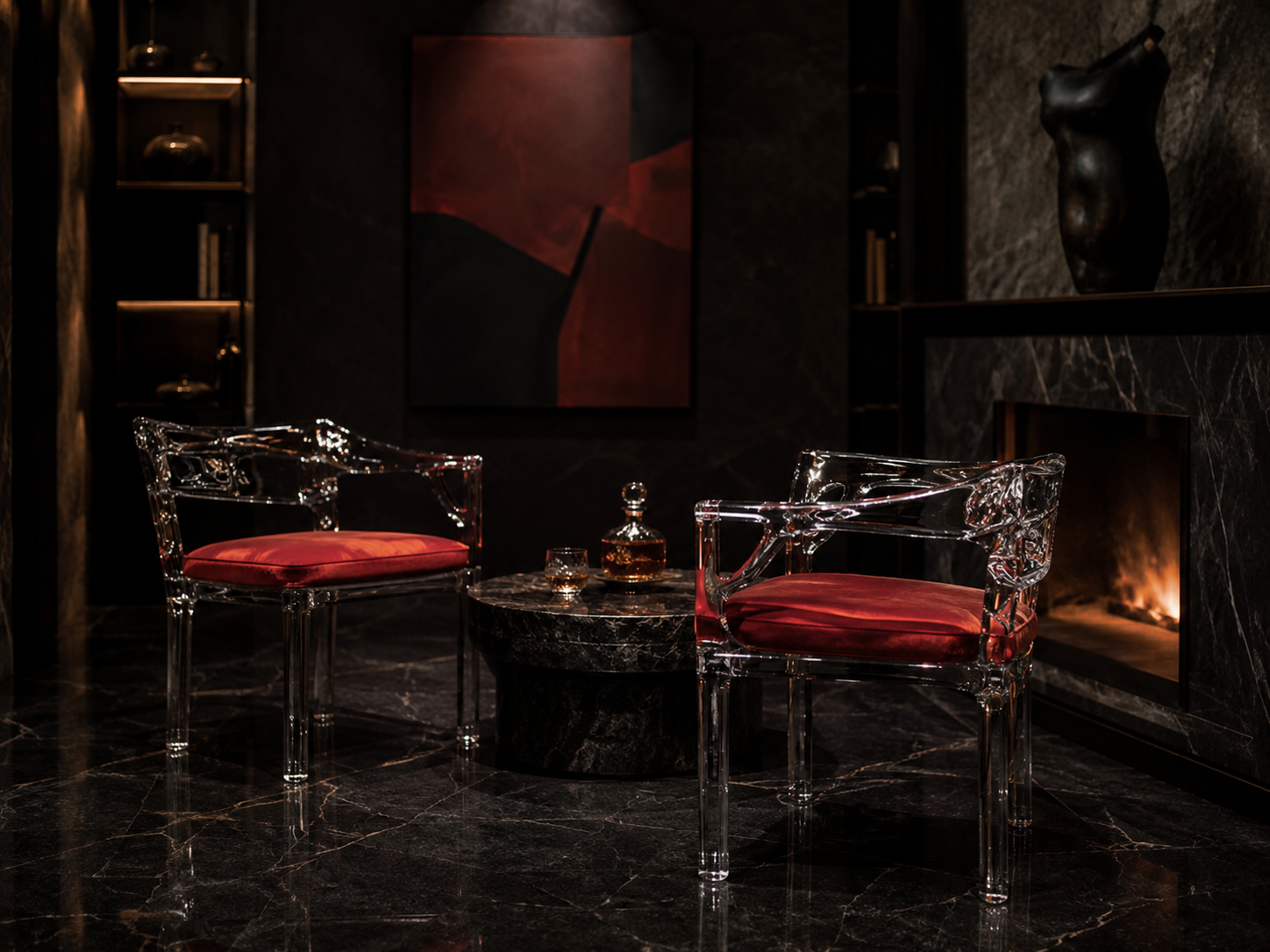
Ordering large transparent furniture for an international project looks straightforward on paper.
A buyer confirms the design, dimensions, material, quantity, finish, and price. The manufacturer produces the pieces. The furniture is packed, shipped, delivered, and installed.
In reality, large-format custom furniture is far more complex.
The larger the piece becomes, the more every decision matters. Material thickness affects weight. Weight affects handling. Handling affects packaging. Packaging affects container planning. Container planning affects freight cost. Freight affects delivery routes. Delivery routes affect installation. And installation conditions can determine whether an excellent piece arrives as an excellent finished result.
For buyers sourcing high-end synthetic crystal furniture for hotels, villas, flagship stores, restaurants, clubs, galleries, offices, and other international projects, the greatest risks often come from details that are not discussed early enough.
A table can be beautifully designed and perfectly manufactured but still create problems if it cannot pass through the entrance of the building.
A large console can look impressive in renderings but become expensive to ship if its structure was never optimized for packing.
A transparent reception desk can meet the visual expectations of the designer yet become difficult to install if the final site dimensions are slightly different from the approved drawings.
This is why successful international projects require more than good furniture.
They require coordination between design, manufacturing, logistics, packaging, site conditions, and installation.

Large Synthetic Crystal Furniture Is Not Just a Bigger Version of a Small Piece
One of the first mistakes buyers make is assuming that increasing the dimensions of a piece does not fundamentally change the project.
It does.
A small side table and a large synthetic crystal dining table may share the same design language, but they behave very differently during production, transportation, and installation.
As dimensions increase, material weight rises significantly.
Long transparent panels require greater control during machining.
Large surfaces become more difficult to handle without scratching.
Structural loads become more important.
Bonding areas may need to be reconsidered.
Packaging becomes more complex.
The number of people required for installation may increase.
This means scaling furniture is not simply a matter of multiplying dimensions.
The structure may need to be redesigned for scale.
For high-end international projects, this should be discussed during the design stage rather than after production begins.
Material Thickness Should Be Chosen for More Than Appearance
Thickness is one of the most visible characteristics of synthetic crystal furniture.
Thick material can create impressive optical depth, stronger edge reflections, and a substantial architectural presence.
But thickness also affects practical factors.
It increases weight.
It influences structural behavior.
It changes machining requirements.
It affects shipping volume.
It may affect how the furniture needs to be lifted and installed.
Buyers sometimes select thickness purely from renderings or aesthetic preferences without considering these consequences.
The right thickness should balance visual intent, structural requirements, handling, transportation, and cost.
For example, an extremely thick tabletop may look impressive, but if the base, floor loading, access route, or installation process has not been planned accordingly, the decision can create unnecessary complications.
High-end design is not about maximizing material.
It is about choosing the correct amount of material for the intended result.
Weight Is Frequently Underestimated
Transparent furniture looks visually light.
That creates a psychological problem.
People often underestimate how heavy a large piece can actually be.
Synthetic crystal furniture may appear almost weightless because the viewer can see through it, but large sections can still have considerable mass.
This matters at almost every stage.
Can the factory team move the piece safely?
Can the crate be handled by normal warehouse equipment?
Does the project site have a freight elevator?
Can the building floor support the temporary load during installation?
How many installers are required?
Are lifting tools necessary?
Can the final piece be rotated or positioned inside the room?
These questions may sound operational, but they can directly affect design decisions.
In some cases, a modular construction may provide a better solution than producing the piece as one enormous unit.
The important point is to consider weight before the furniture exists physically.
Buyers Often Forget to Check Building Access
One of the most common problems in international furniture projects happens at the destination.
The furniture reaches the building.
Then it cannot get inside.
This can happen even when the furniture dimensions fit perfectly within the final room.
The route from the unloading area to the installation position may contain multiple restrictions.
Door widths.
Corridor turns.
Elevator dimensions.
Staircases.
Ceiling heights.
Lobby entrances.
Service entrances.
Loading docks.
Temporary construction barriers.
A large transparent table may fit inside a hotel suite but not inside the elevator serving that floor.
A custom console may fit through the front entrance but not around a narrow corridor corner.
This is why site access measurements should be collected before manufacturing.
For particularly large pieces, designers and buyers should consider the entire movement path, not simply the final location.
Final Site Dimensions Need Verification
Custom furniture is usually developed from architectural drawings.
But construction drawings and finished site conditions are not always identical.
Walls may shift slightly.
Floor finishes may add thickness.
Skirting or baseboards may reduce available space.
Built-in elements may be installed differently from the original plan.
Electrical outlets, floor boxes, or lighting controls may appear near the intended furniture location.
For freestanding furniture, small differences may not matter.
For large custom consoles, reception elements, display structures, or pieces designed to align precisely with architecture, they can matter significantly.
Final dimensions should therefore be confirmed before production whenever possible.
A few centimeters can determine whether a piece feels perfectly integrated or obviously wrong.
Shipping Dimensions Can Be More Important Than Furniture Dimensions
Buyers naturally focus on the size of the furniture.
Logistics teams focus on the size of the crate.
These are not the same thing.
Protective packaging adds significant dimensions.
Foam, corner protection, internal support, wooden framing, and outer crates all increase the overall volume.
A table that appears to fit comfortably within a shipping plan may become much larger once properly packed.
This affects container utilization and freight costs.
For international projects, manufacturers should consider packaging dimensions early, especially for large quantities or oversized pieces.
Efficient packaging does not mean reducing protection.
It means designing the furniture and crate intelligently so that both product safety and shipping efficiency are considered.
One-Piece Construction Is Not Always the Best Choice
Clients often assume that a one-piece structure is inherently more premium.
Sometimes it is.
But not always.
For large international projects, modular construction can provide important advantages.
Smaller components may be easier to machine, polish, pack, transport, move through buildings, and install.
A modular design may also reduce the risk of shipping damage.
The challenge is maintaining the visual quality of the finished piece.
Connections need to be carefully engineered so that the furniture still feels refined rather than obviously assembled.
When properly designed, modular synthetic crystal furniture can offer the appearance of a substantial custom piece while greatly simplifying logistics.
The decision should depend on project conditions, not assumptions about what sounds more luxurious.
Packaging Quality Is Part of Product Quality
For local furniture deliveries, packaging may be relatively straightforward.
International shipping is different.
A large piece may be handled multiple times.
It may move from factory to warehouse, warehouse to port, port to vessel, vessel to destination port, destination port to local warehouse, and finally to the project site.
Every stage introduces risk.
Vibration.
Impact.
Pressure.
Humidity.
Dust.
Incorrect handling.
Stacking.
Forklift contact.
Large synthetic crystal surfaces require particularly careful protection because scratches and edge damage can immediately reduce the appearance of the final piece.
Premium international furniture therefore needs packaging engineered for the actual transport journey.
Protective film alone is not enough.
The crate structure, internal cushioning, fixing method, corner protection, and movement control should all be considered.
Surface Protection Should Be Planned From Factory to Installation
Transparent furniture has one major disadvantage during logistics: every scratch can become visible.
A small surface mark that might disappear into the texture of wood can be obvious on a polished clear surface.
This means protection should remain in place as long as practical.
Premature removal of protective film can expose furniture during warehouse handling or site construction.
But protective materials also need to be selected carefully to avoid adhesive residue or surface issues.
The best approach is to treat the furniture as unfinished until it has reached the final installation position and passed inspection.
For luxury projects, the installation team should understand how and when surface protection should be removed.
Container Planning Can Affect the Entire Order
For large international projects, furniture is often shipped by sea.
Container planning can therefore have a major effect on project cost and efficiency.
Oversized pieces may occupy more volume than expected.
Certain crate dimensions can result in poor container utilization.
Furniture that cannot be stacked may leave large areas of unused space.
Multiple large pieces may require careful loading sequences.
In some cases, adjusting a furniture dimension or using modular construction can significantly improve shipping efficiency without changing the visual result.
This is why logistics should not always be treated as a final-stage concern.
For major projects, it can influence product engineering from the beginning.
Buyers Should Clarify Incoterms Early
International projects involve more than manufacturing and freight.
Responsibility for transportation, customs, insurance, port charges, local delivery, and other costs should be clearly defined.
Incoterms help establish which party is responsible at different stages of the shipment.
Buyers should understand what is included in the quotation.
Does the price cover delivery to the port?
Does it include ocean freight?
Does it include destination charges?
Who is responsible for customs clearance?
Who arranges final delivery?
Unclear assumptions can result in unexpected costs.
This is particularly important when comparing quotations from different suppliers.
A lower product price may not represent a lower total landed cost if logistics responsibilities are structured differently.
Customs Classification Should Not Be an Afterthought
Furniture made from synthetic crystal may need to be classified appropriately for import purposes.
Customs classification can influence duty rates, documentation requirements, and clearance procedures.
The exact treatment varies by destination country and product type.
For large commercial projects, buyers should confirm local import requirements with their customs broker or logistics provider before shipment.
This helps prevent delays at the destination port.
A beautifully manufactured product has little value if it sits in customs because documentation was incomplete or classifications were misunderstood.
International sourcing requires administrative precision as well as manufacturing precision.
Documentation Needs to Match the Shipment
Commercial invoices, packing lists, bills of lading, certificates, product descriptions, country-of-origin information, and other documents may be required depending on the destination.
Inaccuracies can create delays.
Quantities should match.
Product descriptions should be clear.
Crate numbers should correspond with packing lists.
Dimensions and weights should be accurate.
For multi-piece projects, structured documentation also makes on-site receiving easier.
The client can verify which crates have arrived and identify which furniture belongs in which location.
Good documentation reduces confusion throughout the supply chain.
Buyers Should Understand the Difference Between Net Weight and Gross Weight
Net weight refers to the furniture itself.
Gross weight includes packaging.
For large synthetic crystal furniture, the difference can be substantial.
A strong wooden crate may add significant weight.
This matters for freight calculations, handling equipment, local delivery vehicles, and installation planning.
Buyers who plan based only on product weight may underestimate the actual logistics requirements.
Accurate gross weight information should be available before shipment.
Insurance Matters More for Custom Furniture
Custom pieces are difficult to replace quickly.
If a standardized chair is damaged, another unit may be available from inventory.
If a large customized synthetic crystal table is damaged during international transportation, replacement may require new material, new production, new polishing, new packaging, and another shipment.
That can affect the entire project schedule.
Cargo insurance should therefore be considered carefully.
The buyer should understand what types of loss or damage are covered and what documentation would be required if a claim needs to be made.
Insurance does not prevent damage.
But it can reduce financial exposure when unforeseen problems occur.
Installation Is Often More Complex Than Buyers Expect
Large transparent furniture frequently appears simple because the finished design may contain only a few visible elements.
But installation can still be complex.
Components may need to be positioned in a specific order.
Some pieces may require temporary supports.
Heavy parts may need lifting equipment.
Connections must be aligned carefully.
Surfaces need protection during assembly.
The final piece may require leveling.
For synthetic crystal, care is especially important because rough handling can damage polished surfaces or edges.
Installation instructions should therefore be prepared for complex pieces.
Where possible, the manufacturer should provide diagrams, photos, or video guidance.
Local Installation Teams Need Clear Information
For international projects, the manufacturer may not be physically present at installation.
This means the local contractor or furniture installer needs to understand exactly how the piece should be handled.
A professional installation package can include component identification, assembly sequence, lifting recommendations, hardware information, protection instructions, and final cleaning guidance.
Without this information, even experienced installers may make assumptions that are inappropriate for the product.
A small amount of preparation can prevent a major on-site problem.
Elevators Are a Hidden Constraint
Freight elevators are one of the most important details in large furniture projects.
Their published dimensions may not tell the entire story.
The door opening may be smaller than the internal cabin.
Protective wall panels may reduce available space.
The piece may fit horizontally but not allow enough room to rotate.
Weight limits also matter.
For large hotel or residential projects, buyers should verify both the elevator cabin and the door opening.
If the furniture cannot use the elevator, alternative access may involve stairs, cranes, external lifting, or partial assembly on site.
These alternatives can add significant cost.
Crane Lifting Should Be Considered Before Delivery Day
Some oversized pieces can only reach their final destination through external lifting.
This may be necessary for high-rise residences, penthouses, buildings with narrow access, or projects where large windows can temporarily provide entry.
Crane lifting requires planning.
Permits may be necessary.
Windows or façade elements may need temporary removal.
Weather conditions can matter.
Local contractors need to coordinate timing.
The furniture itself may require lifting points or protective structures.
This should never be discovered after the shipment arrives.
Climate Conditions Can Affect Handling and Storage
International furniture may travel through dramatically different climates.
High humidity.
Extreme heat.
Cold conditions.
Coastal environments.
Air-conditioned warehouses.
Unfinished construction sites.
While high-quality synthetic crystal is suitable for many interior applications, storage and handling conditions should still be controlled appropriately.
Crates should not be left in unsuitable environments for unnecessary periods.
Furniture should be protected from construction debris, abrasive dust, and uncontrolled handling.
The project team should understand storage requirements before the shipment arrives.
Construction Sites Are Dangerous Places for Finished Furniture
One of the biggest mistakes in luxury projects is delivering furniture too early.
A nearly completed building can still contain considerable risk.
Workers may be carrying tools.
Dust may remain in the air.
Painting or finishing may still be underway.
Other furniture may still be moving through the space.
Synthetic crystal surfaces can be damaged by careless contact.
Ideally, high-end furniture should arrive when the installation area is sufficiently complete and protected.
If early delivery is unavoidable, secure storage should be arranged.
Cleaning Methods Should Be Confirmed Before Handover
Transparent furniture requires appropriate maintenance.
Using the wrong cleaning materials can damage surfaces or affect appearance.
Project teams should receive clear care instructions.
Cleaning personnel should know which products are suitable and which should be avoided.
This is especially important in hotels, restaurants, retail stores, and other commercial environments where multiple staff members may clean the furniture over its lifetime.
A premium piece should not be damaged by routine maintenance.
Buyers Often Focus Too Much on Unit Price
Price matters.
But for international custom furniture, unit price is only one part of the total project cost.
Buyers should consider:
Manufacturing.
Packaging.
Inland transportation.
Export handling.
Ocean or air freight.
Insurance.
Import duties.
Customs clearance.
Destination port charges.
Local transport.
Special lifting.
Installation.
Potential storage.
Replacement risk.
A piece with a slightly higher factory price may ultimately be more economical if it is engineered for efficient shipping, packed correctly, and easy to install.
Total landed cost is often a more useful comparison than product price alone.
Design Changes Become More Expensive Later in the Process
Custom synthetic crystal furniture requires significant preparation.
Material may be ordered specifically for the project.
Machining programs may be prepared.
Jigs or fixtures may be created.
Components may already be cut.
Late design changes can therefore affect cost and schedule.
Buyers should review dimensions, proportions, finishes, and structural details carefully during drawing approval.
This is particularly important when multiple stakeholders are involved.
Interior designers.
Architects.
Contractors.
Purchasing companies.
Owners.
Hotel operators.
All relevant parties should confirm the final design before production starts.
Samples Are Useful, but They Do Not Tell the Whole Story
Material samples can help buyers evaluate clarity, color, thickness, and finishing.
But a small sample cannot fully represent the experience of a large furniture piece.
Scale changes perception.
A 20-millimeter sample may look excellent in the hand, but the visual impact of a large table depends on proportion, edge length, geometry, and surrounding lighting.
For major projects, prototypes, mock-ups, detailed photographs, production videos, or 3D visualization may help stakeholders understand the final result more accurately.
This is especially valuable for highly customized statement pieces.
Quality Control Should Happen Before Packing
Once a large synthetic crystal piece is packed into a strong export crate, inspection becomes much more difficult.
Quality control should therefore be completed before packing.
Dimensions should be checked.
Surfaces should be inspected.
Edges should be reviewed.
Connections should be verified.
The piece should be photographed from multiple angles.
Where appropriate, final assembly should be tested before disassembly and packing.
This documentation can also provide valuable reference material if questions arise during installation.
Pre-Shipment Photos Can Prevent Misunderstandings
For international buyers, pre-shipment documentation is extremely useful.
Clear photographs and videos can confirm that the finished furniture matches approved specifications before it leaves the factory.
They can show overall appearance, surface condition, packaging method, crate labeling, and component organization.
This creates transparency between buyer and manufacturer.
It also helps local teams understand what they should expect when the shipment arrives.
Crate Labeling Is More Important on Large Projects
Imagine a hotel project receiving dozens of wooden crates at once.
Without clear labeling, installation can quickly become chaotic.
Each crate should be easy to identify.
Project name.
Item number.
Room or area.
Quantity.
Handling direction.
Fragile warnings.
Crate sequence where necessary.
For modular furniture, individual components may also need labels.
Simple organization at the factory can save considerable time on site.
Spare Parts and Repair Planning Should Be Discussed
For complex custom pieces, buyers should consider whether any hardware, connectors, protective pads, or other small components should be shipped as spares.
These items may be inexpensive at the factory but difficult to replace locally if they are unique to the design.
The same applies to potential repair procedures.
If minor surface damage occurs during future use, the client should know what options are available.
Long-term serviceability is part of responsible furniture specification.
Project Schedules Need Logistics Buffer
International shipping does not always follow the ideal schedule.
Ports can experience congestion.
Customs clearance can take longer than expected.
Weather can affect vessels.
Local delivery appointments may change.
Large custom furniture should therefore not be scheduled to arrive immediately before a hotel opening or important event unless the project team is prepared for risk.
A reasonable logistics buffer can protect the overall project schedule.
The closer furniture delivery is to the final deadline, the more expensive any delay becomes.
Communication Becomes Critical Across Time Zones
International projects involve many parties.
Buyer.
Designer.
Manufacturer.
Freight forwarder.
Customs broker.
Contractor.
Installer.
Site manager.
When these teams operate in different countries and time zones, communication needs to be structured.
Final drawings should be clearly versioned.
Changes should be recorded.
Responsibilities should be defined.
Packing lists should be shared.
Delivery contacts should be confirmed.
Installation requirements should be understood before shipment.
Good communication prevents small assumptions from becoming expensive problems.
Custom Synthetic Crystal Furniture Benefits From Early Engineering
The strongest international projects involve the manufacturer early.
When a manufacturer sees the concept before all design decisions are finalized, practical recommendations can often be incorporated without changing the design intention.
A large table might be divided at a visually logical location.
A base might be redesigned to reduce shipping volume.
A connection detail might be adjusted to simplify installation.
Material thickness might be optimized.
Packaging may be planned around container dimensions.
These decisions can improve the project significantly.
Engineering should not be seen as something that limits design.
Used correctly, it protects design.
Why Experience Matters in International Projects
Manufacturing beautiful furniture is one skill.
Shipping large custom furniture internationally is another.
Projects benefit from suppliers who understand both.
An experienced synthetic crystal furniture manufacturer should think beyond the factory floor.
How will the piece be packed?
How will it be moved?
How will it enter the building?
How will it be assembled?
What will the installer need to know?
How can surfaces be protected?
What information does the buyer need before shipping?
These questions reveal whether a supplier is thinking about the complete project rather than only production.
The Best Time to Solve Logistics Problems Is Before Production
Almost every logistics problem becomes more expensive after the furniture has been manufactured.
A piece that is too large for an elevator may need to be redesigned.
A crate that is too large for the planned container may require expensive shipping changes.
A table that cannot be assembled on site may create installation delays.
A component without proper lifting points may require improvised handling.
All of these problems can often be avoided through early planning.
The best international projects treat logistics as part of product development.
Not as something that happens afterward.
A Professional Supplier Should Ask Difficult Questions
Buyers sometimes interpret too many questions as a sign that a supplier is making the project complicated.
In reality, the opposite may be true.
For large custom furniture, a responsible manufacturer should ask questions.
Where is the project located?
What are the access dimensions?
Will the furniture use a freight elevator?
Is one-piece construction required?
What are the site conditions?
Who will install it?
Does the buyer need assembly instructions?
Are there container restrictions?
When is the required delivery date?
The purpose of these questions is not to slow down the order.
It is to prevent problems that would be much harder to solve later.
International Luxury Projects Require Invisible Planning
When an international project is executed well, the final result looks effortless.
The furniture arrives.
The crates are identified.
The pieces fit through the building.
The installation team understands the process.
The components align.
The protective film is removed.
The surfaces are cleaned.
The finished synthetic crystal table stands exactly where the designer intended.
Guests and clients see none of the planning behind it.
They simply see beautiful furniture.
That invisibility is the result of professional preparation.
Conclusion: The Furniture Is Only One Part of the Order
Ordering large acrylic furniture for an international project is not simply a purchasing decision. It is a coordination exercise involving material selection, structural design, scale, packaging, shipping, customs, access, handling, installation, and long-term maintenance.
For high-end synthetic crystal furniture, these considerations become even more important because the visual standard is high and the pieces are often customized specifically for the architecture.
Buyers who think only about appearance and unit price may discover hidden costs later.
Buyers who consider the complete journey from drawing to final installation are far more likely to achieve the result they expected.
The most successful projects are not necessarily the ones with the simplest furniture, but the ones where every invisible detail has been considered before the first piece is cut.
Because when a large custom table has to cross an ocean before it can become part of a luxury interior, the most important question may not be “Can it be made?” but “Have we planned everything that must happen after it is made?”
READ MORE:
- Why Product Photography Can Misrepresent the True Quality of Clear Acrylic Furniture
- When Should Acrylic Furniture Be the Focal Point—and When Should It Stay Visually Quiet?
- Why the Same Acrylic Table Can Look Sophisticated in One Room and Out of Place in Another
- How Lighting Changes the Color, Depth, and Presence of Clear Acrylic Furniture
- Le 4 domande che i designer di hotel fanno più spesso quando scelgono mobili in cristallo sintetico
- I 3 problemi dei materiali che preoccupano di più negli upgrade alberghieri: quali può risolvere l’arredo in cristallo sintetico?
- Da una lobby ordinaria a uno spazio premium: come tavolini da caffè e side table in cristallo sintetico diventano il punto focale del design alberghiero
- Creating a Memorable Hotel Space Without an Expensive Renovation: A Light-Touch Upgrade Strategy with Synthetic Crystal Furniture
- Budget limitato: come aumentare il valore percepito della lobby di un hotel con arredi in cristallo sintetico


