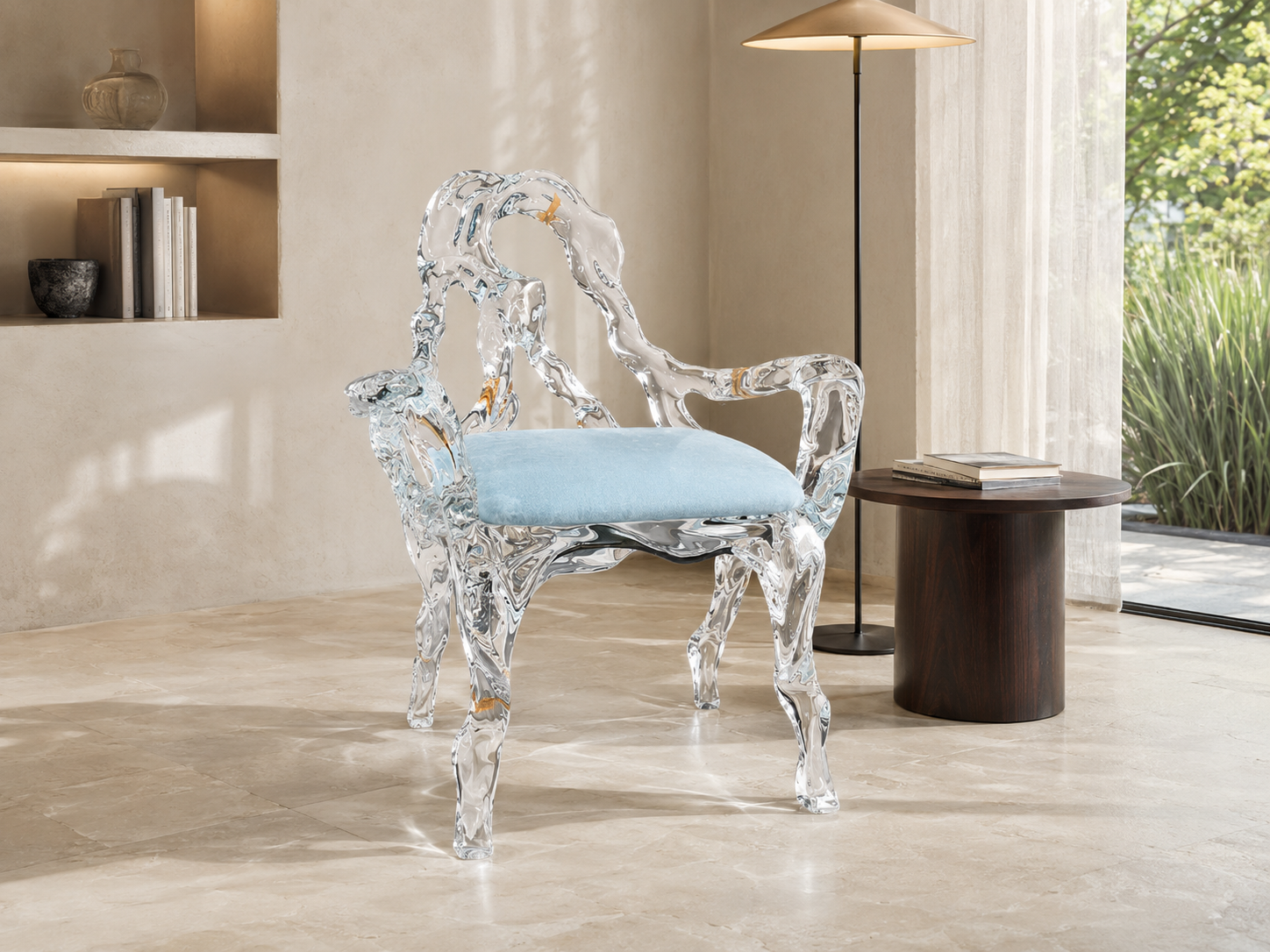
Transparent furniture has a unique ability to do two seemingly opposite things.
It can become the most memorable object in a room, or it can almost disappear.
That duality is one of the reasons high-end synthetic crystal furniture has become increasingly valuable in luxury residential, hospitality, retail, and commercial interiors. Unlike opaque furniture, which usually declares its presence through color, texture, and mass, transparent furniture can shift between visual prominence and restraint depending on its scale, thickness, geometry, placement, lighting, and relationship with surrounding materials.
For designers, this flexibility creates both opportunity and responsibility.
A sculptural synthetic crystal table can define an entire lobby. A transparent console can reinforce a luxury interior without competing with artwork. A clear display table can support premium products while remaining visually quiet. The challenge is knowing which role the furniture should play.
Not every transparent piece should be a statement.
And not every transparent piece should disappear.
The strongest interiors are the ones where the designer has made that decision intentionally.
The First Question Is Not “Is the Furniture Beautiful?”
It is easy to evaluate furniture as an isolated object.
Is the shape elegant?
Is the material clear?
Are the proportions refined?
Does the piece feel premium?
These questions matter, but they are incomplete.
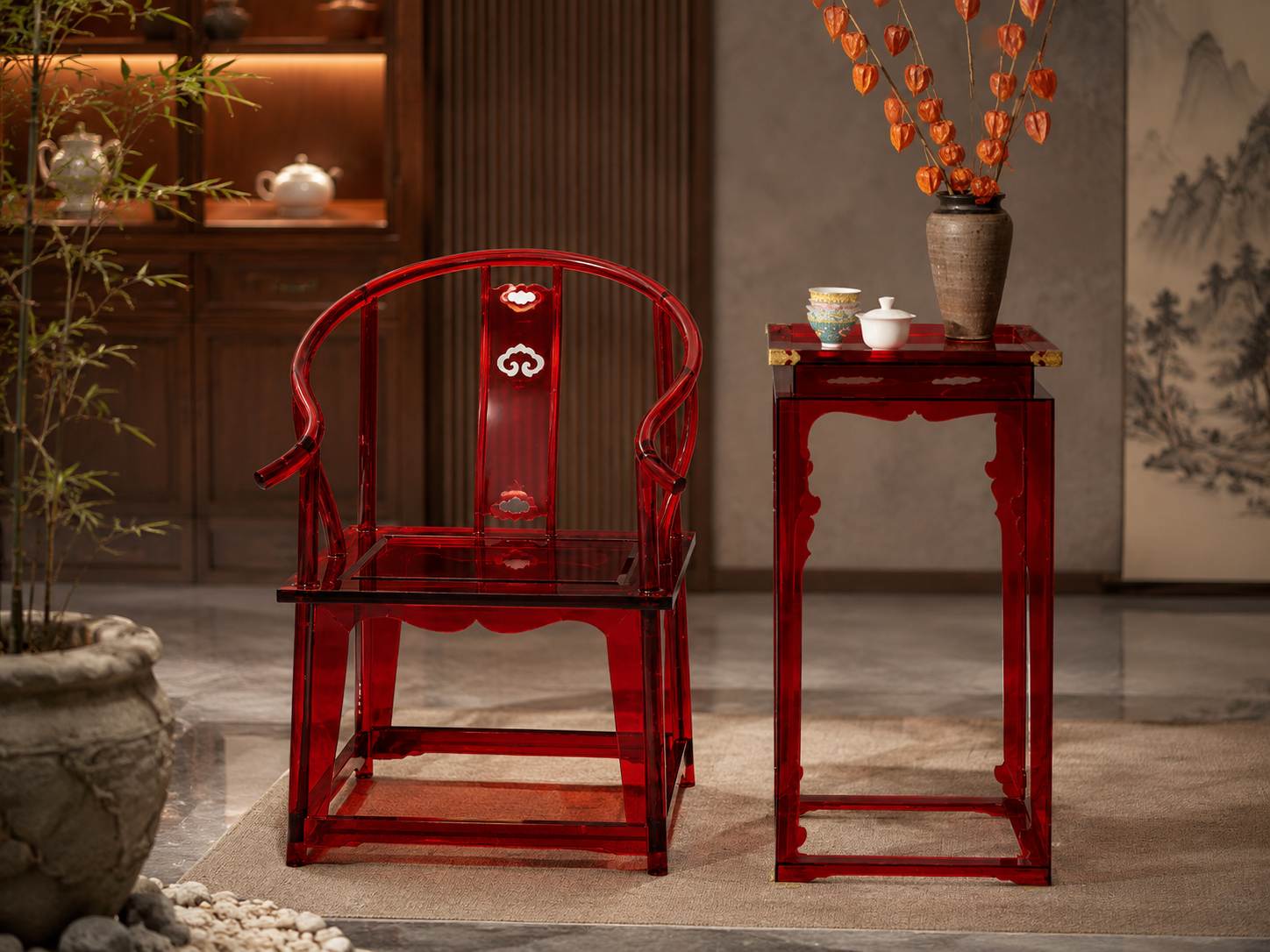
The more important question is: what role should this piece play in the room?
A beautiful table can still be wrong if it competes with something more important.
A simple transparent console can be exactly right if its purpose is to support the architecture.
This is especially true with synthetic crystal because transparency changes the usual hierarchy of materials.
The furniture may physically occupy a large area while appearing visually light. A smaller piece with dramatic thickness or polished edges may attract more attention than expected. Lighting can make a quiet object suddenly more prominent.
Designers therefore need to think in terms of visual hierarchy rather than product beauty alone.
What Makes a Piece a Focal Point?
A focal point is the element that naturally attracts attention first.
In interiors, this can be created through scale, contrast, position, color, material, lighting, or unusual form.
Synthetic crystal furniture can achieve focal-point status without relying on strong color.
A large sculptural table can command attention through proportion.
A thick transparent base can create dramatic optical depth.
A polished edge can catch light and produce unexpected brilliance.
An unusual geometry can make a piece feel more like an installation than conventional furniture.
This gives designers a different way to create visual impact.
The furniture can be dramatic without becoming visually heavy.
That combination is particularly powerful in luxury spaces.
When Synthetic Crystal Should Become the Focal Point
There are situations where transparent furniture should be allowed to lead.
This is especially effective when the architecture needs a strong visual anchor.
Large entrance halls, hotel lobbies, open living areas, flagship stores, private clubs, and luxury reception spaces often benefit from one memorable furniture piece that organizes the room.
In these environments, synthetic crystal can create presence without blocking views.
A large statement table in the center of a lobby may define the seating arrangement while preserving the openness of the architecture.
A sculptural reception desk can become the first object visitors notice without feeling visually bulky.
A transparent dining table in a villa can establish the center of the room while allowing stone flooring or views beyond it to remain visible.
In these cases, transparency does not reduce impact.
It makes impact more sophisticated.
Large Spaces Often Need Stronger Transparent Furniture
Scale matters.
In a large interior, transparent furniture can easily become too visually weak.
A standard clear table that looks impressive in a showroom may feel insignificant inside a double-height lobby or expansive villa.
When the furniture is intended to act as a focal point, designers often need to increase its visual authority.
This can be achieved through greater thickness, stronger geometry, wider proportions, or more sculptural forms.
The goal is not simply to make the piece bigger.
It is to make it feel appropriate for the architectural volume.
A successful focal piece should anchor the room without making the room feel crowded.
Synthetic crystal is particularly effective here because it allows designers to increase physical scale while controlling perceived visual mass.
Statement Furniture Works Best When the Surroundings Are Controlled
A focal piece needs space to perform.
If a synthetic crystal table is intended to attract attention, the surrounding furniture should usually be more restrained.
Too many competing statement pieces can weaken the hierarchy.
The table may fight with a dramatic chandelier, a bold artwork, a highly patterned rug, and sculptural seating all at once.
The result is visual noise.
Luxury design is often strongest when one or two elements lead and the others support.
This does not mean the room needs to be minimal.
It means the hierarchy should be clear.
If the synthetic crystal piece is the hero, the surrounding composition should give it enough breathing room to be recognized as such.
Lighting Can Turn Quiet Furniture Into a Statement
Lighting is one of the most powerful tools for controlling the visual role of synthetic crystal furniture.
A transparent table under soft ambient light may feel quiet.
Place a directional light near a polished edge, and the same table can become dramatically more visible.
Backlighting can create glowing outlines.
Side lighting can emphasize thickness.
Overhead lighting can make a tabletop shimmer.
This means designers can sometimes change the visual hierarchy without changing the furniture.
In hospitality spaces, this can be especially useful.
A table may remain understated during the day and become more expressive in the evening.
The furniture can move between background and focal point as the lighting scene changes.
That flexibility is one of the strongest design advantages of synthetic crystal.
When the Furniture Should Stay Visually Quiet
There are many situations where transparent furniture is more effective when it does not lead.
A room may already contain a strong architectural feature.
There may be a major artwork.
There may be a dramatic view.
A retail display may need to emphasize merchandise rather than furniture.
A hotel suite may need to feel calm rather than theatrical.
In these situations, synthetic crystal can play a supporting role.
Its transparency allows function without excessive visual interruption.
A clear console beneath important artwork can provide a surface without covering the wall.
A synthetic crystal table beside a panoramic window can preserve the view.
A transparent display pedestal can support a luxury product without competing with it.
The furniture is still present.
It simply knows when not to ask for attention.
Luxury Retail Often Requires Visual Restraint
Retail is one of the clearest examples of why transparent furniture should sometimes remain quiet.
In a luxury store, the product usually needs to be the focal point.
Handbags, jewelry, watches, cosmetics, footwear, and accessories should attract the customer's eye first.
If the display furniture becomes too dramatic, it can compete with the merchandise.
Synthetic crystal can solve this problem beautifully.
A clear pedestal can elevate a handbag while remaining visually secondary.
A transparent table can support jewelry or watches while allowing product lighting to dominate.
The furniture still contributes to the premium atmosphere through material quality and craftsmanship, but it does not demand recognition.
This is sophisticated restraint.
The furniture supports the brand by knowing when to disappear.
Artwork Often Benefits From Quiet Furniture
The same principle applies in residential and hospitality interiors with important art.
If the artwork is the primary visual focus, nearby furniture should not interfere.
A bold wood console or highly decorative table may introduce too much visual information.
A simple synthetic crystal console can perform the same functional role while preserving the importance of the artwork.
Because the wall remains visible through the furniture, the composition feels lighter.
This is particularly effective with large paintings, textured wall installations, sculptural objects, or dramatic architectural finishes.
The furniture becomes a frame rather than a competitor.
Views Should Usually Win
In high-end villas, penthouses, resorts, and luxury apartments, the view may be one of the most valuable design assets.
Ocean views.
City skylines.
Mountain landscapes.
Private gardens.
These features should usually remain visually dominant.
Opaque furniture placed directly in front of windows can interrupt the visual connection between the interior and exterior.
Synthetic crystal can reduce that problem.
A transparent coffee table or console can preserve sightlines and allow the landscape to remain the primary focal point.
In this context, the furniture succeeds precisely because it does not become the star.
It supports the experience of the architecture.
A Quiet Piece Still Needs Excellent Craftsmanship
Visually quiet does not mean ordinary.
This distinction is important.
A transparent table can be intentionally understated while still requiring exceptional material quality, accurate proportions, precise bonding, and refined edge polishing.
In fact, quiet furniture can be more demanding because there is less design complexity to distract from imperfections.
A minimal synthetic crystal side table may look simple, but every detail is visible.
If the edges are inconsistent, the piece will look inexpensive.
If the joints are obvious, the restraint feels accidental rather than intentional.
If the proportions are weak, the furniture may simply disappear without contributing anything to the room.
True visual quietness is controlled.
It is not the absence of design.
Thickness Helps Determine Visual Volume
Thickness is one of the easiest ways to control how strongly synthetic crystal furniture appears.
Thin components tend to feel lighter and quieter.
Thicker sections create more edge reflection, optical depth, and perceived value.
This does not mean every focal piece should use maximum thickness.
Proportion remains important.
But when designers want stronger presence, thickness can help.
For a quiet piece, a more delicate profile may be appropriate.
For a statement table in a large lobby, greater thickness can create the architectural weight needed to hold the space.
The key is to treat thickness as a visual tool, not just a structural specification.
Geometry Can Make Clear Furniture Loud or Quiet
A simple rectangular synthetic crystal table is naturally restrained.
The clarity of the material allows the geometry to feel calm and minimal.
Introduce curves, unusual angles, asymmetry, layered forms, or sculptural bases, and the furniture becomes much more expressive.
Geometry therefore plays a major role in visual hierarchy.
Designers should ask whether the room benefits from complexity.
If the architecture is already highly detailed, simple geometry may be more appropriate.
If the space is minimal and needs one distinctive moment, a more sculptural synthetic crystal piece can create the necessary contrast.
The material itself may be transparent, but the geometry determines how loudly it speaks.
Placement Can Be More Important Than Design
A relatively simple piece can become a focal point simply because of where it is placed.
Position a synthetic crystal table in the center of a large room, directly beneath a statement light, and it will naturally gain importance.
Move the same table to the side of the room, and it may become a supporting object.
This means designers can control hierarchy through placement.
Central locations attract attention.
Symmetrical positions feel formal.
Isolated furniture gains significance.
Pieces integrated into larger seating arrangements often feel quieter.
For transparent furniture, this flexibility is particularly useful because the object can change role without appearing visually heavy.
Negative Space Gives Statement Pieces Authority
Luxury interiors often use empty space strategically.
Negative space allows important objects to be seen clearly.
If a synthetic crystal table is meant to be a statement, crowding it with too many nearby objects weakens its impact.
A strong piece needs visual separation.
This may mean leaving more space around it.
Reducing decorative accessories.
Simplifying nearby furniture.
Allowing the flooring beneath it to remain visible.
This approach can make the transparent object feel more expensive because the room appears confident enough not to fill every available area.
Luxury often comes from what is omitted.
Accessories Can Change the Role of a Transparent Table
Transparent tables are unusually sensitive to what is placed on them.
A table that appears quiet when empty may become much more visually dominant when styled with books, sculpture, flowers, trays, or decorative objects.
This can be useful, but it can also create conflict.
If the synthetic crystal furniture is intended to stay understated, accessories should be controlled.
If the table is intended as a focal point, styling can reinforce that role.
The transparent surface can make objects appear almost suspended, which creates strong visual interest.
This is especially effective in hotel lobbies, luxury residences, and retail spaces where accessories are carefully curated.
Color Can Shift the Hierarchy
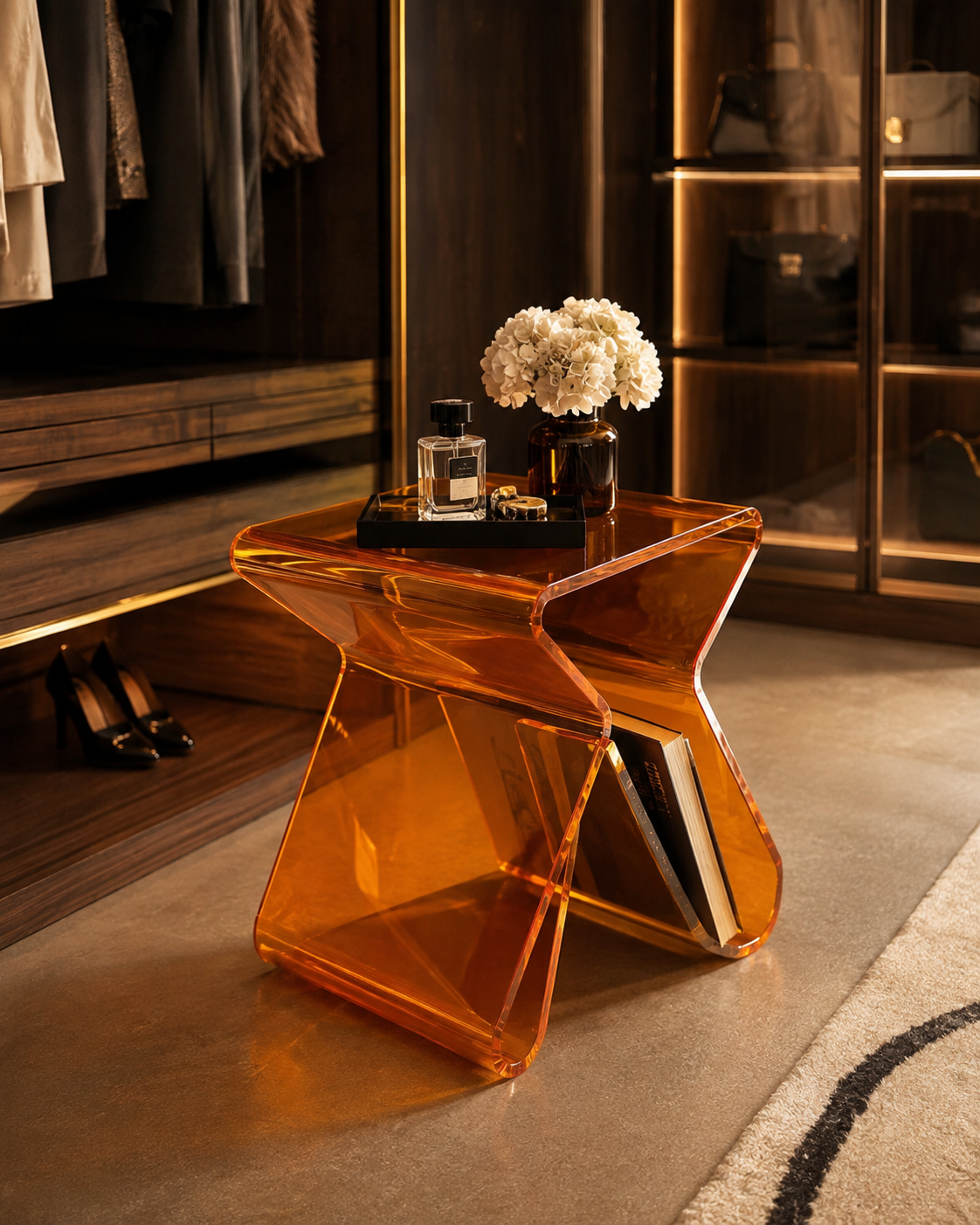
Clear synthetic crystal is generally subtle, but tinted or colored effects can dramatically change its role.
A nearly colorless transparent table may blend easily into a neutral interior.
Introduce a strong tint, and the furniture becomes more assertive.
The surrounding palette matters as well.
A clear piece against a dark background becomes more visible.
The same piece against pale flooring and walls may almost disappear.
Designers can therefore control presence through contrast.
Visual hierarchy is not only about the furniture itself.
It is about the difference between the furniture and its surroundings.
Focal Pieces Should Have a Strong Reason to Lead
Not every unusual piece deserves to become the focal point.
A strong focal object should support the larger design concept.
Perhaps it represents the brand identity of a hotel.
Perhaps it introduces a futuristic element into an otherwise restrained interior.
Perhaps it creates contrast with natural stone and heavy upholstery.
Perhaps it anchors a large seating zone.
The most successful statement furniture has a reason for being memorable.
Without that reason, the piece may feel like decoration added for effect.
Luxury design is more convincing when visual drama supports function, architecture, or storytelling.
Quiet Furniture Can Be More Valuable Than Dramatic Furniture
It is easy to assume that the most expensive or customized furniture should always be highly visible.
That is not always true.
Sometimes the most sophisticated design decision is to invest in a beautifully made piece that does not compete for attention.
A custom synthetic crystal console designed precisely to fit a wall can improve an interior without becoming obvious.
A transparent table can preserve a valuable stone floor.
A clear pedestal can make a luxury product appear more important.
The furniture contributes through restraint.
This kind of design often feels effortless, even though considerable thought has gone into it.
Boutique Hotels Need Both Roles
Boutique hotels offer a useful example because they often require a combination of statement moments and quiet support.
The lobby may need a dramatic synthetic crystal centerpiece that guests immediately remember.
Guest rooms may need more subtle transparent side tables that preserve calm and spaciousness.
A restaurant may use one sculptural table at the entrance while keeping the dining furniture restrained.
A corridor may include simple consoles that support artwork rather than compete with it.
The material can serve multiple roles within the same property.
This versatility helps designers create consistency without repetition.
Restaurants Should Be Careful With Visual Competition
Restaurants already contain many visual elements.
Lighting.
Tableware.
Food.
Artwork.
People.
Architectural finishes.
If every piece of furniture is visually strong, the environment can become exhausting.
Synthetic crystal can help designers control this.
A dramatic transparent host desk may create a strong entrance moment.
Dining tables can then remain quieter.
Alternatively, a private dining room may use one extraordinary synthetic crystal table as the centerpiece while simplifying everything around it.
The hierarchy should reflect the experience the restaurant wants to create.
Luxury Residences Require Balance Between Expression and Comfort
Private homes need a different kind of visual hierarchy.
A statement piece can create identity, but the space still needs to feel comfortable and livable.
A large synthetic crystal coffee table may become the center of the living room.
Nearby side tables can remain understated.
A dramatic dining table may be balanced with simple chairs.
A transparent console may quietly support artwork in a hallway.
Not every room needs a hero object.
Luxury residential design works best when moments of impact are balanced with areas of visual calm.
Commercial Lobbies Often Benefit From Stronger Presence
Corporate headquarters, premium offices, galleries, and luxury commercial spaces frequently contain large reception areas.
These spaces can feel impersonal if the furniture is too small or generic.
A large synthetic crystal statement piece can create a memorable point of arrival.
Because it is transparent, it can achieve scale without making the lobby feel blocked.
This is an ideal situation for furniture to lead.
The piece can communicate innovation, precision, and quality while remaining visually integrated with the architecture.
The Role of the Manufacturer Changes With the Design Intention
Whether a piece should be focal or quiet affects manufacturing decisions.
A statement piece may require more complex geometry, thicker material, more elaborate polishing, or larger dimensions.
A quiet piece may require exceptionally clean construction because simplicity exposes every detail.
In both cases, manufacturing quality matters.
The difference lies in how the craftsmanship is expressed.
For focal furniture, craftsmanship may be intentionally visible through dramatic edges and sculptural forms.
For quiet furniture, craftsmanship may be experienced through seamlessness and restraint.
An experienced synthetic crystal furniture manufacturer should understand both approaches.
Designers Should Communicate Hierarchy Early
When developing custom furniture, it is useful for designers to explain not only what the piece should look like, but what role it should play.
Should it attract attention immediately?
Should it support another feature?
Should it appear almost invisible?
Should it become more dramatic under evening lighting?
Should it photograph strongly?
Should it preserve a view?
These questions can influence thickness, scale, geometry, edge treatment, and finish.
Clear communication between designer and manufacturer helps ensure that the technical solution supports the visual intention.
Photography Changes What Feels Like a Focal Point
A piece that feels quiet in person may become more visible in photographs because of reflections and lighting.
The opposite can also happen.
Transparent furniture may nearly disappear in certain images.
This matters for hotels, luxury brands, interior studios, and commercial projects that rely heavily on photography.
If a synthetic crystal piece is intended to become a signature visual element, its placement and lighting should be evaluated through the camera as well as in person.
If it should remain understated, designers should consider whether strong reflections might unintentionally make it more prominent.
Modern interiors are experienced both physically and digitally.
Focal Points Need Longevity
A statement piece attracts attention, so it must survive repeated viewing.
Furniture that relies entirely on novelty can quickly feel dated.
The strongest synthetic crystal focal pieces usually combine unusual presence with disciplined design.
Clear geometry.
Strong proportions.
High-quality material.
Refined craftsmanship.
A thoughtful relationship with architecture.
These qualities give the piece a better chance of remaining relevant beyond short-lived trends.
Luxury clients are often looking for impact, but they also value longevity.
Quiet Pieces Need Just as Much Design Discipline
A visually quiet piece can fail in a different way.
If it is too generic, it adds little to the interior.
If it is too delicate, it may feel insignificant.
If it is poorly proportioned, the room may feel unresolved.
The challenge is to create quiet furniture that still has authority.
High-end synthetic crystal can achieve this through precise dimensions, thoughtful thickness, refined edges, and excellent material clarity.
The piece does not need to demand attention.
It simply needs to feel unquestionably right.
The Best Interiors Alternate Between Emphasis and Calm
Visual hierarchy works like rhythm.
Not every moment should be equally strong.
A successful luxury interior moves between areas of emphasis and areas of rest.
A dramatic lobby table may be followed by quiet corridor furniture.
A sculptural dining table may sit inside an otherwise restrained room.
A simple transparent console may allow a powerful artwork to dominate.
This alternation creates sophistication.
If everything is important, nothing feels important.
Synthetic crystal is valuable because it can participate in both sides of this rhythm.
How to Decide Which Role Is Right
A useful way to approach the decision is to identify what already deserves attention in the room.
Is there an important view?
A major artwork?
A dramatic staircase?
A chandelier?
A product display?
An architectural wall?
If the answer is yes, the synthetic crystal furniture may work better as a supporting element.
If the room lacks a clear visual anchor, the furniture may have an opportunity to become the focal point.
Scale also matters.
Lighting matters.
Circulation matters.
Brand identity matters.
The role should emerge from the whole space rather than from the furniture catalog.
The Most Expensive-Looking Choice Is Not Always the Loudest One
Luxury is often misunderstood as maximum visual impact.
In reality, expensive-looking interiors frequently depend on restraint.
A highly customized transparent table can feel more premium when it is integrated perfectly into the architecture than when it is trying to dominate every photograph.
At the same time, some spaces genuinely need a bold object.
The sophistication lies in knowing which situation you are designing for.
High-end synthetic crystal gives designers both possibilities.
It can become architecture.
Or it can almost disappear into architecture.
Choosing the Right Synthetic Crystal Furniture Partner
Custom transparent furniture requires a manufacturer capable of understanding more than dimensions.
The supplier should understand visual intention.
If the furniture is meant to be a statement piece, manufacturing decisions need to support strong proportions, optical depth, precise edges, and sculptural quality.
If the furniture should remain visually quiet, the emphasis shifts toward seamless construction, minimal joints, accurate geometry, and refined finishing.
Material clarity remains essential in both cases.
So does communication.
For luxury projects, the best manufacturer is not simply one that can produce the drawing.
It is one that understands what the drawing is trying to achieve.
Conclusion: The Strongest Design Decision Is Knowing When to Speak and When to Stay Quiet
Transparent furniture is powerful because it does not have one fixed visual personality.
High-end synthetic crystal can become the defining object in a hotel lobby, the sculptural center of a luxury residence, or the memorable feature of a commercial space. It can also step back, preserve a view, support artwork, showcase merchandise, and allow architecture to remain dominant.
The decision should never be accidental.
Scale, thickness, geometry, placement, lighting, contrast, and surrounding materials all influence how loudly the furniture speaks.
For designers, the real sophistication lies in controlling that voice.
Sometimes the right synthetic crystal piece should stop people the moment they enter the room.
Sometimes its greatest success is that people barely notice the furniture at all, only that the entire space somehow feels more resolved.
And before specifying your next transparent piece, there may be one question worth asking first: does this room need the furniture to be seen—or does it need the furniture to make everything else look better?
READ MORE:
- Why Product Photography Can Misrepresent the True Quality of Clear Acrylic Furniture
- What Buyers Often Overlook When Ordering Large Acrylic Furniture for International Projects
- Why the Same Acrylic Table Can Look Sophisticated in One Room and Out of Place in Another
- How Lighting Changes the Color, Depth, and Presence of Clear Acrylic Furniture
- Le 4 domande che i designer di hotel fanno più spesso quando scelgono mobili in cristallo sintetico
- I 3 problemi dei materiali che preoccupano di più negli upgrade alberghieri: quali può risolvere l’arredo in cristallo sintetico?
- Da una lobby ordinaria a uno spazio premium: come tavolini da caffè e side table in cristallo sintetico diventano il punto focale del design alberghiero
- Creating a Memorable Hotel Space Without an Expensive Renovation: A Light-Touch Upgrade Strategy with Synthetic Crystal Furniture
- Budget limitato: come aumentare il valore percepito della lobby di un hotel con arredi in cristallo sintetico


