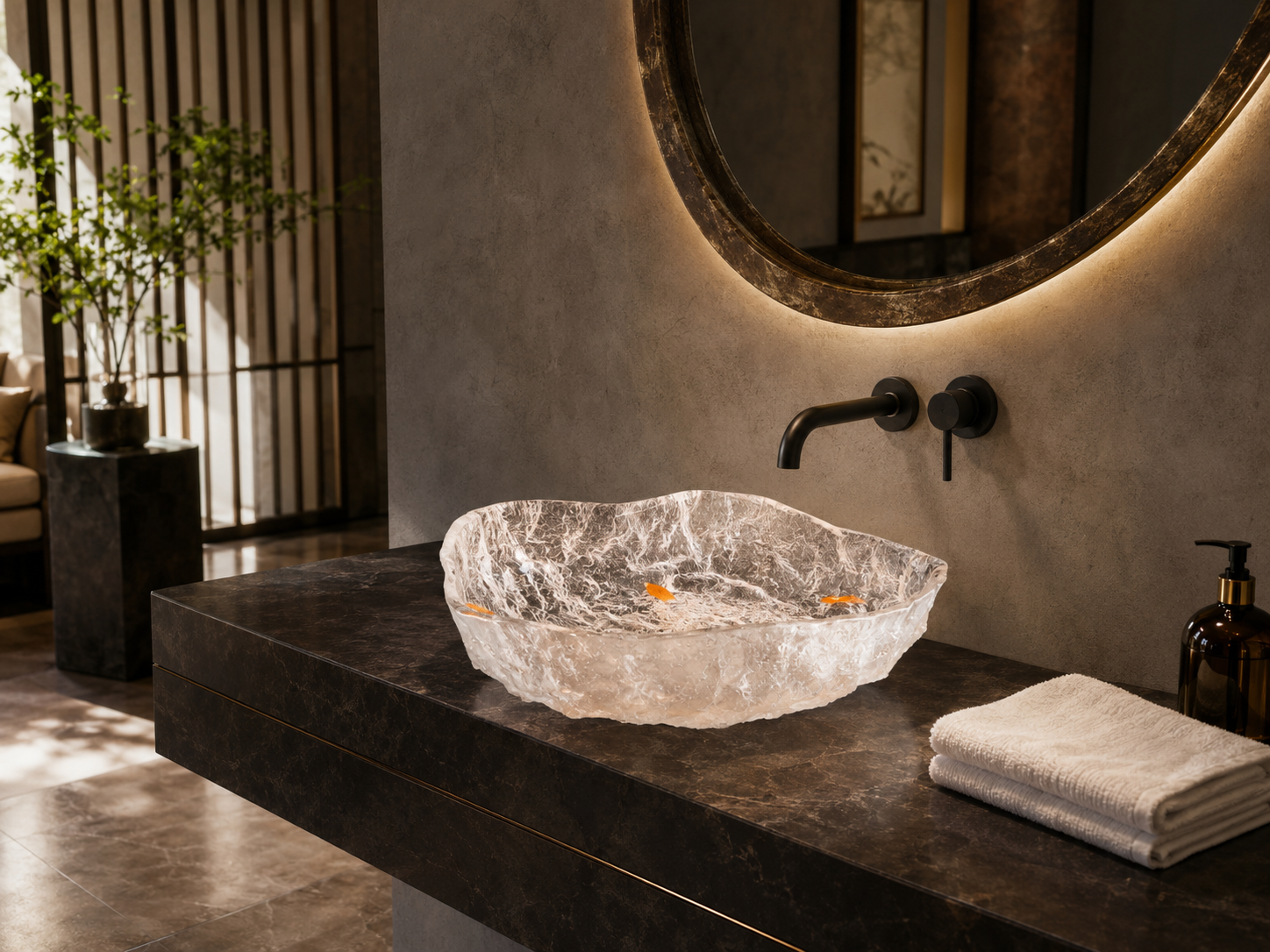
Clear furniture is one of the hardest categories to judge accurately through photographs.
A product image may look flawless, elegant, and highly polished, yet the real piece can feel ordinary when seen in person. The opposite can also happen: a beautifully manufactured piece of transparent furniture may appear almost invisible, flat, or unimpressive in photographs even though its craftsmanship is exceptional.
This is not simply a photography problem.
It is a material problem.
High-end synthetic crystal furniture interacts with light, background color, reflections, camera angle, lens choice, room scale, polishing quality, and surrounding materials in ways that opaque furniture does not. A camera captures only one viewpoint under one lighting condition at one moment. The human eye, by contrast, experiences transparent furniture dynamically. We walk around it. We see the changing edge reflections. We notice optical depth. We compare its scale with the room. We inspect the joints from different directions. We feel its stability and material presence.
That difference matters enormously for designers, buyers, developers, and purchasing teams sourcing premium synthetic crystal furniture online or internationally.
A good photograph can communicate style.
It cannot always communicate quality.
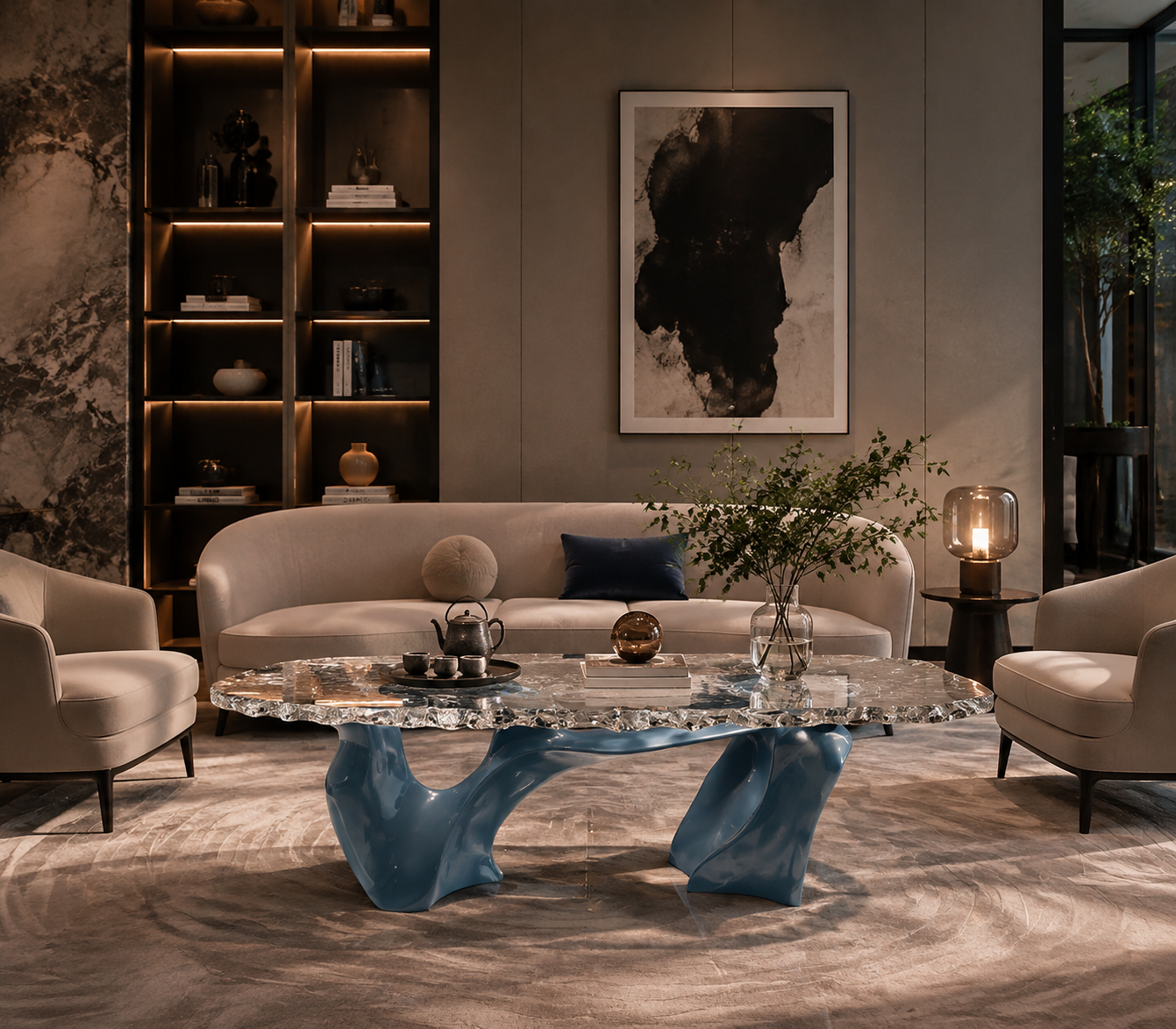
Transparent Furniture Is More Difficult to Photograph Than Opaque Furniture
Most furniture materials are relatively easy for a camera to understand.
Wood has grain.
Fabric has texture.
Stone has veining.
Metal has color and reflectivity.
These materials provide visual information that immediately tells the viewer where the object begins and ends.
Transparent furniture behaves differently.
Large portions of the object may allow the background to remain visible. Edges may appear strongly from one angle and almost disappear from another. Reflections can either clarify the geometry or completely confuse it.
This creates a fundamental challenge.
A photographer needs enough light to reveal the object, but too much light can create glare.
The background needs enough contrast to define the furniture, but too much contrast can exaggerate the edges.
The surface needs to look clean, but aggressive retouching can remove the very details buyers need to evaluate.
As a result, photographs of transparent furniture are often highly dependent on technique.
That means the image is not always a neutral representation of the product.
Lighting Can Make Average Furniture Look Better Than It Is
Lighting is one of the easiest ways to influence how transparent furniture appears.
Under carefully controlled studio lighting, even ordinary clear furniture can look impressive.
Soft diffused light can hide surface inconsistencies.
Strategic highlights can make edges appear brighter and more polished.
Dark backgrounds can create strong contrast that gives the furniture a more dramatic presence.
Reflected light can create the illusion of depth.
None of these techniques are inherently misleading. Professional photography is designed to present products attractively.
The problem begins when buyers assume that lighting reveals objective quality.
It does not.
Lighting can emphasize good craftsmanship, but it can also disguise weaknesses.
For example, a poorly polished edge may look acceptable under soft frontal light but become noticeably cloudy under strong side lighting in a hotel lobby or retail store.
A slightly uneven surface may disappear in a studio image but become visible once sunlight hits it at an angle.
This is why buyers should never evaluate high-end synthetic crystal furniture only under one lighting condition.
Bad Photography Can Also Make Excellent Furniture Look Ordinary
The reverse is equally important.
Poor photography can significantly undervalue premium synthetic crystal furniture.
If the lighting is too flat, the polished edges may not catch enough light to show optical depth.
If the background is too light, the furniture can almost disappear.
If the camera angle is too direct, the geometry may look simpler than it really is.
If the image compression is aggressive, subtle highlights and material clarity can be lost.
A large, thick synthetic crystal table may appear like a thin clear panel in a badly exposed photograph.
This is a serious problem for manufacturers and buyers.
High-end transparent furniture often contains value in details that are difficult to capture digitally.
Material thickness.
Edge precision.
Optical clarity.
Seam quality.
Surface flatness.
Weight and stability.
These qualities may be obvious in person and almost invisible online.
Background Color Can Change the Perceived Quality
One of the biggest variables in transparent furniture photography is the background.
A clear table photographed against white may appear minimal and soft.
The same table photographed against black may suddenly reveal stronger edges and much more optical depth.
Neither image is false.
But each creates a different impression.
Dark backgrounds tend to increase contrast.
They make clear edges appear brighter.
They can emphasize thickness.
They can make furniture feel more dramatic and expensive.
Light backgrounds do the opposite.
They can make the furniture appear more delicate, understated, or almost invisible.
This means buyers need to ask an important question when reviewing product photography:
Are they evaluating the furniture, or are they reacting to the background?
For transparent materials, the distinction is significant.
Camera Angles Can Hide or Exaggerate Thickness
Material thickness is one of the major indicators of visual presence in synthetic crystal furniture.
Yet photography can easily distort it.
A table photographed almost straight-on may make thick legs appear narrow.
A low-angle shot can make the same components look significantly more substantial.
Perspective also affects scale.
Wide-angle lenses can exaggerate the size of the front of the furniture while making the rear appear smaller.
Telephoto lenses can flatten the form.
Professional photographers choose these effects intentionally to create appealing images.
Again, the technique itself is not the problem.
The problem is relying on one or two images to judge the actual construction.
For buyers evaluating large custom furniture, side views, close-ups, scale references, and dimensioned drawings are often far more useful than a dramatic hero photograph.
Reflections Can Hide Surface Problems
Synthetic crystal surfaces are reflective.
This creates visual richness, but it can also make inspection difficult.
A strong reflection may cover a scratch.
A bright highlight may hide haze.
A reflected wall may make a slightly uneven surface appear more complex than it really is.
At the same time, reflections can create the impression of superior polish even when the actual finishing is average.
This is especially relevant in edited commercial photography where contrast, highlights, and sharpness may be enhanced.
A buyer looking at a polished marketing image should therefore pay attention to whether there are any neutral close-up photographs where the surface itself can be evaluated more clearly.
Real quality should remain visible even when the image is less dramatic.
Retouching Can Remove Important Evidence
Image retouching is standard in product photography.
Dust is removed.
Backgrounds are cleaned.
Exposure is adjusted.
Minor distractions are corrected.
This is normal.
But transparent furniture creates a difficult boundary between reasonable editing and excessive editing.
A retoucher may remove small scratches, adhesive marks, polishing inconsistencies, fingerprints, or reflections because they make the photograph look cleaner.
In doing so, the image may stop representing the actual product accurately.
This is particularly concerning for high-end furniture where surface and edge quality are major parts of the product's value.
Buyers do not necessarily need completely unedited images.
But they should request additional documentation that is less stylized.
Close-up videos.
Factory inspection photos.
Edge details.
Joint details.
Images under strong side lighting.
These materials can provide a more realistic understanding of quality.
Transparent Furniture Can Look More Seamless in Photos Than in Person
Joint quality is critical in synthetic crystal furniture.
Transparent materials reveal bonding, alignment, internal bubbles, gaps, and adhesive residue much more clearly than opaque furniture.
However, photographs can minimize these issues.
At certain angles, a joint may align visually with the background and almost disappear.
A frontal image may hide slight misalignment.
A bright highlight can cover a seam.
A carefully chosen camera position can make a bonded connection appear more seamless than it actually is.
This is why buyers should request detailed photographs of joints from multiple directions.
For premium furniture, the joint should remain refined even when it is deliberately inspected.
If the manufacturer only provides distant overall photographs, important construction details may remain hidden.
Scale Is Extremely Difficult to Judge in Product Photography
One of the biggest problems with online furniture sourcing is scale.
A transparent table photographed alone against a clean background can appear much larger or smaller than it really is.
There are no natural reference points.
This issue becomes even more significant because transparent furniture already appears visually lighter than opaque furniture.
A large synthetic crystal dining table may look surprisingly delicate in photographs.
A small table may appear more substantial if photographed from a low angle.
This can lead to incorrect expectations.
For international projects, buyers should always evaluate exact dimensions rather than relying on visual impressions from photos.
Human scale references can also help.
A photograph with a person standing beside the furniture often communicates size more effectively than a heavily styled studio image.
Thickness Is Better Understood Through Detail Photography
Full-room photographs are useful for understanding style.
They are less useful for understanding material thickness.
For synthetic crystal furniture, detail images are essential.
A close-up of the tabletop edge can reveal actual thickness.
A corner view can show the quality of the polish.
A low-angle shot can demonstrate depth.
A photograph showing where two components meet can communicate construction quality.
These images may be less glamorous than hero photography, but they are often more valuable for professional buyers.
The best manufacturers understand the difference between marketing images and inspection images.
Both have a purpose.
Surface Flatness Can Be Difficult to Evaluate on Camera
Large transparent panels require good surface quality.
Any distortion can affect reflections and the way objects appear through the material.
But surface flatness is difficult to judge from still photographs.
The camera may not capture subtle optical distortion.
A static image may show a clean reflection even if the surface behaves differently as the viewer moves.
This is where video becomes particularly useful.
When the camera moves slowly across the surface, distortion becomes easier to detect.
Reflections should move consistently.
Straight architectural lines visible through the furniture should remain visually controlled.
For large synthetic crystal pieces, video inspection can communicate more than multiple still images.
Polishing Quality Depends on the Direction of Light
Edge polishing is another area where photographs can mislead.
A polished edge may look excellent when light hits it directly.
Move the light, and cloudiness or machining marks may become visible.
This is not unique to synthetic crystal. Many polished materials behave this way.
But transparent furniture makes the effect especially important.
A buyer reviewing samples should ideally see the edge under several lighting conditions.
Front light.
Side light.
Natural light.
Strong artificial light.
If the edge remains clean and refined across these conditions, confidence in the finishing quality increases.
A single photograph cannot provide this evidence.
Clear Furniture Often Looks More Expensive in Styled Interiors
Context affects perceived value.
A clear table photographed in a luxury interior with natural stone, premium upholstery, sculptural lighting, and carefully styled accessories may immediately look expensive.
Place the exact same table in a plain warehouse, and the emotional response changes.
This is not because the furniture itself has changed.
The environment has changed the perception.
Styled photography is useful because it shows how the piece can function in a premium setting.
But buyers should separate the quality of the room from the quality of the furniture.
A beautiful interior can elevate an average product.
Likewise, a basic factory setting can make an excellent product look less impressive than it deserves.
Professional evaluation requires looking beyond styling.
Good Styling Can Hide Weak Proportions
A carefully arranged room can also disguise proportion problems.
Large sofas may make a coffee table look smaller.
A minimal setting may make the same piece look more significant.
Camera perspective can further change these relationships.
For designers, this is why dimensioned drawings remain essential.
Furniture proportions should be evaluated against actual project dimensions, not only lifestyle photographs.
A table that looks perfectly balanced in a marketing image may not suit the scale of a double-height villa or a compact hotel suite.
Photography inspires.
Technical information confirms.
Phone Screens Compress Quality Differences
Most buyers now view furniture photography on phones.
This creates another limitation.
Small screens reduce visible detail.
Compression can remove subtle differences in clarity.
Surface imperfections become harder to see.
Fine polishing distinctions may disappear.
Two pieces of very different quality can look nearly identical on a phone.
This is especially problematic for transparent furniture, where quality is often communicated through subtle optical characteristics rather than obvious decoration.
For serious specification decisions, buyers should review high-resolution images on larger screens whenever possible.
Close-ups should be viewed at full size.
Social Media Photography Rewards Drama, Not Accuracy
Social media has changed how furniture is presented.
Images that perform well online often use dramatic lighting, strong contrast, unusual angles, and heavily curated interiors.
These images are excellent for attracting attention.
They are not always ideal for technical evaluation.
A synthetic crystal table with glowing edges under dramatic lighting may receive more engagement than a neutral inspection image showing the same product under ordinary conditions.
This creates a natural incentive for manufacturers and brands to prioritize visual impact.
Again, there is nothing wrong with this.
The mistake is using social media images as the sole basis for a purchasing decision.
Inspiration photography and quality-control photography serve different purposes.
Professional buyers should expect both.
Videos Reveal More Than Still Images
For transparent furniture, video can be much more informative than photography.
As the camera moves, reflections change.
Edges appear and disappear.
The thickness becomes easier to understand.
Joints can be examined from multiple directions.
Surface distortion is more visible.
Scale becomes clearer.
A slow walk-around video provides a much more realistic impression of how the furniture behaves in space.
For international buyers who cannot inspect the piece personally, this can be particularly valuable.
A good supplier should be able to provide clear, unhurried videos of finished custom pieces before packing.
These videos should not rely only on dramatic music and fast editing.
The goal is inspection, not entertainment.
Factory Photos Are Often More Useful Than Perfect Studio Photos
Studio photography creates beautiful marketing assets.
Factory photography creates evidence.
For buyers evaluating a supplier, real production images can reveal important information.
How does the furniture look under ordinary factory lighting?
Are the surfaces clean?
Are the edges consistent?
Are the joints precise?
Does the piece look stable?
How is it handled?
What does the product look like before professional styling?
These images may not be suitable for advertising, but they can build trust.
They show what the product looks like when there is less opportunity to control every visual variable.
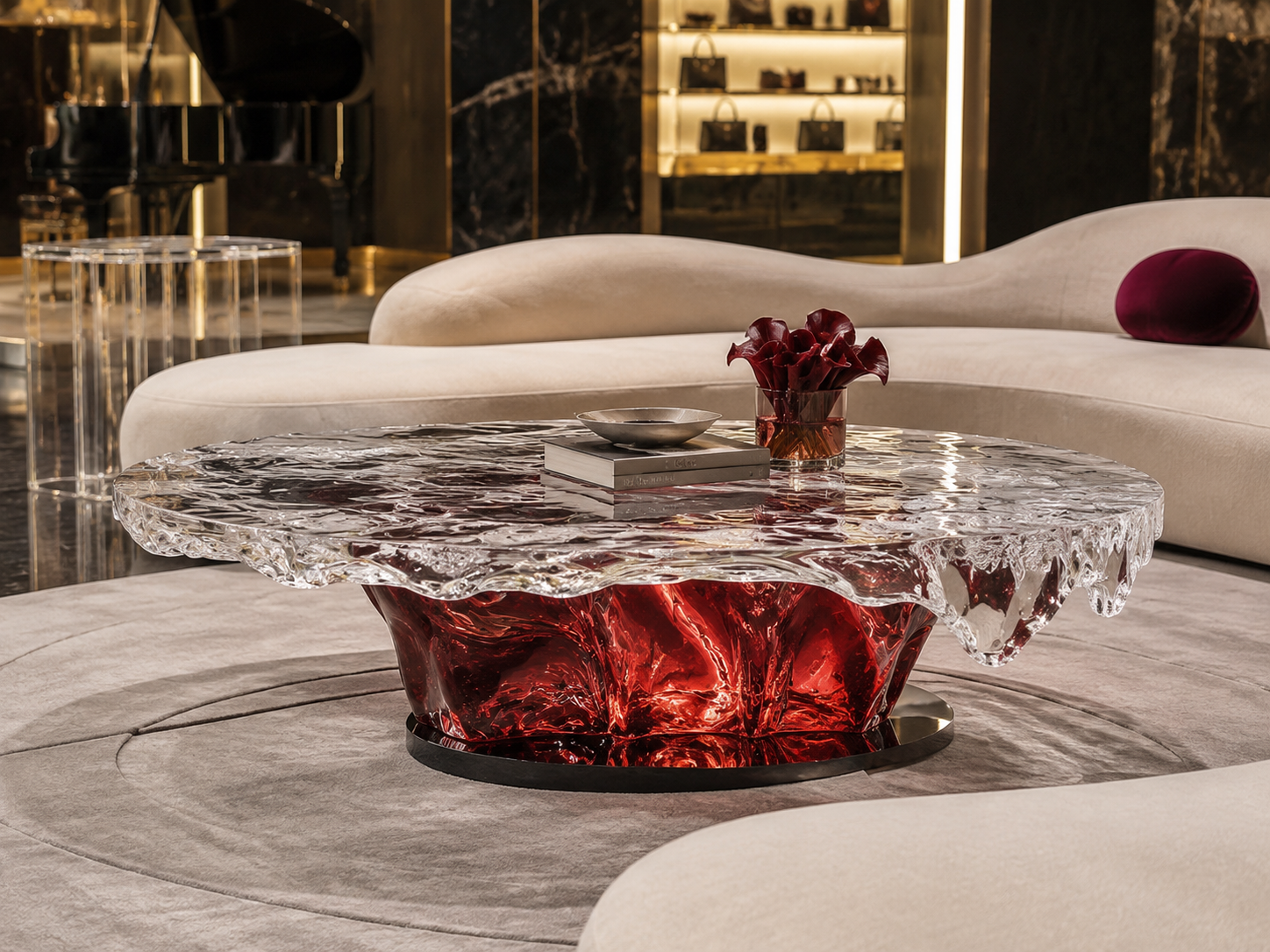
Close-Up Photography Should Be Part of Professional Evaluation
When evaluating high-end synthetic crystal furniture, buyers should ask for specific detail images.
Corners.
Edges.
Joints.
Undersides.
Connection points.
Surface reflections.
Material thickness.
Any metal or hardware integration.
These areas often reveal more about manufacturing quality than the overall design.
A manufacturer confident in its craftsmanship should be comfortable showing them.
If every photograph is taken from a distance, there may be important information missing.
The Underside of the Furniture Can Reveal a Lot
Marketing photography rarely shows the underside of a table.
Yet this area can reveal construction discipline.
How are components connected?
Are reinforcement elements tidy?
Are protective pads integrated well?
Are fasteners exposed?
Is the finishing consistent in less visible areas?
Premium furniture should not only look refined from the best angle.
Its construction should remain convincing even where photographers rarely focus.
This is especially important in transparent furniture because internal and lower details can sometimes be visible through the material.
Product Photography Can Hide Color Differences
Clear materials are not always visually identical.
Slight color casts may become more visible in thick sections.
But photography can alter color significantly.
White balance.
Camera processing.
Lighting temperature.
Monitor settings.
Image editing.
All of these can change what the viewer sees.
A slight warm or cool cast may disappear completely in the image.
Alternatively, the photograph may introduce a color tone that is not present in reality.
For buyers where optical neutrality is critical, physical samples remain valuable.
When samples are not practical, neutral reference photography and video under daylight can help.
Lighting Conditions at the Project Site Matter More Than Studio Conditions
Ultimately, furniture will not live in a photography studio.
It will be installed in a hotel, villa, restaurant, retail store, office, gallery, or other interior.
The site lighting may be completely different from the conditions used for product images.
Strong sunlight may reveal scratches.
Warm hospitality lighting may emphasize thickness.
Cool retail lighting may make joints more visible.
Directional spotlights may create strong edge reflections.
This is why designers should evaluate how synthetic crystal is likely to behave in the actual project environment.
The most relevant question is not “Does it look good in the photo?”
It is “Will it look good under our lighting?”
Photography Cannot Communicate Stability
Visual quality is only part of furniture quality.
A photograph cannot tell you how stable a table feels.
It cannot show whether the structure flexes excessively.
It cannot communicate how substantial the material feels when touched.
It cannot demonstrate whether the piece feels secure during normal use.
For large furniture, these characteristics matter.
A transparent piece may look delicate but feel extremely solid.
Or it may look substantial in images but feel less convincing physically.
This is one of the limitations that photography can never fully overcome.
Technical specifications, engineering information, samples, videos, and supplier experience become important complements.
Photography Cannot Show How the Furniture Ages
A new product always looks its best.
Photographs rarely communicate long-term behavior.
How should the surface be cleaned?
How easily can it be maintained?
What happens if minor scratches appear?
Can the piece be refinished or repaired?
How should it be protected during commercial use?
These questions are particularly important for hotels, restaurants, retail spaces, and other high-traffic projects.
Buyers should evaluate long-term maintenance separately from initial appearance.
A beautiful launch photograph says nothing about how the product will look after years of use.
Renderings Are Even Less Reliable Than Photography
In many custom projects, buyers see a rendering before the furniture exists.
Renderings are valuable design tools.
They help confirm proportions, placement, color relationships, and overall concept.
But they are not evidence of manufacturing quality.
A 3D rendering can make joints completely invisible.
It can create perfect transparency.
It can simulate flawless surfaces.
It can exaggerate thickness or edge glow.
It can show a level of optical perfection that may be difficult to achieve physically.
Buyers should therefore distinguish between design visualization and product documentation.
A rendering shows intention.
A finished-product inspection shows execution.
Sample Photography Should Include a Scale Reference
When evaluating material samples remotely, a scale reference can help.
A ruler, known object, or hand can show actual thickness.
Without this reference, a sample image can be misleading.
A thick polished block may look thin depending on camera angle.
A small sample may appear much larger in a close-up shot.
Professional documentation should make scale easy to understand.
This is a simple step, but it reduces misunderstandings.
Ask for Images Under More Than One Lighting Condition
One of the most practical ways to evaluate transparent furniture remotely is to request multiple lighting conditions.
Natural daylight.
Normal factory lighting.
Side lighting.
Close-up directional light.
The objective is not to create beautiful images.
It is to understand how the material behaves.
If the product looks refined under all of these conditions, the evidence becomes much stronger.
This is especially useful for edge quality, bonding, and surface inspection.
Large Projects Need Pre-Shipment Visual Documentation
For international projects, finished-product documentation should be completed before packing.
Once large synthetic crystal pieces are inside export crates, inspection becomes difficult.
Buyers should receive photographs or videos showing the final condition.
Overall views.
Dimensions where necessary.
Close-ups.
Surface condition.
Joints.
Packaging preparation.
This creates a clear record before shipment.
It can also help installation teams understand the product before it arrives.
Photography Should Support, Not Replace, Technical Information
Professional furniture specification should combine visual and technical evidence.
Photographs show appearance.
Drawings show dimensions.
Material samples show physical quality.
Videos show changing reflections and construction.
Specifications show thickness and structure.
Quality-control documents confirm inspection.
Installation information explains practical requirements.
No single source is enough on its own.
This is especially true for high-end synthetic crystal furniture where much of the value lies in details that are difficult to photograph.
Designers Should Be Careful When Comparing Suppliers Through Images Alone
Online sourcing often encourages direct visual comparison.
Supplier A has brighter photographs.
Supplier B has more dramatic interiors.
Supplier C has beautiful social media content.
But photography quality and manufacturing quality are not the same thing.
A manufacturer with excellent photography may or may not have excellent production.
A manufacturer with basic factory photos may produce exceptional furniture.
Designers and procurement teams should therefore compare the underlying evidence.
Material quality.
Edge finishing.
Bonding.
Production capability.
Custom engineering.
Quality control.
Packaging.
Previous project experience.
Visual presentation matters, but it should not become a substitute for due diligence.
Luxury Buyers Should Ask to See the Imperfections a Camera Usually Avoids
This may sound counterintuitive.
But one of the best signs of a reliable manufacturer is a willingness to show the product under conditions that are not flattering.
Strong side light.
Close-up video.
Unedited factory images.
Corner details.
Joint details.
Surface reflections.
Why?
Because premium quality should survive inspection.
A manufacturer confident in its synthetic crystal furniture should not depend entirely on carefully controlled hero photographs.
Transparency in documentation should match transparency in the material.
The Best Product Photography Still Has an Important Role
None of this means product photography is unimportant.
It is extremely valuable.
Good images help buyers understand style, proportion, atmosphere, and design possibilities.
They show how synthetic crystal can interact with stone, wood, metal, upholstery, and lighting.
They inspire designers.
They help clients visualize possibilities.
They communicate brand identity.
The key is understanding what photography can and cannot prove.
A beautiful image can demonstrate design potential.
It cannot independently confirm material quality.
What Professional Buyers Should Request Before Ordering
For important custom orders, buyers should look beyond the hero image.
Request clear overall photographs.
Ask for close-ups.
Review videos.
Check material thickness.
Examine edges.
Inspect joints.
Confirm dimensions.
Look at the piece under normal light.
Ask how it is constructed.
Understand the packaging and installation process.
For major international projects, these steps can reduce risk significantly.
They also create a more professional relationship between buyer and manufacturer.
Why This Matters Even More for Large Synthetic Crystal Furniture
The financial and logistical consequences of a poor decision increase with size.
A small side table is relatively easy to replace.
A large customized dining table, reception desk, or lobby installation is different.
The material cost is higher.
Production takes longer.
Packaging is more complex.
Shipping is more expensive.
Installation may require specialist handling.
If the real quality does not match the expectation created by photography, correcting the problem can become extremely difficult.
This is why visual verification should become more detailed as project scale increases.
Choosing a Manufacturer That Documents Quality Properly
A strong synthetic crystal furniture manufacturer should understand that international buyers need evidence.
Professional documentation is part of the service.
The supplier should be able to show finished pieces clearly, provide detailed photographs, create inspection videos, confirm dimensions, explain construction, and document products before packing.
This does more than support sales.
It reduces misunderstanding.
It also demonstrates confidence in craftsmanship.
For custom high-end furniture, trust is built through visibility.
The Real Test Happens When the Camera Stops Helping
A product image is always a controlled version of reality.
The angle is selected.
The light is selected.
The background is selected.
The moment is selected.
The finished furniture does not have that protection.
Once installed, it will be viewed from multiple directions, under changing daylight, beside real materials, through cameras, by guests, by designers, and at very close range.
Premium synthetic crystal furniture must perform under all of these conditions.
That is the standard that matters.
Conclusion: Great Photography Can Attract Attention, but Real Quality Must Survive Inspection
Clear furniture is unusually vulnerable to photographic distortion because transparency depends so heavily on light, background, angle, reflections, scale, and visual context.
A strong photograph can make average furniture look more luxurious.
A weak photograph can make exceptional synthetic crystal furniture look ordinary.
Retouching can hide flaws. Dramatic lighting can exaggerate edge brilliance. Camera perspective can change perceived thickness. Styled interiors can transfer their own sense of luxury onto the furniture.
For designers and buyers, the solution is not to distrust photography.
It is to understand its limits.
Use photographs for inspiration and initial evaluation, but combine them with close-ups, video, drawings, material information, quality-control documentation, and real project references whenever the decision matters.
Because when the furniture finally leaves the screen, crosses the factory floor, travels to the project, and stands under the real light of the finished interior, there is only one question that still matters: will the quality remain impressive when there is no camera angle left to hide behind?
READ MORE:
- When Should Acrylic Furniture Be the Focal Point—and When Should It Stay Visually Quiet?
- What Buyers Often Overlook When Ordering Large Acrylic Furniture for International Projects
- Why the Same Acrylic Table Can Look Sophisticated in One Room and Out of Place in Another
- How Lighting Changes the Color, Depth, and Presence of Clear Acrylic Furniture
- Le 4 domande che i designer di hotel fanno più spesso quando scelgono mobili in cristallo sintetico
- I 3 problemi dei materiali che preoccupano di più negli upgrade alberghieri: quali può risolvere l’arredo in cristallo sintetico?
- Da una lobby ordinaria a uno spazio premium: come tavolini da caffè e side table in cristallo sintetico diventano il punto focale del design alberghiero
- Creating a Memorable Hotel Space Without an Expensive Renovation: A Light-Touch Upgrade Strategy with Synthetic Crystal Furniture
- Budget limitato: come aumentare il valore percepito della lobby di un hotel con arredi in cristallo sintetico


