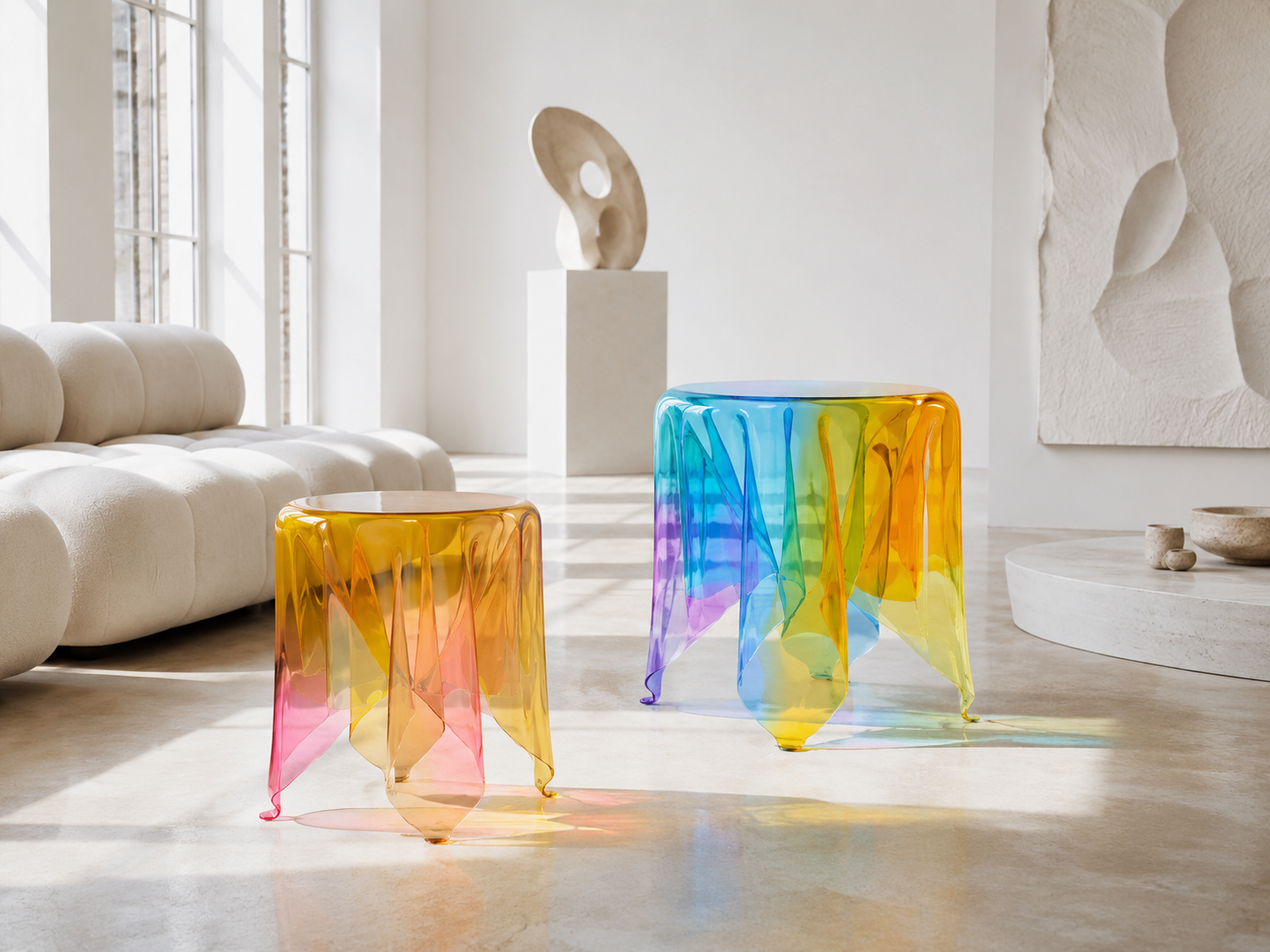
Synthetic crystal acrylic furniture is becoming an increasingly important visual language in luxury residential interiors. Unlike conventional furniture that relies on heavy materials, ornate decoration, or obvious displays of wealth, transparent acrylic creates a more refined kind of luxury through lightness, clarity, craftsmanship, proportion, and spatial freedom. From sculptural dining tables and crystal-clear consoles to custom coffee tables, chairs, benches, and display pieces, luxury acrylic furniture allows designers to introduce statement objects without visually overloading a room.
1. Luxury Is Becoming Lighter, Quieter, and More Visually Refined
For decades, luxury furniture was often associated with visible weight. Thick marble tops, carved hardwood, oversized leather seating, gold detailing, polished brass, and elaborate decorative forms were frequently used to communicate status. These materials remain important, but the definition of luxury is changing.
Today, many sophisticated consumers are moving toward interiors that feel calmer and more controlled. Rather than asking whether an object looks expensive at first glance, they increasingly value proportion, material quality, craftsmanship, originality, and the way an object interacts with the overall architecture.
This shift has created the ideal environment for synthetic crystal acrylic furniture. Acrylic has a rare visual quality: it can be physically substantial while appearing almost weightless. A thick acrylic dining table, for example, may be strong and structurally impressive, yet its transparent body does not create the same visual blockage as a solid timber or stone table.
That contrast is central to the appeal of transparent luxury. The furniture is present, but it does not dominate. It can attract attention through its craftsmanship, polished surfaces, thickness, geometry, and interaction with light while still allowing the room to remain open.
This is especially relevant in high-end home design, where interiors are increasingly treated as complete compositions rather than collections of expensive individual objects. A designer may spend considerable time selecting natural stone flooring, hand-finished wall panels, artwork, lighting, rugs, or architectural details. Traditional furniture can hide these elements. Transparent furniture, by contrast, allows them to remain visible.
Acrylic therefore supports a new interpretation of luxury: luxury through restraint. The idea is similar to what has happened in fashion, architecture, and product design. Premium design is increasingly expressed through precision rather than excess. Clean lines, controlled details, sophisticated finishes, and carefully selected materials often communicate more exclusivity than decoration alone.
This is why luxury acrylic furniture works particularly well in contemporary villas, penthouses, designer apartments, gallery-like residences, and minimalist luxury spaces. It can create visual impact without visual noise.
A beautifully polished acrylic console against a natural stone wall, for instance, does not compete with the stone. Instead, it almost disappears into the architecture while creating reflections and subtle changes in light. Likewise, an acrylic coffee table placed over a handcrafted rug allows the pattern and texture underneath to remain visible.
This relationship between visibility and invisibility is one of the most distinctive qualities of acrylic furniture. The object becomes part furniture, part sculpture, and part optical effect. For homeowners who want their interiors to feel expensive without looking excessively decorated, this balance is extremely attractive.
Luxury is no longer only about adding more. In many of the most sophisticated interiors, luxury is about knowing what can be removed.
2. Transparent Furniture Makes Space Feel Larger and More Architectural
One of the strongest functional advantages of transparent furniture is its ability to reduce visual density. Every piece of conventional furniture creates visual mass. A dark wooden table, upholstered chair, cabinet, or console interrupts sightlines and divides the room into visible zones. Transparent acrylic behaves differently.
Because the eye can see through it, the furniture occupies less perceived space. This makes synthetic crystal acrylic furniture particularly effective in urban luxury residences, where property values may be extremely high and every square meter matters.
A premium apartment may contain exceptional materials and finishes while still having limited floor area. Filling the space with heavy furniture can quickly make the interior feel smaller than it actually is. Acrylic provides an alternative.
Consider a luxury dining room. A traditional dining table with a solid base can visually occupy a large portion of the room. Replacing that base with a transparent acrylic structure immediately opens the sightline beneath and around the tabletop. The floor becomes more visible. Dining chairs appear less crowded. Light moves through the room more freely. The entire space can feel larger.
This effect is one reason luxury acrylic furniture is increasingly used by interior designers who want to create a sense of architectural openness. The same principle works with side tables, consoles, desks, benches, stools, display plinths, shelving, and occasional chairs.
In modern luxury interiors, the ability to control visual mass can be as important as the dimensions of the furniture itself. This is particularly true in open-plan spaces. A contemporary living area may combine the kitchen, dining space, lounge, art display, and circulation areas within one large architectural volume. Furniture must create function without unnecessarily breaking that visual continuity.
A transparent console can define an entry zone without creating a wall-like effect. A transparent coffee table can anchor a seating arrangement without blocking the rug. An acrylic desk can create a functional workspace without making a bedroom or lounge feel like an office.
This is where high-end home design begins to overlap with architectural thinking. Furniture is no longer simply placed inside rooms. It is used to control perception, movement, light, and scale.
Custom acrylic furniture makes this approach even more powerful because dimensions can be adapted to the architecture. A designer might specify an unusually long console to follow the proportions of a wall, a narrow transparent desk for a penthouse window, or a thick sculptural coffee table designed specifically around a seating arrangement.
Because acrylic can be fabricated into highly controlled geometric forms, it gives designers considerable freedom. The result is furniture that feels integrated into the space rather than added afterward.
For luxury homeowners, this can significantly change the experience of a room. A well-designed home should not simply look impressive in photographs. It should feel comfortable to move through. Transparent furniture can improve circulation, reduce visual obstacles, and preserve long views across the interior.
In rooms with panoramic windows, this becomes even more important. A solid piece of furniture can interrupt a valuable city, ocean, mountain, or garden view. Acrylic allows the view to continue through the furniture. In this context, transparency is not merely an aesthetic decision. It becomes an architectural tool.
.png)
3. Crystal-Like Acrylic Creates a Distinctive Material Experience
Not all acrylic furniture looks luxurious. The difference between ordinary plastic furniture and premium synthetic crystal acrylic furniture can be substantial. High-end acrylic pieces depend heavily on material quality, thickness, optical clarity, edge treatment, surface finishing, bonding, polishing, and fabrication precision.
When these elements are handled correctly, acrylic can create an appearance closer to crystal than conventional plastic. This is one reason the phrase transparent luxury is becoming relevant. The material itself may look simple, but producing a truly refined piece requires technical control.
Edges must be polished carefully. Surfaces must remain clear and consistent. Connections must be clean. The geometry must be precise. The relationship between thickness and proportion must feel intentional.
When a thick acrylic slab is polished correctly, light enters and travels through the material, creating highlights along the edges. Depending on the form, this can produce reflections, refractions, shadows, and luminous effects that change throughout the day. This gives acrylic furniture a dynamic quality.
A wooden table looks relatively stable under different lighting conditions. Acrylic may look almost invisible in soft daylight, sharply reflective under architectural lighting, and jewel-like under evening illumination.
For high-end home design, this responsiveness can be extremely valuable. Lighting designers can use transparent objects to extend the effect of the lighting scheme. Near a window, acrylic may capture natural daylight. Near a decorative lamp, it may reflect warm highlights. Under directional lighting, thick polished edges may appear almost illuminated.
The material therefore interacts with the environment rather than remaining visually static. This makes luxury acrylic furniture especially suitable for interiors where lighting is treated as part of the architecture.
It also allows designers to combine transparency with contrasting materials. Acrylic can sit beside marble without competing with marble. It can soften the visual weight of dark timber. It can complement polished stainless steel. It can contrast with boucle, velvet, leather, wool, or linen. It can also create an interesting dialogue with glass.
Although acrylic and glass may both be transparent, they do not create exactly the same experience. Acrylic can generally be fabricated in ways that allow thicker, more sculptural forms and softer visual transitions. It can produce the appearance of a solid transparent block, curved form, waterfall profile, or oversized geometric object.
This gives custom acrylic furniture a sculptural potential that appeals to designers looking for unusual statement pieces. A console may resemble a transparent architectural beam. A table base can appear like a crystal pedestal. A chair can look as though it has been carved from a single clear volume. A display plinth may make an artwork appear to float.
These effects explain why acrylic is increasingly used beyond purely functional furniture. It can become part of the artistic identity of the room.
In the best modern luxury interiors, materials are selected not only for practical performance but also for emotion. Stone can communicate permanence. Wood can communicate warmth. Metal can communicate precision. Textiles can communicate softness. High-quality transparent acrylic communicates lightness, clarity, and visual surprise.
4. Acrylic Works With Many Luxury Interior Styles
One misconception is that acrylic furniture only works in ultra-modern interiors. In reality, transparent pieces can adapt to an unusually wide range of styles because they have very little visual color or texture of their own.
This neutrality makes transparent furniture highly flexible. In a minimalist interior, acrylic reinforces simplicity. In a glamorous interior, it can interact with metallic finishes, mirrors, crystal lighting, and polished stone. In a contemporary classic home, it can provide contrast against traditional moldings and rich fabrics. In an art-focused residence, acrylic allows artworks to remain visually dominant. In a coastal luxury home, transparency supports a light and airy atmosphere. In a dramatic dark interior, crystal-clear acrylic can create contrast without introducing another strong material.
This versatility gives luxury acrylic furniture an advantage over many statement materials. A bright colored lacquer table, for example, immediately defines the palette of a room. A highly patterned stone table can become the visual center of the space. Acrylic can be expressive while remaining neutral.
This allows the surrounding architecture to lead. The concept is particularly important in high-end home design, where homeowners may invest in collectible art, bespoke rugs, stone slabs, designer lighting, or custom wall treatments. Furniture must sometimes support these elements rather than compete with them.
A transparent table can almost act as a frame for what surrounds it. Imagine an acrylic console placed below a large contemporary painting. Instead of creating another strong visual block below the artwork, the console provides function while remaining visually quiet.
Similarly, a transparent coffee table placed over a rare handwoven rug allows the rug to remain fully visible. This combination of function and visual restraint is a key principle of transparent luxury.
It also explains why custom acrylic furniture is frequently specified in projects where standard retail furniture does not fit the design concept. The designer may require a particular height, width, thickness, radius, or shape. Acrylic fabrication allows these requirements to be translated into precise objects.
This can be particularly useful for unusual spaces such as curved walls, narrow hallways, oversized living rooms, dressing areas, galleries, or luxury walk-in wardrobes. A transparent bench in a dressing room can provide seating without visually reducing the space. An acrylic island stool can preserve the appearance of a sculptural kitchen island. A slim console can add functionality to an entry hall while keeping the architecture visible.
This adaptability makes acrylic less of a trend material and more of a design tool. Trends may introduce people to the look, but functionality helps the material remain relevant.
5. Customization Is Turning Acrylic Furniture Into Collectible Design
The luxury market increasingly values personalization. High-end consumers do not always want the same furniture that appears in thousands of homes. They want pieces that fit their architecture, lifestyle, proportions, and aesthetic preferences.
This is creating new opportunities for custom acrylic furniture. Unlike mass-produced transparent chairs or small decorative tables, bespoke acrylic pieces can be developed as architectural objects.
The designer can control the size, geometry, thickness, edge profile, transparency level, tint, surface treatment, and combination of materials. A large dining table might use a thick clear acrylic base with a stone top. A console could combine transparent legs with brushed metal details. A coffee table might use several intersecting acrylic planes to create a sculptural composition. A display cabinet could combine acrylic panels with integrated lighting.
These possibilities move synthetic crystal acrylic furniture closer to collectible design. The value no longer comes only from the raw material. It comes from design, engineering, fabrication, finishing, and exclusivity.
This is similar to the way luxury consumers evaluate bespoke stone furniture, artisan metalwork, handmade cabinetry, or limited-edition designer objects. A simple material can become highly valuable when the execution is exceptional.
For manufacturers, this also means that quality control becomes critical. Premium acrylic furniture must look precise from every angle. Visible imperfections are difficult to hide in a transparent material. This makes transparency unusually demanding.
With opaque furniture, some joints and internal structures can be concealed. With transparent furniture, the construction itself becomes part of the design. Bonding lines, edges, surfaces, and connections may all remain visible. The manufacturing process therefore needs to support the aesthetic promise.
This is one reason high-quality luxury acrylic furniture can command a premium. The apparent simplicity of the final object may hide a complicated production process.
For designers and homeowners, customization also solves practical problems. Standard furniture dimensions are often designed for average rooms. Luxury residences may have unusual proportions. A penthouse living room might require an exceptionally long coffee table. A villa entrance may need a console that visually aligns with a specific wall panel. A dressing room may require a transparent bench tailored to an island unit. A gallery space may need acrylic plinths in precise heights for different artworks.
This is where custom acrylic furniture becomes particularly valuable. It allows furniture to respond to architecture rather than forcing architecture to accommodate furniture.
.png)
6. “Transparent Luxury” Reflects a Broader Change in High-End Living
The growing popularity of transparent luxury is not happening in isolation. It reflects a wider change in how affluent consumers think about homes.
Luxury living is becoming less focused on obvious display and more focused on experience. People increasingly want homes that feel calm, flexible, photogenic, personalized, and comfortable. They want natural light. They want visual openness. They want spaces that support both entertaining and everyday life. They want premium materials without making every room feel heavy.
Transparent furniture fits naturally into this lifestyle. It allows interiors to remain visually open while still providing functionality. It can make a room feel sophisticated without becoming formal. It can work with changing decorative schemes because clear acrylic does not lock the homeowner into a strong color palette.
This flexibility is particularly relevant for homeowners who collect art or frequently update accessories, textiles, and decorative objects. A transparent table can remain useful through multiple design changes. The rug may change. The sofa may change. The artwork may change. The wall finish may change. The acrylic piece can still work.
This makes acrylic furniture more versatile than its futuristic appearance might initially suggest. There is also a psychological dimension. Clear materials can make spaces feel less enclosed. In homes designed around daylight, gardens, terraces, or panoramic views, maintaining that visual connection can significantly affect the atmosphere.
Acrylic can support this by reducing barriers between the viewer and the architecture. For this reason, modern luxury interiors increasingly use transparency not only in furniture but also in architectural elements, lighting, balustrades, partitions, shelving, and decorative objects.
The larger trend is toward visual continuity. Synthetic crystal acrylic furniture participates in that trend while providing a distinctive luxury character.
Contemporary luxury homes are also frequently photographed, shared, and experienced digitally. Transparent pieces often photograph exceptionally well because they create layers without completely blocking the background. They can make interiors appear more spacious and visually complex at the same time.
However, the strongest reason for the growth of luxury acrylic furniture is not simply that it looks good in photographs. It solves real design problems. It helps preserve sightlines. It reduces visual weight. It highlights other materials. It adapts to custom dimensions. It creates unusual lighting effects. It can function as both furniture and sculpture.
When a material combines practical value with a distinctive emotional experience, it has the potential to move beyond short-term fashion. That may be exactly what is happening with acrylic.
The most sophisticated use of the material is not about filling an entire home with transparent objects. Instead, designers are using selected acrylic pieces as moments of contrast: one transparent console, one sculptural coffee table, one pair of crystal-clear side tables, one dramatic dining table base, or one custom bench.
These carefully placed objects can transform the perception of surrounding materials. A heavy marble wall may look even more dramatic beside a nearly invisible table. A textured rug may become more noticeable beneath a clear coffee table. A sculptural chair may appear to float beside a transparent side table.
This ability to enhance other materials is one of the strongest arguments for transparent luxury. The furniture does not always need to become the main character. Sometimes its greatest value is making everything around it look better.
Conclusion: The Future of Luxury May Be More Transparent
The rise of synthetic crystal acrylic furniture reveals an important shift in contemporary interior design. Luxury is becoming less dependent on visual heaviness and more dependent on refinement, proportion, craftsmanship, material interaction, and spatial experience.
This is why high-end home design is increasingly exploring clear and crystal-like materials. Acrylic can make furniture appear lighter. It can preserve architectural views. It can highlight premium flooring and rugs. It can interact beautifully with light. It can be customized into sculptural forms. It can complement marble, timber, metal, glass, textiles, and artwork.
Most importantly, transparent furniture can create a sophisticated impression without overwhelming the space. That quality makes it particularly suitable for contemporary luxury residences.
The future of modern luxury interiors will probably not be completely transparent. Nor will acrylic replace natural stone, timber, metal, or fine upholstery. Instead, its strength lies in combination.
When transparent acrylic is placed beside richer, heavier materials, each material becomes more expressive. The acrylic looks lighter. The stone looks more solid. The timber feels warmer. The metal appears more precise. The textile feels softer. This contrast creates depth.
For homeowners, designers, architects, property developers, and luxury furniture brands, that opens significant creative possibilities. Custom acrylic furniture can move beyond the role of novelty and become a permanent part of the high-end design vocabulary.
The strongest pieces will not succeed simply because they are transparent. They will succeed because their proportions are correct, their surfaces are beautifully finished, their structural details are resolved, and their presence improves the room around them.
That is the true meaning of transparent luxury. It is not luxury that demands attention. It is luxury that controls attention.
READ MORE:
- When Furniture Starts to Look the Same: How Material Details Create Differentiation — A Synthetic Crystal Approach
- How Synthetic Crystal Furniture Uses Transparency to Create an Airy, Understated Luxury Interior
- Customers Care About More Than Furniture Form: How Synthetic Crystal Material Details Influence Purchase Decisions
- Why High-End Clients Pay for Material Quality: What Synthetic Crystal Furniture Reveals About Luxury
- The Luxury of a Space Often Hides in the Details: How Synthetic Crystal Furniture Elevates Overall Visual Quality
- Synthetic Crystal Acrylic Furniture: Building the Next Generation of High-End Living with Innovative Materials
- Why Crystal-Grade Acrylic Is Becoming an Important Direction for the Future of Furniture Design
- Synthetic Crystal Acrylic Furniture: Giving Brands a Distinctive Identity in the High-End Market
- From Material Breakthrough to Spatial Upgrade: The New Value Created by Synthetic Crystal Acrylic Furniture


