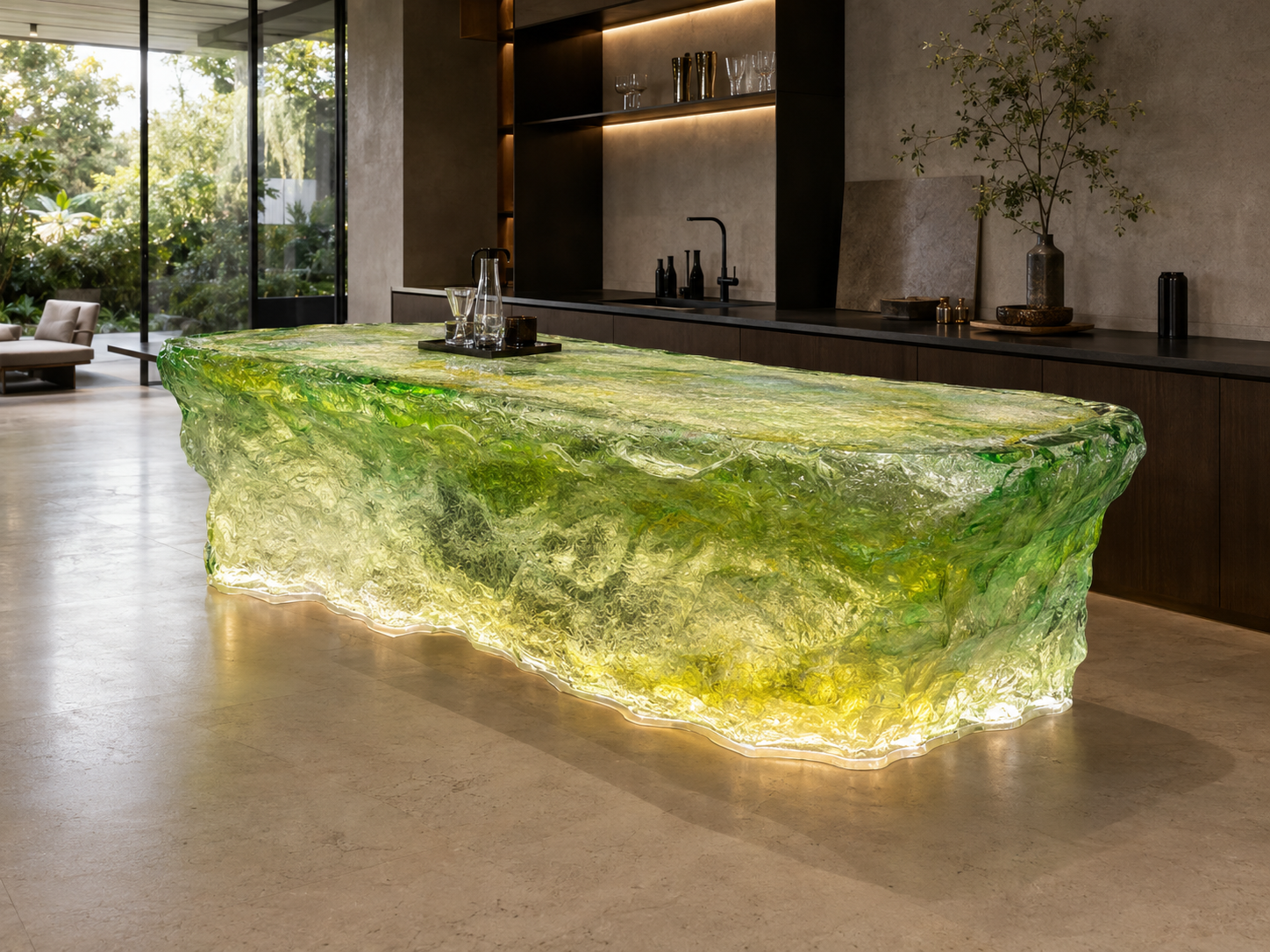
Furniture materials have always influenced the way people understand luxury. Solid wood communicates warmth and tradition. Marble suggests permanence and natural rarity. Metal introduces precision and strength. Upholstery creates softness and comfort. Glass brings transparency and visual lightness.
Today, another material is increasingly entering the premium design conversation: synthetic crystal acrylic furniture.
Acrylic itself is not new. What is changing is the level of material quality, fabrication technology, polishing precision, structural design, and creative application now available to furniture manufacturers and interior designers.
As a result, premium acrylic furniture is no longer limited to lightweight decorative pieces or simple transparent chairs. It can now be used to create substantial dining tables, thick sculptural coffee tables, luxury consoles, benches, desks, side tables, display pedestals, architectural installations, and fully customized furniture.
This development represents more than a material trend. It reflects a broader transformation in the furniture industry: from focusing only on what a piece of furniture is made of to asking what new spatial experience that material can create.
That is where the real value of synthetic crystal acrylic furniture begins.
1. Material Innovation Is Changing the Perception of Acrylic Furniture
For many years, acrylic was often understood primarily as a practical transparent plastic. It was lightweight, versatile, easy to shape, and useful for displays, signs, protective panels, and commercial products.
Premium furniture applications demand something more. When acrylic is used in high-end furniture design, material quality becomes immediately visible. Transparency means that defects, uneven surfaces, poor bonding, scratches, inaccurate joints, and inconsistent polishing can be difficult to hide.
This has pushed manufacturers to improve the entire production process. High-quality synthetic crystal acrylic furniture depends on several factors.
First is optical clarity. A premium transparent furniture piece should allow light to pass through with minimal visual distortion. The clearer the material, the more it can create a crystal-like appearance rather than a conventional plastic appearance.
Second is thickness. Thick acrylic has a very different visual character from thin acrylic sheet. A substantial transparent slab can create a sense of solidity while still maintaining visual lightness. This contradiction is one of the most attractive features of luxury acrylic furniture.
The object looks physically strong but visually almost weightless.
Third is edge treatment. A poorly finished edge immediately reduces the quality of transparent furniture. A precisely polished edge, however, can become one of the most beautiful parts of the piece. Light travels through the transparent material and collects around polished edges, creating bright highlights and a jewel-like effect.
Fourth is joining technology. In transparent furniture, connections are part of the design. If two components are bonded together, the bonding quality affects the entire visual impression. High-end furniture therefore requires clean connections, accurate alignment, and carefully controlled finishing.
Finally, there is structural engineering. Large-scale custom acrylic furniture must do more than look beautiful. It has to support practical loads, maintain stability, preserve its intended geometry, and perform reliably in daily use.
This combination of optical quality and engineering capability has changed the role of acrylic. It is increasingly being treated not as a substitute for glass or plastic, but as a distinctive design material with its own visual language.
This matters because luxury furniture buyers increasingly care about the quality of execution. A material does not become premium simply because it is expensive. It becomes premium when designers and manufacturers use it in a way that creates a level of craftsmanship, precision, and experience that ordinary products cannot easily reproduce.
In this respect, synthetic crystal acrylic furniture fits well with the evolution of contemporary luxury. Modern luxury is often quieter than traditional luxury. Instead of relying on heavy ornamentation, it may depend on perfect proportions, refined surfaces, hidden engineering, precise details, and strong material identity.
A clear acrylic console may appear simple from a distance. But when the proportions, thickness, transparency, polishing, and joints are carefully controlled, that simplicity can become highly sophisticated.
The material breakthrough therefore creates the first layer of new value: technical refinement becomes visual luxury.
2. Transparency Creates More Space Without Changing the Floor Plan
One of the most important advantages of transparent furniture is that it can change the perception of space without changing the physical dimensions of a room.
This is especially valuable in high-end urban homes. A luxury apartment may be located in an expensive city, contain premium finishes, and offer beautiful views, yet still have limited interior space.
Traditional furniture can quickly make such a room feel crowded. Every opaque object creates visual mass. A solid dining table blocks part of the floor. A heavy console interrupts a wall. A dark coffee table creates another horizontal visual barrier. A large desk may make a bedroom feel smaller.
Acrylic behaves differently. Because the eye can see through it, acrylic furniture reduces the amount of visual obstruction in a room. The furniture still occupies physical space, but it does not occupy the same amount of perceived space.
This distinction is extremely important in interior design.
Imagine a living room with an expensive handmade rug. A conventional coffee table may hide a significant part of the rug. A crystal clear acrylic coffee table allows the rug to remain visible beneath it.
The table performs the same practical function, but the visual experience of the room changes dramatically.
The same principle applies to flooring. Luxury interiors often use natural stone, terrazzo, timber, patterned marble, or complex flooring layouts as important design features. Transparent furniture allows more of these materials to remain visible.
This creates a stronger sense of continuity. The floor appears to extend through and beneath the furniture rather than being repeatedly interrupted. That can make the entire interior feel larger.
Synthetic crystal acrylic furniture is therefore particularly effective in open-plan environments. Open-plan design depends on continuity between different functions. The dining area, living room, entry zone, kitchen, reading corner, and workspace may all share one architectural volume.
Furniture needs to define these functions without creating unnecessary visual walls. A transparent console can mark the entrance without closing it. An acrylic desk can create a workspace without making the room feel like an office. A transparent dining table can create a strong functional center while preserving views across the room.
Acrylic furniture also becomes valuable near large windows. Modern villas, penthouses, and luxury apartments often use floor-to-ceiling glazing as a major architectural feature. The view may be one of the most valuable elements in the entire property.
Placing heavy furniture in front of that view can reduce the impact of the architecture. Transparent furniture allows the sightline to continue.
A custom acrylic console table positioned beside a window can provide display space while allowing the outdoor landscape to remain visible. A transparent desk in front of panoramic glass can offer functionality without creating a strong visual barrier.
In this way, the value of acrylic goes beyond appearance. It becomes a method of protecting the architectural experience.
This is why transparent acrylic furniture is increasingly relevant to high-end projects. In premium design, every square meter must work harder. Furniture must provide function, but it must also protect light, views, movement, and visual calm.
Transparency allows designers to do more with the same amount of physical space. That is the second major layer of new value: spatial expansion without architectural reconstruction.
.png)
3. Synthetic Crystal Acrylic Creates a New Relationship With Light
Light is one of the most powerful elements in interior design. It changes color, texture, atmosphere, scale, and emotion.
Most conventional furniture reacts to light mainly through its surface. Wood absorbs and reflects light according to its finish. Metal creates highlights. Textiles soften illumination. Stone reveals grain and texture.
Transparent acrylic interacts with light in a more complex way. Light can pass through the material, reflect from its surfaces, collect along polished edges, and produce subtle refraction.
This gives synthetic crystal acrylic furniture a dynamic quality that can change throughout the day.
In the morning, a clear acrylic table near a window may almost disappear into bright daylight. In the afternoon, sunlight may create stronger reflections along its edges. At night, carefully positioned lighting can make the same piece appear more sculptural and jewel-like.
This creates an important opportunity for high-end interior design. Furniture no longer needs to be treated as a static object. It can become part of the lighting composition.
For example, a thick transparent side table placed beside a decorative lamp can capture small reflections and highlights from the fixture. A polished acrylic console beneath architectural lighting may create illuminated edges. A transparent pedestal under a sculpture can reduce the visible separation between the artwork and the room. A thick acrylic dining table base can create a crystal-like effect under warm evening lighting.
This relationship is particularly valuable in luxury interiors because lighting design is often carefully planned. Premium residential projects may combine daylight, concealed lighting, decorative pendants, wall washers, floor lamps, picture lights, and integrated architectural illumination.
Acrylic can interact with all of them. It does not simply receive light. It redistributes visual attention.
Another advantage is that acrylic does not necessarily introduce a strong new color. A transparent furniture piece can respond to the colors already present in the environment.
Placed near a warm stone wall, it may capture warm tones. Placed near cool metal, it may appear sharper. Placed beside colorful artwork, it can reflect fragments of those colors.
This makes luxury acrylic furniture highly adaptable. Its visual personality changes according to its surroundings.
The material can therefore support many different interior concepts without competing strongly with them.
This quality is especially useful in spaces where materials already have strong identities. A room may contain dark timber, dramatic marble, brushed brass, velvet upholstery, artwork, and textured walls. Introducing another opaque material could make the space feel visually crowded.
Transparent acrylic adds another layer without adding the same amount of visual weight.
This is one reason acrylic works so well as a contrast material. It can make heavy materials appear heavier, rich materials appear richer, and textured materials appear more noticeable.
The eye compares materials. A transparent acrylic element beside a solid marble table creates a strong contrast between visual weightlessness and physical mass. A clear console beside dark wood emphasizes the warmth and density of the wood. A transparent bench on a patterned rug helps the rug remain visually dominant.
This is the third layer of new value: acrylic furniture does not merely occupy light; it participates in the design of light.
4. Greater Design Freedom Expands the Possibilities of Custom Furniture
Luxury interiors are becoming increasingly personalized. Standardized furniture can work well in many projects, but premium homes and commercial spaces often require specific dimensions, unusual proportions, distinctive forms, or custom material combinations.
This is where custom acrylic furniture becomes especially valuable.
Acrylic offers designers considerable freedom in form and scale. Depending on the manufacturing process, it can be used for straight geometric structures, thick block-like forms, curved profiles, waterfall shapes, sculptural bases, layered compositions, and transparent architectural elements.
This allows a furniture piece to respond directly to a room.
A standard console may be too short for a long entrance wall. A custom acrylic console can be proportioned specifically to the architecture. A conventional coffee table may not fit an unusual seating arrangement. A bespoke acrylic coffee table can be produced with dimensions that follow the exact circulation requirements of the space.
A luxury dressing room may require a transparent bench that aligns precisely with a central island. A gallery may need acrylic plinths in multiple heights and sizes. A hotel may need a series of transparent side tables customized for a particular guest room concept. A retail store may require acrylic displays that support products without visually competing with them.
These are not simply decorative applications. They demonstrate how synthetic crystal acrylic furniture can become part of a broader design system.
Another important advantage is the possibility of combining acrylic with other materials. Acrylic and marble can create a contrast between transparency and natural mass. Acrylic and stainless steel can create a precise contemporary aesthetic. Acrylic and brass can introduce a warmer luxury character. Acrylic and wood can balance modern clarity with natural warmth. Acrylic and upholstered surfaces can soften the technical appearance of transparent structures. Acrylic and glass can create layered transparency with different visual characteristics.
This flexibility allows bespoke acrylic furniture design to move beyond the idea of “clear furniture.” The real opportunity is not just transparency. It is controlled material interaction.
Designers can choose where transparency begins and ends. They can decide which parts of a piece should disappear visually and which parts should become focal points.
A table may have a transparent base and a dramatic stone top. A bench may combine clear acrylic legs with upholstered seating. A desk may use a transparent structure to make a thick wooden surface appear to float. A display cabinet may use clear acrylic with integrated metallic details.
This design freedom is particularly important in the luxury market. High-end clients often want a piece that feels specific to their home rather than selected from a catalogue.
Customization creates emotional value. The furniture can be connected to a room, a project, an architectural concept, or a personal preference. This makes the piece harder to replace and more meaningful to the owner.
For manufacturers, it also creates a higher-value business model. Instead of competing only on standardized products, a high-end acrylic furniture manufacturer can compete through engineering capability, finishing quality, custom dimensions, material expertise, and project collaboration.
This changes the conversation from price to capability.
The fourth layer of new value is therefore clear: customization transforms acrylic from a product material into a design platform.
5. Furniture Is Shifting From a Functional Object to a Spatial Design Tool
Traditionally, furniture is often defined by function. A table is used to place objects. A chair is used to sit. A console provides a surface. A bench provides seating. A display pedestal supports artwork or products.
Contemporary interior design increasingly expects furniture to do more. Furniture is now used to guide movement, create visual hierarchy, define zones, frame views, support architecture, and influence the emotional character of a room.
In this context, transparent furniture becomes especially interesting because it can perform physical functions while remaining visually restrained.
Consider a luxury entrance hall. A solid console may become a strong visual object. That may be appropriate in some spaces. In another project, however, the designer may want the stone wall, artwork, or staircase to remain dominant. A transparent acrylic console offers the required function without taking over the composition.
This is furniture working as a spatial tool.
The same principle applies to living rooms. A large coffee table typically establishes the center of a seating arrangement. If it is visually heavy, it can make the entire room feel more enclosed. A thick but transparent crystal clear acrylic coffee table still defines the center physically, yet allows the rug, flooring, and seating to remain visually connected.
Acrylic can also influence circulation. Because transparent objects create less perceived obstruction, people may experience a room as more open even when the actual pathways remain unchanged.
This can be especially valuable in compact luxury apartments, hospitality projects, dressing rooms, galleries, and boutique retail spaces.
In display environments, the effect becomes even more powerful. A transparent acrylic pedestal can support a sculpture, luxury product, handbag, watch, jewelry display, or decorative object while reducing competition between the support structure and the object being presented.
The display appears lighter. The product seems more important. The support almost disappears.
This is why acrylic display pedestals are useful in galleries and premium retail interiors. The furniture becomes infrastructure for attention.
In residential interiors, a similar principle applies to art and decorative objects. Collectors may not want furniture to compete with paintings, sculptures, ceramics, or collectible design. Transparent acrylic can provide function while allowing the collection to remain dominant.
This can also improve visual layering. A well-designed room often contains foreground, middle ground, and background elements. Opaque furniture may block these layers. Transparent furniture allows the eye to read several layers at once.
A person may see the edge of an acrylic table, the rug beneath it, a sofa behind it, and the architecture beyond. This creates depth without clutter.
For this reason, modern transparent home furniture can contribute to a more sophisticated spatial composition.
It is not simply “invisible furniture.” Good acrylic furniture still has presence. Its thickness, polished edges, reflections, and geometry create subtle visual signals.
The goal is not to disappear completely. The goal is to control how strongly the furniture participates in the room.
That level of control is valuable in high-end design. Some pieces should dominate. Some should support. Some should almost disappear. Acrylic gives designers another way to manage this hierarchy.
This is the fifth layer of new value: furniture becomes a tool for controlling space, attention, and visual hierarchy.
.png)
6. New Value Comes From Experience, Customization, and Premium Applications
The strongest future for synthetic crystal acrylic furniture is likely to come from premium applications where material quality, customization, and spatial experience matter more than low-cost mass production.
Luxury residential interiors are one obvious market. Villas, penthouses, designer apartments, vacation homes, and private residences increasingly use furniture as part of the architectural concept.
In these projects, transparent acrylic can help preserve views, enhance natural light, reduce visual weight, and highlight other materials.
Hospitality is another important area. Hotels, luxury restaurants, lounges, private clubs, and resort environments often need furniture that creates a memorable visual identity. A sculptural acrylic table or console can introduce a distinctive element without overwhelming the interior.
High-end retail is also a natural application. Luxury products often need display systems that support the product while remaining visually secondary. Transparent acrylic can create clean platforms, pedestals, risers, counters, and showcase structures.
The same is true for galleries and exhibition environments. In these spaces, visibility is extremely valuable. The furniture or display system must perform a structural role while interfering as little as possible with the object being presented.
This opens opportunities for custom acrylic furniture fabrication beyond conventional home furniture.
There is also growing potential in designer offices, showrooms, beauty spaces, jewelry boutiques, premium fashion environments, and branded experience centers.
In all of these applications, acrylic can communicate modernity, precision, clarity, and visual sophistication.
But the commercial value depends heavily on execution. Low-quality transparent furniture can quickly look inexpensive. Premium applications require precise design, controlled production, careful handling, expert polishing, and appropriate structural engineering.
The market therefore rewards manufacturers that can deliver consistency.
This is important because the new value of acrylic furniture is not based only on the material itself. The raw material is only the beginning.
Value is created through a chain of decisions: the selection of acrylic quality, the thickness of the material, the engineering of the structure, the quality of cutting, the accuracy of bonding, the finish of the edges, the polishing of the surfaces, the proportions of the design, the packaging, the installation, and the relationship between the furniture and the final space.
When these elements are handled professionally, luxury acrylic furniture can move far beyond the perception of conventional plastic furniture. It becomes a specialized premium product.
This shift mirrors what has happened with many other materials. Stone becomes luxury through selection and craftsmanship. Wood becomes luxury through species, drying, joinery, carving, and finishing. Metal becomes luxury through engineering, machining, welding, and surface treatment. Acrylic follows the same principle.
The future value of the material will increasingly depend on what manufacturers and designers are able to do with it. That creates opportunities for businesses that can provide not only products but also solutions.
An architect may need help translating an unusual concept into a stable transparent structure. An interior designer may need custom dimensions for a specific room. A retailer may require prototypes and repeated production. A hotel project may require consistent finishes across multiple pieces. A private client may want a one-of-a-kind sculptural table.
These needs create a market for expertise.
For this reason, the most promising positioning may not simply be “acrylic furniture supplier.” It may be custom transparent furniture solution provider, luxury acrylic furniture manufacturer, or bespoke acrylic furniture specialist.
The difference is important. A supplier sells an object. A specialist helps create a result.
That is the sixth and perhaps most important layer of new value: the market is shifting from purchasing transparent furniture to purchasing a complete material, design, and spatial solution.
Conclusion: The Real Breakthrough Is Not the Material Alone
The growth of synthetic crystal acrylic furniture should not be understood as a simple return of transparent furniture.
The deeper change is happening at three levels. The first is material. Better optical quality, greater thickness, precision fabrication, improved polishing, and stronger structural design are expanding what acrylic can become.
The second is design. Furniture can now be lighter visually, more sculptural physically, and more closely integrated with architecture.
The third is spatial experience. Transparent furniture can preserve views, reveal premium flooring, support lighting design, improve visual continuity, reduce perceived congestion, and help other luxury materials become more expressive.
Together, these changes create a new category of value.
Acrylic is no longer interesting only because people can see through it. It is interesting because transparency can be used strategically.
A transparent acrylic console table can protect an architectural wall. A custom acrylic dining table can preserve sightlines. A luxury acrylic bench can provide function without visually shrinking a dressing room. An acrylic display pedestal can make a collectible object appear to float. A thick acrylic coffee table can combine physical strength with visual lightness. A bespoke transparent structure can become the quietest object in the room while still requiring some of the most precise craftsmanship.
That contradiction is what gives the material its contemporary relevance.
The next stage of luxury furniture will not be defined only by more expensive materials. It will increasingly be defined by smarter use of materials.
In that context, synthetic crystal acrylic furniture offers something highly valuable: the ability to create more function with less visual weight, stronger design identity with less decoration, and richer spatial experiences without adding physical complexity.
The material breakthrough is important. But the real opportunity is the spatial upgrade that follows.
READ MORE:
- When Furniture Starts to Look the Same: How Material Details Create Differentiation — A Synthetic Crystal Approach
- How Synthetic Crystal Furniture Uses Transparency to Create an Airy, Understated Luxury Interior
- Customers Care About More Than Furniture Form: How Synthetic Crystal Material Details Influence Purchase Decisions
- Why High-End Clients Pay for Material Quality: What Synthetic Crystal Furniture Reveals About Luxury
- The Luxury of a Space Often Hides in the Details: How Synthetic Crystal Furniture Elevates Overall Visual Quality
- Synthetic Crystal Acrylic Furniture: Building the Next Generation of High-End Living with Innovative Materials
- Why Crystal-Grade Acrylic Is Becoming an Important Direction for the Future of Furniture Design
- Synthetic Crystal Acrylic Furniture: Giving Brands a Distinctive Identity in the High-End Market
- Synthetic Crystal Acrylic Furniture: Why High-End Homes Are Embracing “Transparent Luxury”


