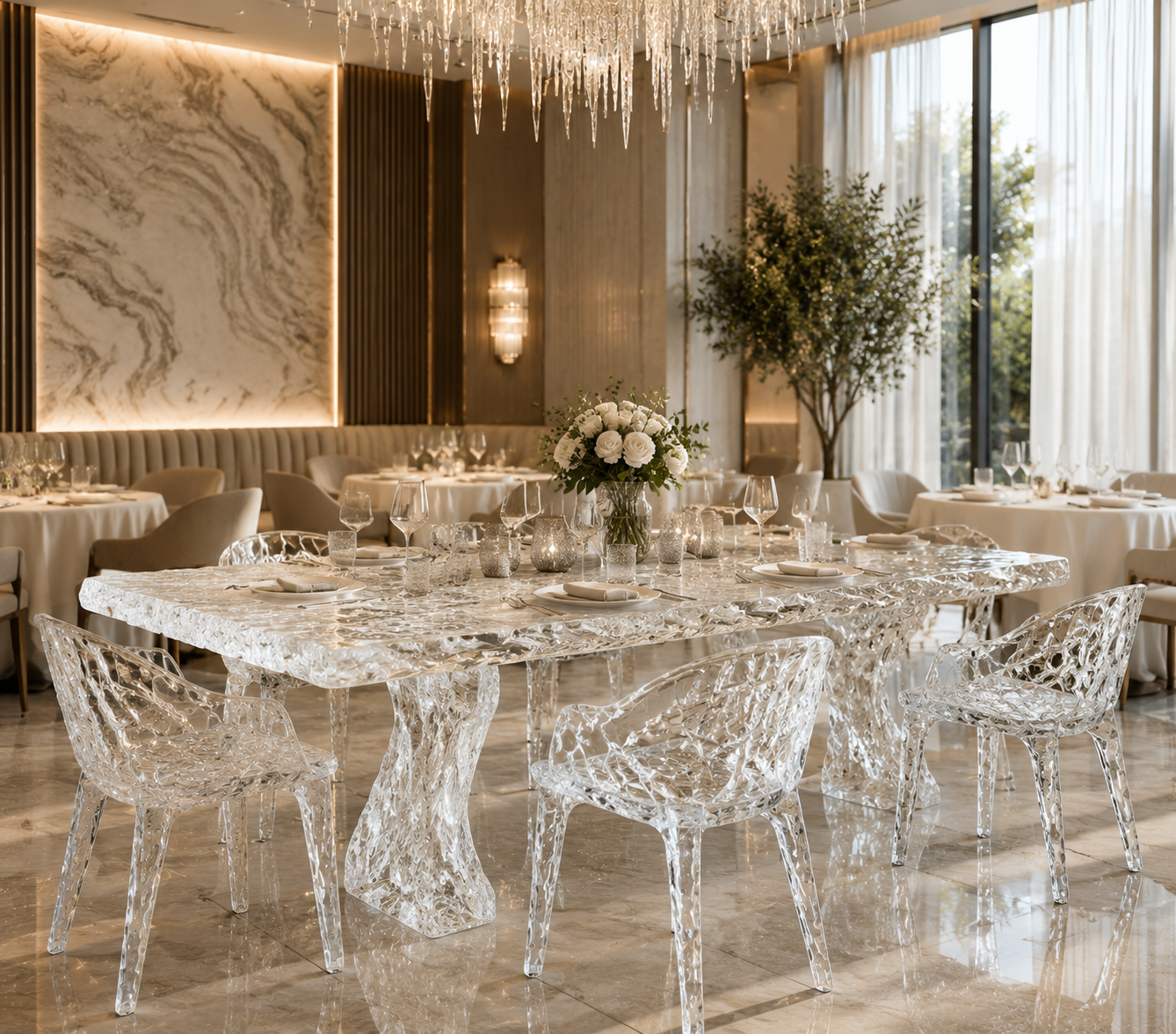
The high-end furniture market is becoming increasingly competitive.
Beautiful furniture is no longer enough. Good materials are no longer enough. Even excellent craftsmanship alone may not guarantee that customers remember a brand.
Luxury consumers, interior designers, architects, hotel groups, retailers, and property developers are surrounded by thousands of furniture products every year. Many of them are professionally photographed, carefully styled, and marketed through similar visual languages.
This creates a fundamental challenge: How can a furniture brand become recognizable before the customer even sees its logo?
One answer is material identity.
For brands working with synthetic crystal acrylic furniture, transparency can become much more than a product feature. When it is supported by high-quality material selection, precision fabrication, distinctive proportions, advanced finishing, and consistent design language, acrylic can become a recognizable signature.
A thick transparent table with jewel-like polished edges. A sculptural acrylic console that appears to float. A crystal-clear pedestal that allows an object to become visually dominant. A custom acrylic dining table whose base creates a powerful architectural silhouette.
These pieces can communicate a brand identity immediately.
This is particularly important in the premium market, where customers are not only buying furniture. They are buying taste, exclusivity, design confidence, craftsmanship, and a story they can associate with a particular manufacturer or designer.
For this reason, synthetic crystal acrylic furniture is creating a new opportunity for brands that want to differentiate themselves in high-end residential and commercial markets.
1. Material Distinction Creates Immediate Brand Recognition
Strong brands are often associated with specific visual signals. Some luxury brands are recognized through a particular color. Others are known for a characteristic metal finish, stitching pattern, silhouette, surface texture, or architectural form.
Furniture brands can build similar recognition through materials.
This is where luxury acrylic furniture has a major advantage. Transparent acrylic has an immediate visual presence that differs significantly from common furniture materials such as timber, marble, steel, upholstery, and painted panels.
When it is used in a highly refined way, it can become a powerful brand identifier.
The key is consistency.
If a manufacturer repeatedly creates furniture using exceptionally clear material, substantial thicknesses, clean geometric forms, carefully polished edges, and nearly invisible bonding, customers begin to associate those characteristics with the brand.
The product becomes recognizable even without visible branding.
This is extremely valuable in the luxury market. A high-end brand should ideally be identifiable through design language rather than relying completely on labels.
Synthetic crystal acrylic furniture can support this because the material responds strongly to proportion and finishing.
A thin acrylic panel communicates something very different from a thick transparent block. A simple folded sheet looks different from a highly engineered sculptural structure. A roughly finished edge feels very different from a crystal-polished edge that captures light.
These differences allow brands to create their own interpretation of acrylic.
One company might specialize in minimal architectural forms. Another might create highly sculptural custom acrylic furniture. A third may combine acrylic with marble. Another may focus on acrylic with brass, stainless steel, leather, or natural timber.
The material becomes a platform for differentiation.
This is important because high-end customers often seek products that do not feel interchangeable. If ten suppliers offer visually similar tables, price becomes a major competitive factor.
If one supplier has a strong, recognizable product language that the others cannot easily reproduce, the conversation changes. Customers begin comparing identity rather than price.
That is one of the most valuable positions a premium brand can achieve.
Material distinction can also help customers remember where they encountered a product. A transparent table with unusual proportions may stay in the viewer's memory longer than another conventional wooden table.
A dramatic crystal clear acrylic coffee table can become the object people remember from a hotel lobby, showroom, luxury residence, or interior design exhibition.
That memory has commercial value. Brand recognition often begins with a single visual impression. If the product creates that impression consistently, the material itself becomes part of the brand.
2. Transparent Furniture Turns Space Into a Brand Communication Medium
Luxury brands are not experienced only through individual products. They are experienced through spaces.
A showroom communicates brand values. A hotel lobby communicates positioning. A retail boutique communicates identity. A restaurant communicates atmosphere. A luxury residence designed around a particular furniture collection communicates lifestyle.
This means furniture has a role beyond function. It becomes part of spatial branding.
Transparent acrylic furniture is particularly effective in this context because it can create a recognizable presence without visually overwhelming the environment.
This is a powerful combination.
A brand may want its furniture to be distinctive while still allowing architecture, artwork, merchandise, or interior materials to remain important. Acrylic can achieve both.
Consider a luxury fashion boutique. The product should remain the focus. Heavy display furniture can compete with clothing, handbags, jewelry, or accessories.
Acrylic pedestals, consoles, shelves, and display structures can provide physical support while reducing visual interference. At the same time, their polished surfaces and transparent forms can reinforce a premium atmosphere.
The furniture becomes part of the brand experience without dominating the merchandise.
The same principle applies to hotels. A hotel group may use a series of luxury acrylic furniture pieces across lobby areas, suites, lounges, restaurants, or private club spaces.
If these pieces share a consistent design language, they begin to function like visual signatures.
Guests may not consciously analyze the material, but they notice the atmosphere. Over time, repeated design elements create familiarity.
This is how physical space can strengthen brand recognition.
Acrylic also works well in interiors with strong architectural features. Natural stone walls, panoramic windows, sculptural staircases, dramatic lighting, or large artworks may be important parts of the identity of a space.
Opaque furniture can compete with those features. Transparent furniture allows them to remain visible.
A transparent acrylic console table can provide function beneath artwork while preserving the wall composition. A clear coffee table can anchor seating without hiding a custom rug. An acrylic bench can offer seating in a dressing room while allowing the cabinetry and flooring to remain visually continuous.
For brands, this creates an important strategic advantage. The furniture can become memorable without becoming visually aggressive.
This is especially suitable for contemporary luxury, where refinement often depends on restraint.
The strongest branding does not always come from adding logos or obvious decorative elements. Sometimes it comes from repeating a distinctive material experience.
A recognizable thickness. A particular edge profile. A characteristic transparency. A consistent relationship between acrylic and metal. A specific geometry.
When these details appear across multiple spaces, the furniture begins to communicate the brand silently.
.png)
3. Customization Makes Products Harder to Copy and Easier to Remember
The high-end furniture market increasingly rewards originality.
Customers can easily find standard tables, chairs, consoles, and cabinets from thousands of suppliers. What is more difficult to find is a product that feels specific.
This is why custom acrylic furniture can become a powerful tool for brand differentiation.
Customization allows a manufacturer to move beyond standard sizes and familiar forms. Instead of producing another transparent rectangular table, the company can explore unusual thicknesses, curved structures, interlocking components, sculptural bases, integrated metal details, colored transparent elements, oversized proportions, or project-specific designs.
These decisions create uniqueness. And uniqueness creates memory.
A product that could only have come from one design language is far more valuable to brand identity than a product that looks similar to everything else on the market.
This is particularly important for suppliers working with architects and interior designers. Design professionals often have concepts that cannot be solved with standard catalog furniture.
They may need a console that matches a specific wall length. A dining table with a customized transparent base. A display pedestal with precise dimensions. A curved acrylic element. A special combination of clear acrylic and stone.
A hotel project may require dozens of pieces with consistent but project-specific details. A retail brand may need transparent structures designed around merchandise dimensions.
In these cases, the manufacturer's ability to customize becomes part of its brand identity.
The message changes from: “We sell acrylic furniture.” to: “We can turn difficult transparent furniture concepts into finished products.”
That is a much stronger market position.
Bespoke acrylic furniture design also makes direct imitation more difficult. Mass-market products can often be copied quickly because their structure is simple and their dimensions are standardized.
A complex customized product requires more than basic fabrication. It may depend on structural knowledge, careful material selection, controlled bonding, specialized polishing, accurate engineering, packaging expertise, and communication with the designer.
The more capability embedded in the product, the more difficult it becomes for a low-cost competitor to reproduce the complete experience.
This creates what could be called a capability barrier.
The brand is protected not by the material alone but by what it knows how to do with the material.
For high-end manufacturers, this is essential. Competing only through access to raw materials is difficult because many suppliers can purchase acrylic.
Competing through craftsmanship, engineering, customization, and design collaboration creates a stronger advantage.
This is how synthetic crystal acrylic furniture can help build long-term differentiation.
The transparent material becomes only the visible surface of a deeper manufacturing capability.
4. Craftsmanship Transforms Acrylic From a Material Into a Luxury Signal
Acrylic presents an interesting challenge.
When produced poorly, it can look inexpensive. When produced exceptionally well, it can look sophisticated, architectural, and almost jewel-like.
The difference lies in craftsmanship.
This makes production quality a central part of brand positioning.
Premium synthetic crystal acrylic furniture requires control at every stage. Material clarity must be consistent. Cutting must be accurate. Surfaces must remain clean. Bonding lines must be carefully managed. Edges must be polished. Corners and radii must feel intentional. Large components must remain structurally stable. Packaging must protect surfaces during transportation. Installation must prevent damage.
Every one of these details influences the final perception of the brand.
Transparency makes imperfections particularly visible. With opaque furniture, some internal joints, adhesives, or structural details can be hidden. With acrylic, the customer may see through the entire object.
This makes manufacturing discipline part of the visual design.
A poorly bonded joint can immediately reduce the perception of quality. An uneven edge can make the furniture feel mass-produced. Scratches can become obvious under strong light. Incorrect proportions can make thick acrylic appear heavy rather than refined.
High-end manufacturers therefore need to approach acrylic almost like a luxury finishing material.
This is where craftsmanship becomes branding.
When customers consistently see flawless polishing, clear surfaces, precise geometry, and strong structural performance, they begin associating those qualities with the manufacturer.
Over time, craftsmanship becomes a recognizable standard.
This is similar to what happens in luxury watchmaking, leather goods, automotive interiors, or fine cabinetry. Customers may not understand every technical process, but they can feel the difference between average execution and exceptional execution.
Acrylic is particularly effective at revealing that difference.
For example, a thick luxury acrylic dining table may appear very simple in photographs. But creating that simplicity can be technically demanding.
The thickness must be visually balanced. The structure must support the tabletop. The acrylic must remain optically attractive. The edges must be finished consistently. The joints must align. The surface must arrive at the project site without damage.
The final result communicates precision. That precision itself becomes a luxury signal.
This also means that a high-end acrylic furniture brand should not sell only appearance. It should communicate capability. Material expertise. Fabrication knowledge. Quality control. Customization. Finishing standards. Project support.
These characteristics help customers understand why one transparent table may be fundamentally different from another.
In a premium market, education can strengthen positioning. When designers understand the complexity behind the product, they are more likely to value the manufacturer as a specialist rather than a commodity supplier.
5. A Distinctive Customer Experience Strengthens High-End Positioning
Luxury brands compete through experience as much as through products.
The customer remembers how a space felt. How the product interacted with light. How the furniture affected the atmosphere. How photographs looked. How guests responded. How easy it was to customize the piece. How professionally the project was handled.
Luxury acrylic furniture can contribute strongly to these experiences.
One reason is visual openness. Transparent furniture allows customers to experience more of the surrounding interior.
A hotel guest can see the marble floor beneath a table. A homeowner can enjoy a handmade rug without hiding it under a solid coffee table. A boutique customer can see merchandise through a display structure. A gallery visitor can focus on artwork rather than the supporting pedestal.
This creates a sense of spatial refinement.
Another advantage is photography. Contemporary luxury brands live in both physical and digital environments.
Hotels, furniture companies, interior designers, retailers, and property developers all depend heavily on photographs and video.
Transparent acrylic performs well visually because it creates layers without blocking the background. A clear table can reveal the floor, furniture, lighting, and architecture behind it. Polished edges create highlights that help define the object.
This makes designer acrylic furniture particularly useful in projects intended for editorial photography, social media, hospitality marketing, property sales, or luxury retail campaigns.
Acrylic also creates an element of surprise.
People understand the function of a table immediately, but a thick transparent table can still create curiosity. How is it constructed? How heavy is it? How are the joints made? Why does the edge glow under the light?
That curiosity creates engagement. A memorable product encourages conversation. Conversation strengthens recognition. Recognition strengthens the brand.
Customer experience also includes customization.
High-end buyers often value the ability to participate in the design process. A client may want different dimensions. A designer may request a particular thickness. A hotel may need a custom finish. A retailer may want integrated branding. An architect may request a unique shape.
When the manufacturer can respond effectively, the customer experiences the company as a problem-solving partner.
This is especially important in B2B luxury markets. Architects, designers, hotels, and retailers do not simply need suppliers. They need partners who can interpret concepts and deliver them reliably.
A strong custom acrylic furniture manufacturer can build loyalty through this service.
Over time, successful collaboration can become more valuable than any individual product. A designer who trusts a manufacturer may return for future projects. A hotel group may standardize certain solutions. A retailer may expand the relationship across stores. A furniture brand may develop exclusive collections with the same fabrication partner.
This is how customer experience becomes long-term commercial value.
.png)
6. Brand Recognition Creates Long-Term Commercial Value and Pricing Power
The strongest brands do not compete only on product specifications. They compete on meaning.
Customers choose them because they recognize the design language, trust the quality, value the experience, and believe the product represents something distinctive.
This creates pricing power.
For manufacturers of synthetic crystal acrylic furniture, this is an important opportunity.
The basic material can be purchased by many companies. What cannot be purchased instantly is brand reputation.
A reputation for exceptional polishing. A reputation for large-scale custom fabrication. A reputation for difficult engineering. A reputation for working successfully with luxury designers. A reputation for creating unusually clear, sculptural, or architecturally integrated furniture.
These qualities accumulate over time. They become intellectual and commercial assets.
A company that builds this reputation is less vulnerable to simple price competition.
This is particularly important in global furniture manufacturing, where customers can compare suppliers from many countries.
If every supplier presents itself with the same language—factory, quality, good price, customization—the differences become difficult to see.
A strong brand needs a clearer story.
For an acrylic specialist, that story can be built around several ideas: precision transparency, crystal-like finishing, architectural furniture, bespoke fabrication, material innovation, premium customization, and spatial design.
These themes create a more distinctive position than simply selling acrylic tables.
They also allow the manufacturer to serve several related high-value markets: luxury residential interiors, hotels and hospitality, designer furniture brands, retail displays, art galleries, jewelry boutiques, fashion stores, property showrooms, corporate reception areas, and premium exhibitions.
In each case, the underlying capability is similar: creating transparent objects that provide function while preserving visual openness.
A company can therefore build recognition around the idea of transparent spatial solutions.
This is broader and more valuable than a single product category.
It also supports premium pricing. Customers generally accept higher prices when they understand why the product is different.
Customization has value. Engineering has value. Finishing quality has value. Design expertise has value. Reliability has value.
Brand recognition helps communicate all of these before the customer begins comparing quotations.
In the long term, this can fundamentally change a manufacturer's business model.
Instead of being selected after a customer decides what product to buy, the brand may become involved earlier. Architects may specify the manufacturer. Designers may contact the company during concept development. Hotels may request custom proposals. Retail brands may collaborate on new store concepts.
At this point, the manufacturer is no longer merely competing for orders. It is participating in design decisions.
That position creates stronger customer relationships and better commercial opportunities.
This is the final and most strategic value of luxury acrylic furniture.
The product creates recognition. Recognition creates trust. Trust creates preference. Preference creates pricing power. And pricing power creates the resources needed to invest in better design, manufacturing, marketing, and innovation.
The result is a cycle that strengthens the brand over time.
Conclusion: Transparency Can Become a Signature, Not Just a Material Choice
The future of high-end furniture will not be determined only by which materials are popular. It will also be determined by which brands use those materials in ways that customers can recognize.
This is where synthetic crystal acrylic furniture offers significant strategic value.
Its transparency is visually distinctive. Its thickness can create sculptural presence. Its polished edges can produce jewel-like highlights. Its neutrality allows it to work with stone, metal, timber, textiles, and architecture. Its customization potential supports unique forms. Its technical demands allow excellent manufacturers to demonstrate craftsmanship. Its visual lightness allows it to create memorable furniture without overwhelming a room.
Together, these characteristics give brands a powerful opportunity.
Acrylic can become part of a signature design language.
For a manufacturer, that might mean becoming known for exceptionally thick transparent furniture. For a designer, it might mean creating recognizable sculptural forms. For a hotel, it might mean using transparent elements consistently across guest experiences. For a retail brand, it might mean presenting products on crystal-clear displays. For a luxury residence, it may mean using carefully selected acrylic pieces to create a unique visual identity.
The most important point is that brand differentiation does not come from acrylic alone. It comes from how the material is interpreted.
The proportions. The craftsmanship. The engineering. The edge treatment. The material combinations. The way the furniture interacts with light. The way it supports architecture. The way it is photographed. The way customers experience it.
When all of these factors are controlled consistently, custom acrylic furniture becomes more than a transparent object.
It becomes recognizable design.
And in the high-end market, recognizable design is one of the strongest forms of competitive advantage.
Luxury customers have many choices. Brands that look similar are easy to replace. Brands that create a distinctive visual world are much harder to forget.
That is the new value of synthetic crystal acrylic furniture: not simply making furniture transparent, but making the brand visible.
READ MORE:
- When Furniture Starts to Look the Same: How Material Details Create Differentiation — A Synthetic Crystal Approach
- How Synthetic Crystal Furniture Uses Transparency to Create an Airy, Understated Luxury Interior
- Customers Care About More Than Furniture Form: How Synthetic Crystal Material Details Influence Purchase Decisions
- Why High-End Clients Pay for Material Quality: What Synthetic Crystal Furniture Reveals About Luxury
- The Luxury of a Space Often Hides in the Details: How Synthetic Crystal Furniture Elevates Overall Visual Quality
- Synthetic Crystal Acrylic Furniture: Building the Next Generation of High-End Living with Innovative Materials
- Why Crystal-Grade Acrylic Is Becoming an Important Direction for the Future of Furniture Design
- From Material Breakthrough to Spatial Upgrade: The New Value Created by Synthetic Crystal Acrylic Furniture
- Synthetic Crystal Acrylic Furniture: Why High-End Homes Are Embracing “Transparent Luxury”


