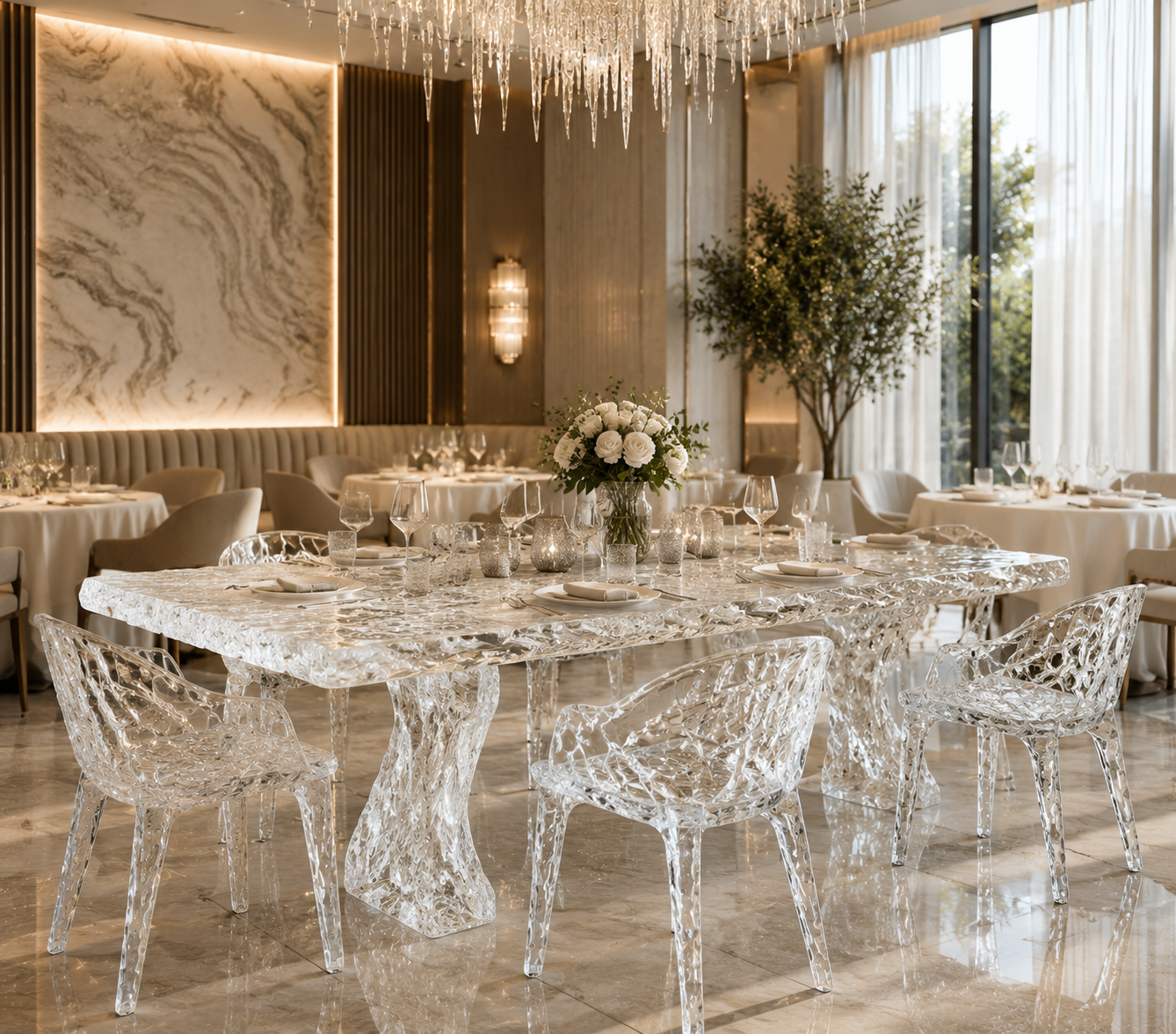
Furniture design changes whenever materials change.
New manufacturing techniques influence what designers can build. New lifestyles influence what customers expect. New architectural trends influence how furniture needs to interact with space.
For decades, wood, metal, stone, glass, leather, and textiles have formed the core material vocabulary of premium furniture. They remain essential, but another material is attracting increasing attention in contemporary interiors: crystal-grade acrylic.
Unlike ordinary plastic furniture, high-quality crystal-grade acrylic furniture is defined by exceptional optical clarity, substantial thickness, precise machining, polished surfaces, carefully controlled joints, and sophisticated structural design.
These characteristics allow acrylic to do something unusual.
It can appear visually light while remaining physically substantial. It can occupy a room without blocking the room. It can reflect and transmit light while supporting practical furniture functions. It can complement expensive materials without competing with them. It can be transformed into highly customized forms that would be difficult to achieve with many traditional materials.
For these reasons, acrylic furniture is increasingly moving from a niche decorative category toward a more serious role in luxury residential, hospitality, retail, exhibition, and architectural design.
The future of furniture will not belong to one material. Instead, it will belong to materials that solve multiple design problems at the same time.
Crystal-grade acrylic is becoming important because it combines aesthetic distinction, spatial efficiency, customization, technical precision, and a strong contemporary identity.
1. Material Performance Is Moving Acrylic Beyond Conventional Plastic Furniture
One of the biggest barriers to the wider use of acrylic in high-end furniture has historically been perception.
Many people still associate acrylic with lightweight plastic products, inexpensive displays, simple decorative objects, or mass-produced transparent chairs.
That perception changes dramatically when the material reaches a higher level of quality.
Premium crystal-grade acrylic furniture depends on much more than transparency.
Optical clarity is one of the first requirements. A high-quality transparent acrylic component should allow light and surrounding objects to remain visually clear. Excessive cloudiness, inconsistent color, poor surface treatment, or visible manufacturing defects can quickly reduce the premium effect.
Thickness is equally important. Thin acrylic can appear lightweight and temporary. Thick acrylic produces a completely different emotional response.
A substantial transparent slab may look almost like a block of crystal. It creates physical presence without the visual heaviness of marble, timber, or solid metal.
This balance between strength and apparent weightlessness is one of the material's most important characteristics.
Surface finishing also changes the experience.
High-end acrylic furniture manufacturing requires accurate cutting, careful sanding, polishing, bonding, and protection.
The edges are especially significant.
When polished properly, thick transparent edges can capture and redirect light, producing a luminous effect similar to crystal.
This means that an edge is no longer simply a technical detail. It becomes part of the aesthetic.
Bonding quality matters for the same reason.
Transparent materials reveal construction details that opaque furniture can conceal. An ordinary cabinet can hide internal fasteners, adhesive, joints, and structural components. A transparent acrylic table may expose almost everything.
The manufacturer therefore has fewer places to hide mistakes.
This creates a demanding standard of craftsmanship. The cleaner the furniture appears, the more technical discipline is often required behind the scenes.
Structural engineering is another important factor.
As acrylic furniture becomes larger and thicker, designers must consider loading, spans, balance, support, connection methods, and long-term dimensional stability.
A large acrylic dining table, for example, must achieve much more than visual transparency. It must also remain practical and stable in everyday use.
This combination of visual refinement and engineering performance is changing the market's understanding of the material.
Acrylic is no longer interesting simply because it is clear. It is increasingly valued because advanced manufacturing can transform clarity into a premium design language.
That is why crystal acrylic furniture manufacturers are moving toward more specialized production rather than competing only with basic plastic furniture suppliers.
The future market will likely distinguish more clearly between ordinary acrylic products and precision-made crystal-grade furniture.
Just as there are significant differences between basic wood products and fine cabinetry, there are significant differences between simple acrylic fabrication and luxury acrylic furniture manufacturing.
The material may be similar. The value created from it is not.
2. Transparency Responds to the New Aesthetic of Modern Luxury
Luxury interiors are changing.
Traditional luxury often emphasized abundance. Large furniture, ornate decoration, polished stone, dark timber, metallic finishes, rich fabrics, and highly visible craftsmanship were used to communicate wealth.
Contemporary luxury is increasingly more restrained.
Many homeowners and designers now prefer rooms that feel calm, spacious, carefully edited, and architecturally coherent.
This change benefits transparent furniture.
Acrylic can create a premium presence without adding excessive visual weight.
A thick transparent console may be physically substantial, but because light passes through it, the room still feels relatively open.
This quality fits naturally with minimalist and contemporary luxury interiors.
Modern design increasingly values what could be called visual silence. Not every object needs to compete for attention. Some pieces should define the room. Others should support it.
Crystal-grade acrylic gives designers an effective material for creating furniture that is present without becoming visually dominant.
This can be especially useful when an interior already contains strong materials.
Consider a room with heavily veined marble. Adding another highly decorative furniture material may create competition.
A transparent acrylic coffee table can perform a practical function while allowing the stone, rug, upholstery, and artwork to remain important.
The same is true in spaces with detailed timber. Acrylic can create contrast without introducing another strong grain or color.
Beside brass, stainless steel, leather, boucle, velvet, or natural stone, clear acrylic acts almost like a visual connector.
It allows other materials to express themselves.
This characteristic supports the growing preference for layered but controlled interiors.
High-end design is increasingly about relationships between materials rather than the individual cost of each object.
A marble wall may feel more dramatic beside transparent furniture. A handwoven rug becomes more visible under a clear table. A sculptural sofa can appear more dominant when the nearby side table has little visual mass.
This ability to strengthen surrounding materials gives luxury acrylic furniture an unusual role.
It can become valuable precisely because it does not always demand attention.
That is a sophisticated form of luxury.
The material also works with many design styles.
In a minimalist apartment, it reinforces visual simplicity. In a glamorous interior, polished acrylic can interact with mirrors, metal, and decorative lighting. In a contemporary classic home, transparent furniture can create contrast with architectural moldings and traditional fabrics. In a coastal residence, it supports brightness and openness. In an art collector's home, it allows paintings and sculpture to remain visually dominant.
This stylistic adaptability makes acrylic less dependent on one trend.
The best materials are not those that belong to one moment. They are those that can be interpreted differently as design evolves.
Crystal-grade acrylic has that flexibility.
.png)
3. Crystal-Grade Acrylic Improves Spatial Efficiency and Visual Openness
One of the most practical reasons transparent acrylic is likely to remain important is its effect on perceived space.
Furniture occupies both physical space and visual space. These are not always the same.
A solid table may occupy exactly the same floor area as a transparent table, but it can make the room feel much more crowded.
Why? Because the eye cannot see through it.
Opaque furniture interrupts sightlines. It hides flooring. It blocks parts of walls. It creates stronger visual boundaries.
Transparent furniture reduces these interruptions.
This is particularly valuable in modern urban housing.
Luxury does not always mean unlimited space. Premium apartments in cities such as New York, London, Paris, Singapore, Hong Kong, or Tokyo may be extremely valuable while still having carefully controlled floor areas.
Designers therefore need furniture that provides full functionality without making spaces feel smaller.
A crystal clear acrylic coffee table can define a living area while preserving the appearance of the rug and flooring beneath it.
A transparent desk can create a workspace without visually converting the entire room into an office.
A clear console can provide storage or display space in a hallway without producing the heavy appearance of a conventional cabinet.
An acrylic dining table base can support a substantial tabletop while keeping the floor visible.
This effect becomes even more important in open-plan environments.
Modern homes frequently combine living, dining, kitchen, and entertainment functions.
Designers must create separate activity zones without destroying visual continuity.
Transparent furniture can help.
It defines function physically while maintaining continuity visually.
The same advantage applies to panoramic views.
Many premium homes are designed around large windows. A coastal villa may be oriented toward the ocean. A penthouse may overlook a city skyline. A mountain property may use floor-to-ceiling glazing to connect the interior with the landscape.
Traditional furniture can interrupt these valuable views.
Transparent acrylic reduces that problem.
Acrylic furniture positioned near windows can provide practical surfaces while preserving more of the exterior visual experience.
In this context, the furniture is doing more than looking modern. It is protecting architectural value.
The effect is also relevant to interior materials.
Luxury projects frequently invest heavily in flooring. Rare stone, patterned marble, custom timber, handmade rugs, terrazzo, or intricate floor details may be important elements of the design.
Opaque furniture hides them. Transparent furniture reveals them.
This creates better visual continuity and allows expensive surfaces to deliver more design value.
For architects and interior designers, this makes acrylic almost an architectural tool.
The question is no longer simply, “Which table should we place here?” It becomes, “How can this table perform its function without interrupting the visual structure of the room?”
Custom acrylic furniture provides one possible answer.
As property values rise and interiors become increasingly optimized, furniture that preserves perceived space will remain relevant.
That makes transparency more than a decorative trend. It becomes a practical spatial strategy.
4. Greater Design Freedom Is Expanding the Possibilities of Custom Furniture
Another reason crystal-grade acrylic is becoming important is its ability to support customization.
The luxury furniture market is moving toward greater personalization.
Architects, interior designers, hotels, retail brands, and private clients increasingly want products developed specifically for individual projects.
Standard sizes are not always enough. Standard forms are not always appropriate.
Acrylic gives designers significant flexibility.
It can be used for clean geometric furniture, thick transparent slabs, waterfall forms, sculptural bases, curved elements, layered components, display structures, and mixed-material designs.
This enables custom acrylic furniture to respond directly to architecture.
A long entrance wall may require a console that does not exist in standard retail dimensions. A large living room may need an oversized coffee table. A narrow penthouse window may require a slim transparent desk. A hotel suite may need bespoke side tables designed around a particular bed and lighting concept. A gallery may need transparent pedestals in exact heights. A luxury boutique may require display furniture developed around specific product dimensions.
In these situations, customization creates value beyond appearance.
The furniture becomes part of the project rather than an object added after the project is finished.
Crystal-grade acrylic also works effectively with other premium materials.
An acrylic base can support a marble tabletop. Transparent legs can make a wooden surface appear to float. Clear components can be combined with stainless steel for a highly precise modern look. Brass can create warmer contrast. Leather and upholstery can introduce softness. Colored acrylic can add controlled visual identity.
This opens a large design vocabulary.
The future of designer acrylic furniture is therefore unlikely to be limited to completely clear objects.
Instead, the material will increasingly appear as one component in sophisticated mixed-material compositions.
Customization also creates stronger commercial differentiation for manufacturers.
Many factories can produce standard furniture. Far fewer can convert complex architectural concepts into technically reliable transparent structures.
That requires communication, engineering, prototyping, fabrication expertise, quality control, and finishing capability.
For a high-end acrylic furniture manufacturer, these skills can become a competitive advantage.
The business is no longer selling only tables or chairs. It is selling the ability to solve design problems.
That positioning is particularly valuable when working with professional customers.
Interior designers may need unusual dimensions. Architects may need structural advice. Luxury brands may require exclusive forms. Hotels may need consistency across multiple pieces. Retail companies may need products that can be reproduced across several locations.
A manufacturer capable of supporting these needs becomes more than a supplier. It becomes a design and production partner.
This transition is likely to shape the future of the acrylic furniture sector.
5. Durability, Adaptability, and Long-Term Design Value Support Its Future Growth
Future furniture design is not only about appearance.
Customers increasingly consider how products will perform over time.
Will the furniture remain visually relevant? Can it work if the interior changes? Can it be integrated with different materials? Can it serve multiple environments?
This is another area where premium acrylic has advantages.
Clear acrylic furniture is highly adaptable because it does not impose a strong color or grain.
A wooden table is closely connected to a particular timber tone. A colored lacquer piece influences the entire room palette. A highly patterned stone surface can become a dominant visual element.
Transparent acrylic is more neutral.
This means the same piece may continue to work even if the owner changes the rug, wall color, upholstery, artwork, or lighting.
That flexibility can increase its long-term design value.
It also means acrylic can move between different environments more easily.
A clear side table can work in a bedroom, living room, dressing room, showroom, or boutique. An acrylic pedestal can support artwork in a residence and products in a retail environment. A transparent console can work in both contemporary and transitional interiors.
This adaptability supports longer relevance.
Another important consideration is visual aging.
Strong decorative trends can date quickly. Highly specific colors, patterns, or silhouettes may immediately reveal when a piece was designed.
Transparent geometry can be less time-specific when proportions and craftsmanship are handled carefully.
This does not mean every acrylic product is timeless. Poorly designed acrylic furniture can look dated like any other material.
But refined, minimal forms have the potential to remain relevant across multiple design cycles.
Maintenance and surface care will continue to be important considerations for premium applications.
High-quality furniture must be properly used and protected, particularly because transparent surfaces make scratches and marks more visible.
For manufacturers, this creates an opportunity to provide better guidance on care, packaging, installation, and long-term maintenance.
A premium product experience should continue after delivery.
This is especially important in hospitality and commercial environments where furniture may receive intensive use.
Designers need to select appropriate material specifications and construction methods for the intended application.
When this is done correctly, crystal-grade acrylic can support demanding residential and commercial projects.
The wider lesson is that future materials must deliver both emotional and practical value.
Customers may initially notice the transparency. They continue valuing the furniture because it works.
That combination is essential for long-term market growth.
.png)
6. Furniture Is Evolving Into a Material, Spatial, and Brand Experience
Perhaps the most important reason crystal-grade acrylic is becoming a future direction is that the role of furniture itself is changing.
Furniture is no longer evaluated only as an isolated object. It is part of a larger experience.
Interior designers ask how it affects the room. Architects ask how it interacts with the building. Luxury brands ask how it supports identity. Retailers ask how it presents products. Hotels ask how guests experience it. Homeowners ask how it makes everyday living feel.
Crystal-grade acrylic can contribute to all of these objectives.
In luxury retail, transparent furniture can support merchandise without visually competing with it.
A clear acrylic display pedestal can make a handbag, watch, sculpture, jewelry piece, or decorative object appear almost suspended in the environment.
In galleries, the same principle helps artworks remain dominant.
In hotels, transparent tables and consoles can create a contemporary identity while maintaining openness in guest rooms and public spaces.
In private homes, acrylic can help preserve light, views, artwork, flooring, and architectural details.
For furniture brands, the material can become part of a recognizable signature.
A company may become known for unusually thick acrylic. Another may specialize in acrylic combined with stone. Another may develop curved sculptural pieces. Another may focus on large-scale architectural furniture.
These differences create brand identity.
That matters because the premium market increasingly rewards distinction.
When customers can find hundreds of similar furniture products online, generic products become easier to compare by price.
Distinctive products are evaluated differently.
They are compared through craftsmanship, design, originality, brand reputation, and emotional appeal.
This creates greater pricing power for companies that develop recognizable capabilities.
Crystal-grade acrylic is particularly well suited to this because manufacturing quality is highly visible.
Good polishing is visible. Good bonding is visible. Correct proportions are visible. Material clarity is visible. Poor workmanship is also visible.
The transparency of the product therefore becomes a demonstration of manufacturing confidence.
There is almost nowhere for the maker to hide.
When the execution is excellent, this openness strengthens the premium impression.
Future furniture brands will increasingly need this kind of material story.
Customers want to understand what makes one product different from another. They want to see craftsmanship. They want customization. They want visual originality. They want furniture that works in photographs as well as physical spaces. They want products that contribute to an overall lifestyle.
Synthetic crystal acrylic furniture responds to many of these expectations simultaneously.
That is why its future value extends beyond the material itself.
It can support design innovation, spatial performance, customization, brand differentiation, commercial presentation, and emotional experience.
Conclusion: Crystal-Grade Acrylic Is Becoming a Strategic Furniture Material
Crystal-grade acrylic is unlikely to replace wood, marble, metal, glass, leather, or other traditional furniture materials.
That is not its role.
Its value comes from doing things those materials cannot do in exactly the same way.
It can create physical presence with reduced visual weight. It can preserve views and architectural continuity. It can reveal rugs and flooring instead of hiding them. It can interact dynamically with natural and artificial light. It can support highly customized forms. It can complement stronger materials without competing with them. It can serve residential, hospitality, retail, gallery, and commercial environments.
Most importantly, it can turn transparency into a design strategy.
The future of furniture design will increasingly focus on experience rather than objects alone.
Designers will ask how furniture affects light. How it affects circulation. How it affects perceived space. How it supports architecture. How it communicates a brand. How it can be customized for individual projects. How its materials interact with everything around them.
In all of these questions, crystal-grade acrylic furniture offers compelling answers.
The material represents a shift from traditional visual weight toward controlled transparency. From standardized furniture toward customization. From standalone objects toward spatial integration. From basic fabrication toward precision craftsmanship. From simple functionality toward experience.
That combination makes crystal-grade acrylic more than a fashionable material.
It is becoming an important tool for the next generation of furniture designers, architects, manufacturers, retailers, hospitality brands, and luxury homeowners.
Future furniture will not simply occupy space. It will shape how space is perceived.
And that is exactly where crystal-grade acrylic has the potential to become increasingly important.
READ MORE:
- When Furniture Starts to Look the Same: How Material Details Create Differentiation — A Synthetic Crystal Approach
- How Synthetic Crystal Furniture Uses Transparency to Create an Airy, Understated Luxury Interior
- Customers Care About More Than Furniture Form: How Synthetic Crystal Material Details Influence Purchase Decisions
- Why High-End Clients Pay for Material Quality: What Synthetic Crystal Furniture Reveals About Luxury
- The Luxury of a Space Often Hides in the Details: How Synthetic Crystal Furniture Elevates Overall Visual Quality
- Synthetic Crystal Acrylic Furniture: Building the Next Generation of High-End Living with Innovative Materials
- Synthetic Crystal Acrylic Furniture: Giving Brands a Distinctive Identity in the High-End Market
- From Material Breakthrough to Spatial Upgrade: The New Value Created by Synthetic Crystal Acrylic Furniture
- Synthetic Crystal Acrylic Furniture: Why High-End Homes Are Embracing “Transparent Luxury”


