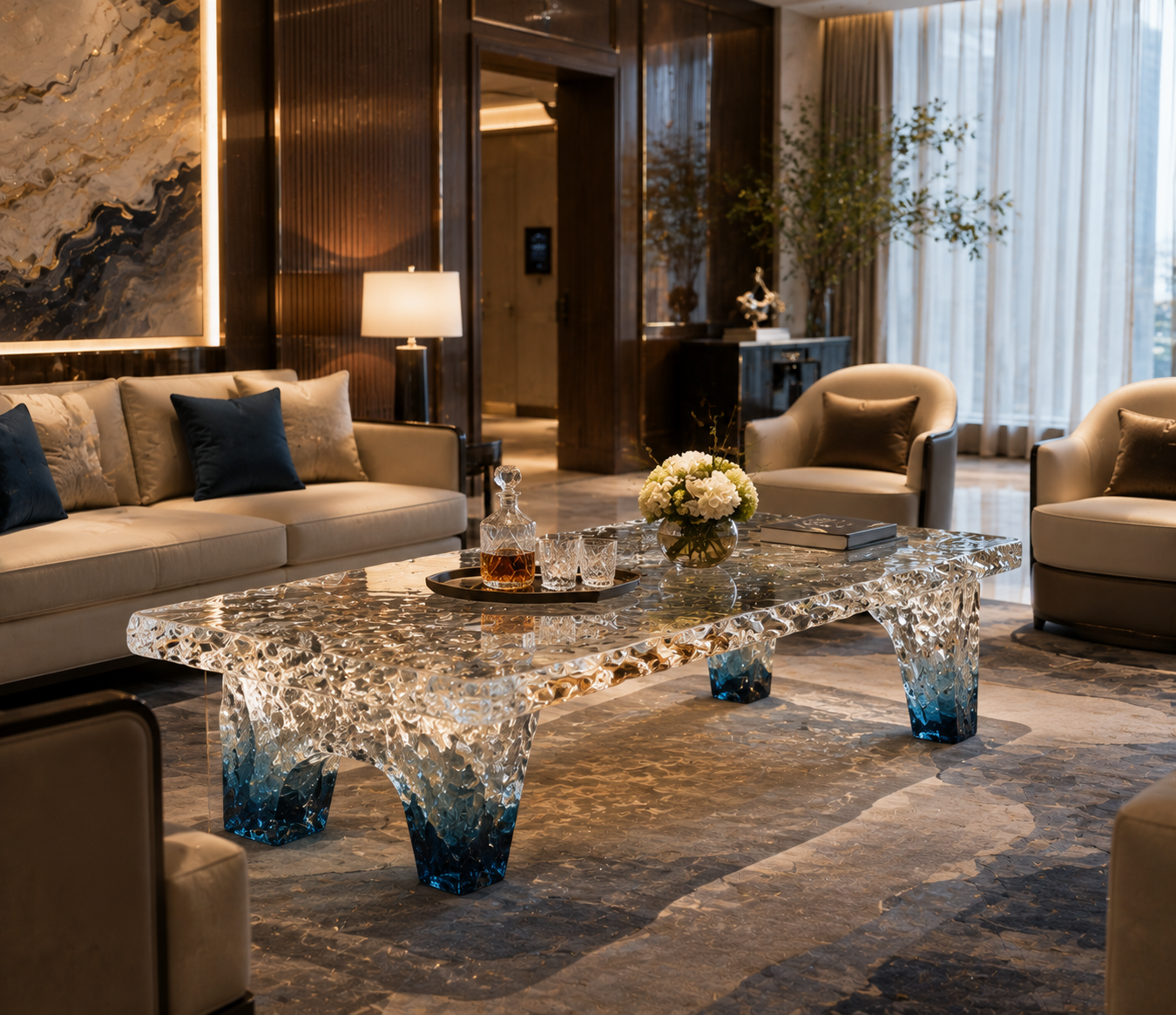
Luxury living has never been defined by furniture alone.
It is defined by how materials, architecture, light, technology, comfort, and personal identity come together to create an experience.
For decades, the language of luxury interiors was dominated by familiar materials: marble, hardwood, leather, brass, stainless steel, glass, and fine textiles.
These materials continue to play an essential role.
But the next generation of premium interiors is beginning to explore a broader question: What materials can create luxury in a way that feels lighter, more flexible, more contemporary, and more closely connected to the future?
One of the most interesting answers is synthetic crystal acrylic furniture.
Acrylic has existed for many years, but high-quality furniture applications are changing the way the material is perceived.
Advanced material production, precision fabrication, thicker structural components, better polishing, cleaner bonding, and more ambitious furniture design are allowing acrylic to move far beyond the image of conventional transparent plastic.
Today, premium acrylic can be transformed into large dining tables, sculptural coffee tables, transparent consoles, benches, desks, display pedestals, furniture bases, custom installations, and architectural objects.
This evolution matters because furniture is no longer judged only by function.
High-end consumers want products that improve the way a space feels. They want furniture that reflects personal taste. They want materials that support architecture rather than compete with it. They want design that feels distinctive without becoming excessive. They want a living environment that can adapt to changing lifestyles.
In this context, synthetic crystal acrylic furniture offers a unique combination of visual clarity, sculptural potential, customization, and spatial efficiency.
It is not simply a new furniture trend. It is part of a broader shift toward a new model of high-end living.
1. Innovative Materials Are Redefining What Luxury Furniture Can Be
Luxury furniture has traditionally relied on the value associated with natural materials.
Rare timber, natural stone, handcrafted leather, precious metal finishes, and artisanal textiles have long communicated exclusivity.
However, the luxury market is evolving.
Premium value is increasingly being created not only by material rarity but also by innovation, precision, engineering, and design intelligence.
This creates space for crystal-grade acrylic furniture.
High-quality acrylic demonstrates how an engineered material can achieve a sophisticated visual and functional identity.
The key difference lies in execution.
Ordinary acrylic may appear thin, lightweight, or purely functional. Premium acrylic furniture depends on optical clarity, substantial thickness, precise proportions, high-quality surface finishing, and carefully controlled construction.
When these factors come together, acrylic begins to communicate something very different.
A thick transparent slab can create a powerful physical presence while remaining visually light.
This contradiction is one of the material's greatest strengths.
A marble table looks heavy because it is both physically and visually dense. A thick acrylic table may also be physically substantial, but the eye can still see through it.
The result is a piece of furniture that feels architectural without making the room feel overloaded.
This quality makes luxury acrylic furniture particularly appropriate for contemporary interiors.
The material can look minimal while requiring complex manufacturing. It can appear simple while demonstrating precise craftsmanship.
This is becoming increasingly important in high-end design.
Modern luxury is often less interested in decoration for its own sake. Instead, it values precision.
A perfect joint. A carefully controlled proportion. A polished edge. A clean transition between materials. A surface that interacts beautifully with light.
These details are where premium acrylic becomes valuable.
The material is also highly responsive to design.
Thickness changes its personality. Edge treatment changes the way it captures light. Geometry changes how transparent volumes overlap. Surface quality affects the perception of depth.
This means designers are not working with transparency alone.
They are working with a material that can produce a wide range of visual effects.
The future of high-end furniture will increasingly depend on materials that allow designers to create new experiences rather than simply repeat traditional forms.
Synthetic crystal acrylic fits this direction well.
It expands the luxury material vocabulary.
2. Transparency Creates a New Visual Language for High-End Living
One of the clearest changes in luxury interior design is the movement toward greater visual openness.
Modern homes are increasingly designed around natural light, larger windows, open-plan layouts, calm color palettes, carefully selected materials, and fewer unnecessary visual barriers.
This shift is changing what people expect from furniture.
A piece of furniture no longer exists independently from the room. It must respond to the architecture. It must support views. It must work with natural light. It must coexist with stone, wood, artwork, textiles, and decorative objects.
This is where transparent acrylic furniture becomes especially relevant.
Transparent furniture creates presence without creating the same degree of visual mass as opaque furniture.
A clear acrylic coffee table can anchor a living room without hiding the rug beneath it. A transparent console can create a functional surface without covering an important wall treatment. An acrylic desk can provide a working area in a bedroom without making the room feel visually divided. A clear dining table base can support a dramatic tabletop while keeping the surrounding space open.
This creates a new visual language.
The furniture becomes less like a solid object placed in a room and more like a controlled layer within the architecture.
That distinction is important.
The next generation of luxury living is increasingly focused on flow.
People want spaces that feel connected. The living room should connect to the dining area. The interior should connect to the exterior. The furniture should connect visually with the floor, walls, windows, and artwork.
Transparency helps create that continuity.
It can also create a more refined form of luxury.
Traditional luxury often communicates value by showing more. More ornament. More materials. More decoration. More visual complexity.
Contemporary luxury often works in the opposite direction.
It asks how much can be removed while still creating richness.
Synthetic crystal acrylic furniture fits naturally into this philosophy.
It can introduce sophisticated craftsmanship without making the room feel busier. It can create strong details without creating visual clutter. It can make expensive surrounding materials more visible.
This is why acrylic works especially well with marble, timber, metal, leather, linen, wool, velvet, and decorative stone.
Acrylic does not necessarily compete with these materials. Instead, it can reveal them.
A transparent table makes a rug more visible. A clear console makes a stone wall more prominent. A crystal-like pedestal makes the artwork above it more dominant.
The furniture contributes to luxury by helping other materials perform better.
That is a highly contemporary idea.
.png)
3. Acrylic Furniture Makes Luxury Spaces Feel Lighter, Larger, and More Flexible
One of the most valuable qualities of acrylic is its ability to change how a room is perceived.
A room has a physical size. But it also has a visual size.
Furniture strongly influences that visual dimension.
Large opaque furniture can make a space feel smaller even when the actual floor area remains unchanged.
Dark tables, solid cabinets, wide bases, and heavy visual forms interrupt sightlines.
Transparent acrylic reduces these interruptions.
This makes clear acrylic furniture particularly valuable in premium urban residences.
Luxury apartments in major cities may have extraordinary views, expensive finishes, and carefully designed interiors while still needing to maximize every square meter.
The furniture must therefore provide full functionality without visually reducing the room.
Acrylic can help.
A crystal clear acrylic coffee table allows the floor or rug to remain visible. A transparent side table provides a surface without creating another strong visual block. A clear desk can be placed near a window while preserving more of the view. An acrylic bench can provide seating in a dressing room without making the space feel crowded.
This matters because modern luxury increasingly values perceived freedom.
People want rooms that feel easy to move through. They want clear views. They want natural light to travel deeper into the space. They want furniture arrangements that feel open rather than congested.
Transparent furniture supports this experience.
It is especially effective near panoramic windows.
In luxury villas, penthouses, coastal properties, and mountain homes, exterior views can be one of the property's most valuable features.
The furniture should not unnecessarily block them.
A transparent acrylic console placed near glazing can provide functionality while allowing the landscape to remain visible.
The same principle applies to premium flooring.
High-end interiors often use natural stone, patterned marble, timber, terrazzo, or custom rugs as major design features.
Opaque furniture covers part of these surfaces. Transparent furniture allows them to remain part of the visual composition.
This makes the space feel more continuous.
It can also make expensive materials feel more valuable because more of them can be seen.
Flexibility is another major advantage.
Transparent furniture is visually neutral. It does not impose a strong color or grain.
This makes it easier to combine with changing interior palettes.
A homeowner can replace the sofa. Change the rug. Add artwork. Update lighting. Introduce new accessories.
A high-quality acrylic side table or console can often continue working with all of these changes.
This ability to adapt supports the next generation of high-end living.
Luxury interiors are becoming less static.
People want homes that can evolve.
Furniture that can move between different aesthetic contexts has long-term value.
4. Customization Turns Acrylic Into a Platform for Personalized Luxury
Personalization is becoming one of the strongest forces in the luxury market.
High-end consumers do not always want products designed for the average customer.
They want furniture that responds to their home, their architecture, their lifestyle, and their personal preferences.
This is creating growing demand for custom acrylic furniture.
Acrylic can be fabricated into many different forms.
Clean geometric tables. Thick block-like bases. Curved structures. Waterfall profiles. Sculptural coffee tables. Transparent benches. Architectural consoles. Display pedestals. Layered furniture compositions. Mixed-material designs.
This flexibility allows acrylic to become more than a furniture material.
It becomes a design platform.
For example, a designer may need a three-meter-long console for a large villa entrance. Standard furniture may not provide the correct dimensions. A custom acrylic piece can be created specifically for that wall.
A penthouse may require a transparent table that preserves the view through floor-to-ceiling windows. A bespoke structure can be developed around the exact spatial conditions.
A dressing room may need a clear bench with dimensions aligned to a central cabinet island. Acrylic can be tailored accordingly.
A luxury boutique may require transparent display structures developed around specific products. A hotel may need customized side tables repeated across multiple suites.
The ability to respond precisely to these requirements creates real value.
It also allows designers to combine acrylic with other premium materials.
A clear base can support a marble top. Transparent legs can make a timber surface appear to float. Brass can add warmth. Stainless steel can create a sharper contemporary aesthetic. Leather can introduce softness. Colored transparent acrylic can add controlled personality.
This opens up a wide range of creative possibilities.
The future of designer acrylic furniture is therefore not limited to completely transparent objects.
The most interesting products may combine transparency with strong contrasting materials.
This creates tension. Heavy and light. Opaque and transparent. Natural and engineered. Warm and cool.
These contrasts make interiors more sophisticated.
Customization also changes the relationship between manufacturer and customer.
A factory that only sells standard acrylic products competes mainly on price, quality, and delivery.
A manufacturer that can engineer custom forms, solve structural problems, advise on thickness, prototype complex pieces, and coordinate with designers competes on capability.
That is a stronger position in the luxury market.
Architects and interior designers value suppliers who can translate ideas into reliable products.
A custom acrylic furniture manufacturer can become part of the creative process.
This creates deeper relationships and higher-value projects.
5. Technology and Craftsmanship Are Creating a New Standard of Premium Furniture
The future of acrylic furniture depends heavily on manufacturing quality.
Transparency is unforgiving.
It reveals almost everything.
Poor joints. Uneven edges. Scratches. Incorrect alignment. Cloudy material. Visible bonding. Weak proportions.
These issues can immediately reduce the perception of quality.
This is why high-end acrylic furniture manufacturing requires both technology and craftsmanship.
Precision cutting is essential. Components must fit accurately. Polishing must be consistent. Edges must look clean and intentional. Bonding needs to be carefully controlled. The material must remain protected throughout production, transportation, and installation.
Structural engineering must also be appropriate for the size and application of the furniture.
This is especially important as products become larger.
A small decorative acrylic table is relatively simple. A large dining table, architectural console, oversized bench, or thick transparent structure requires more technical knowledge.
Designers must consider material thickness, weight, load distribution, connection points, spans, and long-term performance.
This technical complexity creates a barrier between basic production and premium production.
That barrier creates value.
A finished acrylic table may appear visually simple. But producing that simplicity at a high level can require a disciplined manufacturing process.
This is similar to many luxury products.
A minimalist watch may require extraordinary engineering. A simple leather bag may depend on exceptional stitching and edge finishing. A clean architectural interior may require more precision than a heavily decorated one.
Acrylic furniture follows the same principle.
The cleaner the final appearance, the more important the hidden craftsmanship becomes.
This is especially relevant for crystal-grade acrylic furniture because the customer expects a high degree of optical perfection.
Polished edges should enhance the material. The geometry should feel deliberate. Connections should not distract from the design.
The result should look closer to a transparent architectural object than an ordinary plastic product.
This craftsmanship can also become part of brand positioning.
A manufacturer known for exceptional polishing or difficult custom structures can build recognition in the market. A designer can create a signature using specific thicknesses or edge profiles. A luxury furniture brand can use acrylic as a recurring material across collections.
In this way, manufacturing capability becomes part of design identity.
The next generation of luxury furniture will increasingly reward this combination of advanced production and human judgment.
Technology enables precision. Craftsmanship determines whether that precision feels beautiful.
.png)
6. The Next Generation of High-End Living Will Be Built Around Experience
The most important change in luxury is that customers are increasingly buying experiences rather than objects alone.
A table is not only a table. It affects how a room feels. A chair affects how people interact. A display pedestal affects how a product is perceived. A console affects the relationship between furniture, art, and architecture.
This is why synthetic crystal acrylic furniture is particularly relevant to future lifestyle design.
The material can perform different roles in different environments.
In private residences, acrylic can create openness and visual calm. In hotels, it can help develop a distinctive contemporary atmosphere. In luxury retail, transparent display furniture can support merchandise without competing with it. In galleries, clear pedestals can reduce visual distraction. In showrooms, acrylic can create clean product presentations. In offices, transparent tables can support a lighter, more contemporary environment.
The same material can therefore move across multiple premium sectors.
This versatility makes acrylic strategically interesting.
Luxury is also becoming increasingly visual.
Interior projects are photographed. Homes appear on social media. Hotels depend on digital marketing. Retail brands create content around physical spaces.
Furniture is experienced through screens before many customers see it in person.
Transparent acrylic performs strongly in this environment.
It creates visual layers. It allows backgrounds to remain visible. Polished edges catch light. Thick transparent forms create a recognizable silhouette without hiding the architecture behind them.
This can make acrylic furniture highly effective in photography and video.
However, digital visibility alone is not enough.
The physical experience must also be strong.
The customer needs to feel the quality. The proportions must work. The furniture needs to perform its function. The surface should feel refined. The piece should interact naturally with the rest of the room.
When these elements come together, acrylic becomes a complete experience.
This is where the idea of the “next generation of high-end living” becomes important.
Future luxury homes will likely place greater emphasis on flexibility, individuality, spatial openness, material innovation, and integrated design.
Furniture will need to respond to all of these demands.
It will need to be beautiful but adaptable. Distinctive but not visually overwhelming. Technically advanced but emotionally appealing. Functional but sculptural. Personalized but timeless enough to remain relevant.
Luxury acrylic furniture can meet many of these requirements.
That does not mean every piece of furniture should become transparent.
The strongest interiors depend on contrast.
Stone provides weight. Wood creates warmth. Textiles introduce softness. Metal adds precision. Acrylic contributes clarity and visual lightness.
The future lies in combining these qualities intelligently.
Acrylic becomes most powerful when it is used strategically.
One transparent coffee table in a richly layered living room. One sculptural acrylic console against a stone wall. One clear bench in a dressing room. One transparent pedestal beneath an important artwork. One custom dining table base in front of a panoramic view.
These moments create contrast and memory.
That is how an innovative material becomes part of a luxury lifestyle.
Conclusion: Innovative Materials Will Shape the Future of Luxury Living
The next generation of high-end living will not be created simply by using more expensive materials.
It will be created by using materials more intelligently.
That is why synthetic crystal acrylic furniture deserves increasing attention.
It represents a different way of thinking about luxury.
Luxury through visual openness. Luxury through material precision. Luxury through customization. Luxury through architectural integration. Luxury through restraint. Luxury through experience.
Crystal-grade acrylic can create physical substance without excessive visual weight. It can preserve views. It can reveal flooring and rugs. It can support natural light. It can complement marble, timber, metal, leather, and textiles. It can be formed into custom furniture for individual spaces. It can become part of a brand's visual identity. And it can support residential, hospitality, retail, gallery, and commercial applications.
Most importantly, it gives designers another way to think about space.
Furniture does not have to dominate a room in order to be valuable.
Sometimes the most sophisticated piece is the one that allows the architecture around it to become more visible.
That is the deeper potential of acrylic.
The material is transparent. But the value it creates is highly visible.
As fabrication technology improves and high-end customers continue to seek more distinctive, flexible, and personalized interiors, synthetic crystal acrylic furniture is likely to become increasingly important.
Not as a replacement for traditional luxury materials. But as a new partner to them.
A material capable of bringing clarity to stone. Lightness to timber. Contrast to metal. Visibility to artwork. Freedom to architecture. And a more contemporary identity to luxury living.
That is what makes crystal-grade acrylic more than a design trend.
It is becoming part of the material language of the future.
READ MORE:
- When Furniture Starts to Look the Same: How Material Details Create Differentiation — A Synthetic Crystal Approach
- How Synthetic Crystal Furniture Uses Transparency to Create an Airy, Understated Luxury Interior
- Customers Care About More Than Furniture Form: How Synthetic Crystal Material Details Influence Purchase Decisions
- Why High-End Clients Pay for Material Quality: What Synthetic Crystal Furniture Reveals About Luxury
- The Luxury of a Space Often Hides in the Details: How Synthetic Crystal Furniture Elevates Overall Visual Quality
- Why Crystal-Grade Acrylic Is Becoming an Important Direction for the Future of Furniture Design
- Synthetic Crystal Acrylic Furniture: Giving Brands a Distinctive Identity in the High-End Market
- From Material Breakthrough to Spatial Upgrade: The New Value Created by Synthetic Crystal Acrylic Furniture
- Synthetic Crystal Acrylic Furniture: Why High-End Homes Are Embracing “Transparent Luxury”


