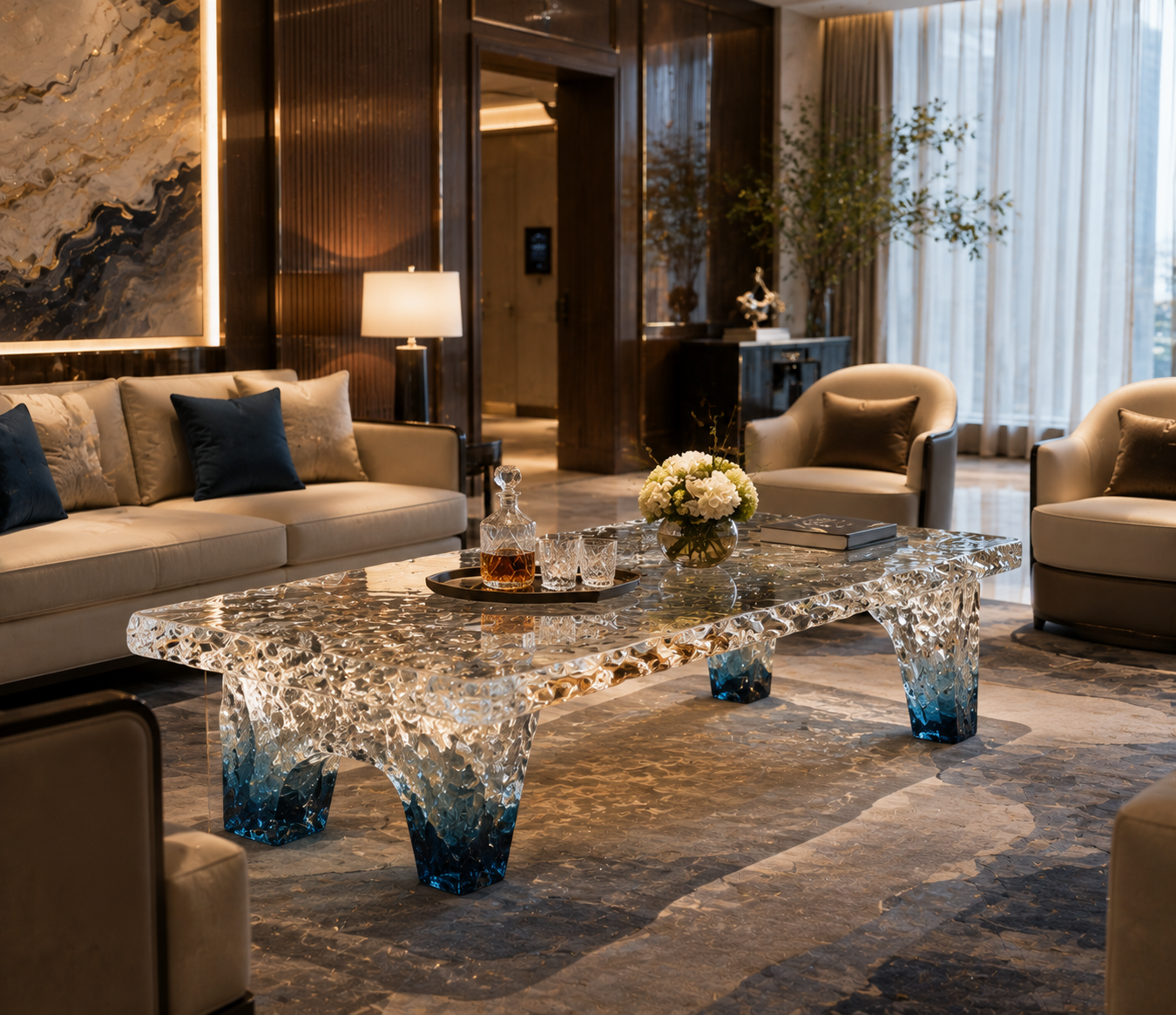
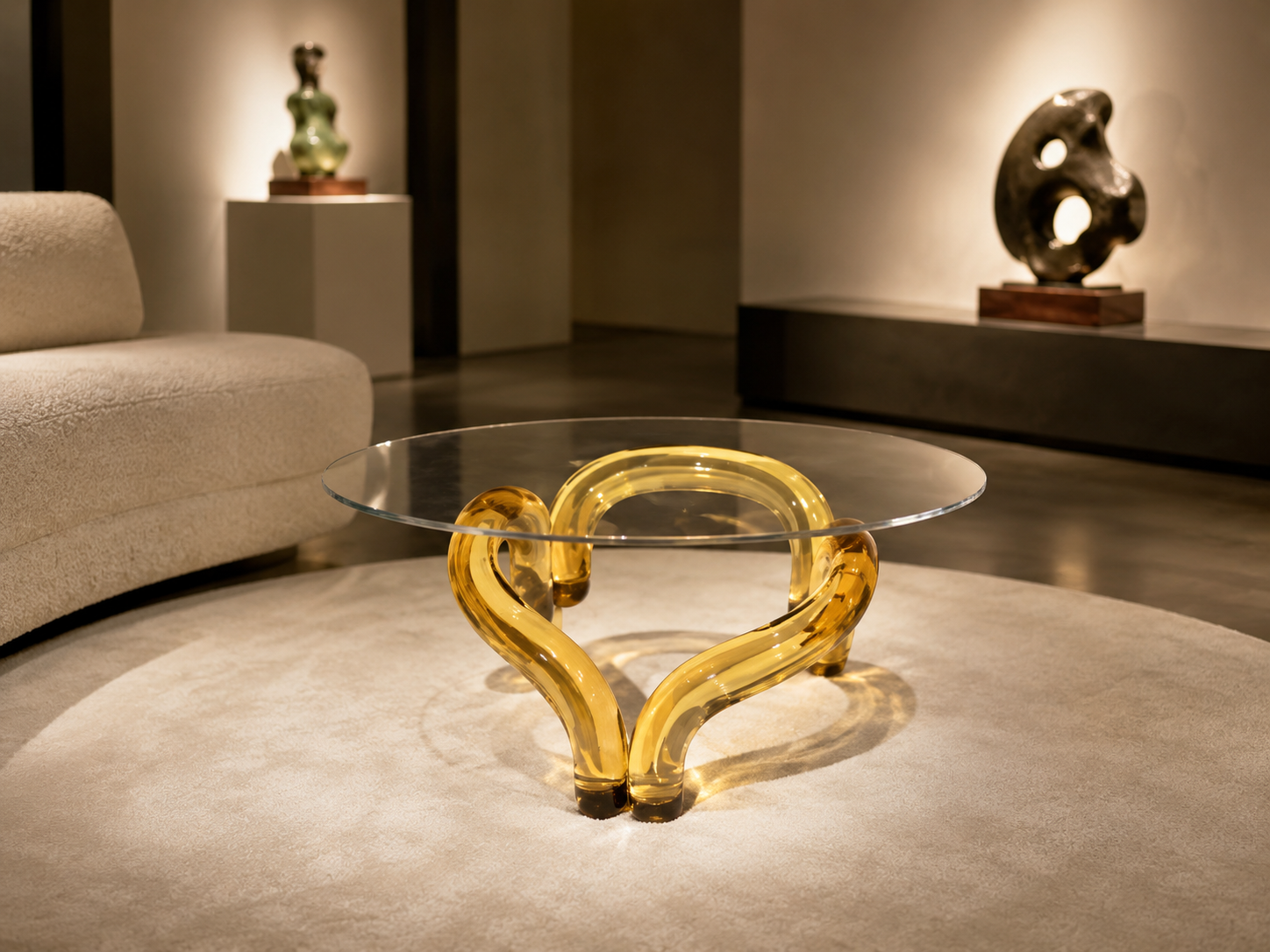
Luxury in interior design is rarely created by adding more expensive objects. More often, it is created by controlling what the eye notices: the way light travels through a room, how materials meet at an edge, whether a table appears visually heavy or almost weightless, and how surfaces respond when the viewer moves around them.
This is why some interiors filled with marble, metal, and designer furniture can still feel ordinary, while a relatively restrained space can immediately communicate refinement. The difference is often found in material selection and detailing.
For architects, interior designers, hospitality developers, luxury retailers, and high-end homeowners, transparent and semi-transparent furniture has become particularly valuable because it does something conventional opaque furniture cannot: it interacts with the architecture rather than simply occupying it.
Synthetic crystal furniture, high-end resin furniture, and premium or platinum acrylic furniture can refract, transmit, reflect, diffuse, and frame light. When properly designed and manufactured, coffee tables, consoles, dining tables, benches, shelving, display pedestals, side tables, furniture legs, and sculptural bases made from these materials can become part furniture, part optical object, and part architecture.
The result is not merely “transparent furniture.” It is a way of controlling visual weight, spatial continuity, contrast, light, and material perception.
1. Luxury Begins With Light, and Transparent Furniture Changes the Way Light Behaves
One of the fastest ways to distinguish a sophisticated interior from an ordinary one is to observe how it handles light.
The International WELL Building Institute emphasizes that the quality and reflectance of interior surfaces significantly affect how much light ultimately reaches the eye. Its WELL Building Standard notes that much of the light experienced inside buildings is reflected from surfaces rather than received directly from a light source. It also recognizes that brightness influences both visual appeal and the perception of spaciousness.
This has important implications for furniture.
A conventional dark timber console, for example, tends to absorb light and create a visually solid block. A clear synthetic crystal console behaves differently. Natural daylight, decorative lighting, and surrounding colors can remain visually active through and around the piece. Polished edges may catch concentrated highlights, while thicker transparent sections can create a sense of optical depth.
The effect becomes particularly powerful in luxury spaces where lighting is deliberately layered. Imagine a synthetic crystal side table beside a textured limestone wall under a warm wall washer. During the day, the table appears quiet and almost weightless. At night, its polished edges and internal surfaces become more visible, creating controlled points of brilliance without requiring additional decoration.
The optical properties of premium acrylic help explain why this effect can be so convincing. Röhm, one of the major global PMMA manufacturers, reports visible-light transmission of more than 92% for high-clarity PMMA and notes that PMMA can be approximately 50% lighter than glass. Its PLEXIGLAS technical information similarly reports light transmission of up to 92% for clear transparent material.
For designers, that combination opens possibilities that conventional crystal or thick glass may make more difficult. Substantial furniture components can retain an impression of transparency rather than heaviness.
This is where premium synthetic crystal and platinum acrylic furniture earn their place in high-end interiors: they do not simply receive light. They actively participate in the lighting composition of the space.
2. Transparency Reduces Visual Weight and Makes a Space Feel More Expansive
Luxury is often associated with generosity of space. Yet not every high-end residence, hotel suite, yacht interior, boutique, or private club has unlimited floor area.
The challenge is therefore not simply to create more physical space, but to reduce perceived congestion.
Transparent furniture is particularly effective because it preserves sightlines. Instead of interrupting the visual field with another opaque mass, a synthetic crystal coffee table or platinum acrylic console allows flooring, rugs, architectural details, wall finishes, and surrounding furniture to remain visible.
This principle has been recognized in mainstream design media as well. Architectural Digest has discussed clear acrylic and Lucite furniture as a solution for reducing visual clutter in smaller rooms, noting that transparent pieces allow surrounding colors and finishes to remain visible rather than creating additional visual bulk. The publication has also highlighted acrylic furniture for its ability to create a lighter and airier interior impression.
But the principle is equally relevant to large luxury interiors.
Consider a living room finished with book-matched marble, a hand-knotted rug, sculptural seating, and panoramic windows. A heavy coffee table positioned in the center can unintentionally compete with every one of those elements. Replacing it with a thick, precisely polished synthetic crystal table changes the visual hierarchy. The furniture remains physically present and functional, but the rug, stone, and architecture continue through the visual field.
That restraint is often what makes a room feel expensive.
The same strategy works in hotel lobbies and branded residences. A large transparent console can define an arrival zone without forming a visual barrier. A crystal-clear dining-table base can support a substantial tabletop while allowing statement chairs to remain visually dominant. Transparent plinths in luxury retail can elevate handbags, jewelry, watches, fragrance, or art without introducing another competing color.
The historical legitimacy of this approach should not be overlooked. The Victoria and Albert Museum documents David Colwell's 1967–68 Contour Chair, whose clear acrylic shell explored the unusual structural and visual possibilities of the material. The V&A describes such designs as products of experimentation with the properties of acrylic rather than simply substitutes for traditional materials.
Today, advanced casting, machining, bonding, polishing, coloring, and finishing allow designers to push the same idea much further. Transparent furniture can now be substantial without appearing bulky—a highly valuable contradiction in sophisticated interior design.
3. What Makes Synthetic Crystal Look Expensive Is Not Transparency Alone, but the Quality of the Detail
Two transparent tables can have almost identical dimensions and still communicate completely different levels of quality.
The reason is that human observers are remarkably sensitive to surface appearance.
A review published in Vision Research explains that gloss perception is created through a complex interaction between illumination, surface properties, object shape, and the observer. Research reviewed in the paper found that three-dimensional surface relief alone could change perceived gloss substantially under the same illumination conditions. Another study in Vision Research found that contrast in natural surface images correlates strongly with perceived gloss.
More recent research in Nature Human Behaviour reinforces the point: the structure of specular reflections helps the visual system categorize materials. In other words, people do not need to touch an object before making judgments about what kind of material they are seeing. Reflection patterns already provide important visual information.
For furniture manufacturers, this makes edge finishing, polishing, casting quality, bonding accuracy, surface flatness, internal clarity, color consistency, and joint design critical.
A poorly finished transparent table exposes its problems immediately. Bubbles, cloudy bonding lines, visible machining marks, uncontrolled scratches, distorted edges, inconsistent thickness, or yellow undertones cannot easily be hidden beneath paint or veneer. Transparency reveals the manufacturing process.
Premium synthetic crystal furniture therefore requires a different mindset from ordinary plastic furniture. A thick console leg should not simply be clear; its thickness, geometry, polished surfaces, and edge treatment should be engineered to produce controlled optical depth. A clear table base should not look like several pieces of plastic assembled together; the transitions should appear intentional and visually clean.
High-end resin provides another creative route. Sika, a global specialty chemicals company, specifically identifies highly transparent epoxy casting systems for furniture, art, decoration, deep-pour applications, embeddings, and river tables. Its technical information emphasizes transparency, UV resistance, and the ability to produce substantial transparent castings.
This allows resin furniture to move beyond the familiar “river table” format. Designers can introduce controlled translucency, mineral-like effects, embedded textures, pigments, metallic particles, gradients, smoky colors, or internal sculptural forms.
The premium character does not come from transparency itself. It comes from control.
That distinction separates an ordinary clear object from furniture that reads like a deliberately engineered piece of contemporary collectible design.
4. Sophistication Comes From Material Contrast, Not From Making Everything Transparent
An interior filled entirely with high-gloss transparent furniture would quickly lose the effect that makes the material special.
Luxury depends on contrast.
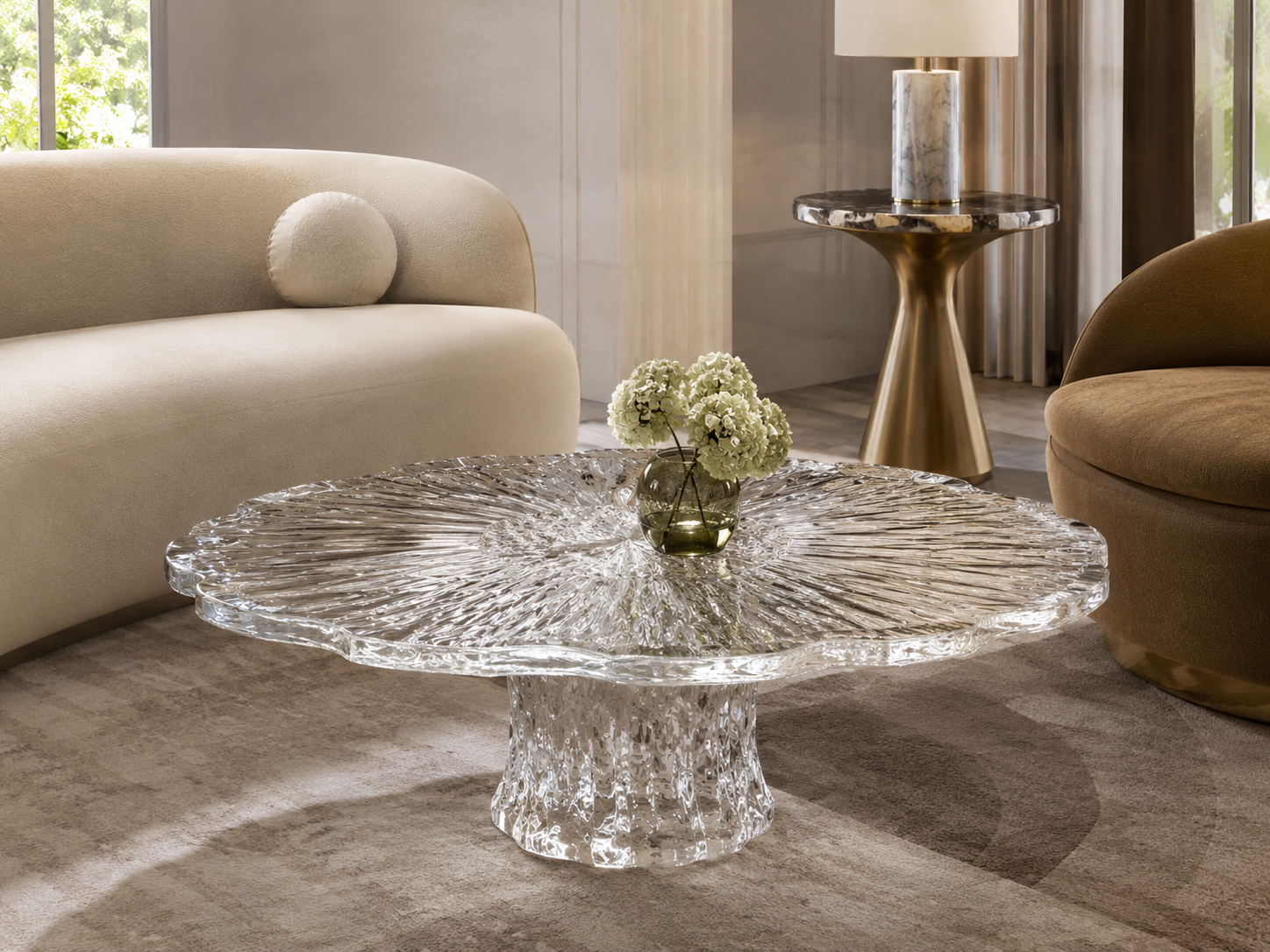
Transparent synthetic crystal becomes more visually dramatic beside matte limestone. Platinum acrylic feels sharper beside brushed stainless steel. A high-gloss resin table gains depth when placed on a wool or silk rug. Clear furniture legs become more noticeable beneath a richly veined stone top. Smoked resin can provide a transitional layer between dark timber and polished metal.
This is why premium transparent materials are often most successful when they are used as visual punctuation rather than as a universal finish.
Research into material perception supports this approach. An Annual Review of Vision Science paper explains that people make rapid judgments about whether materials appear hard, soft, rough, smooth, wet, dry, glossy, or matte based largely on visual information. Material appearance emerges from the relationship between surface, shape, light, and surroundings.
Professional designers can use these relationships strategically.
In a luxury residence dominated by travertine, oak, boucle, and bronze, a crystal-clear console introduces precision against softer natural textures. In a fashion boutique, an ice-like synthetic crystal display plinth can make leather goods feel richer because the materials are perceptually opposite. In a hotel lobby, an amber-tinted resin table can bridge warm timber architecture and metallic lighting without becoming another visually heavy element.
Platinum acrylic can perform a similar role where extremely clean lines and high optical clarity are required. Depending on the design specification, it can be machined into thick geometric legs, layered panels, sculptural blocks, shelves, table bases, or illuminated components.
The V&A's 2018 Memory & Light installation provides an interesting architectural example of transparent acrylic used for experience rather than simple utility. A curved transparent Perspex screen was incorporated as a visual interpretation of a prism, demonstrating how acrylic can become an active component in the manipulation and perception of light.
The lesson for furniture design is important: transparent material should not be treated as “invisible plastic.” It should be treated as an optical material.
Once that happens, synthetic crystal, premium resin, and acrylic can be combined with marble, wood, leather, stainless steel, brass, textiles, and stone to create richer material compositions without making the room feel overdesigned.
5. High-End Furniture Must Look Convincing in Real Spaces, Not Only in Product Photographs
A dramatic product photograph can make almost any reflective object look luxurious. Real interiors are less forgiving.
Furniture has to perform under morning daylight, warm evening lighting, hotel spotlights, retail track lighting, shadows, reflections from windows, and constantly changing viewing angles. It also has to survive being approached, touched, cleaned, and examined from close range.
This is why specification matters.
Clear furniture placed next to a large window needs optical consistency because strong daylight can expose imperfections. A hotel console positioned beneath decorative lighting needs polished surfaces capable of generating intentional highlights rather than visual haze. A retail plinth supporting luxury merchandise needs excellent edge finishing because customers may inspect it from only centimeters away.
Material stability is equally important. Röhm states that premium PMMA offers high weather and UV resistance, while its 2026 PMMA documentation reports long-term resistance to yellowing and transparency loss under tested conditions. Exact performance naturally depends on the specific grade, application, environment, thickness, and maintenance regime, but the broader point is crucial: high-end transparent furniture should be specified according to measurable material performance, not appearance alone.
The same applies to resin. Transparent resin formulations vary considerably. Furniture-grade projects should therefore consider UV resistance, casting depth, hardness, heat behavior, polishing requirements, pigment stability, and intended use rather than treating every clear resin as interchangeable.
Maintenance should also be designed into the product. Architectural Digest's guidance on acrylic furniture, for example, specifically warns against inappropriate cleaners such as ammonia-based household products and recommends suitable plastic cleaners and microfiber materials to preserve clarity.
This practical dimension is especially important for hospitality, luxury retail, and commercial projects, where furniture may receive much more frequent cleaning and contact than a residential statement piece.
True luxury is not the ability to impress for a photograph. It is the ability to retain visual precision after repeated real-world use.
For manufacturers of synthetic crystal, high-end resin, and premium acrylic furniture, this creates an opportunity to compete on more than design. Material selection, engineering, surface treatment, quality control, packaging, installation guidance, and maintenance recommendations can all become part of the premium proposition.

6. The Highest Level of Luxury Comes When Furniture Becomes Part of the Architecture
The most compelling application of synthetic crystal furniture is not to copy conventional wooden or glass furniture in a transparent material. It is to create forms that become possible—or significantly more expressive—because of the material itself.
This is particularly relevant as luxury hospitality and retail become increasingly experience-driven.
Gensler's 2025 research on sensory design in hospitality argues that memorable spaces are created through the coordination of light, texture, color, materiality, sound, and other sensory signals rather than through visual decoration alone. Its 2026 hospitality research similarly emphasizes sensory coherence: individual elements need to reinforce a unified emotional experience instead of competing for attention.
Custom furniture can become a powerful part of that coherence.
A hotel may commission an oversized synthetic crystal reception console whose color subtly matches the brand palette. A luxury villa may use a monolithic clear dining-table base designed around the geometry of the architecture. A jewelry boutique may specify platinum acrylic display pedestals that appear to disappear beneath the merchandise. A private club may use smoked resin tables with internally suspended metallic elements to create a recognizable visual signature. A fashion flagship might combine colored transparent resin with stainless steel so that the fixtures change character under different lighting scenes.
These are no longer generic pieces of furniture. They become spatial identities.
Gensler's Experience Index, based on research involving more than 4,000 people in the United States and more than 60 hours of ethnographic studies, was developed specifically to understand how design affects human experience and behavior. The implication for premium furniture is clear: the most successful pieces do more than occupy space; they contribute to the experience people remember.
This is where synthetic crystal, high-end resin, and platinum acrylic have particularly strong potential. Their transparency, color possibilities, casting flexibility, thickness, optical depth, and ability to interact with light give designers a vocabulary that conventional opaque materials cannot completely replicate.
A luxury interior does not become sophisticated because every object announces its price.
It becomes sophisticated when every material appears intentional.
A polished edge catching a line of light, a transparent table preserving the view of a hand-knotted rug, a resin console carrying a subtle internal color gradient, or a crystal-clear base visually floating beneath stone may appear to be small details. Yet these are precisely the details through which people read quality.
The highest level of synthetic crystal furniture therefore does not need to shout.
It controls light. It removes unnecessary visual weight. It creates contrast. It reveals precision. It works with architecture. And, when executed correctly, it allows the space itself to feel more refined.
That is where the real sense of luxury begins.

READ MORE:
- When Furniture Starts to Look the Same: How Material Details Create Differentiation — A Synthetic Crystal Approach
- How Synthetic Crystal Furniture Uses Transparency to Create an Airy, Understated Luxury Interior
- Customers Care About More Than Furniture Form: How Synthetic Crystal Material Details Influence Purchase Decisions
- Why High-End Clients Pay for Material Quality: What Synthetic Crystal Furniture Reveals About Luxury
- Synthetic Crystal Acrylic Furniture: Building the Next Generation of High-End Living with Innovative Materials
- Why Crystal-Grade Acrylic Is Becoming an Important Direction for the Future of Furniture Design
- Synthetic Crystal Acrylic Furniture: Giving Brands a Distinctive Identity in the High-End Market
- From Material Breakthrough to Spatial Upgrade: The New Value Created by Synthetic Crystal Acrylic Furniture
- Synthetic Crystal Acrylic Furniture: Why High-End Homes Are Embracing “Transparent Luxury”


