

When customers first encounter a piece of furniture, shape often creates the initial attraction. A dramatic coffee table, a sculptural console, or a transparent dining-table base can capture attention within seconds. But in the premium furniture market, visual form alone rarely completes the purchase.
High-end residential clients, interior designers, hotel developers, luxury retailers, and procurement professionals look more closely. They examine whether a transparent material appears truly clear or slightly cloudy, whether edges are polished consistently, whether joints interrupt the design, whether a resin casting has unwanted bubbles, whether the color will remain stable, and whether a customized piece can maintain the same quality when produced at project scale.
This distinction is becoming more important as luxury customers become increasingly selective. Boston Consulting Group and Altagamma's 2025 True-Luxury Global Consumer Insights, based on more than 7,000 luxury consumers as well as high-net-worth-individual data, found that 89% of top-tier clients regard craftsmanship and product quality as major drivers of value. McKinsey's 2026 luxury research goes even further, describing craftsmanship and quality as effectively the “price of entry” for luxury brands.
For manufacturers of synthetic crystal furniture, high-end resin furniture, and platinum acrylic furniture, this changes the sales conversation completely. Customers are not simply deciding whether they like the shape. They are deciding whether the material details justify trust, specification, and ultimately the price.
1. Furniture Form Wins Attention, but Material Quality Justifies the Price
A distinctive silhouette can persuade a customer to stop and look, but high-end buyers usually need more evidence before they decide that a piece deserves a premium price.
This is particularly true in transparent furniture. Imagine two synthetic crystal coffee tables with almost identical dimensions and overall geometry. In a catalog image viewed on a phone, they may appear comparable. When the customer sees physical samples or examines detailed photographs, however, the difference can become obvious. One may show slightly milky transparency, inconsistent edge polishing, visible adhesive lines, surface waviness, or minor internal imperfections. The other may have clean optical depth, crisp edges, consistent thickness, accurate geometry, and nearly seamless visual transitions.
The furniture shape has not changed. Its perceived value has.
BCG and Altagamma's 2025 study is especially relevant here. Top-tier luxury consumers represent only around 0.1% of luxury customers but account for approximately 37% of total market value when luxury mobility and wellness categories are included. More importantly, BCG found that 89% of these clients identify craftsmanship and product quality as key drivers of value.
This suggests an important lesson for high-end furniture suppliers: sophisticated customers are willing to spend, but they require reasons to believe the premium is real.
For a synthetic crystal console, those reasons might include material grade, clarity, substantial thickness, precise edge treatment, and clean bonding. For a high-end resin dining table, they may include casting quality, controlled pigmentation, intentional transparency, bubble management, surface polishing, and consistency between samples and final production. For platinum acrylic furniture, the customer may focus on optical cleanliness, machining accuracy, joint execution, and whether large transparent components retain a refined appearance.
A beautiful form creates desire. Material execution gives the buyer permission to pay for it.

2. Transparency Is Judged Instantly, Making Optical Quality Part of the Buying Decision
Transparent furniture presents an unusual challenge: the material itself is constantly visible.
With painted wood, metal, stone veneer, or upholstery, some structural or processing details can remain concealed. Transparent synthetic crystal and acrylic reveal far more. Light enters the material, travels through its thickness, reflects from edges, and exposes variations that might remain unnoticed in an opaque product.
Human visual perception is highly sensitive to these signals. A review published in the Annual Review of Vision Science explains that people can infer material characteristics remarkably quickly without touching an object. Through visual information alone, observers routinely judge whether materials appear hard or soft, smooth or rough, glossy or matte. These judgments emerge from interactions among lighting, shape, reflectance, texture, and transparency.
That helps explain why buyers can often say that one clear table “looks expensive” while another looks ordinary, even if they cannot immediately describe the technical reason.
Optical clarity is one factor. Röhm reports visible-light transmission of up to 92% for clear-transparent PLEXIGLAS PMMA products. The company notes that high-grade transparent PMMA absorbs very little visible light, which is one reason it can maintain clarity even at substantial thicknesses.
The specific performance of synthetic crystal, resin, or acrylic furniture naturally depends on the actual formulation, thickness, color, processing, and finishing, so one manufacturer's PMMA specification should never be generalized to every transparent polymer. Nevertheless, the data demonstrate that transparency is a technical property that can be specified and measured—not simply described as “crystal clear” in marketing language.
For customers selecting a thick synthetic crystal coffee table, platinum acrylic console, transparent bench, or dining-table base, material depth matters. A substantial clear section can capture highlights and produce a jewel-like optical effect. Poor clarity, by contrast, becomes increasingly visible as thickness increases.
The buyer may initially fall in love with transparency. The quality of that transparency determines whether the attraction survives closer inspection.
3. Edges, Joints, and Surface Finishing Can Quietly Make or Break the Sale
In premium transparent furniture, some of the most commercially important details occupy only a few millimeters.
Consider the edge of a synthetic crystal console. If machining and polishing are carefully controlled, the edge can appear sharp, luminous, and precise. Under natural daylight or directional lighting, it catches highlights that reinforce the sense of depth and craftsmanship. If the polishing is inconsistent, however, the same edge can appear hazy, scratched, distorted, or unfinished.
Research published in Nature Human Behaviour in 2023 helps explain why these apparently small differences matter. Researchers found that the structure of specular reflections influences not only perceived gloss but also how viewers categorize the material itself. Changing the sharpness, contrast, and characteristics of reflections could change whether surfaces were perceived as different material categories.
Furniture buyers may never discuss “specular image structure,” but they respond to its effects.
The same principle applies to bonding. On a minimalist platinum acrylic side table, a visible joint can immediately become a focal point because there is little else to distract the eye. A clean joint preserves the illusion of a unified architectural object. A cloudy or poorly aligned joint communicates assembly rather than craftsmanship.
High-end resin introduces another set of details. Uncontrolled bubbles, inconsistent pigments, casting lines, sanding marks, or poor surface flatness can weaken the perceived quality of a resin coffee table or console. At the same time, intentionally designed bubbles, suspended metallic elements, mineral effects, gradients, or embedded materials can become valuable aesthetic features when their placement clearly appears deliberate.
That difference—between defect and design—is crucial.
For this reason, buyers of premium transparent furniture increasingly benefit from close-up photography, physical material samples, edge samples, color chips, and prototypes rather than relying only on full-room renders. For designers and procurement companies, these details provide evidence that the supplier can translate a beautiful concept into a finished object.
In high-end furniture, craftsmanship is often most convincing where the manufacturer appears to have nothing to hide.

4. Material Performance Influences Purchase Decisions Because Buyers Are Also Purchasing Future Appearance
A furniture purchase is not judged only on installation day.
A private homeowner expects a statement dining table or console to continue looking refined after years of use. A luxury hotel may clean furniture repeatedly every day. A flagship retail store may expose transparent display furniture to strong lighting for thousands of operating hours. Project buyers therefore evaluate risk as well as beauty.
Long-term optical stability is particularly relevant to transparent materials because yellowing, cloudiness, scratches, or loss of surface quality can be visually obvious.
Röhm states that certain clear-transparent PLEXIGLAS products are guaranteed to retain up to 90% light transmission, depending on product type and region, even after 30 years, and attributes their UV performance to the material's intrinsic UV stability. This does not mean every acrylic or “crystal” furniture product automatically carries the same performance, but it illustrates why resin chemistry and material grade should be part of a professional purchasing discussion.
High-end resin requires equally careful specification. Sika's technical documentation for transparent epoxy casting systems lists formulations developed specifically for furniture, art, deep transparent casting, embeddings, and decorative applications. Depending on the system, properties include high transparency, self-degassing behavior, UV resistance, and deep-pour capabilities.
For an actual project, these details affect the questions a serious buyer should ask. What environment will the furniture be used in? How much sunlight does it receive? What cleaning method is appropriate? Will a resin tabletop encounter heat? Does a transparent table require additional protection in a hospitality setting? Can scratched surfaces be refinished? How will a large piece be packed and transported without damaging polished surfaces?
A lower-priced product may look attractive in the initial quotation. If the buyer believes it carries greater risk of discoloration, surface damage, inconsistent production, or difficult maintenance, the apparent saving becomes less persuasive.
Premium customers are therefore not paying only for today's appearance. They are paying for confidence that the material will continue supporting the design concept tomorrow.
5. Custom Material Effects Often Matter More Than Creating Another Unusual Shape
There is a practical limit to how many furniture shapes the market can reinvent.
A table still needs an appropriate height. A console must fit circulation space. A side table has to function beside seating. When every manufacturer competes only through silhouette, dramatic forms can quickly begin to resemble one another.
Material customization provides another route to differentiation.
High-end resin is particularly powerful in this respect. Sika's documentation confirms that transparent casting systems can be used for furniture and deep castings, including applications involving embedded objects. Modern resin techniques make it possible to create controlled smoky effects, amber tones, gradients, metallic inclusions, translucent colors, and combinations with other materials.
For a designer, this means a relatively restrained console shape can become highly project-specific through its material treatment.
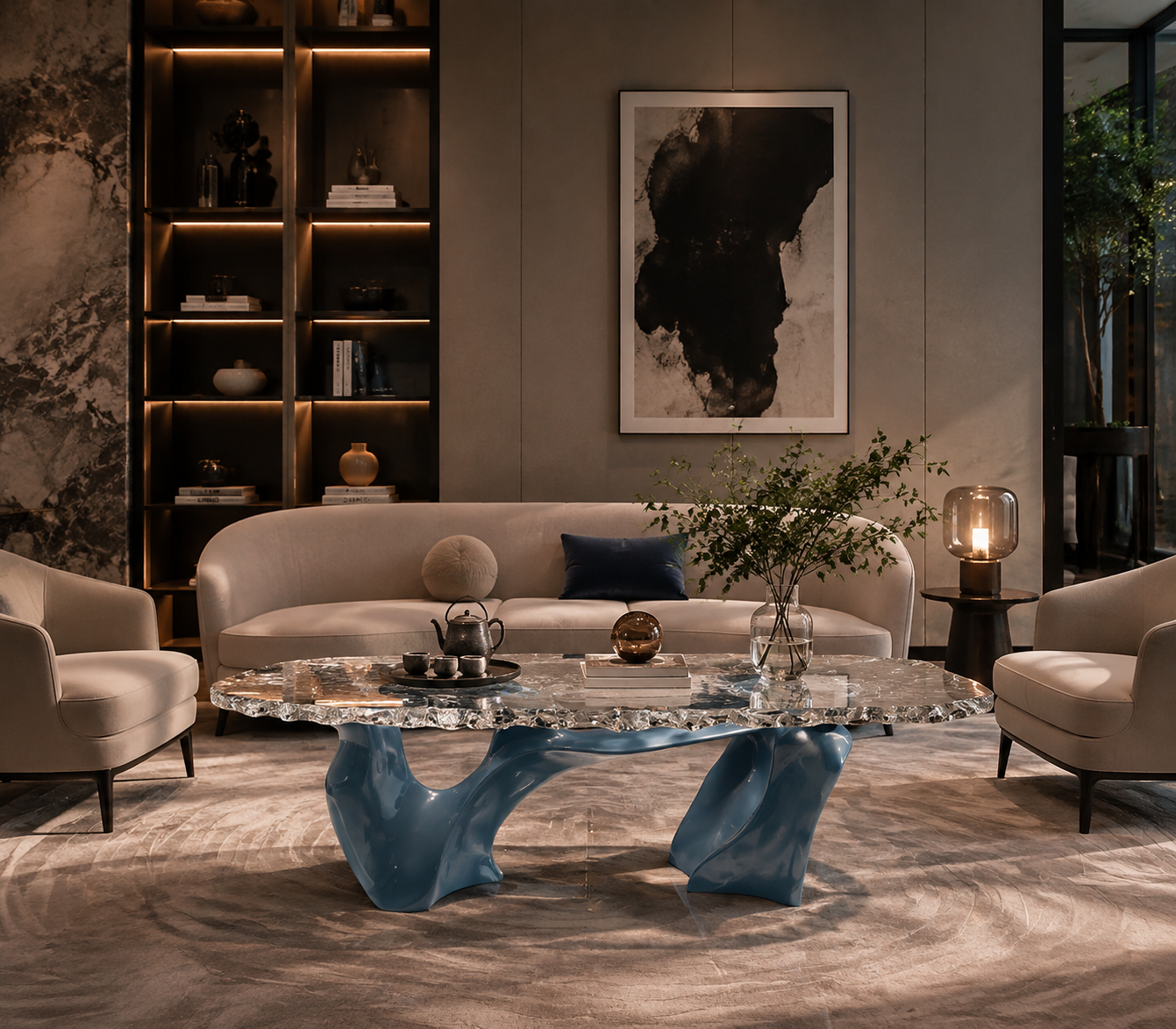
A hospitality project might specify a champagne-tinted resin side table that connects with brushed-brass lighting. A coastal villa could use pale blue translucent resin with a controlled depth effect rather than an obvious “ocean” motif. A luxury retail project might use synthetic crystal display plinths with subtle brand colors. A marble dining top could be supported by platinum acrylic legs customized in thickness and geometry so that the stone appears to float.
This directly connects with changing luxury expectations. BCG's 2025 research found that top-tier customers increasingly value personalization, intimacy, excellence, and recognition. The study also reported that 65% of these clients feel overwhelmed by excessive, poorly personalized brand communication, highlighting how strongly they value relevance over generic luxury messaging.
Furniture suppliers can apply the same lesson.
Instead of presenting twenty visually similar transparent tables, it may be more persuasive to demonstrate how one design can be adjusted in dimensions, thickness, transparency, resin color, embedded effects, edge geometry, hardware, or combinations with marble, wood, stainless steel, and brass.
For premium buyers, customization is valuable when it makes the furniture belong to the project rather than simply appear expensive.
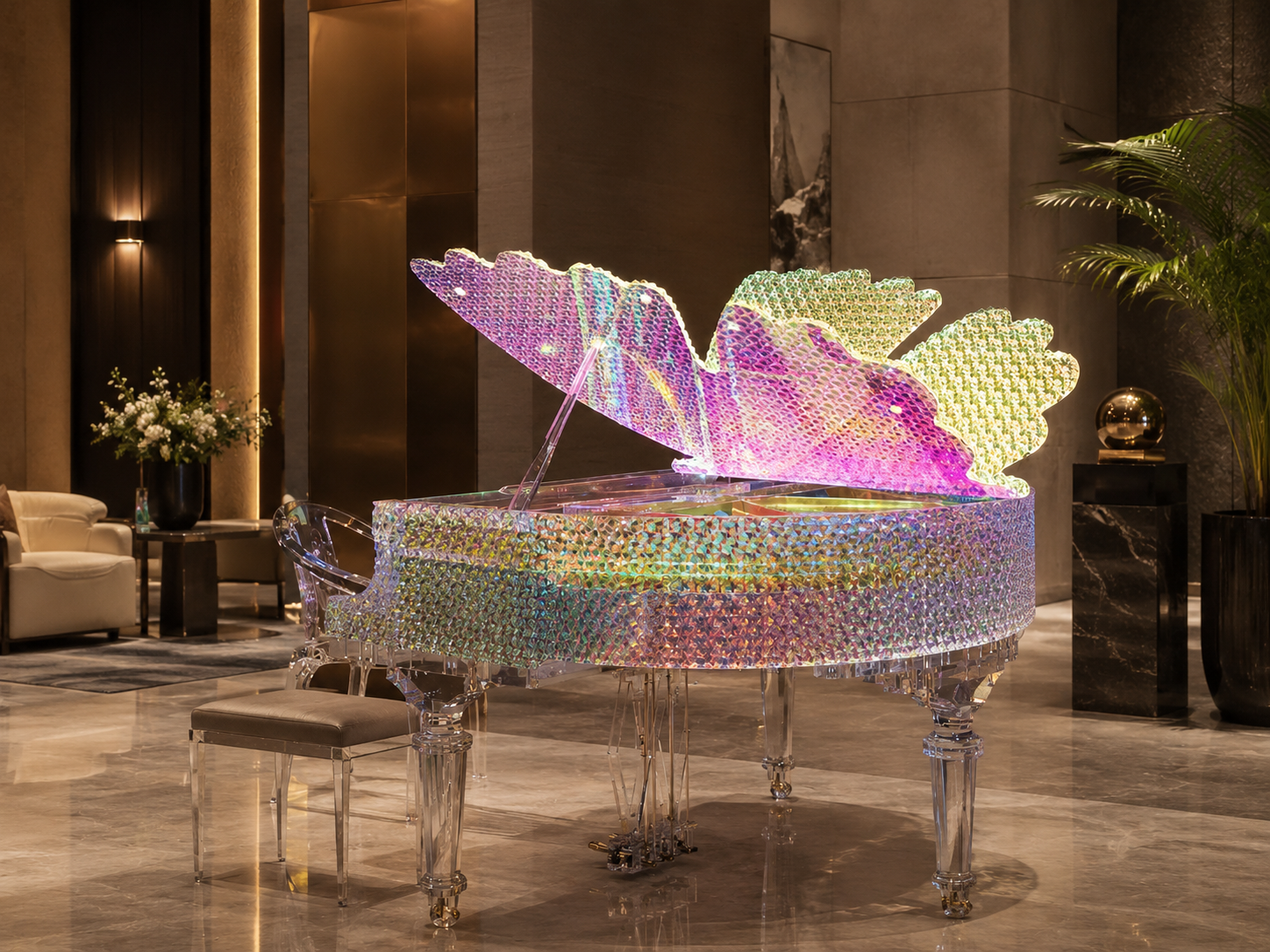
6. The Final Purchase Decision Comes From the Complete Material Story, Not One Attractive Feature
The strongest premium furniture proposition combines form, material, craftsmanship, performance, customization, and service into one convincing story.
McKinsey's 2026 research into luxury consumers in the United States and China found that craftsmanship and quality have become baseline expectations rather than optional differentiators. Among high-net-worth shoppers, higher product quality and craftsmanship are also among the leading factors that could encourage greater luxury spending.
That insight matters for synthetic crystal furniture because selling only the shape leaves too much value unexplained.
Consider a hotel designer evaluating a transparent console. The silhouette may generate initial interest, but the actual decision can depend on a much longer sequence of questions. Does the material have the right optical character under warm lighting? Will the thickness make it look substantial rather than inexpensive? Can the edges maintain consistent polishing over a long piece? Will the joint remain visually clean? Can the dimensions be customized? Can production quality be repeated across twenty units? How will each unit be protected during international shipping?
A residential customer may ask different questions but follow the same logic. A synthetic crystal coffee table must work with the rug beneath it. A platinum acrylic dining-table base must support the chosen tabletop without visually overwhelming it. A high-end resin console must have exactly the right smoke, amber, champagne, or custom color to coordinate with stone, timber, fabrics, and metal finishes.
This is why effective premium furniture presentation should move beyond general descriptions such as “luxury,” “high quality,” or “crystal clear.” Those claims are easy for every supplier to make.
Customers need visible evidence: close-up details, material samples, polished-edge samples, transparent thickness comparisons, resin color samples, realistic project photography, dimensional drawings, technical information, packaging solutions, and explanations of how customization is controlled.
The shape may be what brings a customer to the product.
But the purchase decision is usually made when the customer understands why the material looks different, why the craftsmanship is difficult to reproduce, how the product will perform in the intended space, and why the supplier can deliver the same quality from sample to installation.
For manufacturers working with synthetic crystal, high-end resin, and platinum acrylic, that is the commercial value hidden in material detail.
The best transparent furniture does not need excessive ornamentation to communicate luxury. Its clarity, depth, polishing, joints, color, surface quality, proportions, and interaction with light do the talking.
And for a discerning buyer, those details are rarely secondary.
They are often the reason to buy.
READ MORE:
- When Furniture Starts to Look the Same: How Material Details Create Differentiation — A Synthetic Crystal Approach
- How Synthetic Crystal Furniture Uses Transparency to Create an Airy, Understated Luxury Interior
- Why High-End Clients Pay for Material Quality: What Synthetic Crystal Furniture Reveals About Luxury
- The Luxury of a Space Often Hides in the Details: How Synthetic Crystal Furniture Elevates Overall Visual Quality
- Synthetic Crystal Acrylic Furniture: Building the Next Generation of High-End Living with Innovative Materials
- Why Crystal-Grade Acrylic Is Becoming an Important Direction for the Future of Furniture Design
- Synthetic Crystal Acrylic Furniture: Giving Brands a Distinctive Identity in the High-End Market
- From Material Breakthrough to Spatial Upgrade: The New Value Created by Synthetic Crystal Acrylic Furniture
- Synthetic Crystal Acrylic Furniture: Why High-End Homes Are Embracing “Transparent Luxury”


