1. In High-End Interiors, Material Selection Is About More Than Appearance
Choosing furniture for a luxury interior is very different from furnishing an ordinary residential or commercial space. In a high-end hotel lobby, private residence, flagship boutique, luxury club, gallery, or executive office, furniture is expected to perform several roles at once. It must provide function, contribute to the architectural language, remain visually relevant for years, withstand real-world use, and communicate a level of quality that guests can recognize even before they understand why.
For that reason, selecting a furniture material purely because it “looks expensive” is usually a mistake.
Natural marble can create an immediate sense of permanence, but large stone furniture can become extremely heavy and difficult to transport or reposition. Solid wood brings warmth and craftsmanship, but its appearance, dimensional stability, maintenance requirements, and sourcing can vary considerably between species and applications. Glass provides transparency, but weight, edge protection, breakage risk, and installation must be considered. Metal offers excellent structural possibilities, yet a large amount of exposed metal can sometimes make an interior feel visually cold or heavy.
The real question is therefore not, “Which material is the most luxurious?” It is, “Which material creates the right combination of visual impact, engineering performance, maintenance, customization, and long-term value for this particular space?”
This way of thinking is consistent with the Ellen MacArthur Foundation’s guidance on material selection. The organization argues that designers should consider not only what a material is made from, but also its durability, expected service life, maintenance requirements, ability to be repaired, and what happens to the material after use.
This is particularly relevant to premium furniture. A spectacular dining table that becomes difficult to maintain after one year is not a successful luxury product. Nor is a transparent console truly premium if polishing marks, yellowing, bubbles, unstable joints, or poor edge finishing become visible under architectural lighting.
For designers and buyers, the most useful approach is therefore to evaluate materials according to the space, rather than according to reputation alone. This is one reason synthetic crystal, high-end casting resin, and premium or “platinum” acrylic furniture are attracting increasing interest. These materials can provide transparency, sculptural volume, optical effects, customized colors, embedded decorative elements, and strong visual presence without repeating the familiar language of stone, wood, or conventional glass.
2. Understand What Each Material Contributes to the Space
Every premium furniture material has a different visual and functional personality. The best interiors often succeed because designers combine those personalities intelligently rather than depending on a single material throughout the project.
Wood works exceptionally well when a space requires warmth, natural texture, tactile familiarity, and traditional craftsmanship. Stone is effective when the designer wants mass, permanence, geological character, and a strong sense of luxury. Stainless steel, brass, bronze, and aluminum can provide structural precision and create either an industrial or jewelry-like effect depending on the finish. Glass is valuable when transparency and reflected light are important.
Transparent polymers and cast-resin materials introduce another possibility: physical volume without the same degree of visual weight.
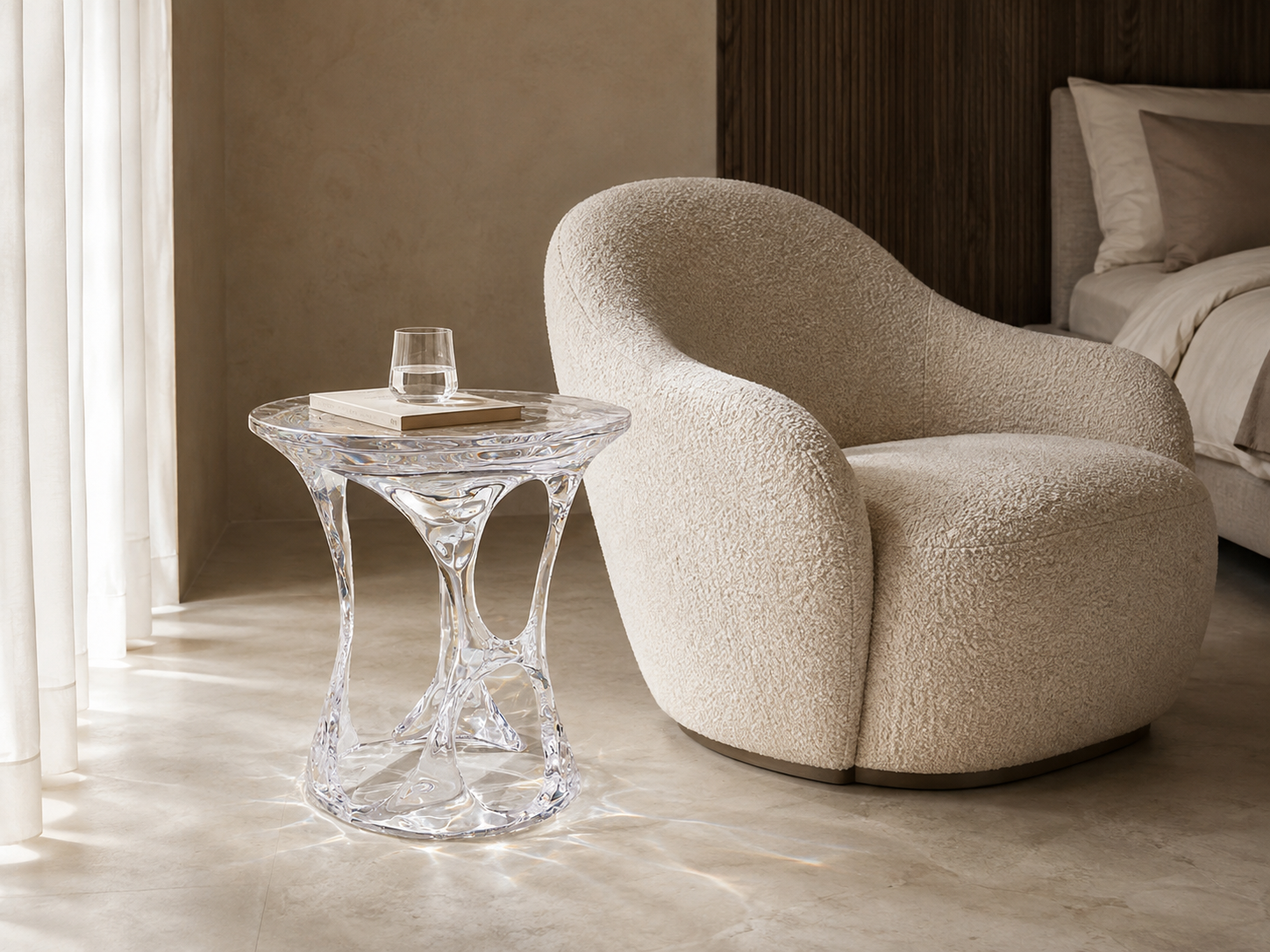
Architectural Digest has repeatedly highlighted the ability of clear acrylic and Lucite furniture to reduce visual clutter because floors, walls, rugs, upholstery, and architectural details remain visible through the furniture. In practical interior design terms, this means a substantial coffee table, console, chair, or pedestal can occupy real physical space while appearing less visually dominant than an equally sized piece made from dark wood or stone.
That characteristic can be particularly useful in luxury apartments, suites, dressing rooms, boutiques, and hospitality environments where designers want to preserve long sightlines.
The optical performance of premium acrylic also explains part of its appeal. Technical information published for PLEXIGLAS Optical 0Z024, a specific optical-grade PMMA product, reports 92% light transmission at a thickness of 3 mm, a density of 1.19 g/cm³, and describes the material as approximately half the weight of glass. These specifications should not be assumed for every acrylic product, but they demonstrate what professionally engineered PMMA can achieve.
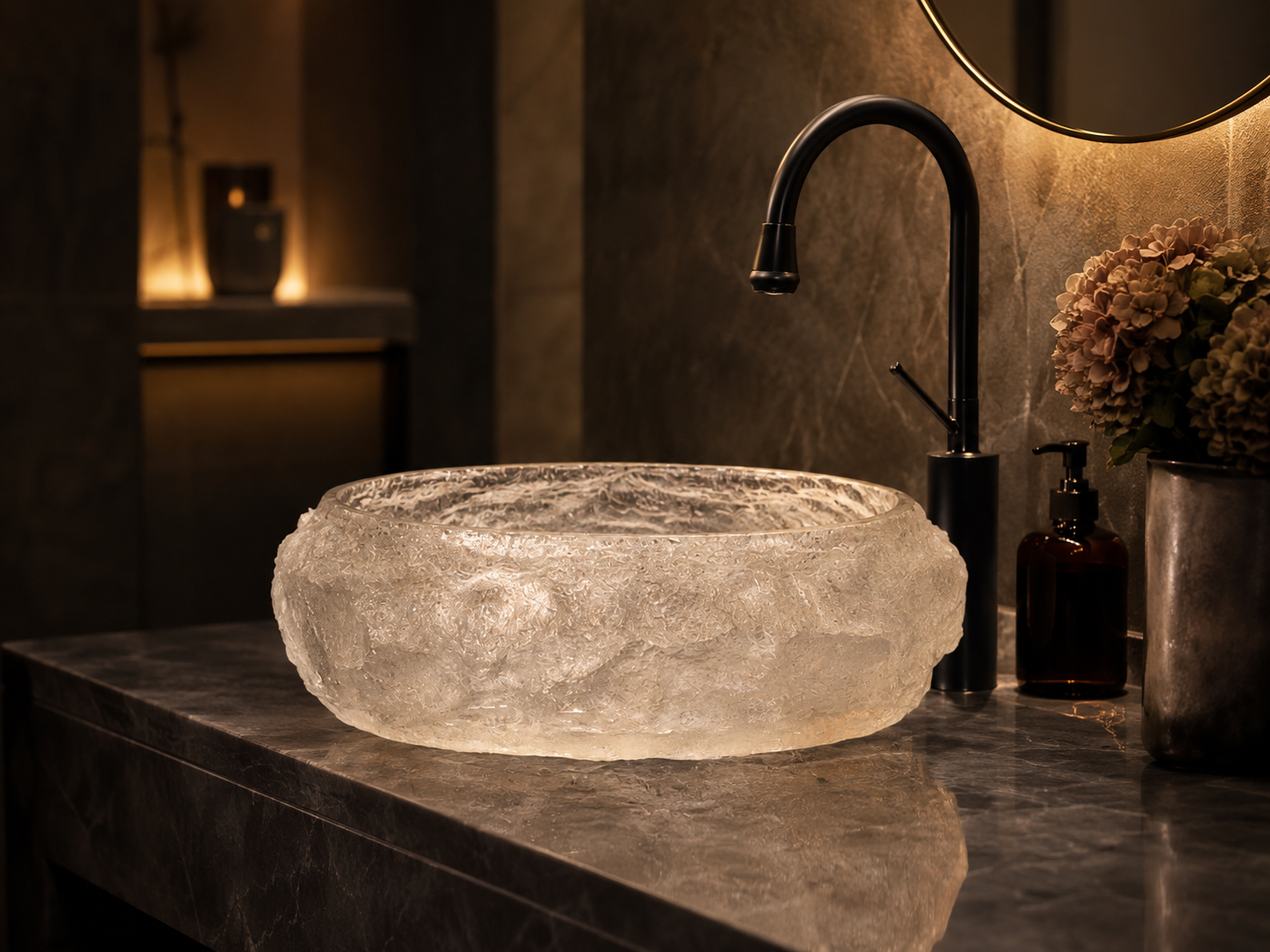
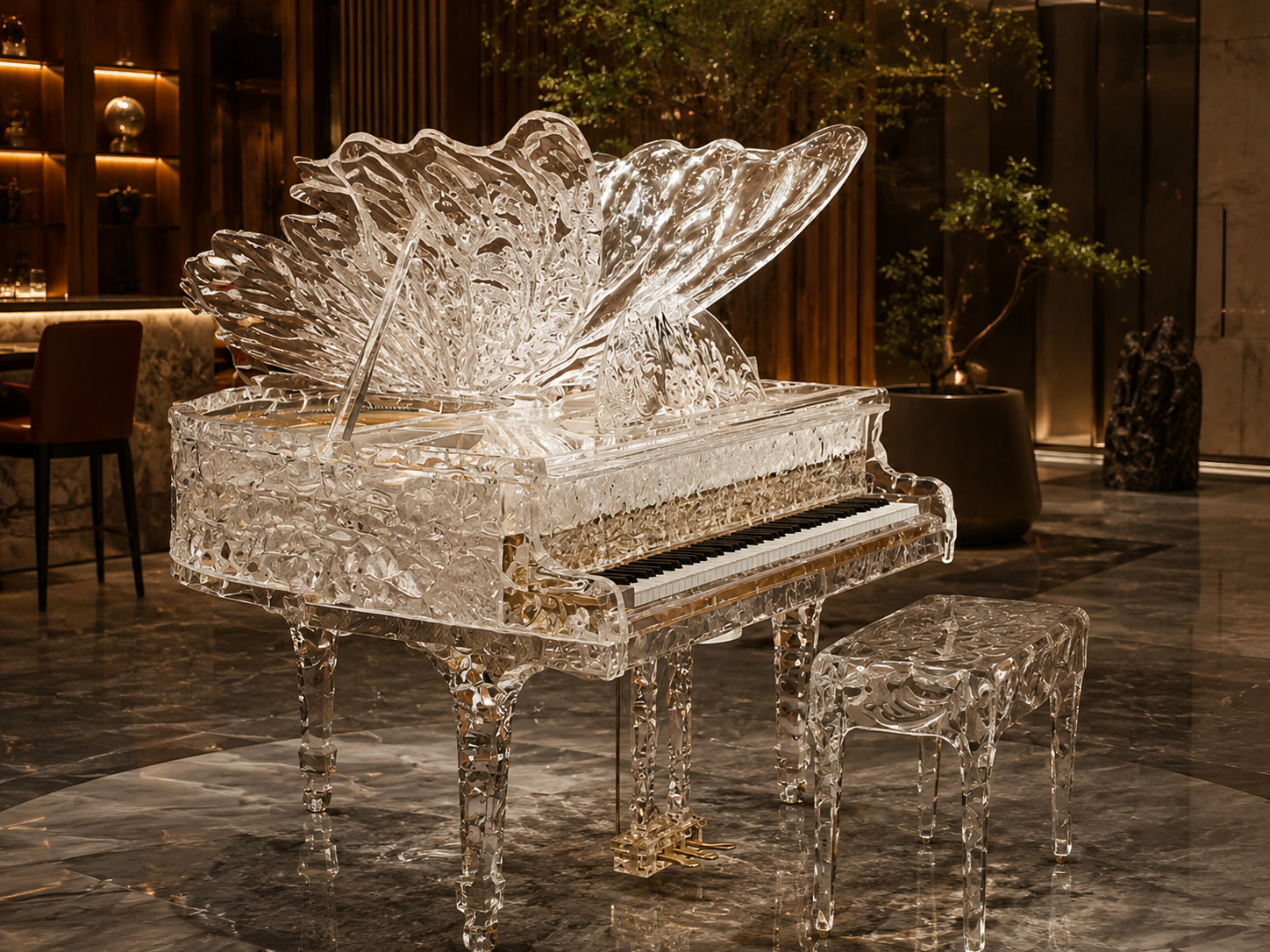
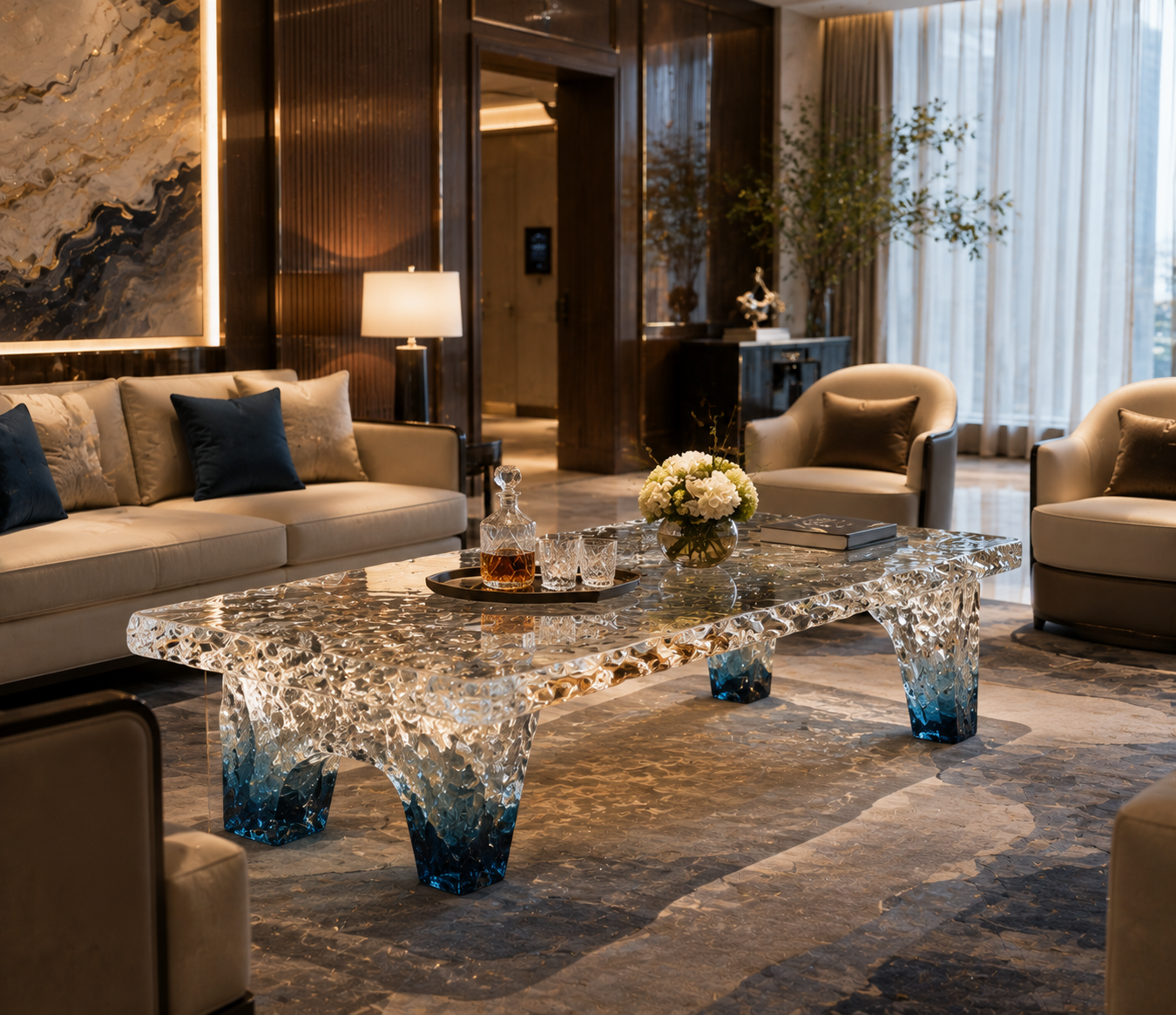
High-end synthetic crystal and cast resin offer a somewhat different design language. Instead of simply disappearing visually, they can be intentionally expressive. A thick crystal-clear table leg can refract surrounding light. A colored resin console can create depth similar to a gemstone. A cast side table can contain gradients, metallic details, natural textures, artistic inclusions, or suspended decorative objects.
That ability to combine material and decoration inside one volume gives designers something that marble, metal, wood, and ordinary glass cannot reproduce in the same way.
For this reason, synthetic crystal furniture does not necessarily need to replace traditional luxury materials. It can complement them. A transparent synthetic-crystal base can support a stone tabletop. Platinum acrylic can be combined with polished stainless steel or brass. High-end resin can encapsulate wood, metal mesh, shells, decorative aggregates, or custom artistic elements. The result is a more layered material vocabulary rather than a simple choice between “natural” and “synthetic.”
3. Why Synthetic Crystal and Resin Are Moving from Novelty to Collectible Design
Transparent furniture is not a temporary design trend. It has a much longer history in collectible and museum-level design than many buyers realize.
The Museum of Modern Art in New York, for example, holds Shiro Kuramata’s famous 1988 Miss Blanche Chair, made with acrylic resin, aluminum, and synthetic roses suspended inside the transparent body of the chair. MoMA describes how the roses appear to float within the acrylic, demonstrating how transparency can turn the internal volume of a piece of furniture into part of the design itself.
MoMA’s collection also includes an acrylic chair designed by Karim Rashid, as well as earlier furniture combining Plexiglas with stainless steel. Its documentation notes that Plexiglas and Lucite—trade names associated with the same family of transparent synthetic polymer—were already generating major design interest around the period of the 1939 New York World’s Fair.
Commercial design provides another well-known example. Philippe Starck’s Louis Ghost chair for Kartell uses transparent polycarbonate in a single molded form. Kartell describes the chair as combining a crystalline appearance with structural stability, impact resistance, weather resistance, and stackability.
These examples matter because they demonstrate an important principle: transparent polymer furniture becomes valuable when the material is used as a design medium, not merely as a cheaper substitute for glass.
The same principle applies to modern synthetic crystal and high-end resin furniture.
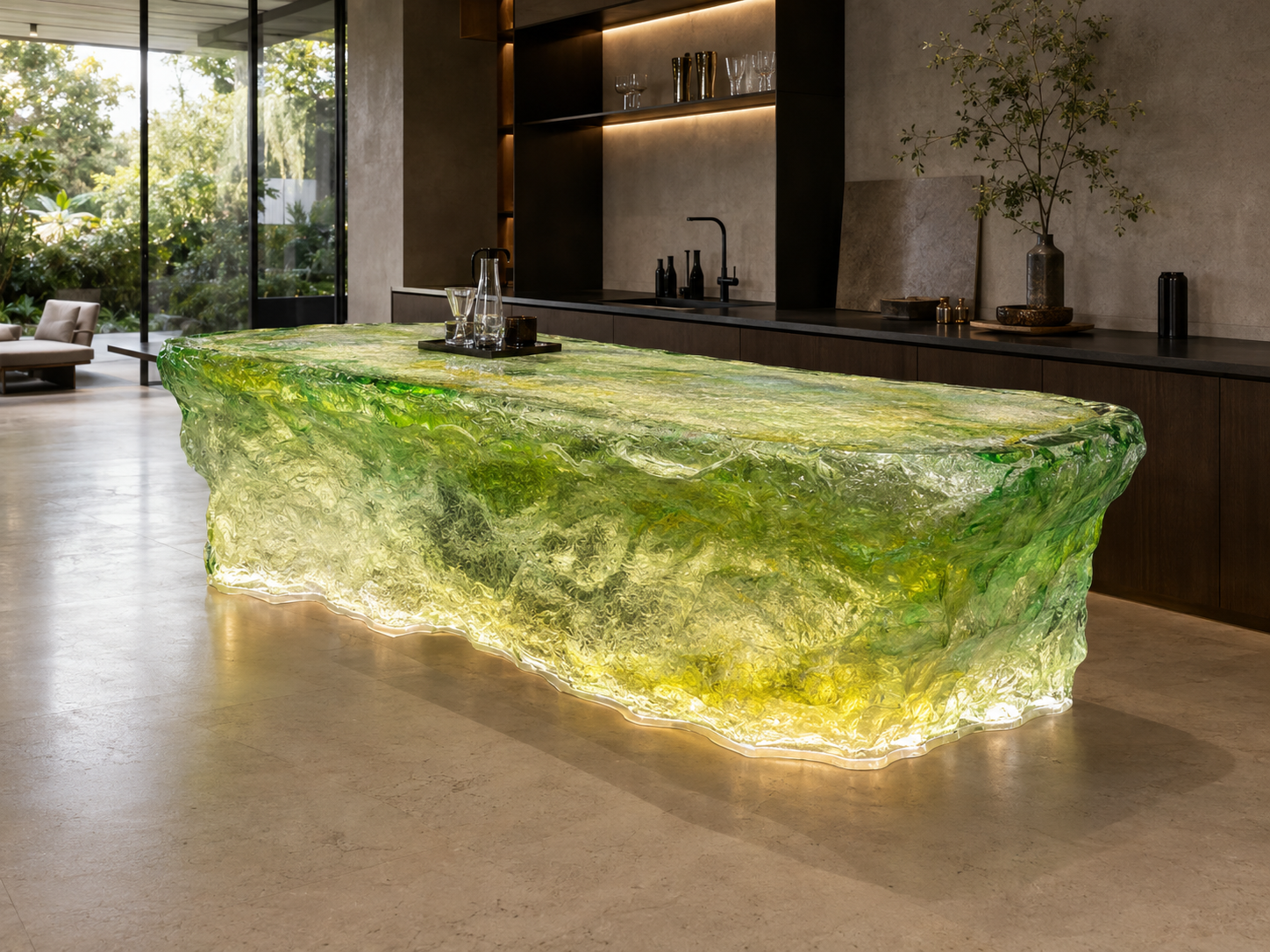
Imagine a reception table for a luxury fashion showroom. If it is simply a transparent rectangular block, the result may feel generic. But if the material contains a controlled champagne tint, carefully engineered internal refraction, precision-polished edges, and discreet brushed-metal connections, it becomes part furniture and part installation.
A resin dining table can also preserve materials inside its structure. Design media have documented projects in which transparent resin is combined with timber, colored layers, and decorative inclusions. Designboom, for example, has featured resin tables that visually suspend ancient wood inside transparent material as well as furniture combining crystal resin, acrylic, and mother-of-pearl to manipulate reflection and changing light.
This is where synthetic crystal furniture becomes particularly valuable for custom projects. Designers are no longer limited to choosing a surface finish from a catalog. They can potentially define transparency, translucency, tint, internal texture, thickness, embedded elements, surface gloss, geometry, and interaction with lighting.
In a luxury environment, that degree of customization is often more important than the raw material price itself.
4. Premium Transparent Furniture Must Be Evaluated by Performance, Not Just Clarity
One of the biggest mistakes in specifying acrylic, resin, or synthetic crystal furniture is judging quality from a photograph.
Two tables can look almost identical online and perform very differently after installation.
For transparent furniture, material purity is only one part of the equation. Buyers should also consider yellowing resistance, UV stability, surface hardness, scratch behavior, polishing quality, bonding technology, internal bubbles, dimensional stability, load-bearing structure, heat resistance, chemical resistance, edge finishing, and repair options.
This becomes especially important with thick-section furniture. A large synthetic-crystal dining table leg, resin reception counter, transparent bench, or sculptural coffee table requires much more process control than a thin decorative sheet.
Casting must be carefully managed because excessive heat, trapped gas, uneven curing, internal stress, shrinkage, or contamination can affect optical quality. Poor polishing becomes especially visible because light highlights every edge and surface defect.
PMMA and high-end acrylic also have different behavior from glass. Their lower weight can be an advantage for transportation and installation, but their surfaces require appropriate care. Architectural Digest’s maintenance guidance for acrylic furniture specifically warns against inappropriate cleaners and recommends microfiber materials and cleaners suitable for plastics because aggressive chemicals can damage or cloud a transparent surface.
For a luxury furniture manufacturer, this means the product should ideally be sold together with realistic maintenance guidance instead of being described simply as “maintenance-free.”
Designers should also select the material according to the furniture type. A transparent pedestal that mainly supports sculpture has different engineering requirements from a dining table used daily. A hotel side table faces different wear patterns from a collectible console in a private residence. Outdoor furniture requires another level of UV, weather, and temperature evaluation.
The same applies to “platinum acrylic.” If the term refers to a premium optical acrylic supplied or manufactured to a particular specification, the project team should request measurable information rather than relying on the name alone. Relevant documentation may include light transmission or haze data, UV-aging performance, density, impact data, allowable temperature range, surface treatment, chemical resistance, and applicable structural test results.
This approach actually strengthens the value proposition of premium synthetic materials. High-end clients rarely object to paying for quality when quality can be explained and demonstrated. What creates uncertainty is an expensive product supported only by adjectives such as “crystal clear,” “luxury,” or “premium.”
In professional specification, data turns a visual material into a credible furniture solution.
5. Health, Emissions, Sustainability, and Certification Are Becoming Part of Luxury
Luxury interiors are increasingly judged not only by what occupants can see, but also by what they cannot see.
Indoor air quality is one example. The U.S. Environmental Protection Agency states that volatile organic compounds can be emitted by various building materials and furnishings and reports that studies have found concentrations of several organic pollutants averaging approximately two to five times higher indoors than outdoors.
This does not mean that all resin or acrylic furniture has an indoor-air problem. It means buyers should avoid making assumptions based only on the generic material name.
The finished furniture system matters: the base polymer, pigments, coatings, adhesives, sealants, cleaning treatments, composite-wood components, upholstery, and manufacturing process can all influence project requirements.
This is why standards increasingly focus on measurable emissions. LEED v5 documentation from the U.S. Green Building Council includes furniture-emissions pathways involving recognized testing methods and third-party certification, including ANSI/BIFMA methods for furniture. BIFMA itself describes ANSI/BIFMA e3 as a sustainability standard covering environmental, health and wellness, and social impacts related to furniture products.
For manufacturers targeting luxury hotels, commercial offices, international retailers, developers, and design studios, providing relevant material and emissions documentation can therefore become a competitive advantage.
Sustainability should be treated with the same level of precision.
A claim that a material is “recyclable” does not automatically mean every finished furniture product will be recycled in every country. Collection systems, adhesives, mixed-material construction, pigments, inserts, and local recycling infrastructure all affect the real outcome.
However, PMMA has interesting circular potential. Röhm announced in March 2026 that its chemical-recycling process can depolymerize PMMA back into methyl methacrylate and reported yields above 90% in its depolymerization process. The company is also participating in a European PMMA recycling alliance intended to establish more closed-loop material flows.
For high-end furniture, an equally important sustainability strategy is longevity. A well-made synthetic crystal table that remains desirable and serviceable for many years can be more meaningful than creating disposable furniture around a sustainability marketing claim. The Ellen MacArthur Foundation explicitly connects circular design with physical durability, emotional durability, repair, reuse, and keeping products and materials at their highest value for longer.
For luxury design, this idea is especially relevant: enduring beauty is also a form of performance.
6. The Best Material Is the One That Solves the Design Problem
So, how should designers, developers, furniture buyers, and private clients choose materials for a high-end interior?
They should begin with the experience the space needs to create.
If the goal is warmth and natural variation, high-quality timber may remain the strongest choice. If the project needs monumental weight and geological character, natural stone can be difficult to replace. If maximum visual lightness is required, glass or optical acrylic may be appropriate. If the designer wants a sculptural transparent object with significant thickness, custom coloration, optical depth, embedded elements, or unusual geometry, synthetic crystal and high-end cast resin become much more compelling.
This is why synthetic crystal furniture is emerging as a valuable new option rather than simply another transparent material.
It can solve a specific problem found in many contemporary luxury interiors: designers want furniture with strong physical presence but less visual heaviness.
A thick synthetic-crystal coffee table can become the center of a living room without blocking the rug or floor pattern below it. A platinum acrylic console can occupy a narrow hotel corridor while maintaining visual openness. A tinted resin side table can introduce color without adding another opaque mass to the room. A transparent dining-table base can support stone, wood, or metal while creating the impression that the top is floating. In a boutique, gallery, or jewelry showroom, synthetic crystal pedestals can support merchandise without competing visually with the objects being displayed.
The material can therefore function almost like architecture made from light.
But achieving that effect requires disciplined manufacturing. The premium end of this category depends on optical clarity, controlled casting, precise polishing, reliable engineering, refined joints, stable coloration, appropriate UV performance, and strong quality control.
That distinction is important because “synthetic crystal” is generally a design or commercial description rather than one universal international material specification. Different manufacturers may use different resin systems or polymer technologies. Professional buyers should therefore compare actual technical data, samples, finishing standards, testing, and manufacturing capability rather than purchasing on terminology alone.
For furniture manufacturers working with synthetic crystal, high-end resin, and premium platinum acrylic, this is also the strongest positioning strategy.
Do not sell the material simply because it is transparent.
Sell what the transparency enables.
It can preserve architectural sightlines. It can make heavy forms visually lighter. It can interact with natural and artificial light. It can create extraordinary thickness without the visual mass associated with stone. It can encapsulate decorative materials. It can be colored, sculpted, polished, combined with metal or wood, and customized for a project rather than selected from a limited surface catalog.
In the next generation of high-end interiors, material luxury will increasingly be defined by more than scarcity. It will be defined by how intelligently a material solves the spatial, emotional, technical, and operational requirements of the project.
Synthetic crystal furniture belongs in that conversation—not as a replacement for marble, timber, metal, or glass, but as an additional design language capable of creating spaces that feel lighter, more individual, and unmistakably contemporary.
READ MORE:
- Trasparenza di lusso: perché i mobili ispirati al cristallo stanno diventando una nuova scelta per gli interni premium
- Transparency, Artistry, and Durability: Can One Material Deliver All Three? The Design Advantages of Synthetic Crystal Furniture
- From Maintenance Costs to Visual Impact: How One Material Can Shape the Entire Spatial Experience
- Clients Want a Unique Design but Have a Limited Budget? Synthetic Crystal Furniture Offers a Balanced Solution
- Why Are More Designers Moving Away from Traditional Materials? How Synthetic Crystal Furniture Is Changing Interior Space
- How Modern Commercial Spaces Use Artistic Furniture to Influence Customer Perception
- Why Durability and Maintenance Matter More in Premium Furniture Investments
- How Luxury Furniture Trends Are Shifting from Decoration to Experience
- The Hidden Value of Custom-Made Acrylic Furniture for Premium Interior Projects


