

For decades, luxury interiors have relied on a familiar group of materials: marble, natural stone, hardwood, metal, leather, and glass. These materials are not disappearing, nor should they. They continue to provide qualities that are difficult to replace. What is changing is the assumption that premium furniture must always be made from traditional materials.
Contemporary designers are increasingly looking beyond that conventional palette because modern spaces demand something different. Luxury apartments are becoming more visually open. Hotel lobbies must feel impressive without appearing overcrowded. Fashion boutiques need furniture that supports products rather than competing with them. High-end residences are expected to feel distinctive rather than simply expensive.
Against this background, synthetic crystal, high-end casting resin, premium acrylic, and what is sometimes marketed in the luxury furniture sector as platinum acrylic are becoming useful design tools. Their greatest advantage is not simply transparency. It is their ability to change how furniture occupies, reflects, divides, and visually influences a space.
1. Designers Are No Longer Choosing Materials Only for Prestige
Traditional luxury furniture has historically been closely connected with the perceived value of its raw materials. A marble table looks expensive because stone communicates weight, permanence, and natural rarity. Solid timber communicates craftsmanship and authenticity. Brass and bronze create an association with jewelry and architectural detailing.
But contemporary interior design increasingly evaluates materials according to what they actually do for a space.
A large marble coffee table may be beautiful, but in a compact luxury apartment it can visually dominate the center of the living room. A dark hardwood console can provide richness, yet it can also interrupt a carefully designed sightline. Glass solves some of this visual heaviness, but large glass elements introduce their own considerations involving weight, edges, fabrication, transportation, and installation.
This helps explain why designers are experimenting more actively with transparent and translucent furniture.
Architectural Digest has specifically discussed the ability of clear acrylic, Lucite, and similar transparent furniture to reduce visual clutter. Because floors, rugs, architectural details, and surrounding colors remain visible through the object, substantial furniture can occupy physical space without creating the same visual interruption as an opaque piece.
That principle is extremely important in premium interior projects.
Consider a luxury living room with a hand-knotted rug, natural stone flooring, sculptural seating, and panoramic windows. Placing a heavy dark table at the center may divide those elements visually. A clear synthetic crystal coffee table or platinum acrylic table can perform the same practical function while allowing the eye to travel through it.
The furniture has not disappeared. Instead, its relationship with the room has changed.
That is one of the most important reasons designers are moving beyond traditional materials. They are not necessarily searching for something “more expensive.” They are searching for materials that give them greater control over how space is perceived.
2. Transparent Furniture Can Create Physical Presence Without Visual Weight
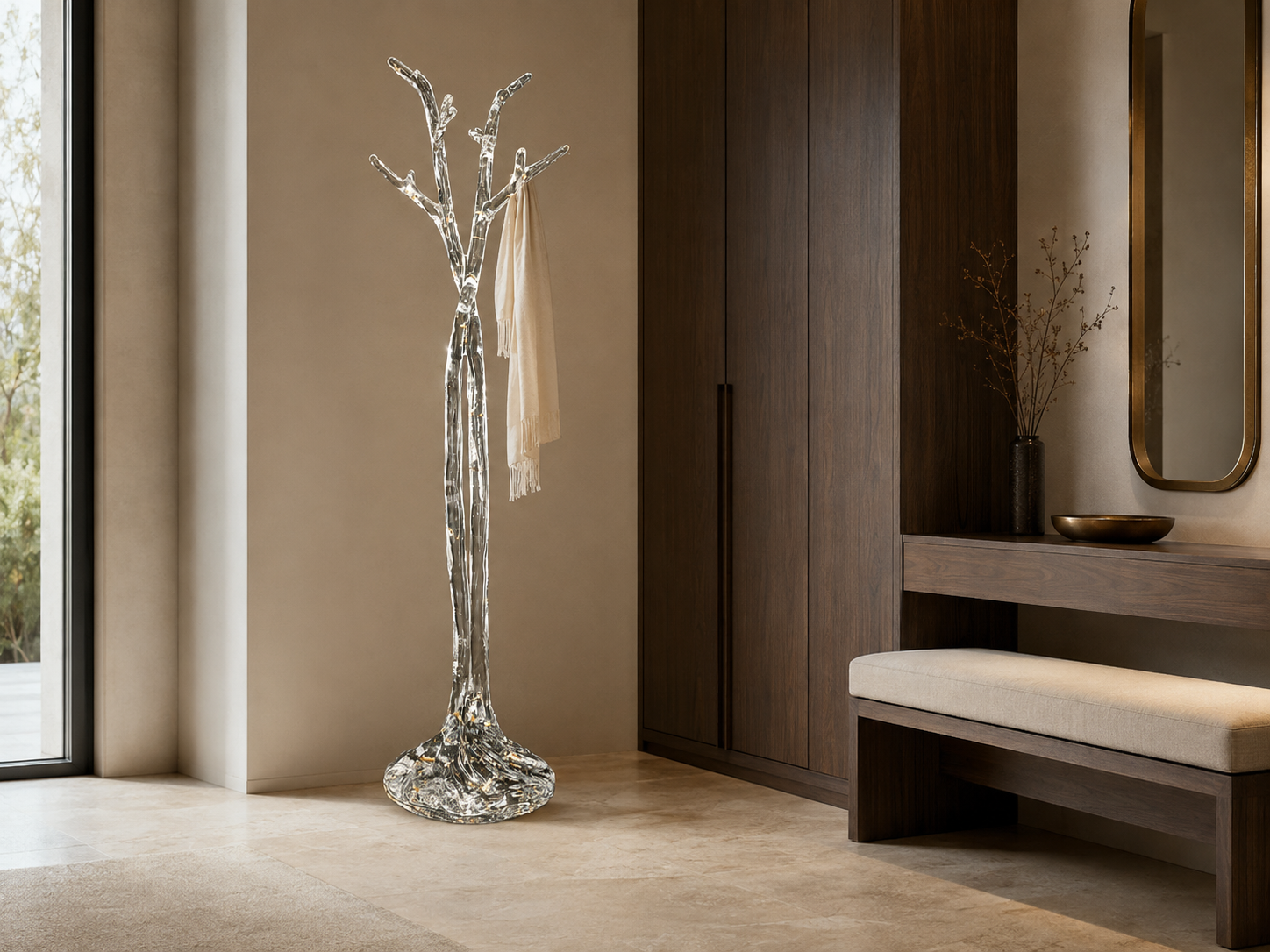
One of the most interesting contradictions in synthetic crystal furniture is that it can be physically substantial while appearing visually light.
A thick transparent table base may weigh considerably and have a powerful sculptural form, yet because light and surrounding colors pass through the material, it does not read as a solid visual barrier. This allows designers to introduce large-scale furniture without making the interior feel crowded.
The optical performance of premium acrylic illustrates why this effect can be so powerful. Technical data published for PLEXIGLAS Optical 0Z024, a specific optical PMMA product, reports light transmission of 92% at a thickness of 3 mm, with haze below 1% and a refractive index of 1.49. Its reported density is 1.19 g/cm³. These values apply to that particular product rather than every acrylic formulation, but they demonstrate the optical potential available from professionally engineered transparent polymers.
For furniture designers, transparency becomes almost another architectural material.
A clear dining table base allows patterned flooring to remain visible. A synthetic crystal console placed in front of textured stone does not completely conceal the wall behind it. Transparent side tables beside a sofa avoid creating multiple blocks of color at floor level. In a hotel lobby, crystal-clear pedestals can support decorative objects while keeping the overall environment visually open.
Architectural Digest has documented this principle in real interiors as well. Designer Charlotte Lucas Bees, for example, explained that a small acrylic table was selected for a richly decorated room so that it could appear to “float” without adding visual clutter.
The effect becomes even more valuable when furniture is intentionally oversized.
Luxury spaces increasingly use statement objects: large coffee tables, monolithic consoles, thick dining-table legs, display plinths, reception desks, and sculptural benches. If every statement object is made from stone, wood, or dark metal, the room can quickly feel overloaded.
Synthetic crystal changes that equation.
A 150 mm or 200 mm thick transparent element can look dramatic without appearing like a solid wall. High-end resin can also be produced with controlled translucency, smoke effects, amber tones, champagne colors, blues, gradients, or internal textures. Instead of simply being invisible, the furniture can visually change as daylight, artificial lighting, and viewing angles change.
In this sense, transparent furniture does not merely occupy a room.
It participates in the light of the room.
3. Synthetic Crystal Gives Designers a New Level of Customization
Traditional materials come with natural limitations. Marble has veining determined by geology. Timber contains grain patterns created by growth. Metals can be shaped extensively, but their fundamental opacity remains. Glass can be colored, laminated, curved, textured, and cast, yet certain complex thick forms can require demanding fabrication.
High-end resin and synthetic crystal introduce a different design process because the material can often be developed around the object itself.
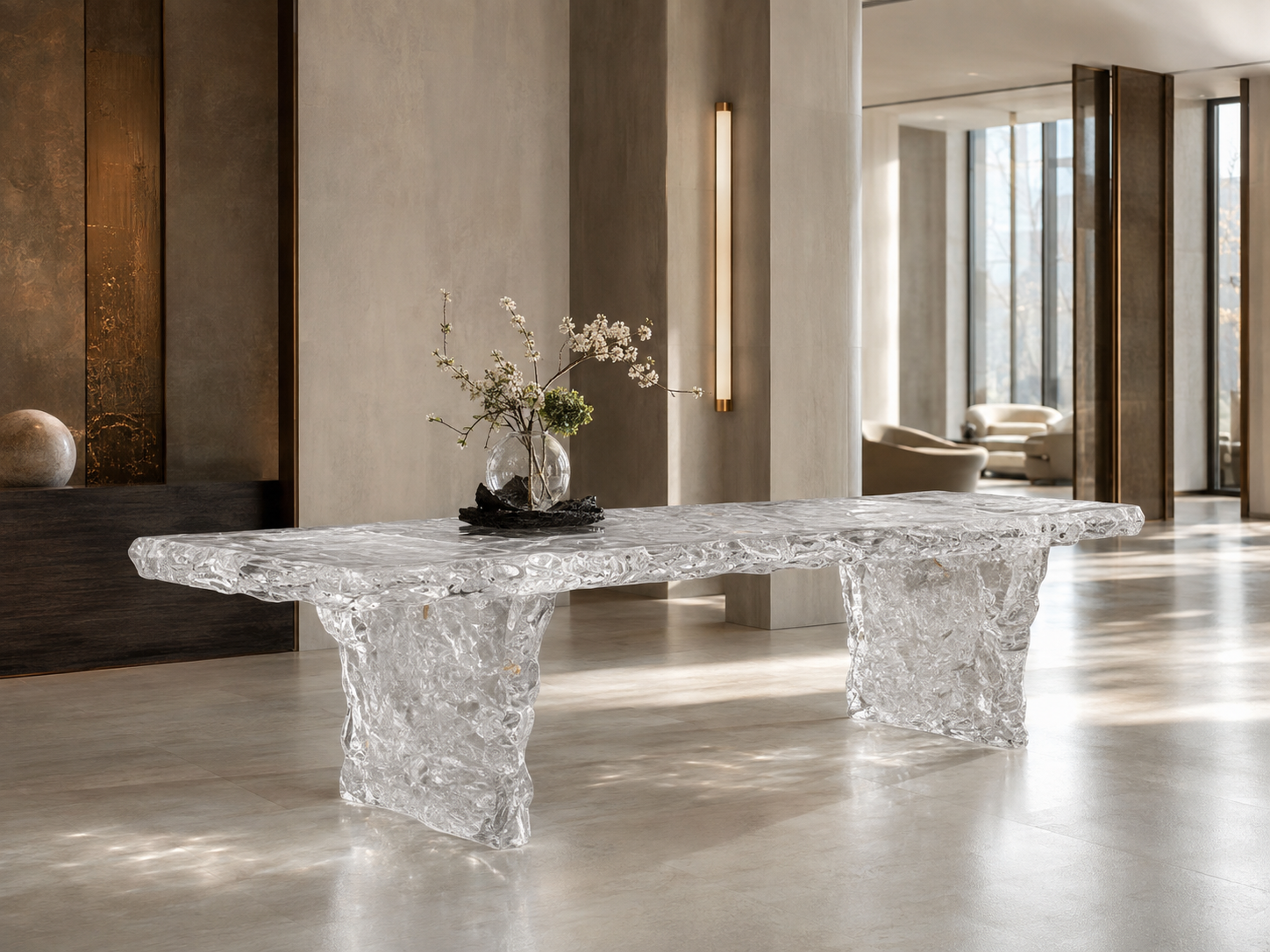
Color can be controlled. Transparency can range from crystal clear to translucent. Decorative elements can be encapsulated within the material. Metal, stone fragments, shells, fabric, pigments, artistic objects, or other inclusions can become part of the volume rather than being applied only to the surface.
This concept has a significant history in serious design.
The Museum of Modern Art in New York holds Shiro Kuramata’s 1988 Miss Blanche Chair, one of the most recognizable examples of acrylic resin used as an expressive furniture material. Artificial roses are suspended inside the transparent acrylic body of the chair, creating the appearance that they are floating in space. MoMA describes the chair as an icon of postmodern design and notes the painstaking casting process required to position the flowers while the resin hardened.
The significance of the piece extends beyond its appearance. Kuramata demonstrated that transparent resin could make the interior of a furniture object part of the design.
With wood or stone, we normally design the surface of an object. With clear cast resin or synthetic crystal, designers can also design what happens inside it.
That opens interesting possibilities for contemporary luxury projects.
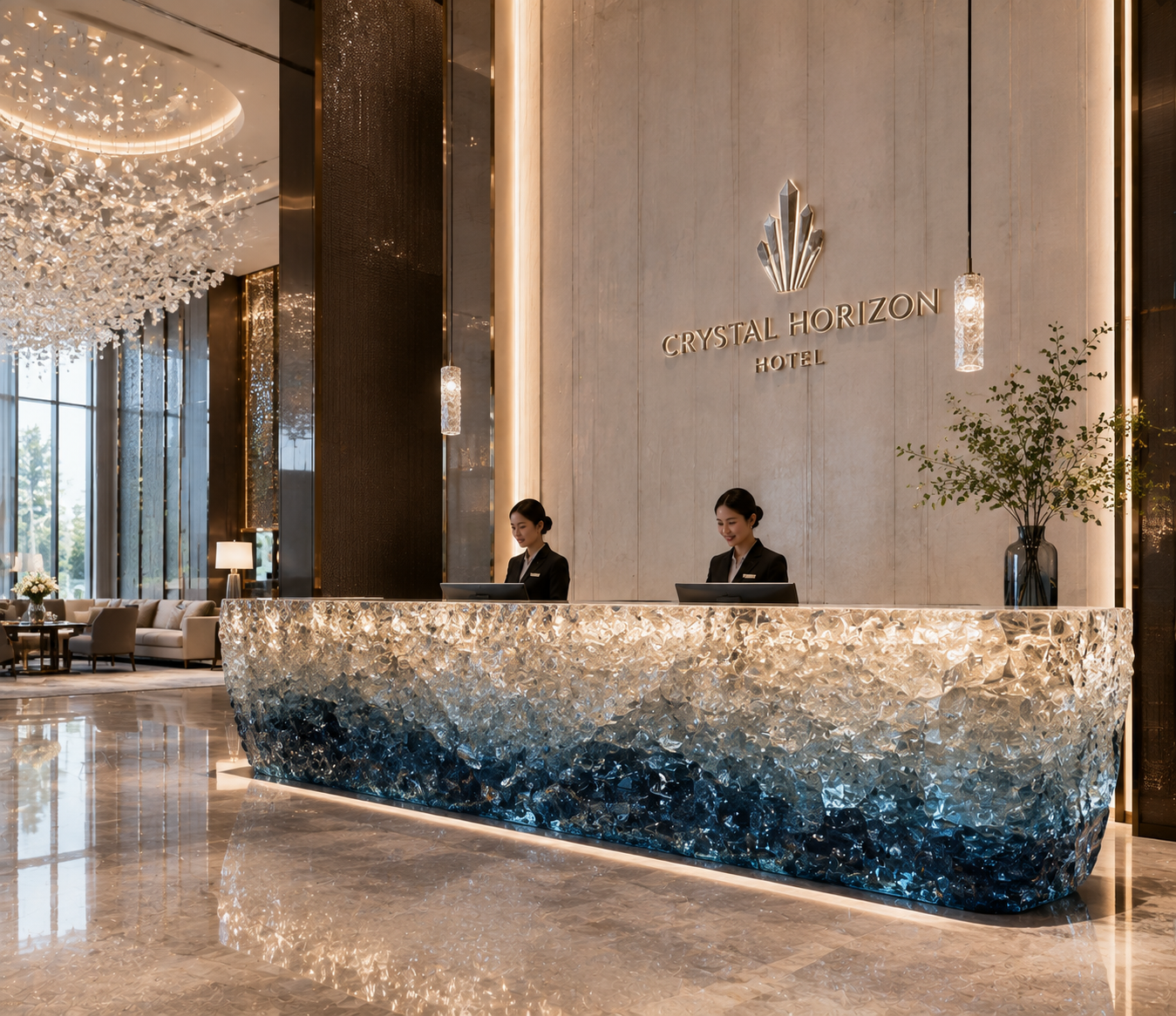
A hotel could commission reception furniture containing metallic details that reference its brand identity. A jewelry boutique could use lightly tinted synthetic crystal display tables whose color complements gemstones without overpowering them. A luxury residence could combine a clear resin table base with natural wood or marble, creating a deliberate contrast between opacity and transparency.
High-end resin can also produce one-of-a-kind effects that are difficult to reproduce exactly. Controlled bubbles, cloud-like translucency, layered coloration, metallic inclusions, or embedded natural objects can turn a functional table into something closer to collectible design.
For manufacturers of synthetic crystal, premium resin, and platinum acrylic furniture, this is where the strongest value lies.
The customer is not simply purchasing another material.
The customer is gaining access to a broader design language.
4. Transparent Polymers Have Already Proved They Belong in Serious Furniture Design
One reason some buyers remain cautious about synthetic materials is the assumption that “natural” automatically means high-end while polymers automatically belong to mass-market furniture.
Design history shows otherwise.
Shiro Kuramata’s work is held by MoMA, and his experiments with transparency included both laminated glass and acrylic resin. The museum explicitly presents these works as explorations of transparency through different materials.
Philippe Starck’s Louis Ghost chair for Kartell provides another important example. Produced from transparent polycarbonate in a single molded form, the chair reinterprets the silhouette of a Louis XV chair using an entirely contemporary material. Kartell describes it as stable, impact resistant, weather resistant, and stackable despite its visually delicate crystalline appearance.
The significance of these products is not that synthetic crystal, PMMA, polycarbonate, and casting resin are identical—they are not. Each polymer system has different optical, structural, chemical, thermal, and manufacturing characteristics.
The lesson is that premium furniture is defined by design, engineering, finishing, and execution rather than by whether the raw material was formed by geology or chemistry.
This matters when specifying modern synthetic crystal furniture.
A poorly made transparent table can expose every weakness: bubbles, internal stress, yellowing, scratches, uneven polishing, visible joints, distortion, or inconsistent coloration. Because the material is transparent, manufacturing quality is literally visible.
High-end production therefore requires careful control of casting conditions, curing, polishing, bonding, machining, surface finishing, and structural engineering.
This is also where platinum acrylic or other premium acrylic grades can differentiate themselves from inexpensive transparent plastic. Buyers should examine real samples and request relevant technical information covering optical quality, UV stability, surface performance, allowable temperature, load requirements, and long-term maintenance.
The objective should not be to imitate crystal glass cheaply.
The objective should be to use advanced polymers in ways that traditional materials cannot easily achieve.
When that happens, furniture stops looking like a substitute and starts becoming a design statement in its own right.
5. Sustainability and Indoor Environmental Quality Are Changing Material Decisions
Another reason material selection is changing is that architects, designers, and commercial buyers are being asked increasingly detailed questions about environmental impact and indoor air quality.
A visually beautiful product is no longer enough for many international projects.
The U.S. Environmental Protection Agency notes that building materials and furnishings can be sources of volatile organic compounds and reports findings from its TEAM studies in which levels of several organic pollutants averaged approximately two to five times higher indoors than outdoors.
This does not mean that resin or acrylic furniture is automatically high-emitting. Nor does it mean that traditional furniture is automatically safer. It means that serious projects increasingly require evidence rather than assumptions.
LEED v5 reflects this shift. Current U.S. Green Building Council guidance includes furniture among product categories evaluated for low emissions and references testing under ANSI/BIFMA Standard Method M7.1 together with specific requirements in the ANSI/BIFMA e3 Furniture Sustainability Standard.
BIFMA’s current e3-2024 standard goes even further by evaluating furniture through environmental, health and wellness, and social criteria. BIFMA states that the sixth edition introduces progressively stronger performance tiers and remains aligned with major frameworks including LEED, WELL, and ILFI.
For manufacturers of high-end resin and acrylic furniture, the implication is important: future competitiveness will increasingly depend on documentation.
International designers may ask what resin system was used, what coatings or adhesives are present, whether emissions have been tested, whether the material contains recycled content, and how the product can be repaired, separated, or recycled.
PMMA also has developing circular possibilities. In March 2026, Röhm announced an industrial-scale chemical recycling initiative in which PMMA can be depolymerized back into methyl methacrylate. The company reported yields above 90% for the depolymerization process.
Separately, PLEXIGLAS has documented transparent PMMA sheet products containing substantial recycled content while retaining 92% light transmission in specified variants, illustrating how recycled feedstock and high optical performance can potentially coexist when the manufacturing system is properly controlled.
For luxury furniture, sustainability should therefore move beyond vague claims such as “eco-friendly.” Durability, repairability, verified composition, emissions, recycling pathways, and service life provide much stronger arguments.
6. The Real Change Is Not the Material—It Is the Way Designers Think About Space
The most important change created by synthetic crystal furniture is ultimately not technological.
It is spatial.
Traditional furniture often defines space by occupying it. A cabinet creates a solid visual wall. A stone table becomes a central mass. A wooden console creates a strong horizontal line. These effects can be desirable, but contemporary interiors increasingly require furniture that can perform its function without visually closing the room.
Synthetic crystal, high-end resin, and premium acrylic provide another option.
Imagine a luxury fashion boutique where the merchandise should remain the visual priority. Transparent display tables allow products to appear almost suspended within the room. Imagine a hotel lobby with expensive stone flooring whose pattern forms part of the architectural identity. A clear synthetic crystal coffee table allows that surface to remain visible. Imagine a penthouse overlooking a skyline. A transparent console in front of the windows can provide function without creating an opaque barrier across the view.
These are not simply aesthetic advantages. They are solutions to real design problems.
The same logic applies to material combinations. Synthetic crystal does not need to compete with marble, wood, stainless steel, brass, or leather. It can make those materials more powerful through contrast.
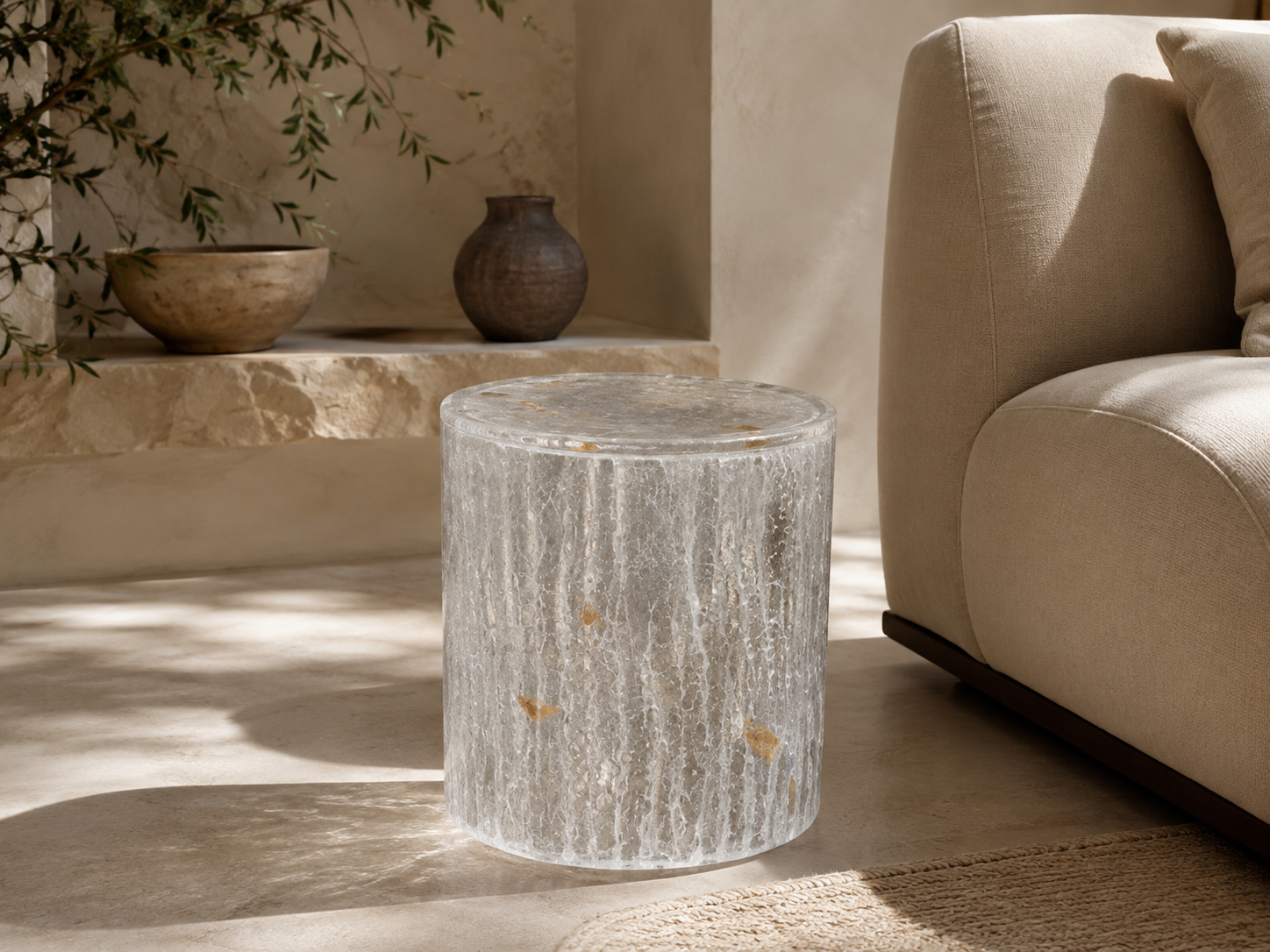
A marble tabletop can appear to float on transparent crystal legs. A dark walnut surface can become visually lighter when supported by platinum acrylic. Brushed brass encapsulated inside a clear resin volume can appear suspended in space. A resin side table containing stone fragments can connect a contemporary polymer with the natural materials already used in the interior.
The Ellen MacArthur Foundation advises designers to consider material durability, expected product life, maintenance, repair, and what happens to materials after use rather than evaluating materials only at the moment of manufacture.
That is an appropriate way to think about high-end furniture as well.
The future of luxury is unlikely to be a world in which synthetic materials replace every traditional one. Marble will remain marble. Timber will retain its warmth. Metal will continue to provide strength and precision. Glass will continue to offer unique optical qualities.
What is changing is that designers no longer have to accept those materials as the limits of the furniture vocabulary.
Synthetic crystal furniture introduces transparency with sculptural volume. High-end resin introduces color, depth, encapsulation, and artistic customization. Premium and platinum acrylic introduce optical clarity and precise contemporary forms. When combined intelligently with stone, timber, metal, leather, textiles, and lighting, they can create interiors that feel open, layered, and materially sophisticated.
That is why the most interesting question is no longer, “Is synthetic crystal better than traditional furniture materials?”
A better question is, “What can we design now that was difficult to design before?”
For architects, interior designers, hotel developers, luxury retailers, and private clients, that question opens an entirely new range of possibilities.
And that is where synthetic crystal furniture is truly changing the space.
READ MORE:
- Trasparenza di lusso: perché i mobili ispirati al cristallo stanno diventando una nuova scelta per gli interni premium
- Transparency, Artistry, and Durability: Can One Material Deliver All Three? The Design Advantages of Synthetic Crystal Furniture
- From Maintenance Costs to Visual Impact: How One Material Can Shape the Entire Spatial Experience
- Clients Want a Unique Design but Have a Limited Budget? Synthetic Crystal Furniture Offers a Balanced Solution
- How to Choose the Right Furniture Materials for High-End Spaces: Why Synthetic Crystal Furniture Is Becoming a New Design Solution
- How Modern Commercial Spaces Use Artistic Furniture to Influence Customer Perception
- Why Durability and Maintenance Matter More in Premium Furniture Investments
- How Luxury Furniture Trends Are Shifting from Decoration to Experience
- The Hidden Value of Custom-Made Acrylic Furniture for Premium Interior Projects


