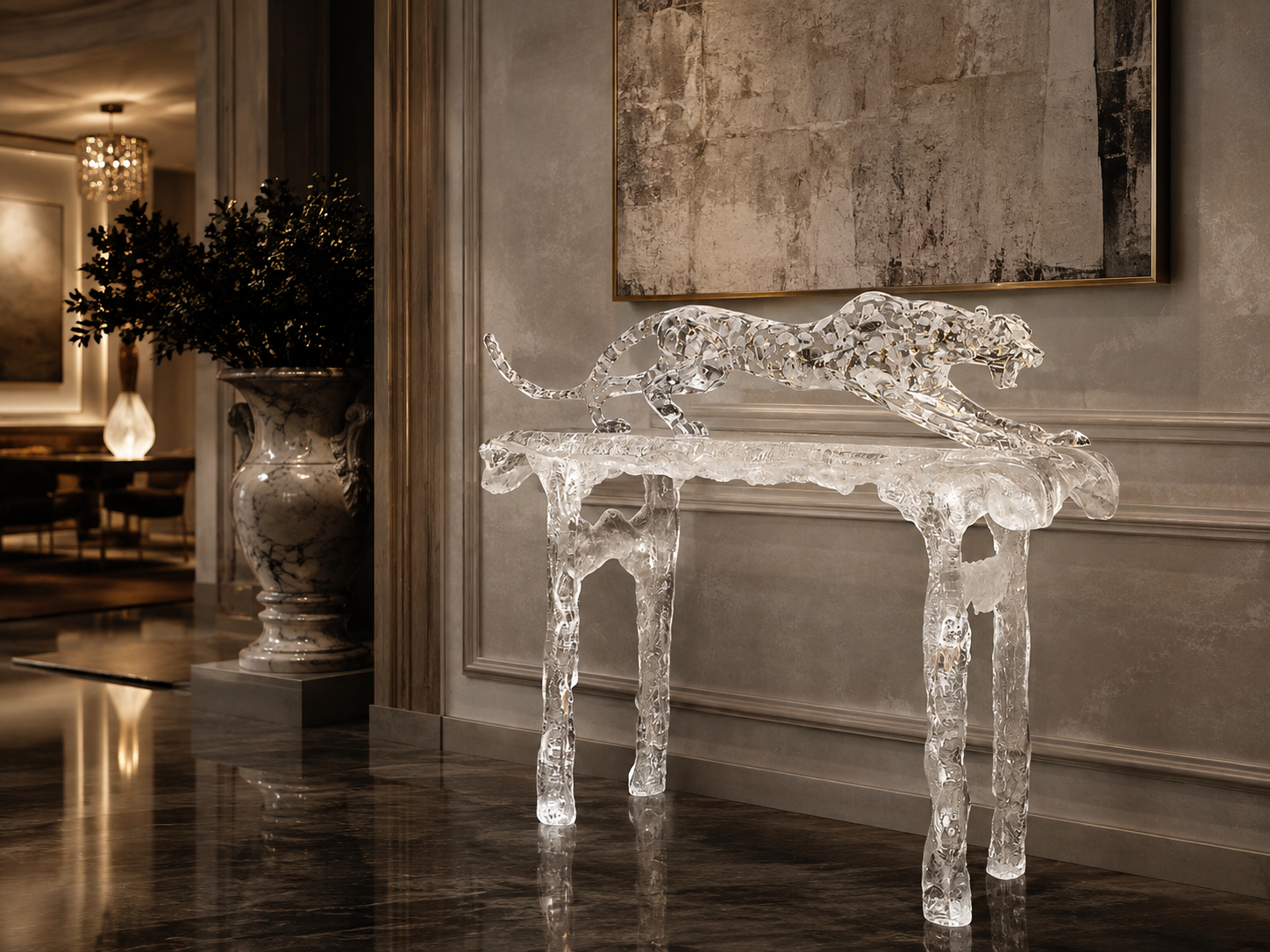
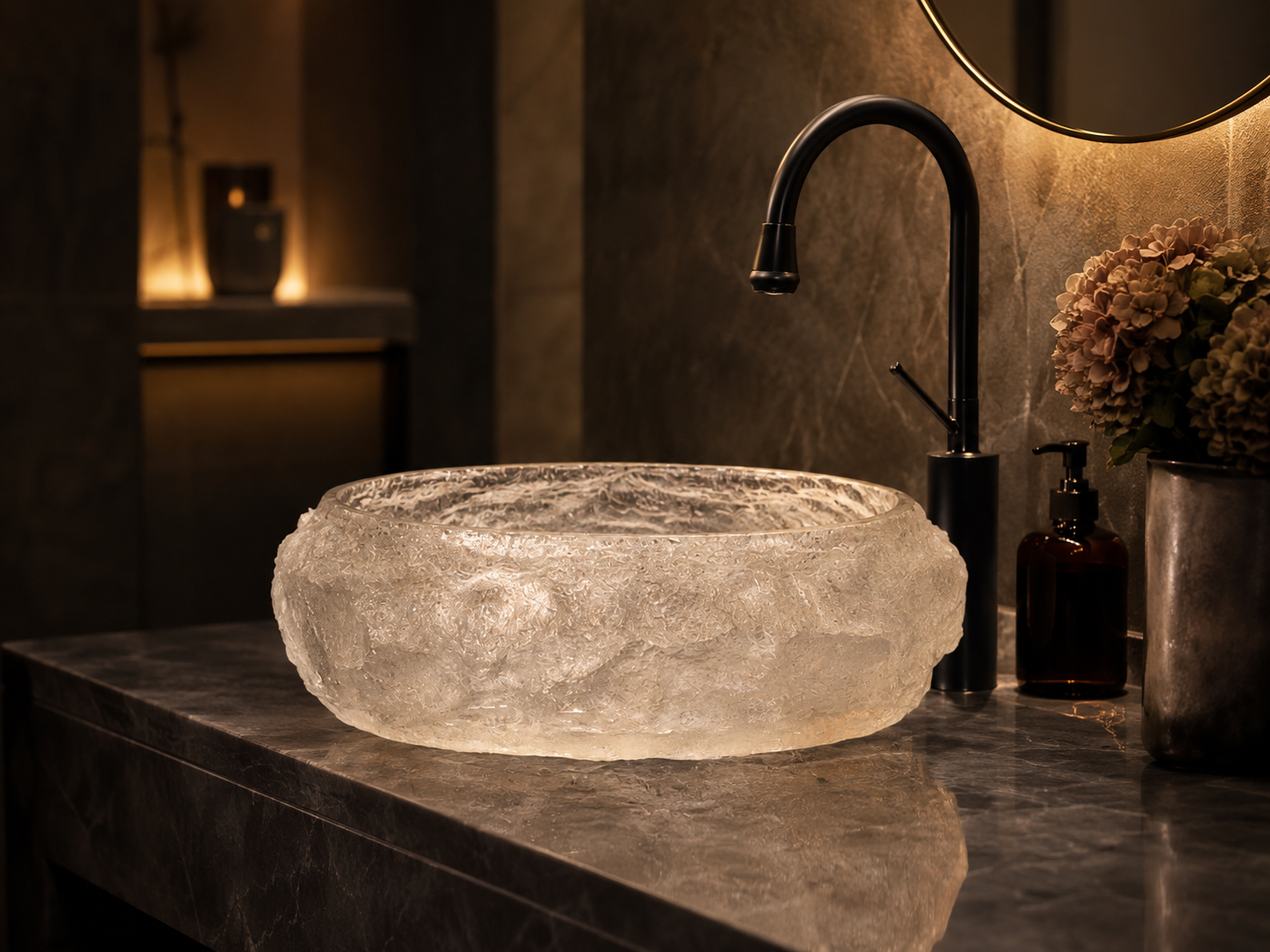
In high-end interior design, a furniture material is never just a surface choice. It influences how often a piece needs to be cleaned, how difficult it is to install, how light travels through a room, whether sightlines remain open, how the furniture ages, and even how occupants perceive the size and atmosphere of the space.
This is why material specification has become increasingly important in luxury residences, hotels, boutiques, galleries, clubs, and premium commercial interiors. A table may represent only one item on a furniture schedule, yet its material can affect housekeeping procedures, transportation requirements, lighting decisions, visual balance, and long-term ownership costs.
Traditional materials such as marble, timber, metal, and glass continue to play an essential role in luxury interiors. However, designers now have additional options, including synthetic crystal, high-end casting resin, premium PMMA acrylic, and what some furniture manufacturers describe commercially as platinum acrylic. These transparent and translucent materials are particularly interesting because they can influence both the operational and emotional experience of a space.
The question is therefore no longer simply, “What material looks best?” A more useful question is: “What will this material make the space easier, harder, lighter, heavier, calmer, more memorable, or more expensive to operate over the next several years?”
1. Maintenance Cost Begins with the Material, Not with the Cleaning Team
The purchase price of furniture is only one part of its real cost. In a high-end hotel, luxury residence, retail boutique, or commercial lobby, furniture may be cleaned hundreds or even thousands of times during its service life. Every material therefore creates its own maintenance routine.
Stone may require sealing or specialist stain treatment depending on the type and finish. Metal surfaces can show fingerprints and may require specific polishing products. Timber can react to moisture, heat, sunlight, and unsuitable chemicals. Glass is familiar to maintenance teams, but fingerprints, mineral deposits, and edge damage can become highly visible on large transparent surfaces.
Premium acrylic and synthetic crystal introduce a different maintenance profile.
PLEXIGLAS, one of the best-known PMMA acrylic brands, states that its non-porous surface makes it difficult for dirt to adhere and that, for ordinary indoor cleaning, water and a soft lint-free cloth are often sufficient. At the same time, the manufacturer specifically warns against dry rubbing and unsuitable solvents because they can scratch or damage the acrylic surface.
That distinction matters in real projects.
Imagine two transparent console tables in a hotel lobby. Both may look equally clear when newly installed. One is supplied with a detailed maintenance specification, suitable cleaning products, polishing procedures, and repair guidance. The other is treated exactly like ordinary glass. After repeated use of an unsuitable cleaner, its surface begins to cloud or develop fine marks. The material itself may not have failed; the maintenance system failed.
Architectural Digest gives similar advice for acrylic and Lucite furniture, recommending microfiber cloths and plastic-specific cleaners while warning against ammonia-based household glass cleaners. It also notes that minor scratches may be polished, while deeper damage may require professional treatment.
Repairability can directly affect ownership cost. PLEXIGLAS technical guidance explains that scratched or scuffed PMMA surfaces can, under appropriate conditions, be sanded and repolished.
For synthetic crystal furniture, high-end resin tables, and platinum acrylic consoles, this creates an important purchasing principle: maintenance should be designed at the same time as the furniture. A premium material is not one that never requires care. It is one whose care requirements are understood, manageable, and compatible with the environment in which it will actually be used.

2. Visual Weight Can Change the Perceived Size of a Room
Furniture has physical dimensions, but it also has visual dimensions.
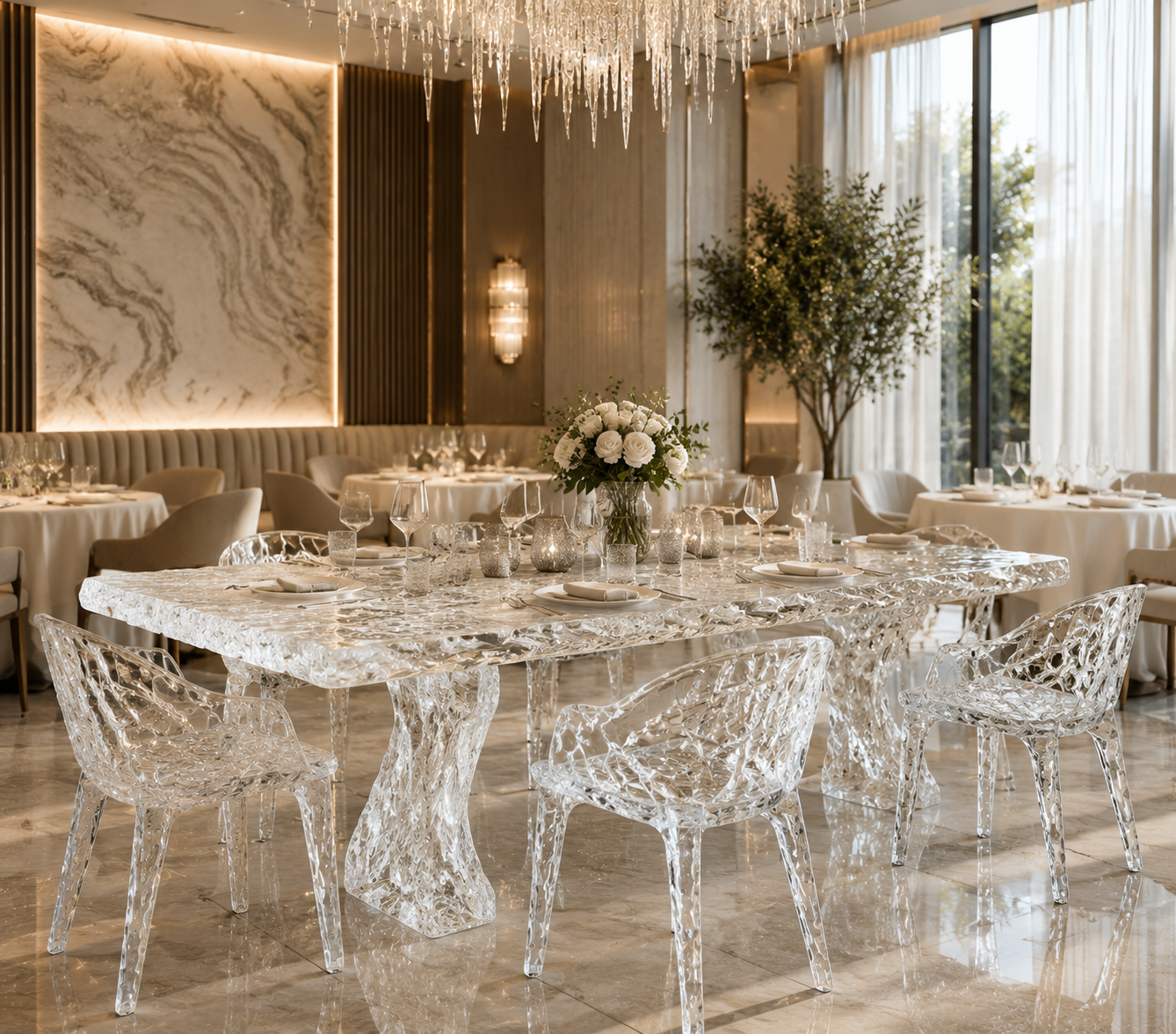
A black marble coffee table and a clear synthetic crystal coffee table may occupy almost exactly the same floor area, yet the two pieces can make the room feel completely different. An opaque object blocks the floor, interrupts sightlines, and creates a defined mass. A transparent object allows colors, flooring, rugs, and architectural elements to remain visible through it.
Architectural Digest has specifically recommended transparent furniture as a way to reduce visual clutter. Its discussion of acrylic, Lucite, and glass furniture explains that clear pieces allow existing surfaces and colors to remain visible rather than introducing another visually dominant object into a room.
This principle becomes particularly valuable in high-end spaces because expensive interior finishes are often part of the visual story.
Consider a luxury apartment with book-matched stone flooring and a hand-knotted rug. A large opaque coffee table may conceal a considerable portion of both. A clear synthetic crystal or platinum acrylic table can provide the required surface while allowing those investments to remain visible.
The same principle applies in retail. In a jewelry store or fashion boutique, furniture should often support the merchandise rather than compete with it. Transparent display tables, acrylic pedestals, resin consoles, and crystal-clear product stands create physical platforms while reducing visual obstruction.
There is also measurable optical science behind this effect. Technical data for PLEXIGLAS Optical 0Z024, a specific optical-grade PMMA product, reports 92% light transmission through a 3 mm sheet, haze below 1%, and a refractive index of 1.49. The same manufacturer describes the material as approximately half the weight of glass. These figures apply to this particular PMMA grade, not automatically to every acrylic or synthetic crystal product, but they demonstrate what engineered transparent polymers can achieve.
This is why transparent furniture can feel paradoxical. A thick synthetic crystal table base can be physically substantial and sculptural while appearing visually lighter than a thinner opaque structure.
For designers, that is not simply a material characteristic. It is a tool for controlling the perceived volume of a room.
3. Light Turns Transparent Furniture into Part of the Architecture
Lighting is normally discussed in relation to ceilings, walls, windows, and decorative fixtures. Transparent furniture changes that relationship because the furniture itself begins to interact with the light.
A conventional walnut table primarily reflects light from its surface. Marble reveals color and veining. Metal produces controlled highlights. A transparent synthetic crystal or high-end resin object can transmit, refract, reflect, and internally scatter light depending on its geometry, color, thickness, finish, and formulation.
This gives designers another layer of spatial control.
During daylight hours, a clear synthetic crystal console beside a window may visually absorb the colors of the surrounding landscape. In the evening, the same object can capture highlights from architectural lighting. A champagne-tinted resin side table may appear pale in natural daylight and significantly warmer under low-temperature decorative lighting.
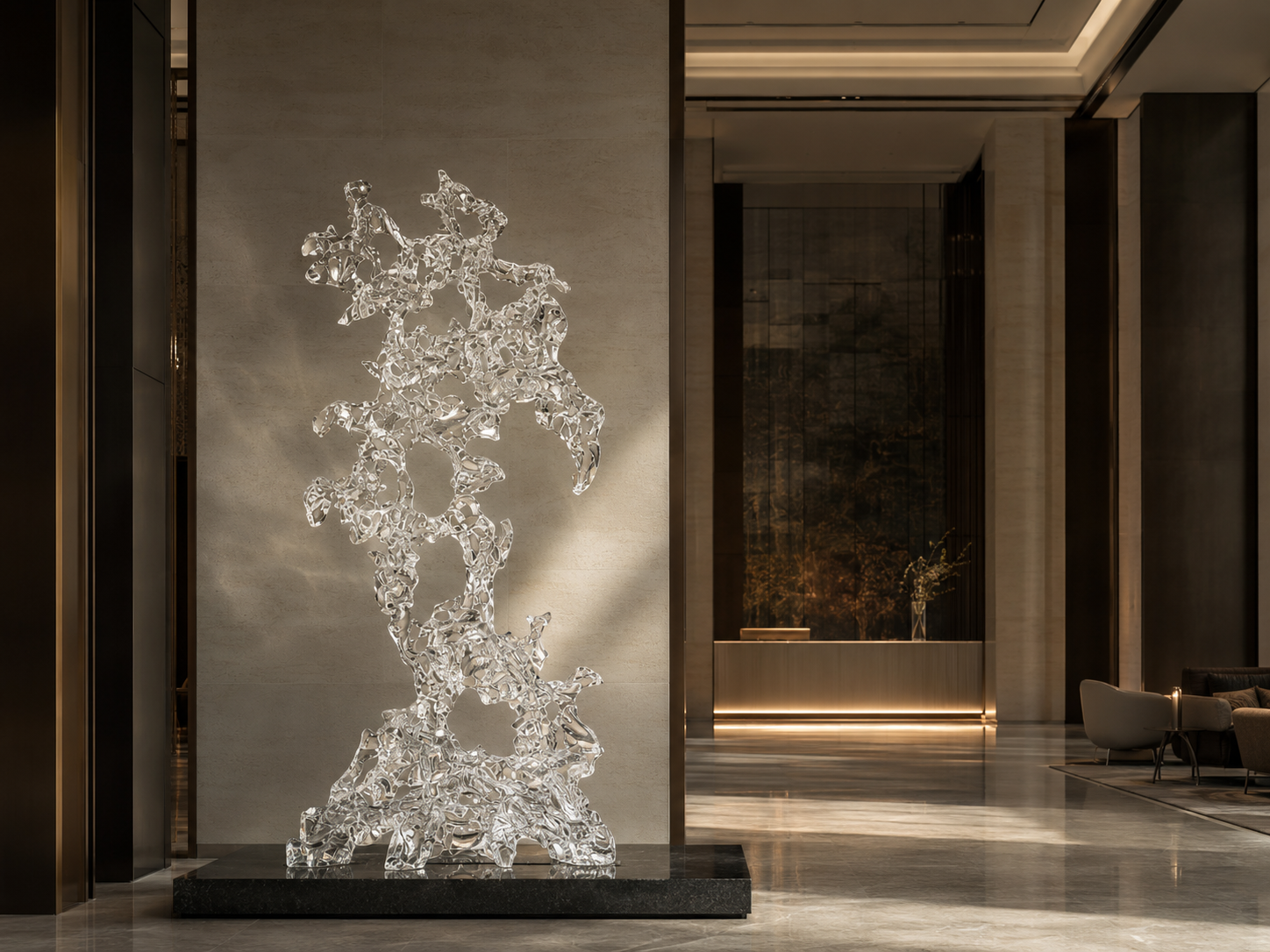
Thick sections make the effect particularly interesting. Instead of treating transparency as a two-dimensional sheet, cast synthetic crystal and high-end resin can create depth. Rounded corners, polished edges, internal curves, embedded objects, bubbles, pigments, gradients, metallic particles, or decorative inclusions can manipulate how light moves through the furniture.
This is not a new idea in serious furniture design.
The Museum of Modern Art in New York holds Shiro Kuramata's 1988 Miss Blanche Chair, made from acrylic resin, aluminum, and synthetic roses. MoMA describes how the roses appear suspended within the acrylic body and records the demanding casting process used to maintain their positions while the resin hardened.
The significance of this design goes beyond transparency. Kuramata demonstrated that the interior volume of a piece of furniture could become part of its visual composition.
That principle remains highly relevant to contemporary synthetic crystal furniture.
A designer can place metallic elements inside a resin console rather than attaching decoration only to the outside. A luxury hotel can commission a reception feature using a customized amber or smoke tint. A villa can combine transparent crystal-style legs with a natural marble top so that the density of stone appears almost suspended in space.
In these applications, the material does more than match the interior.
It changes how the interior responds to light.
4. Installation, Handling, and Daily Use Are Part of the Space Experience
A material can look extraordinary in a rendering and still create problems once it reaches the project site.
High-end furniture often passes through elevators, narrow corridors, finished doorways, stone floors, luxury wall coverings, and spaces where damage during installation is extremely expensive. Weight, component size, edge vulnerability, lifting requirements, and assembly methods therefore influence the practical value of a material.
This is one area where premium acrylic can provide advantages in suitable applications. PLEXIGLAS describes its optical PMMA as approximately half the weight of glass.
Lower material density does not mean that every finished acrylic table will be lightweight—a thick, monolithic piece can still be very heavy—but reducing weight relative to an equivalent volume of glass can affect transportation and handling decisions.
Synthetic crystal and high-end casting resin offer another advantage: geometry can often be developed around the project.
For example, a designer may want a dramatic 200 mm-thick transparent table leg. Reproducing that visual effect in solid glass could involve very different manufacturing, weight, joining, and installation considerations. Cast resin or synthetic crystal may provide another route, depending on structural requirements and the specific resin formulation.
However, the material must always be matched to the application.
A decorative pedestal supporting a handbag in a boutique has very different performance requirements from a 3-meter dining table, hotel bench, or reception desk used continuously by the public. Structural loads, creep, heat exposure, UV exposure, impact, scratching, bonding, and surface chemistry should all be considered.
This is particularly important when terms such as “synthetic crystal” and “platinum acrylic” are used. They are often commercial or design descriptions rather than single internationally standardized material categories. Professional buyers should therefore ask for actual material specifications, samples, test results, engineering information, and recommended operating conditions.
That transparency is valuable commercially.
A luxury project client is not simply buying a beautiful table. They are buying confidence that the table can be transported, installed, cleaned, touched, used, repaired, and maintained without becoming a recurring operational problem.
The best furniture material therefore improves the spatial experience long before the guest ever enters the room.
5. Material Choice Also Affects Invisible Environmental Quality
Not every effect of furniture can be seen.
Interior designers and developers increasingly consider emissions, coatings, adhesives, environmental documentation, and material chemistry when specifying products, particularly for hospitality, offices, healthcare, luxury residential developments, and internationally certified projects.
The U.S. Environmental Protection Agency identifies building materials and furnishings among potential sources of volatile organic compounds. EPA's TEAM studies found levels of several common organic pollutants averaging approximately two to five times higher inside homes than outside under the conditions studied.
This should not be interpreted as evidence that synthetic crystal or acrylic furniture is inherently problematic. It actually demonstrates why buyers should avoid judging emissions based only on broad categories such as “natural” or “synthetic.”
The finished furniture system matters.
A resin table may include pigments, coatings, adhesives, metal inserts, sealants, or other components. A wooden cabinet may contain composite boards, glue, lacquer, and coatings. What matters in professional specification is measurable performance.
The current LEED v5 Interior Design and Construction guidance illustrates this shift clearly. Furniture is explicitly included within its Low-Emitting Materials criteria, and qualifying furniture can be evaluated under ANSI/BIFMA Standard Method M7.1 together with relevant sections of the ANSI/BIFMA e3 Furniture Sustainability Standard. The LEED guidance also addresses custom furniture, allowing compliance to be considered through qualifying components or testing of the finished piece.
BIFMA describes its e3-2024 standard as a framework covering environmental, health and wellness, and social impacts associated with furniture products.
For manufacturers of synthetic crystal, high-end resin, and platinum acrylic furniture, this creates an opportunity.
The next level of luxury manufacturing is not simply better polishing. It is better documentation.
Material composition information, appropriate emissions testing, maintenance instructions, engineering data, UV-aging information, and transparent quality-control procedures make it easier for architects and designers to specify unfamiliar materials with confidence.
In a professional project, confidence itself becomes part of the customer experience.
6. Long-Term Value Comes from Combining Visual Impact with Service Life
Luxury furniture should survive beyond the moment when it is photographed.
The real test comes after several years of cleaning, sunlight, guest use, accidental impacts, changing interiors, and repeated maintenance.
This is why the Ellen MacArthur Foundation recommends that material selection consider expected product life, durability, maintenance, repair, material separation, and what happens to the material after the use phase.
That framework is particularly relevant to high-end furniture.
A synthetic crystal coffee table that can remain visually desirable for many years, be refinished when appropriate, and adapt to different interior styles may create greater long-term value than a fashionable object intended to be replaced quickly.
Transparent furniture has an additional advantage in this respect: visually neutral materials can work with changing surroundings.
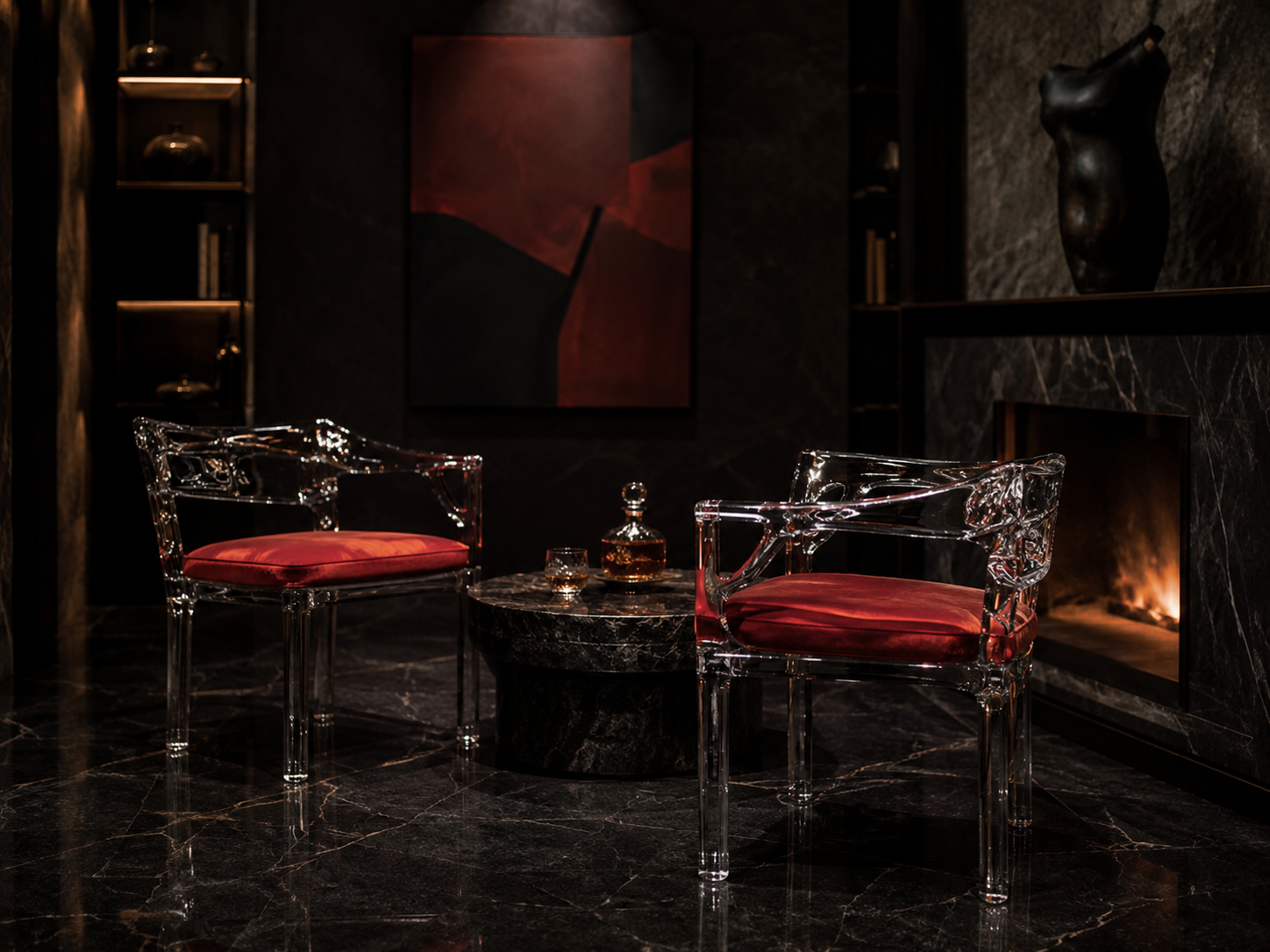
If a hotel replaces blue upholstery with beige upholstery, a crystal-clear acrylic side table may continue to work. If a residence changes its rug, artwork, or wall color, a clear synthetic crystal console does not necessarily need to change with it. Transparency can therefore provide visual flexibility as well as physical function.
End-of-life considerations are also becoming more relevant. PMMA, one material used in premium acrylic products, has established recycling potential. In March 2026, Röhm announced the industrial-scale integration of chemical recycling technology for PMMA and reported more than 90% yield in its depolymerization processes, which convert PMMA back into methyl methacrylate feedstock.
That does not mean every acrylic or resin furniture product will automatically be recycled. Pigments, embedded materials, adhesives, mixed construction, transportation, and local recycling infrastructure can all affect what happens in reality. High-end casting resins can also differ substantially in chemistry from PMMA.
The stronger sustainability argument is therefore not a simplistic statement that “synthetic crystal is recyclable.”
It is to design furniture deliberately for long service life, appropriate maintenance, responsible material selection, repair where technically possible, and clearer end-of-life pathways.
Ultimately, this brings the discussion back to spatial experience.
A material determines whether a hotel lobby looks open or crowded. It influences whether a cleaning team can maintain a surface efficiently. It changes the way natural light passes through a table. It can expose or conceal an expensive floor. It affects how easily a piece enters the building, how confidently architects specify it, and how long the product continues to look appropriate.
Synthetic crystal furniture, high-end resin tables, platinum acrylic consoles, transparent pedestals, sculptural dining-table bases, and crystal-clear coffee tables are therefore interesting not simply because they look modern.
Their real potential lies in their ability to solve several design problems at the same time.
In high-end interiors, the best material is rarely the one with the most impressive name or the highest initial price. It is the material that creates the right visual experience while remaining practical throughout its service life.
When material selection successfully connects beauty, maintenance, engineering, light, health, and longevity, one piece of furniture can change far more than its immediate surroundings.
It can change the experience of the entire space.
READ MORE:
- Trasparenza di lusso: perché i mobili ispirati al cristallo stanno diventando una nuova scelta per gli interni premium
- Transparency, Artistry, and Durability: Can One Material Deliver All Three? The Design Advantages of Synthetic Crystal Furniture
- Clients Want a Unique Design but Have a Limited Budget? Synthetic Crystal Furniture Offers a Balanced Solution
- Why Are More Designers Moving Away from Traditional Materials? How Synthetic Crystal Furniture Is Changing Interior Space
- How to Choose the Right Furniture Materials for High-End Spaces: Why Synthetic Crystal Furniture Is Becoming a New Design Solution
- How Modern Commercial Spaces Use Artistic Furniture to Influence Customer Perception
- Why Durability and Maintenance Matter More in Premium Furniture Investments
- How Luxury Furniture Trends Are Shifting from Decoration to Experience
- The Hidden Value of Custom-Made Acrylic Furniture for Premium Interior Projects


