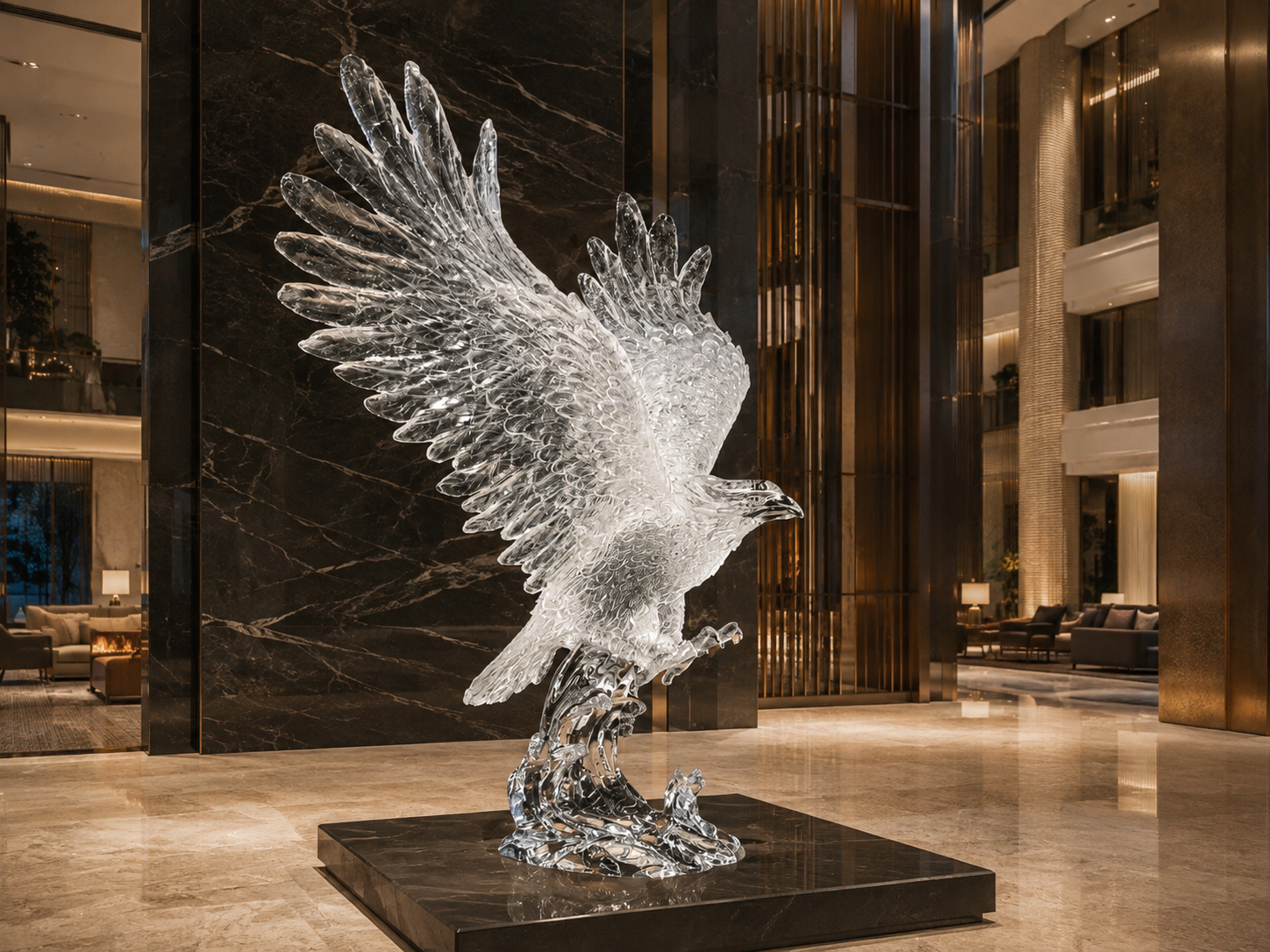
In high-end residential, hospitality, retail, and commercial projects, one of the most common design conflicts is easy to describe but difficult to solve: the client wants something distinctive, but the project does not have an unlimited budget.
A private homeowner may want a dining table that no one else owns. A boutique hotel may need a memorable lobby without commissioning collectible furniture throughout the entire property. A fashion retailer may want custom display furniture that expresses its brand while still controlling construction costs. In all of these situations, the challenge is not simply to “spend less.” The challenge is to decide where customization creates the greatest visual value.
This question is becoming more relevant as clients increasingly expect interiors to feel personal. Architectural Digest recently described a broader movement away from predictable definitions of “good taste,” noting a growing preference for individuality, personal expression, and interiors that feel less standardized.
Synthetic crystal furniture, high-end casting resin, premium acrylic, and commercially described platinum acrylic can provide designers with another way to respond. These materials are not automatically inexpensive, and they should not be marketed as cheap substitutes for stone, glass, or handcrafted wood. Their real value lies in giving designers more ways to control form, transparency, color, visual weight, and material combinations while deciding carefully where the project budget should be spent.
1. A Limited Budget Does Not Mean the Design Has to Look Standardized
When clients say they want “custom furniture,” they are rarely asking only for unusual dimensions. What they usually want is a sense that the furniture belongs specifically to their space.
Traditional materials can achieve this beautifully, but highly customized traditional furniture can involve multiple cost layers. A sculptural stone table may require careful slab or block selection, machining, finishing, reinforcement, specialized packaging, and difficult installation. A highly detailed solid-wood piece may require extensive handwork, joinery, finishing, and material selection. Bespoke metal furniture can involve molds, welding, polishing, plating, and repeated prototype adjustments.
None of these processes is undesirable. They simply show why customization must be managed strategically when budgets are limited.
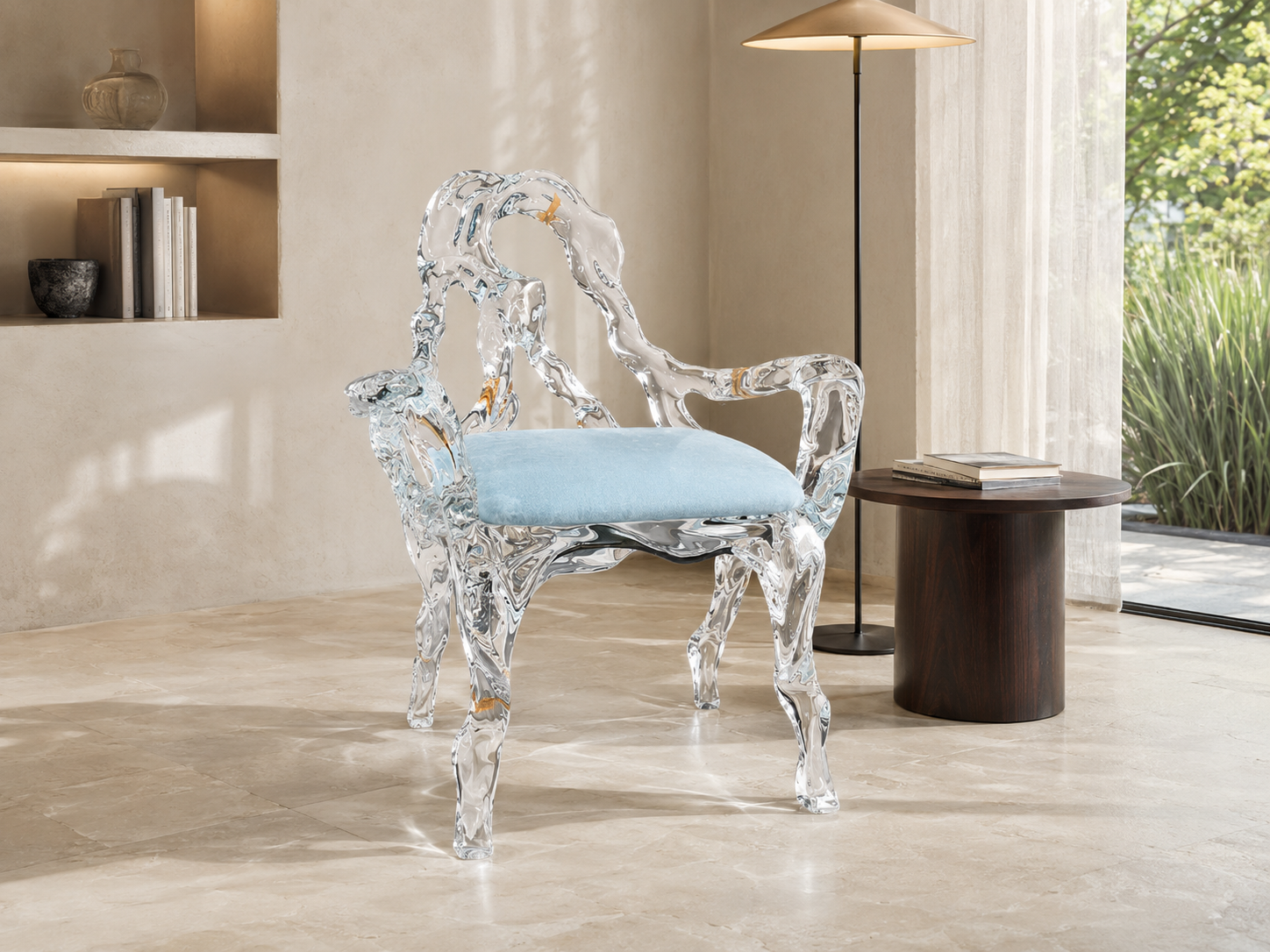
Synthetic crystal and high-end resin offer a different route because the visual identity can come from the material itself. Depending on the specific resin system and manufacturing process, designers can work with transparent, translucent, tinted, layered, or embedded effects. A relatively simple geometric coffee table can therefore become distinctive through a champagne tint, a smoke gradient, an internal decorative element, or an unusual optical depth rather than through extremely complicated external ornamentation.
The history of design already demonstrates how powerful this approach can be. The Museum of Modern Art holds Shiro Kuramata's 1988 Miss Blanche Chair, made from acrylic resin, aluminum, and synthetic roses. The artificial flowers are suspended inside the transparent body of the chair, turning the internal volume of the material into part of the design itself. MoMA describes the painstaking casting process required to keep each flower in position as the resin hardened.
The lesson for contemporary projects is not that every piece should imitate Miss Blanche. It is that uniqueness can come from how a material is used, not only from how much material or labor is added.
For a client with a controlled budget, that difference is important. A clean synthetic crystal console with one carefully developed visual feature may feel more custom than an expensive but conventional table made from a familiar material.

2. Transparency Can Create More Visual Impact with Less Visual Clutter
One of the most useful characteristics of synthetic crystal and premium acrylic furniture is that physical size and visual weight do not have to be the same thing.
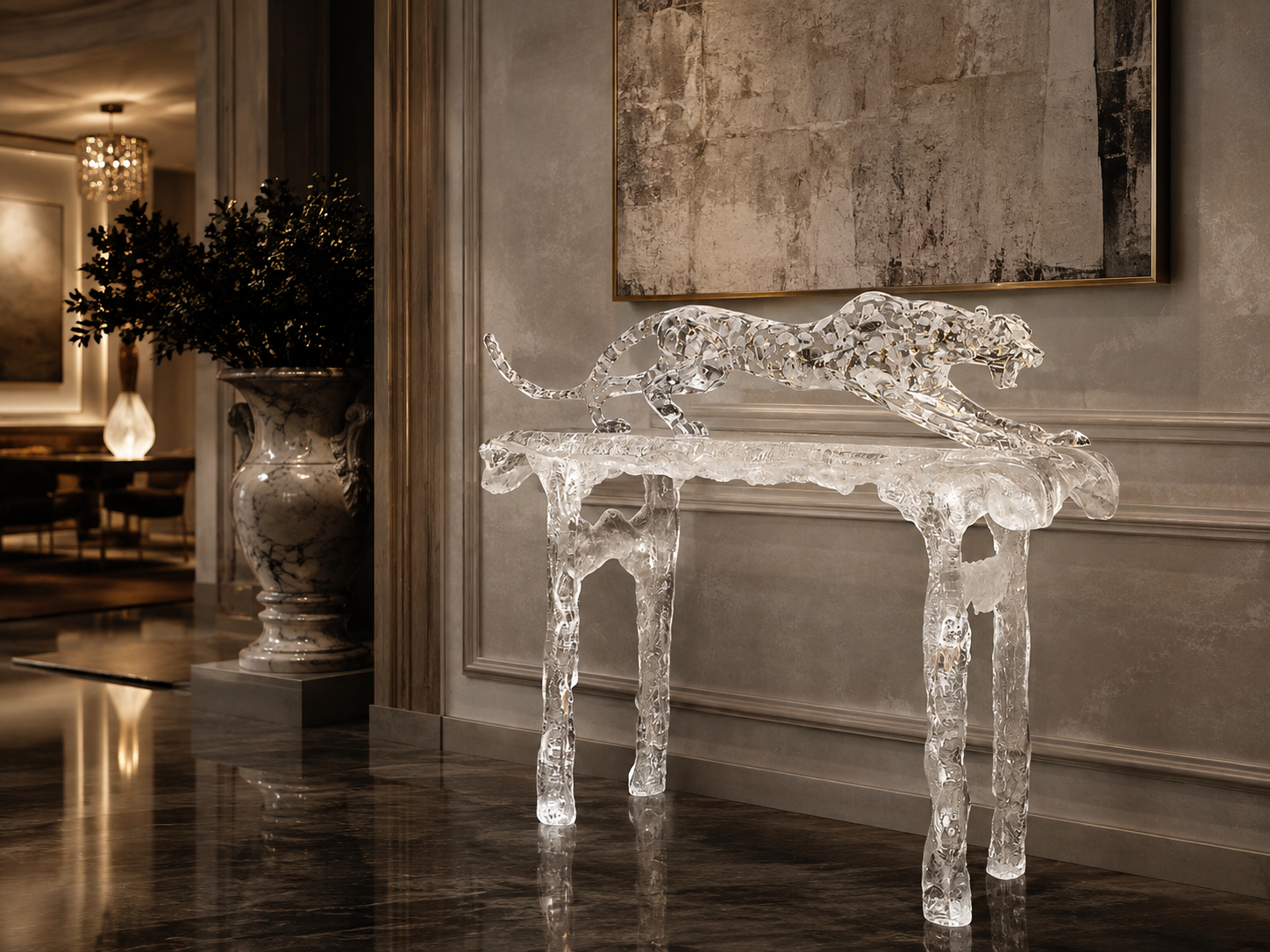
A coffee table can be large enough to anchor a seating area while still allowing the rug underneath to remain visible. A transparent console can occupy a hallway without creating another opaque horizontal block. A crystal-clear display pedestal can support merchandise without visually competing with the product.
Architectural Digest has specifically identified this advantage of transparent furniture, explaining that acrylic, Lucite, and glass pieces can reduce visual clutter because surrounding floors, colors, and decorative elements remain visible through them.
For budget-controlled projects, this can have an indirect but important financial advantage: one well-designed transparent object can create a strong contemporary effect without requiring the designer to add numerous decorative layers around it.
Consider a luxury apartment where the budget has already been invested in natural-stone flooring and an expensive rug. A highly decorative opaque coffee table may conceal those elements and introduce another visual material that must coordinate with everything else. A clear synthetic crystal or platinum acrylic coffee table can perform the required function while allowing the existing investments to remain part of the visual composition.
The optical capability of premium acrylic helps explain this effect. Technical information for PLEXIGLAS Optical 0Z024, a particular optical-grade PMMA product, reports 92% light transmission through a 3 mm sample and a density of approximately 1.19 g/cm³. These figures should not be generalized to all acrylic or synthetic crystal furniture, but they demonstrate what professionally engineered transparent PMMA can achieve.
Transparency also gives designers flexibility when the surrounding interior changes. If a hotel replaces upholstery, artwork, or rugs several years later, a clear table or console may continue to work because it does not depend heavily on one color palette.
This is an important form of budget efficiency. The goal is not merely to reduce initial expenditure. It is to choose furniture whose visual language can survive more than one version of the interior.
3. Customization Can Be Concentrated Where the Client Actually Notices It
Successful value engineering does not mean removing every custom element. It means identifying which custom elements create the greatest difference.
With synthetic crystal, high-end resin, and platinum acrylic furniture, designers can concentrate customization in highly visible areas while keeping other components relatively simple.
For example, a dining table does not necessarily need a completely experimental structure. A client could use a conventional stone, timber, or engineered top while investing in distinctive transparent synthetic crystal legs. A console might combine a relatively simple premium acrylic body with brushed brass details. A hotel side table could use a clear resin volume with a customized tint rather than requiring complicated carving or metalwork.
This hybrid approach allows materials to support one another.
Marble provides natural pattern and perceived permanence. Wood introduces warmth. Metal creates precise lines and jewelry-like detailing. Synthetic crystal adds depth and transparency. Premium acrylic can create sharp contemporary geometry. High-end casting resin can introduce color, embedded effects, and thicker sculptural volumes.
Manufacturing flexibility is another reason these materials are relevant. PLEXIGLAS states that acrylic can be cut, bonded, polished, drilled, and thermoformed, and describes the material as capable of being formed into a wide range of shapes with heat.
Casting systems provide different possibilities. Depending on the chemistry and manufacturing method, high-end resin can create volumes, internal decorative effects, and forms that would require completely different fabrication strategies in glass or natural stone.
However, customization must still be disciplined. Every additional color test, complex mold, embedded object, extreme thickness, unusual joint, or finishing requirement can increase cost.
The intelligent approach is therefore not “make everything custom.”
It is “customize the feature the customer will remember.”
In a fashion boutique, that may be the transparent display table at the center of the room. In a hotel, it may be one synthetic crystal console facing the entrance. In a residence, it may be the dining-table base that creates the impression that a marble top is floating.
When budget is limited, visual hierarchy becomes one of the most powerful design tools available.
4. Installation and Maintenance Can Change the Real Cost of Furniture
A furniture budget should not end at the factory price.
Transportation, packaging, installation, cleaning, refinishing, repair, and eventual replacement can all change the real cost of an apparently inexpensive or expensive material.
This is particularly relevant in hospitality and commercial projects. A table may need to pass through finished corridors, lifts, narrow doorways, and spaces containing expensive flooring and wall finishes. Large and extremely heavy objects may require additional handling procedures and installation planning.
Premium acrylic can provide useful weight advantages compared with equivalent volumes of glass. PMMA has a density of roughly 1.19 g/cm³ for the cited PLEXIGLAS material, although the final weight of a furniture piece obviously depends on thickness, construction, inserts, and dimensions. A substantial platinum acrylic table can still be heavy, but material density can influence logistics when designers compare alternative transparent solutions.
Maintenance matters just as much.
Transparent furniture exposes scratches and poor cleaning practices quickly. This is why premium acrylic should not be presented as maintenance-free. Röhm's PLEXIGLAS guidance specifically warns against unsuitable alcohol-containing cleaners and recommends appropriate cleaning methods for acrylic surfaces. At the same time, the manufacturer explains that scratches and scuffed areas can, in suitable situations, be wet-sanded and polished to restore a glossy transparent surface.
That repair potential can be valuable in long-term projects.
Imagine a hotel replacing a transparent side table because of superficial scratching even though the underlying structure remains functional. If the material can instead be professionally refinished, the service-life equation changes.
The Ellen MacArthur Foundation makes a similar broader argument in its circular-design guidance. It advises designers to consider durability, expected lifetime, maintenance, repair, and what happens to materials after the product's use phase.
For clients with limited budgets, this is a critical lesson: the cheapest purchase is not always the least expensive furniture to own.
5. The Best Budget Strategy Is Often to Combine Materials Rather Than Replace Them
Synthetic crystal furniture should not be presented as a universal replacement for marble, wood, glass, or metal.
In many premium projects, the strongest results come from using less of an expensive material while allowing another material to amplify its effect.
A dramatic marble dining table, for example, does not necessarily require marble legs. A premium stone top paired with clear synthetic crystal bases can retain the natural beauty of the stone while changing the table's visual mass. A walnut console can use platinum acrylic supports to create an unexpected contrast between warmth and transparency. A resin coffee table can incorporate metal inserts so that a relatively small amount of brass appears suspended inside a much larger clear volume.
This approach is particularly useful for clients who want a bespoke appearance without treating every component as a collectible art commission.
It also prevents a common mistake in value engineering: downgrading every material equally until the entire project loses character.
Instead, the designer can preserve one or two high-value natural materials and introduce synthetic crystal, acrylic, or resin where they create the greatest visual change.
There is also a sustainability argument for thinking in systems rather than individual materials. The Ellen MacArthur Foundation emphasizes that material choices should be considered together with product durability, maintenance, separation, reuse, and recovery rather than evaluated in isolation.
For PMMA specifically, circular technologies are continuing to develop. In March 2026, Röhm announced an industrial-scale chemical-recycling initiative for PMMA and reported yields above 90% in its depolymerization process, which converts PMMA back toward methyl methacrylate feedstock.
This should not be interpreted to mean that every acrylic or synthetic crystal table is automatically recyclable. Furniture may contain adhesives, pigments, metal inserts, coatings, or different resin chemistries, and recycling infrastructure varies by market.
The more useful design lesson is that material efficiency, repairability, modular construction, and responsible end-of-life planning can contribute to both budget control and better product design.

6. The Balance Comes from Designing for Value, Not Designing for the Lowest Price
Clients with limited budgets do not necessarily want inexpensive-looking interiors.
They want confidence that the money they spend will be visible.
This is exactly where synthetic crystal furniture can become an effective design solution.
A transparent coffee table can preserve the visual value of an expensive rug. A platinum acrylic console can create a strong contemporary identity without visually crowding a narrow space. A tinted high-end resin side table can introduce custom color without requiring an entire room of bespoke furniture. Synthetic crystal legs can transform a relatively familiar tabletop into a memorable centerpiece.
These are examples of design leverage: relatively focused material decisions creating disproportionately strong spatial effects.
But there is an important qualification. “Synthetic crystal” is commonly used as a design or commercial description rather than as one universal technical standard. High-end resin, cast acrylic, PMMA, and other transparent polymer systems can have significantly different properties.
Professional buyers should therefore evaluate real samples and ask manufacturers about material chemistry, UV stability, yellowing resistance, surface hardness, allowable temperatures, load performance, polishing quality, bonding methods, cleaning requirements, packaging, and repair procedures.
This is particularly important when comparing quotations.
Two clear tables may appear almost identical in a rendering, yet one may use better raw materials, more controlled casting, longer curing, precision machining, superior polishing, reinforced packaging, and stricter quality inspection. Those differences may not be visible in the initial quotation, but they can become very visible after installation.
The objective of value engineering should therefore never be to select the lowest number on a price sheet.
It should be to remove costs that customers do not value while protecting the details they do.
For manufacturers working with synthetic crystal, high-end resin, and platinum acrylic furniture, this is also a stronger sales proposition than simply saying the product is “more affordable than traditional materials.”
The real message is more sophisticated.
Synthetic crystal allows designers to decide where transparency matters. Resin allows them to place color and decoration inside the material. Premium acrylic can create precise, visually lightweight structures. Hybrid furniture allows natural stone, wood, and metal to be used selectively rather than excessively.
Together, these strategies can give clients something they increasingly want: furniture that looks individual, feels considered, and creates a strong visual identity without requiring an unlimited project budget.
In luxury design, value does not mean using the least expensive material.
It means achieving the greatest design effect from every part of the budget.
That is where synthetic crystal furniture can offer a genuine balance between individuality, performance, and cost.

READ MORE:
- Trasparenza di lusso: perché i mobili ispirati al cristallo stanno diventando una nuova scelta per gli interni premium
- Transparency, Artistry, and Durability: Can One Material Deliver All Three? The Design Advantages of Synthetic Crystal Furniture
- From Maintenance Costs to Visual Impact: How One Material Can Shape the Entire Spatial Experience
- Why Are More Designers Moving Away from Traditional Materials? How Synthetic Crystal Furniture Is Changing Interior Space
- How to Choose the Right Furniture Materials for High-End Spaces: Why Synthetic Crystal Furniture Is Becoming a New Design Solution
- How Modern Commercial Spaces Use Artistic Furniture to Influence Customer Perception
- Why Durability and Maintenance Matter More in Premium Furniture Investments
- How Luxury Furniture Trends Are Shifting from Decoration to Experience
- The Hidden Value of Custom-Made Acrylic Furniture for Premium Interior Projects


