
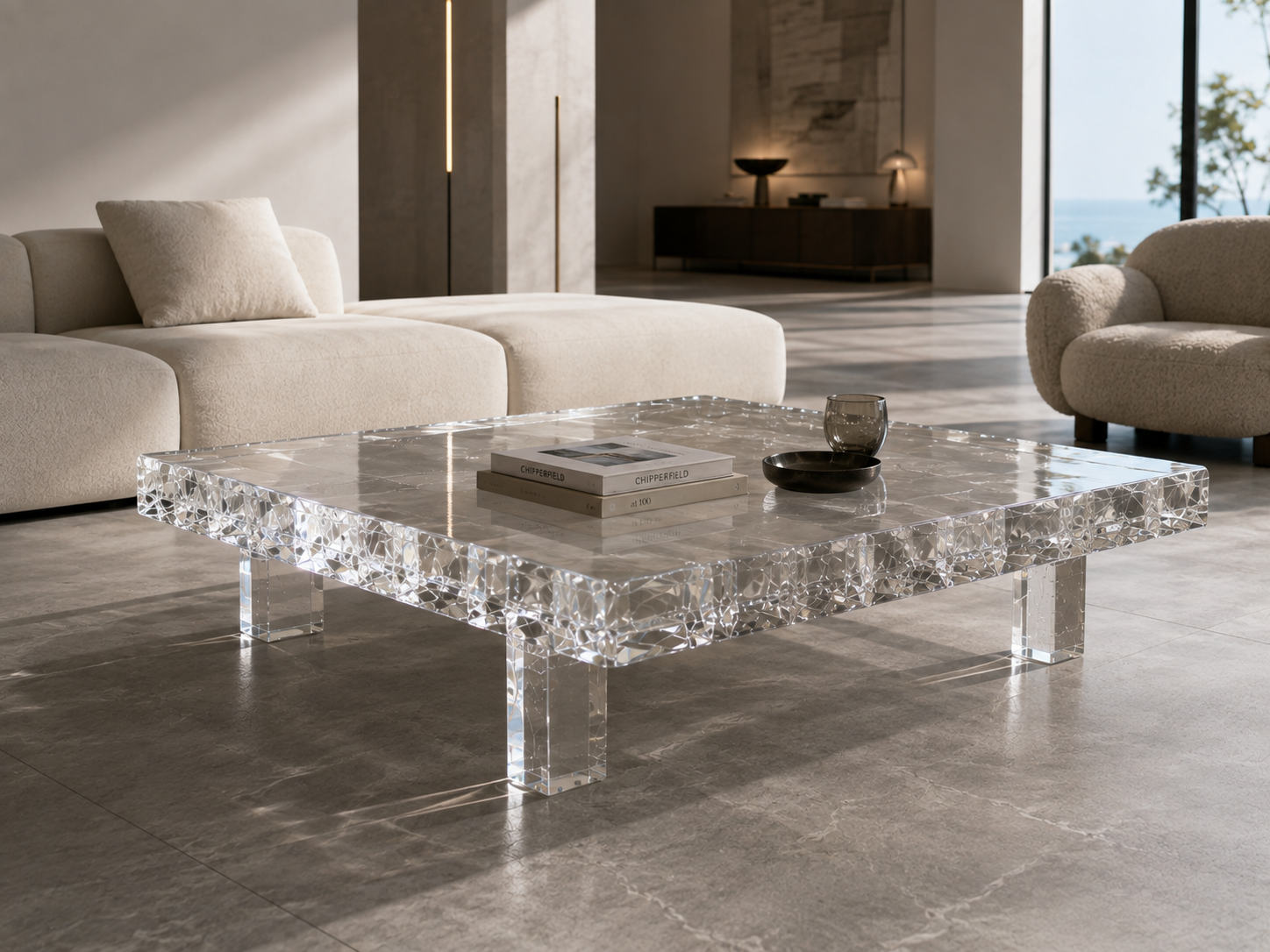
Small-space furniture design is often misunderstood as a problem of dimensions. Make the sofa shorter, reduce the depth of the cabinet, choose a smaller coffee table, and the room should automatically feel larger.
In practice, it is more complicated.
A piece of furniture can have relatively modest dimensions and still feel visually heavy because it blocks sightlines, absorbs light or creates a large opaque surface in the middle of the room. Conversely, a carefully designed piece made with transparent or translucent materials can occupy a substantial physical footprint while appearing much lighter.
This distinction is increasingly relevant in apartments, compact hospitality interiors, luxury residential projects and boutique retail environments, where every piece of furniture must provide function without making the space feel crowded.
Research also suggests that furnishing affects how people perceive space. A study published in PLOS ONE by researchers at Johannes Gutenberg University Mainz found that, in one experiment using scaled rooms, furnished environments were perceived as less spacious than unfurnished ones. The researchers also emphasized that perceived spaciousness is complex and depends on factors such as room size, arrangement and viewing conditions rather than furniture quantity alone.
For designers and furniture manufacturers, this leads to an important principle: the goal is not simply to make furniture smaller. The goal is to reduce its visual occupation of the room.
Transparent materials—including premium acrylic, high-end casting resin and synthetic-crystal elements—can be highly effective tools for achieving that result.
1. Visual Lightness Begins by Reducing Visual Mass, Not Physical Function
The first principle of furniture for small spaces is to distinguish physical volume from visual volume.
A conventional coffee table with a solid wooden base may occupy approximately the same floor area as a transparent acrylic table. Functionally, the two pieces may be identical. Visually, however, the solid table interrupts the flooring, rug and space behind it, while the transparent structure allows those elements to remain visible.
The difference is significant because the human eye does not perceive an interior only according to square meters. It also interprets boundaries, continuity, depth, contrast and obstruction.
The PLOS ONE research on perceived spaciousness is useful here. In the model-room experiment, introducing furniture produced a measurable reduction in perceived spaciousness. Earlier research discussed in the same paper had also found a negative relationship between furnishing density and perceived room volume. At the same time, the authors cautioned that these effects are not universal: their virtual-reality experiment did not reproduce the same furnishing effect.
For furniture design, the practical lesson is not that small rooms should contain almost no furniture. It is that every large opaque object creates visual information that the eye must process.
Transparent furniture reduces some of that information.
This is why high-clarity acrylic side tables, transparent console bases and synthetic-crystal coffee table supports can be especially effective in compact interiors. They preserve functionality without creating the same sense of blockage.
Consider a 35-square-meter apartment with a patterned rug in the living area. A heavy black coffee table divides the rug visually into several smaller zones. Replace the same table with a polished clear acrylic or synthetic-crystal structure and the rug becomes visually continuous again. The room itself has not increased by a single centimeter, yet the visual field feels less interrupted.
This is what “lightness” really means in small-space furniture: not the absence of furniture, but the reduction of unnecessary visual barriers.
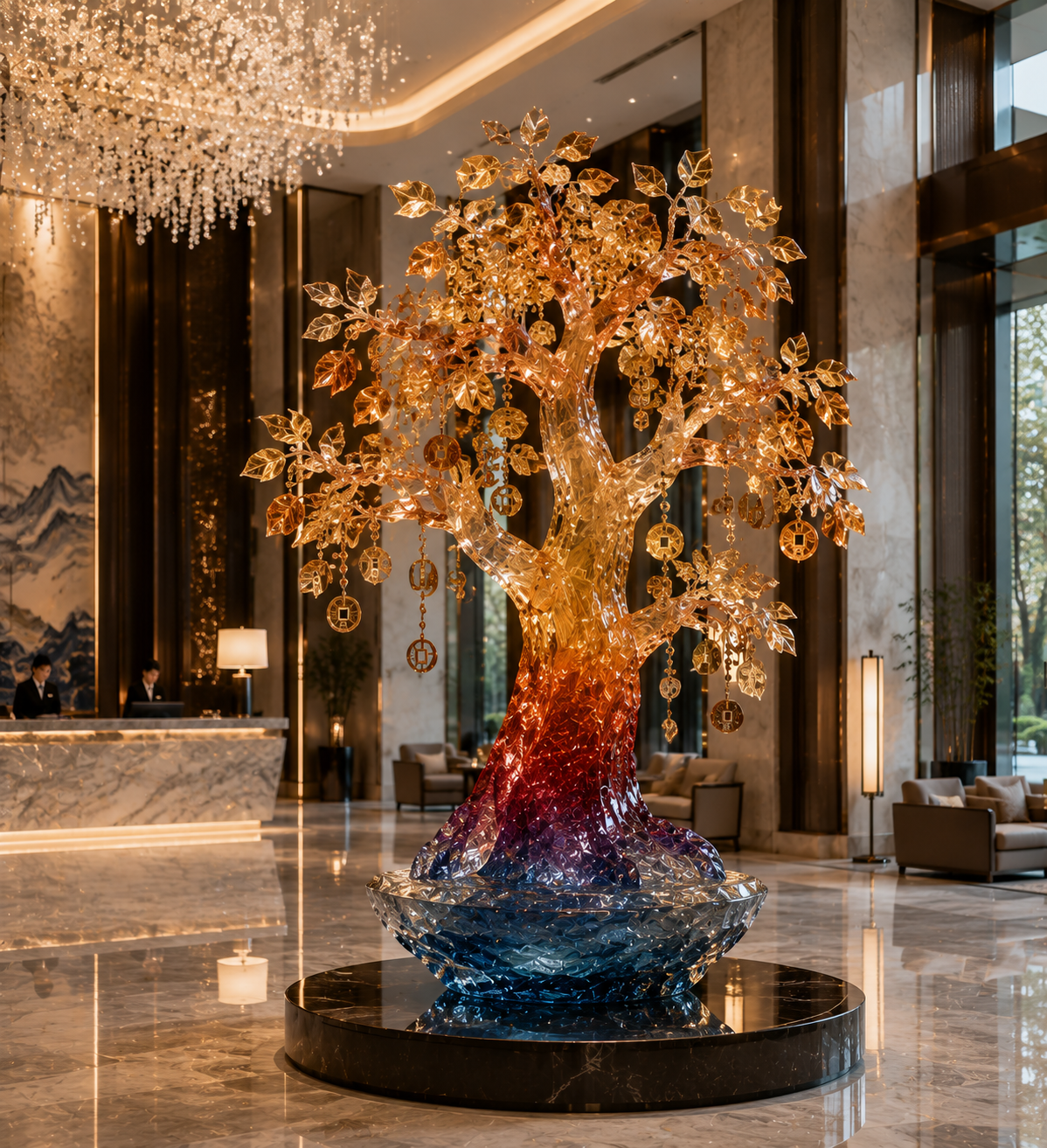
2. Protecting Sightlines Is More Important Than Simply Choosing Smaller Furniture
In a compact interior, the eye needs somewhere to travel.
When large furniture pieces create repeated visual stops, the room can feel fragmented. This is why maintaining long sightlines is one of the most effective ways to make a small interior feel calmer and more open.
Architectural projects provide useful evidence.
In Shanghai's 50-square-meter Folded Apartment, published by ArchDaily, More Design Office specifically addressed the challenge of making a compact apartment feel larger while still providing privacy. One of the strategies was the use of translucent glass doors, which allowed daylight to move through the apartment while maintaining separation between different functions.
Although this example involves architectural partitions rather than furniture, the same visual principle applies directly to product design.
A bookcase with solid sides creates a barrier. A shelving system using clear acrylic uprights creates storage while maintaining visual continuity. A conventional console against a window may block part of the view; a transparent console can provide a display surface while allowing the architecture behind it to remain visible.
This becomes especially useful for furniture positioned in the center of a space.
Coffee tables, occasional tables, stools and room-dividing shelving units often sit directly in major sightlines. These are therefore strong candidates for platinum-grade high-clarity acrylic, synthetic-crystal components or premium transparent resin.
The goal does not have to be complete invisibility. In fact, completely transparent furniture can sometimes lack presence.
A more sophisticated strategy is partial transparency.
For example, a walnut console can use clear acrylic legs. A stone coffee table can sit on a transparent synthetic-crystal base. A bedside table can combine an opaque drawer unit with a translucent resin support.
This preserves visual lightness while giving the furniture enough material contrast to feel intentional.
In small spaces, therefore, designers should ask a different question before reducing dimensions: “Which part of this furniture actually needs to be opaque?”
Often, the answer is much less than expected.
3. Transparent Materials Can Make Light Part of the Furniture
Transparent furniture becomes particularly powerful when designers consider light rather than transparency alone.
A 2025 study published in the Journal of the Korea Furniture Society examined visual experiences created by transparent materials and surveyed 180 respondents. The researchers identified several perceptual effects associated with transparency, including visual ambiguity, distortion and illusion, spatial expansion and depth. Importantly, the study concluded that transparency by itself was not sufficient; stronger effects depended on interaction with light, structural layering and the surrounding environment.
This is a crucial distinction for premium furniture.
A basic transparent panel may simply disappear. A carefully engineered transparent material can manipulate light.
Röhm reports that clear PLEXIGLAS acrylic products can achieve visible-light transmission of up to approximately 92%. The company also notes that certain clear-transparent products are designed to retain very high levels of light transmission over long-term use. These performance figures relate specifically to Röhm's products and should not automatically be attributed to every acrylic on the market, but they demonstrate the optical performance high-quality PMMA can achieve.
This matters especially when acrylic is used in thick furniture components.
Light entering a polished acrylic table leg can travel through the material and become concentrated along the edges. A synthetic-crystal pedestal can appear almost invisible from one angle yet dramatically brighter from another. High-end resin can introduce translucent color, creating depth that changes throughout the day.
ArchDaily's coverage of the Dreamscape Apartment by Red5studio provides a practical example of this approach. The interior includes furniture using green acrylic and a resin dining table inspired by water; the resin surface was designed specifically to create a water-like light effect.
For compact interiors, these optical effects are valuable because decoration no longer needs to rely on additional physical objects.
Instead of adding another sculpture, lamp or decorative accessory, the table itself can create the visual experience.
Light becomes part of the furniture.
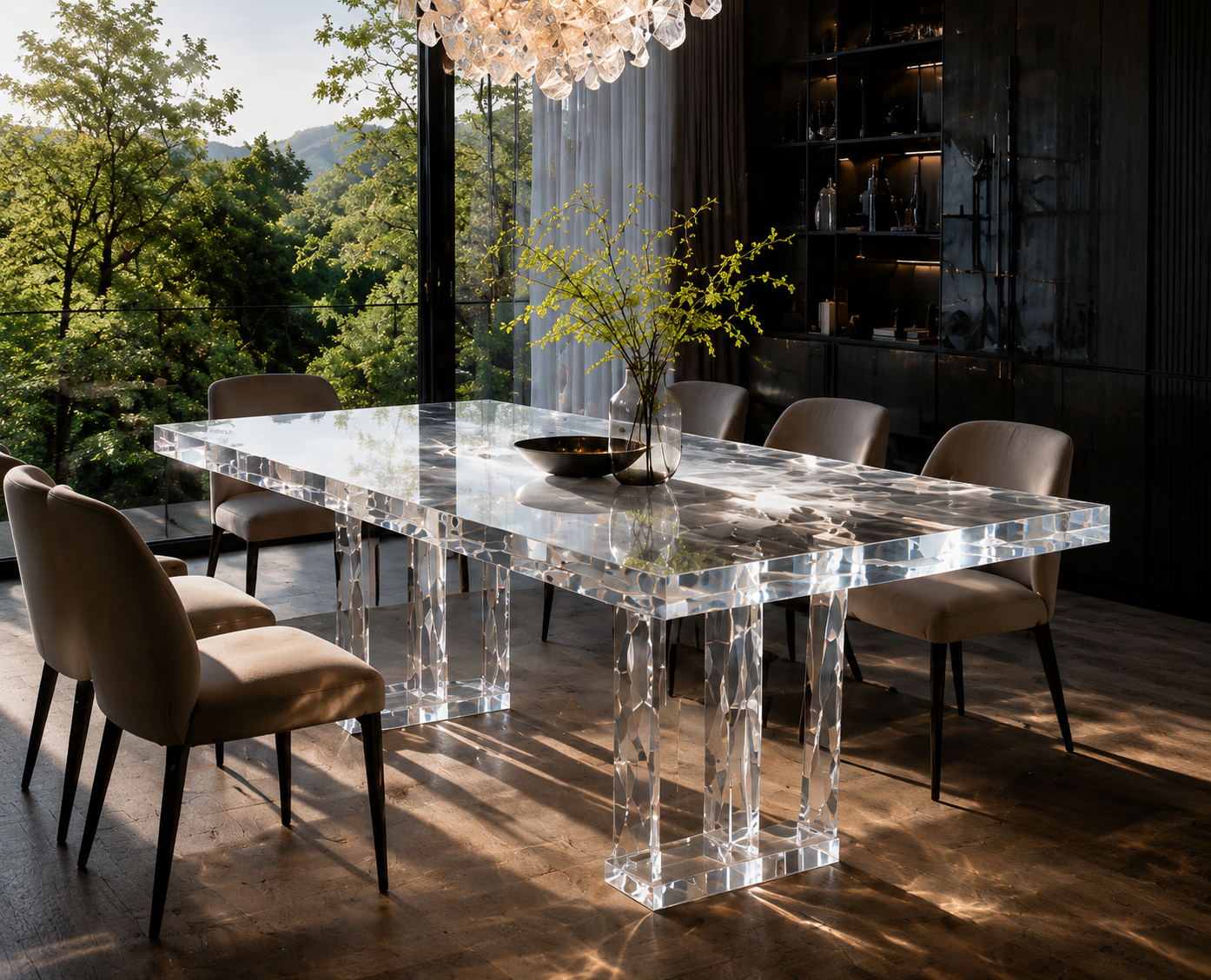
4. The Best Applications Are Coffee Tables, Consoles, Side Tables and Display Furniture
Not every piece of furniture in a small apartment should be transparent.
If every object is made from acrylic or resin, the room can become visually cold, overly reflective and disconnected from the tactile qualities that make residential spaces comfortable.
The strongest approach is selective use.
Coffee tables are one of the most logical starting points because they usually occupy a visually sensitive position in the center of the living room. A high-clarity acrylic or synthetic-crystal coffee table can maintain functionality without visually dividing the seating area.
Console tables are another strong application. In narrow entrances, corridors and behind sofas, conventional consoles can easily appear bulky. Transparent legs or a fully transparent body allow the piece to remain functional while reducing its presence.
Side tables are particularly suitable because they offer opportunities for more experimental forms. Premium resin can be cast into compact sculptural objects containing color gradients, internal textures or embedded decorative elements without making the overall interior visually heavy.
Transparent display pedestals and shelving can also work effectively in luxury retail and residential environments because they support objects while keeping attention focused on what is being displayed.
The commercial success of transparent furniture demonstrates that this design language can reach well beyond niche experimentation. Kartell states that Philippe Starck's transparent Louis Ghost chair has sold more than 1.5 million units, making it one of the company's most successful design products. Kartell's transparency program has also included tables, cabinets, lamps and seating designed specifically around the visual qualities of transparent polymers.
The lesson is not that manufacturers should reproduce an existing transparent chair. It is that transparency works particularly well when it changes how a familiar furniture type interacts with space.
For manufacturers working with synthetic crystal, high-end resin and platinum-grade acrylic, this creates many opportunities: crystal-clear coffee tables, resin side tables, acrylic console bases, transparent benches, display plinths, shelving, dining-table supports and mixed-material cabinets.
The more effective strategy is usually to select one or two visually important pieces rather than making the entire furniture collection transparent.
Lightness depends on contrast.
5. Transparent Furniture Only Looks Light When the Manufacturing Quality Is High
Transparency creates an unusual problem: it reveals almost everything.
Opaque furniture can hide internal connections, bonding areas and certain imperfections. Transparent furniture cannot.
Scratches, bubbles, haze, poorly polished edges, adhesive marks, inaccurate joints, inconsistent pigmentation and internal contamination may all become visible.
This is why transparent furniture can look either extremely sophisticated or unexpectedly inexpensive.
There is often very little middle ground.
For high-end acrylic furniture, edge finishing is particularly important. A precision-polished edge can capture and transmit light, turning a simple rectangular component into a visually refined feature. A poorly finished edge immediately weakens the illusion of lightness.
Thickness also changes perception. Thin transparent panels can feel technical or utilitarian, while thicker acrylic or synthetic-crystal components create optical depth and a more substantial luxury impression. However, thicker transparent sections also make optical imperfections easier to detect.
Premium resin introduces different technical challenges. Casting temperature, curing conditions, pigment distribution, bubble control and polishing all influence the finished appearance. Some artistic resin furniture intentionally incorporates clouds, layers or inclusions, but those effects need to look controlled rather than accidental.
MoMA's collection provides one of the most famous examples of controlled resin craftsmanship. Shiro Kuramata's 1988 Miss Blanche chair uses artificial roses suspended within acrylic resin. MoMA describes the painstaking production process in which each flower was positioned while the resin hardened. The result is not valuable because resin itself is expensive; its importance comes from the relationship among material, concept and manufacturing difficulty.
That distinction is essential for manufacturers.
Calling a material “synthetic crystal,” “premium resin” or “platinum-grade acrylic” does not automatically create a luxury product.
The premium perception comes from what the customer can actually see: clarity, depth, consistency, polished transitions and precision.
In transparent furniture, manufacturing quality is part of the design language.

6. The Ultimate Goal Is Not to Make Furniture Invisible, but to Make Small Spaces Feel More Valuable
There is a common misconception that the best transparent furniture should disappear completely.
In reality, high-end interior design rarely benefits from furniture that has no visual identity.
The stronger objective is to create furniture that feels physically present but visually light.
Synthetic crystal is particularly useful for this because it can create jewel-like edges and substantial sculptural forms while preserving transparency. High-end resin can introduce artistic depth, translucent color and embedded details. High-clarity acrylic can create precise geometry and visually open structures.
Used together with wood, stone, metal or upholstery, these materials can create a balance between warmth and lightness.
A compact apartment might use a solid upholstered sofa for comfort, a walnut cabinet for storage and a platinum-grade clear acrylic coffee table to prevent the center of the room from feeling heavy. A luxury bedroom could combine an upholstered bed with synthetic-crystal bedside tables. A narrow entrance could use a stone-topped console supported by transparent acrylic legs. A boutique could place products on lightly tinted resin pedestals that appear almost luminous beneath architectural lighting.
Transparency can even transform unavoidable structural elements. In a 2026 Madrid apartment project reported by designboom, architects Bardo enclosed an existing structural column and beam in translucent neon-colored acrylic rather than trying to hide them. The material turned an obstruction into part of the visual composition while maintaining continuity between spaces.
This is the larger opportunity for furniture manufacturers.
Do not sell transparent furniture only as a solution for “small rooms.”
That positioning is too limited.
Sell visual continuity. Sell light transmission. Sell preserved sightlines. Sell material contrast. Sell the ability to create a functional object without introducing unnecessary visual weight.
For manufacturers specializing in synthetic crystal, premium resin and platinum-grade high-clarity acrylic, this is also where stronger product differentiation begins.
A low-cost transparent table competes mainly on price.
A premium transparent table can compete on optical quality, thickness, edge polishing, casting technology, customized color, unusual geometry, embedded elements and the way it transforms the surrounding interior.
The difference is important because small-space customers are not necessarily looking for smaller lives or cheaper furniture. Many simply need every object to work harder.
Furniture must provide function, preserve circulation, interact intelligently with light and still contribute to the identity of the interior.
That is why the future of small-space furniture is unlikely to be defined only by compact dimensions or folding mechanisms.
It will also be defined by visual weight.
When designers understand how transparent materials, high-end resin, synthetic crystal and high-clarity acrylic can control that visual weight, furniture no longer has to compete with a small space.
It can help the space breathe.
READ MORE:
- From Acrylic to Synthetic Crystal: How Can Transparent Furniture Create More Depth and Stronger Product Differentiation?
- Where Does Synthetic Crystal Furniture Work Best? Applications for Living Rooms, Hotels, Weddings and Commercial Spaces
- How Can Ordinary Furniture Look More Premium? Three Upgrade Directions from Hardware and Materials to Crystal Elements
- Why More Designers Are Paying Attention to Transparent Furniture: From Spatial Perception to Product Premium
- Synthetic Crystal Acrylic Furniture: An Innovative Direction Worth Watching in the Future High-End Furniture Market
- Why Are More High-End Design Projects Choosing Crystal-Grade Acrylic as a Core Material?
- Synthetic Crystal Acrylic Furniture: Creating Brand Differentiation Through a Distinctive Visual Language
- From Transparent Material to Premium Experience: How Synthetic Crystal Acrylic Furniture Enhances Product Value
- Synthetic Crystal Acrylic Furniture: Why Is It Becoming the “Texture Upgrade Solution” for High-End Spaces?


