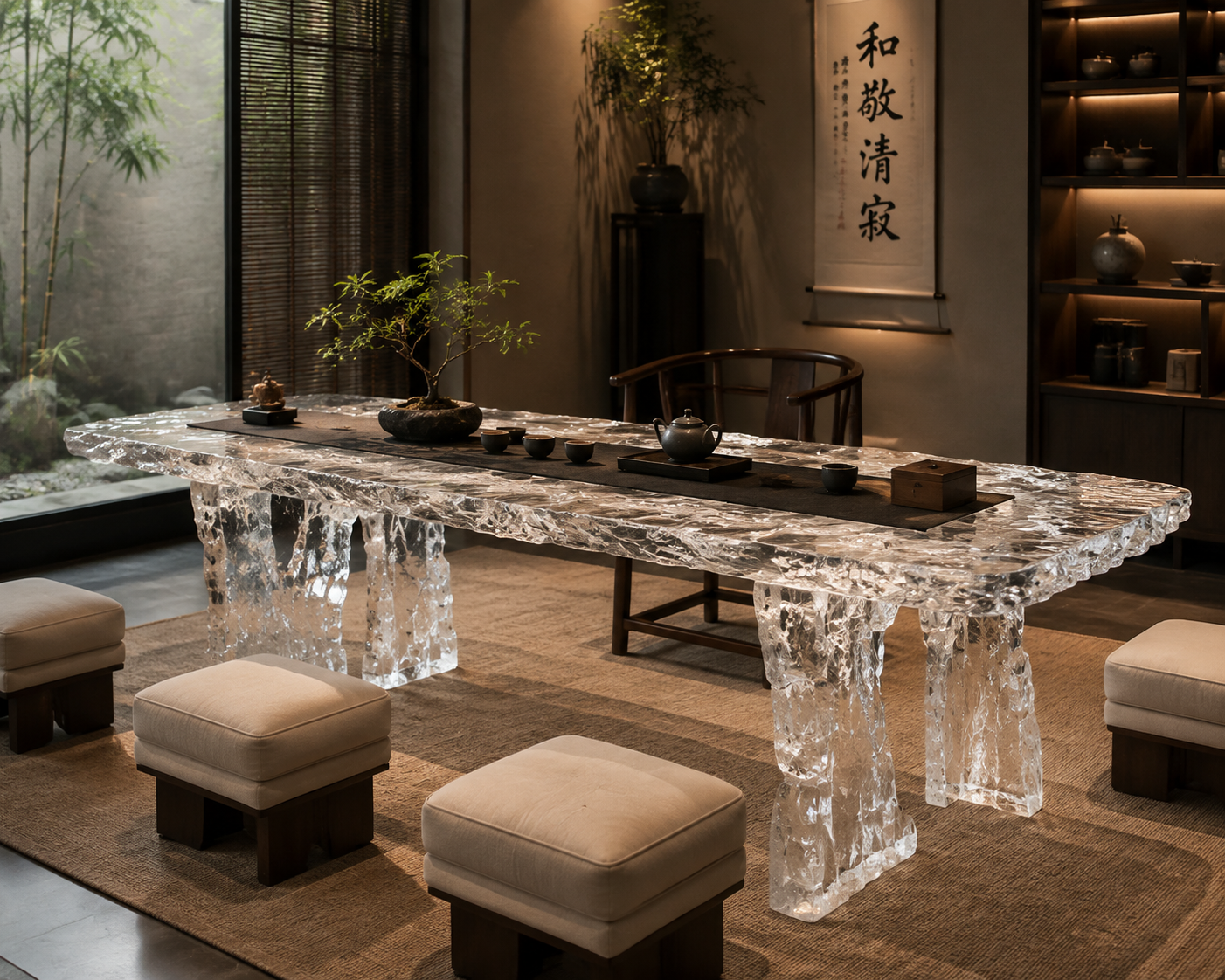
Custom transparent furniture can create some of the strongest visual moments in a luxury hotel, flagship retail environment, restaurant, club, showroom, or high-end commercial interior. It can make large objects feel lighter, preserve sightlines, interact with architectural lighting, and create a level of material sophistication that standard furniture rarely achieves.
However, large-scale transparent furniture projects also demand disciplined planning. A concept that looks simple in a rendering may involve complex questions about structural performance, thickness, bonding, machining, color consistency, logistics, cleaning, installation, and repeatability. For project teams considering synthetic crystal furniture, the most important decisions should therefore be made before production begins, not after the first problem appears on site.
Start With the Real Use Case
The first question should not be which transparent material looks best. It should be how the finished piece will actually be used.
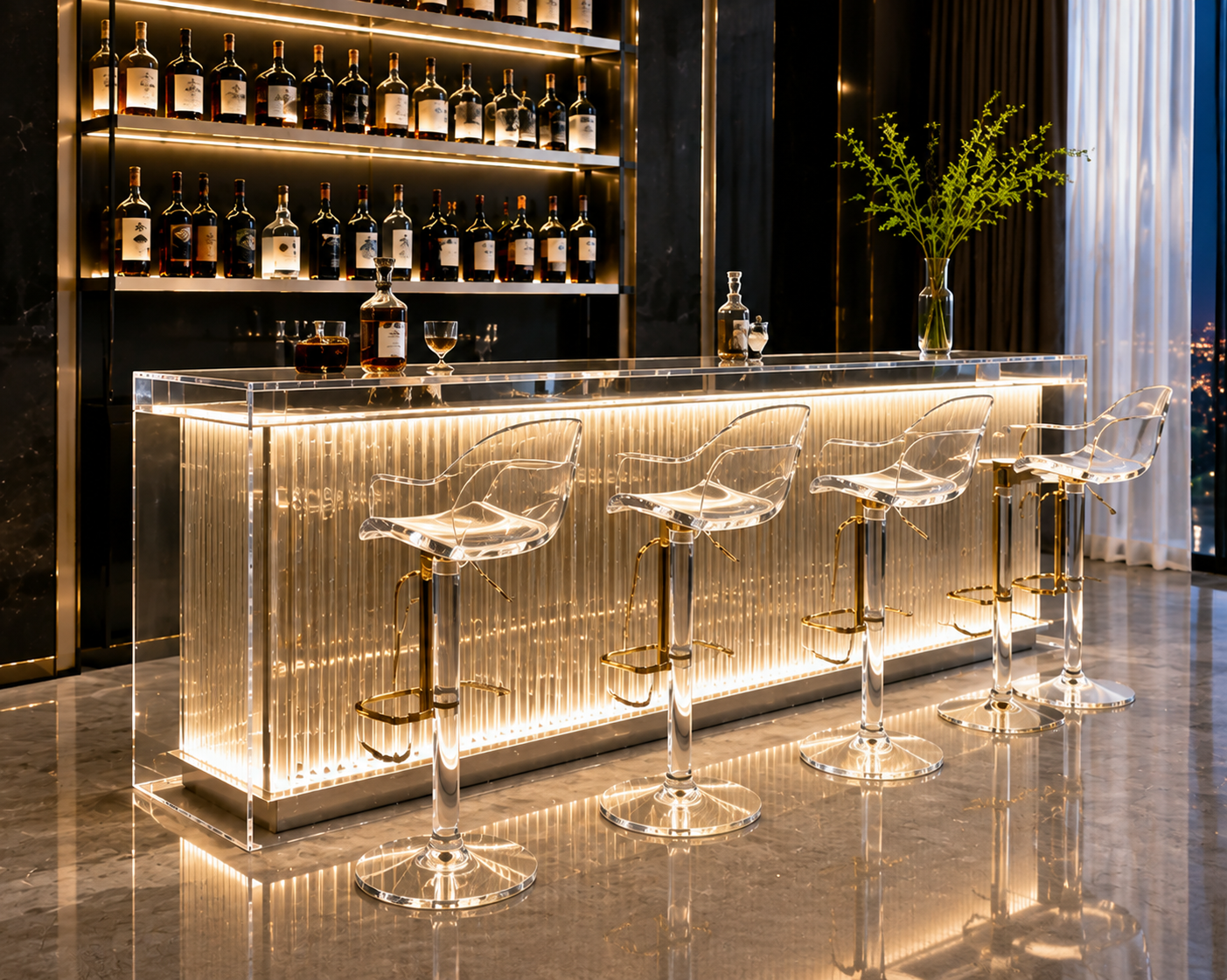
A lobby table in a five-star hotel faces different conditions from a decorative console in a private residence. A reception desk may experience constant staff contact, equipment loading, cable routing, cleaning, and guest interaction. A restaurant table must handle repeated service cycles. A retail display needs to support merchandise while remaining visually clean. A bar or club installation may be exposed to intensive cleaning, lighting, liquids, and frequent movement around the space.
These conditions influence the correct specification for custom synthetic crystal furniture. Thickness, support locations, edge treatment, surface finish, connection details, and maintenance requirements should all be based on actual use rather than appearance alone.
Understand Structural Requirements Early
Transparency often creates a visual expectation of simplicity, but simple-looking forms can be technically demanding. Large spans, cantilevered shapes, thick legs, sculptural curves, integrated tops, and minimal visible hardware all require careful engineering.
Project teams should confirm expected loads, unsupported distances, stress concentration points, connection methods, and any interaction with metal substructures or embedded components. When synthetic crystal furniture is used for substantial pieces, the relationship between visual mass and structural performance must be resolved before the design is frozen.
Early engineering can also prevent unnecessary visual compromises. If structural issues are discovered late, teams may be forced to add visible brackets, enlarge supports, change proportions, or divide a seamless form into multiple sections.
Material Consistency Is Critical at Scale
Producing one strong sample is not the same as producing fifty, one hundred, or several hundred matching pieces. Large hotel and commercial projects require repeatability.
For transparent furniture, variation can be especially visible. Differences in tint, clarity, thickness, polishing, gloss, edge quality, bonding lines, or embedded details may be obvious when multiple pieces are installed in the same space.
A reliable custom furniture manufacturer should have a defined process for raw material inspection, color control, machining tolerance, polishing standards, bonding quality, and final approval. Project teams should ask how batches are managed and how the supplier records approved samples so later production can be checked against the same reference.
Clarify Optical Expectations
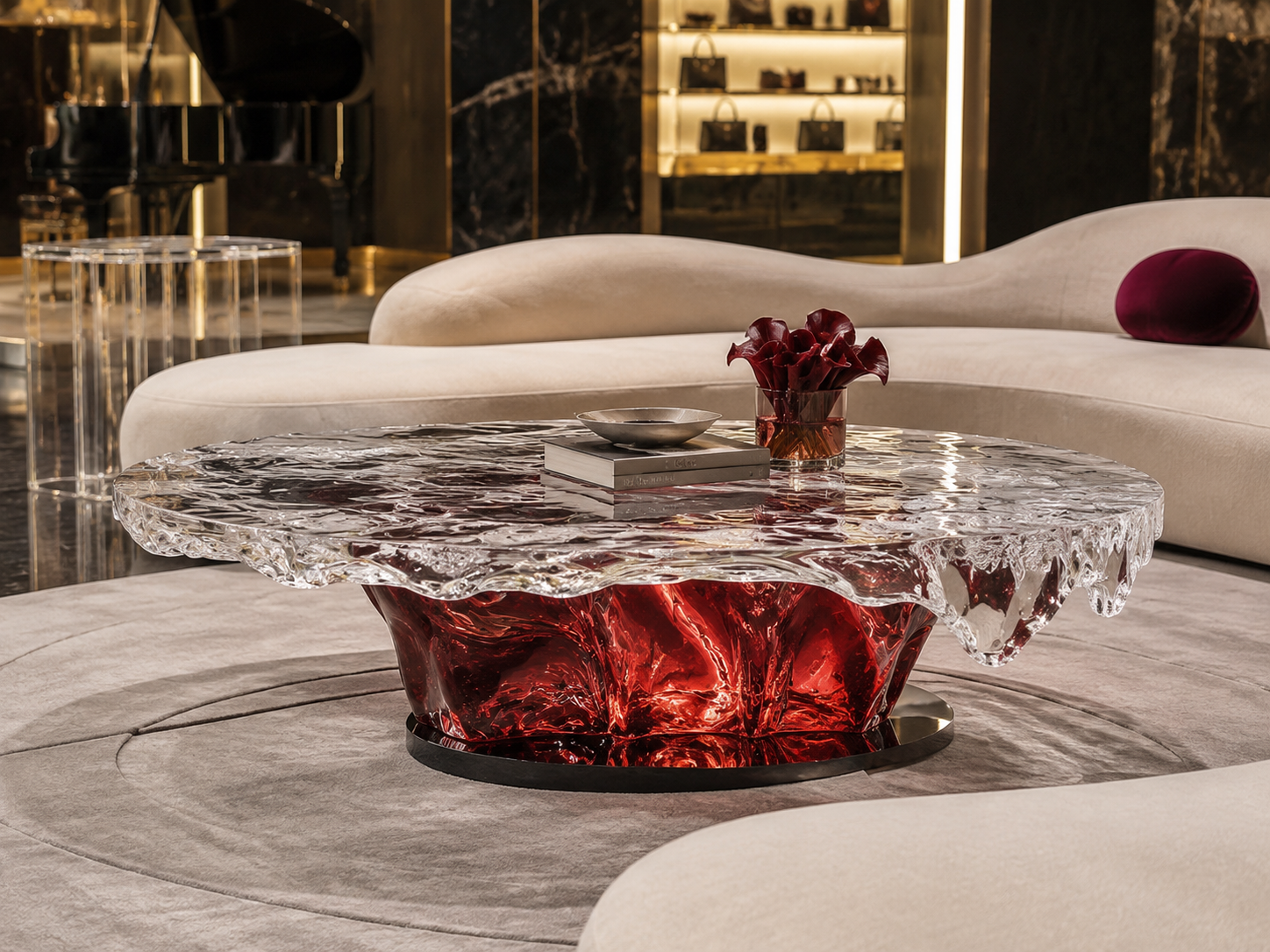
Not all transparent furniture is intended to be perfectly colorless or visually neutral. Some designs require a subtle tint, controlled translucency, internal texture, layered color, or a more crystal-like optical effect.
This is where synthetic crystal furniture can offer design flexibility, but only when expectations are clearly documented. Terms such as clear, crystal, transparent, smoky, amber, blue, frosted, or tinted can mean different things to different teams.
Physical samples are therefore essential. Designers should approve material under lighting conditions that resemble the final environment whenever possible. Thick transparent sections can appear different from thin samples because light travels through more material. Edge polishing can also change the perceived brightness of a piece.
Consider the Relationship Between Furniture and Lighting
Transparent materials are highly sensitive to lighting. Spotlights may create strong edge highlights. Concealed LEDs may reveal internal transitions. Warm light can change color perception. Dark walls can make clear furniture appear more reflective, while bright stone floors can increase visual transparency.
For this reason, architects and lighting designers should coordinate key synthetic crystal furniture pieces with the lighting plan. If integrated lighting is involved, cable routing, heat management, access for maintenance, driver locations, diffusion, and replacement procedures should be resolved during engineering.
A successful transparent piece should look intentional both when the lighting is fully active and during normal daytime conditions.
Plan for Maintenance Before Production
Luxury furniture must remain attractive after opening day. Maintenance is therefore part of design performance.
Transparent surfaces show dust, fingerprints, water marks, scratches, and cleaning residue more readily than many opaque finishes. This does not mean they are unsuitable for commercial use, but maintenance procedures need to be realistic.
Project teams should ask which cleaning agents are suitable, which materials should be avoided, how minor surface marks are handled, whether polishing can be performed on site, and how frequently high-contact surfaces may need attention. Hospitality furniture should be designed around the capabilities of normal operational staff rather than assuming specialist intervention for every cleaning cycle.
Think Through Installation Access
One of the most common causes of site problems is approving furniture that can be manufactured but cannot be moved into the final location efficiently.
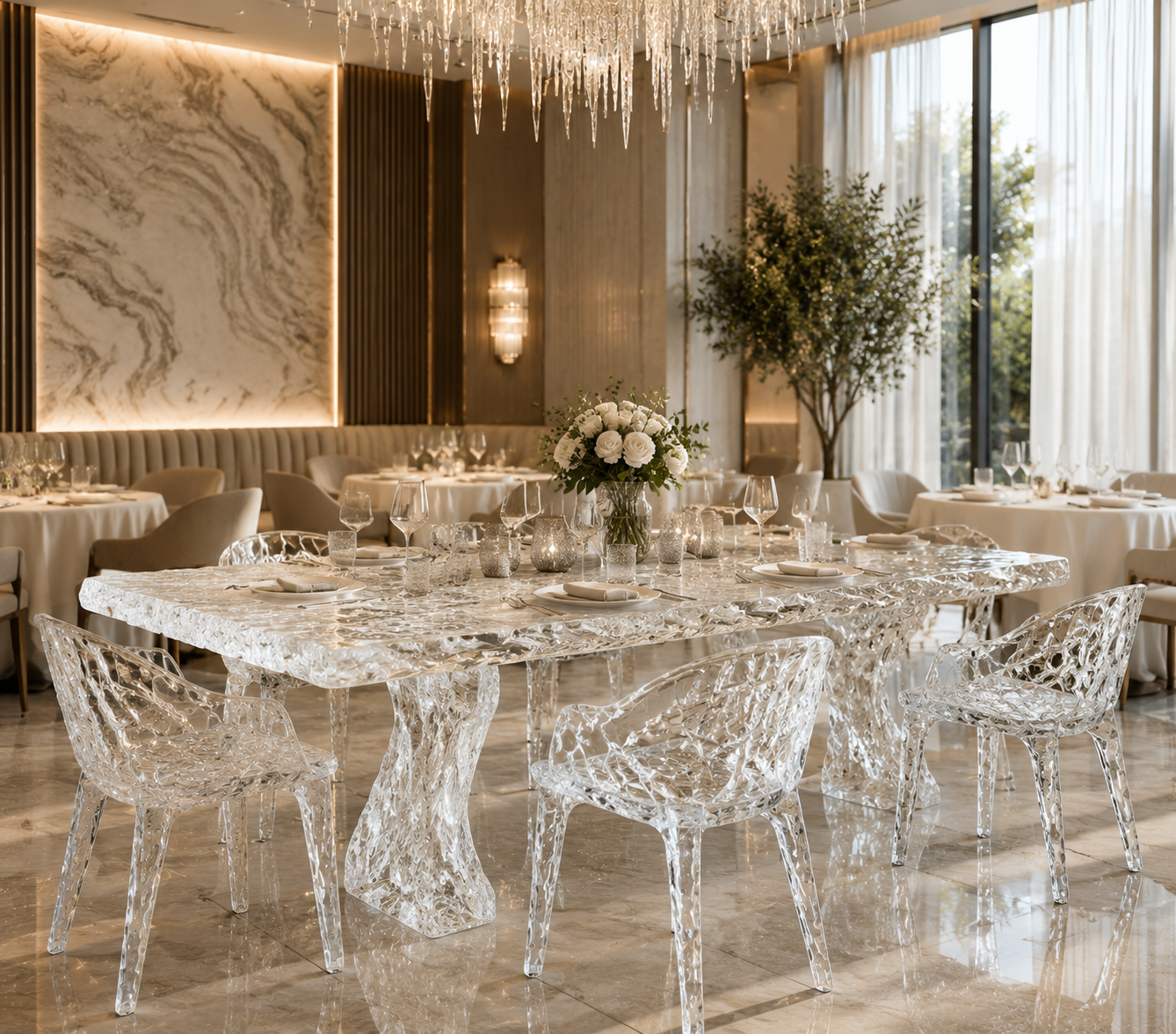
Large synthetic crystal furniture pieces can be substantial in size and weight. Before production, teams should confirm elevator dimensions, corridor widths, door openings, turning radii, ceiling clearances, floor loading, loading dock access, delivery restrictions, and final placement methods.
If a piece must be assembled on site, the connection details should be visually discreet and mechanically reliable. If it arrives fully assembled, protective packaging and lifting procedures become even more important.
Packaging Is Part of Product Quality
Premium finishing can be damaged during transport if packaging is treated as an afterthought. Transparent surfaces need protection from abrasion, impact, vibration, dust, and inappropriate wrapping materials.
A qualified supplier of premium furniture should design packaging around the specific geometry of each piece. Large edges, projecting corners, polished surfaces, and delicate embedded features may require custom supports, protective films, foam systems, crates, or lifting points.
For international projects, the packaging plan should also consider long transit periods, container handling, site storage, customs inspections, and repeated movement before installation.
Prototype the Difficult Parts
For large-scale programs, prototyping should focus on the areas with the highest technical or visual risk. It may not always be necessary to build an entire final piece first. A partial mock-up can test a critical joint, color thickness, curved section, embedded insert, illuminated area, or polishing method.
With custom synthetic crystal furniture, these targeted prototypes can save significant time because they allow teams to solve difficult details before full production tooling or batch manufacturing begins.
Prototype approval should include documented photographs, measurements, finish references, and written comments so the production team has a clear standard to follow.
Control Design Changes Carefully
Large projects often change during execution. Floor levels shift, wall finishes change, mechanical services move, lighting layouts are revised, and furniture dimensions may be adjusted to respond.
These changes can create risk if production teams are working from outdated drawings. A strong project process should include revision numbers, formal approvals, clear drawing issue dates, and a defined point at which manufacturing is authorized.
For luxury furniture, even a small dimensional change can affect proportion, structural behavior, packaging, or visual alignment with the architecture. Change control is therefore an essential part of quality control.
Evaluate Supplier Capacity, Not Just Samples
A beautiful sample proves that a supplier can make one piece. It does not prove that the supplier can manage a large project.
Before awarding a major synthetic crystal furniture package, project teams should evaluate production capacity, engineering support, quality inspection, communication procedures, schedule management, packaging capability, export experience, and ability to coordinate revisions.
For complex commercial work, the supplier should be able to provide more than fabrication. They should help translate the design into production-ready solutions while protecting the key visual intentions of the concept.
Define Acceptance Standards
Transparent materials can reveal minor optical effects that may not be visible in opaque furniture. Because of this, acceptance standards should be agreed before mass production.
Project teams should define which dimensions are critical, how color is evaluated, what level of polishing is expected, where joints may be visible, how bonding should appear, and how finished pieces will be inspected. A reference sample can be especially valuable for transparent furniture because verbal descriptions alone are often too subjective.
This protects both the buyer and the manufacturer by reducing disagreements at the final inspection stage.
Balance Aesthetics With Operational Reality
The strongest statement furniture is not simply dramatic. It is also practical enough to remain part of the project for years. Designers should consider cleaning access, replacement components, movement, repair strategy, interaction with guests, and whether the piece can tolerate expected operating conditions.
In a high-end environment, durability is part of aesthetics because damaged or poorly maintained furniture quickly undermines the perception of quality.
Good design therefore does not ignore practical constraints. It uses them to create a more intelligent object.
Build the Project Around Early Coordination
Successful large-scale custom furniture programs usually share one characteristic: the difficult questions are discussed early.
Architects define the visual intent. Interior designers refine proportion and material relationships. Contractors identify site constraints. Procurement teams control budget and schedule. Manufacturers translate the concept into a repeatable production process. When those groups communicate before manufacturing starts, synthetic crystal furniture can be executed with much lower risk.
That coordination is especially important when the material itself is part of the visual identity of the project. Transparency, polish, thickness, color, and light response must remain consistent from drawings to samples to final installation.
A Better Way to Specify Custom Transparent Furniture
Choosing custom transparent furniture for a major hospitality or commercial project should never be reduced to a sample comparison or a unit price. The real decision involves material behavior, engineering, production control, logistics, installation, maintenance, and supplier reliability.
When these factors are considered together, synthetic crystal furniture can deliver the visual impact designers want without creating unnecessary uncertainty for contractors or owners. The goal is not merely to manufacture something transparent; it is to build a repeatable system that performs technically, visually, and operationally at project scale.
Before approving the next custom transparent piece, ask one question that often reveals more than the quotation ever will: what has the supplier already solved before your project reaches the factory floor?
READ MORE:
- Why Material Consistency Defines Quality in Premium Synthetic Crystal Furniture
- The Business Value of Statement Synthetic Crystal Furniture in Luxury Spaces
- How Synthetic Crystal Furniture Protects Design Vision from Concept to Installation
- Why High-End Spaces Are Moving Beyond Traditional Materials to Acrylic and Synthetic Crystal Furniture
- Come i mobili in cristallo sintetico stanno diventando la nuova tendenza nel design degli spazi di lusso
- Dal mobile ordinario al punto focale artistico: come il cristallo sintetico aumenta il valore degli spazi contemporanei
- Anche i piccoli spazi possono avere un'anima di lusso: tecniche di design con mobili in cristallo sintetico
- Non solo elementi decorativi: come i mobili in cristallo sintetico combinano estetica e funzionalità
- Trasformazione degli spazi: come i mobili in cristallo sintetico creano un'atmosfera di lusso e raffinatezza


