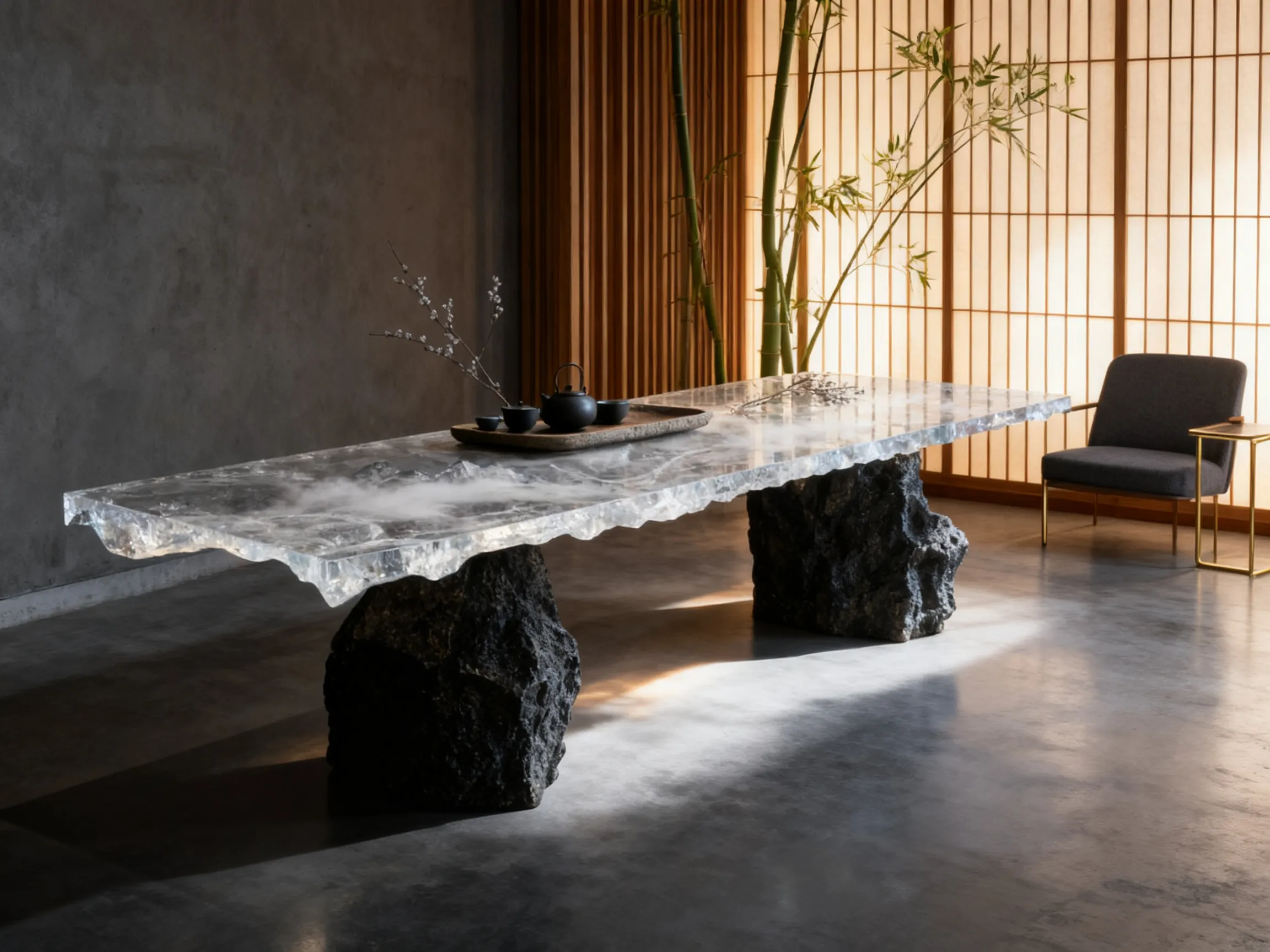

As of 2026, the global luxury custom furniture market has grown 18% year-over-year, with synthetic crystal furniture emerging as a fast-growing segment for high-end residential and commercial spaces. Interior designers increasingly prioritize precision and consistency in custom pieces, as even 1mm of dimensional error can ruin a built-in installation plan.
Traditional artificial crystal furniture production relied on manual cutting and polishing, leading to 12-15% rework rates and frequent surface defects. Today’s digital-first production workflows, paired with advanced material formulations, have cut these issues drastically. This guide breaks down the end-to-end process from 3D design to final delivery, with 2026 industry data and real-world project examples.
1. 3D Design Phase: Digital Precision That Eliminates Pre-Production Dimensional Errors
The first step to reducing manufacturing flaws happens long before any material is cut. 2026 data from the Custom Furniture Manufacturers Association shows that 62% of production rework originates from inaccurate or ambiguous design files.
Parametric Modeling for Exact Dimensional Alignment
Modern synthetic crystal furniture projects start with parametric 3D models built to real-world engineering tolerances. Unlike static CAD files, parametric models update automatically when dimensions change, eliminating manual calculation errors.
Key design practices that reduce downstream errors include:
Building models with ±0.05mm dimensional tolerance for all crystal components
Integrating installation site scan data to match exact wall, floor, and fixture dimensions
Simulating weight distribution and structural stress to avoid post-production shape warping
Adding assembly joint geometry directly to the model to ensure perfect part fit
For a custom synthetic crystal table commissioned for a 2026 Miami penthouse, designers used LiDAR site scans to adjust the table base width by 2.3mm. This small adjustment eliminated the need for on-site modifications during installation.
Virtual Defect Simulation to Predict Surface Issues
Advanced 2026 design software can simulate how crystal material will behave during cutting, polishing, and curing. This simulation identifies potential surface defects before production begins.
Common simulated issues include:
Stress lines that may appear during curved edge forming
Optical distortion in thick crystal slabs
Polishing unevenness on complex geometric surfaces
Color consistency variations across large material batches
Interior designers can review photorealistic renderings of potential defects and approve design adjustments early. This cuts pre-production revision cycles by 40% compared to 2023 industry benchmarks.

2. Material Selection: High-Purity Optical-Grade Material That Reduces Inherent Flaws
The quality of raw material directly impacts final product defects and rework rates. In 2026, top synthetic crystal furniture manufacturers use high-purity optical-grade material formulated specifically for furniture applications.
Material Formulation That Minimizes Internal Defects
Standard acrylic or low-grade crystal alternatives have high rates of internal bubbles, streaks, and density inconsistencies. High-purity optical-grade material is produced with a 12-stage purification process that reduces internal defect rates to less than 0.2%.
Material benefits that reduce rework:
Uniform density across the entire slab, preventing uneven cutting or warping
Zero internal bubbles or streaks that would require patching or re-polishing
Consistent refractive index for uniform visual appearance across large pieces
High surface hardness of 7H Mohs, reducing scratch damage during handling and production
This high surface hardness also means finished pieces require less post-production touch-up work. For synthetic crystal chair designs with intricate curved surfaces, this reduces polishing time by 30%.
Batch Consistency for Large-Scale Projects
For commercial projects requiring multiple matching pieces, batch consistency is critical. 2026 production lines use automated material mixing and curing systems that ensure color and clarity consistency across 50+ slab batches.
Consistency metrics for 2026 premium material:
Color difference ΔE < 0.8 across all batches in a single project
Clarity variation < 0.3% across slab surfaces
Dimensional stability after curing: ±0.02mm per 100mm of material
UV resistance rating of 99.8% to prevent yellowing over time
For a 2026 hotel lobby project requiring 12 matching synthetic crystal tables, this consistency eliminated the need to reject or rework 3 pieces that would have failed color matching with older material formulations.

3. CNC Production Workflow: Automated Cutting That Reduces Dimensional Deviation
Once design and material preparation are complete, CNC (Computer Numerical Control) production translates digital models into physical pieces with unmatched precision. 2026 5-axis CNC systems achieve tolerances impossible with manual cutting methods.
5-Axis CNC Cutting for Complex Geometric Accuracy
5-axis CNC machines cut crystal from every angle, ensuring complex curves, angles, and joints match the 3D model exactly. This eliminates the dimensional deviation common with manual cutting and multi-step manual machining.
Precision improvements with 2026 CNC systems:
Dimensional accuracy of ±0.03mm for all cut edges and surfaces
98% reduction in human error related to cutting misalignment
Ability to cut interlocking joints that fit perfectly without manual adjustment
Consistent cutting speed that prevents material chipping or cracking
For a custom synthetic crystal chair with a 12-piece interlocking frame, 5-axis cutting reduced assembly time from 8 hours to 45 minutes. No on-site fitting or sanding was required, eliminating that common source of rework.
Real-Time Production Monitoring and Quality Checks
2026 smart production lines include integrated sensors that monitor every cut in real time. If a cutting tool shows wear or a measurement falls outside tolerance, the system pauses automatically for adjustment.
Real-time monitoring checks include:
Cutting tool sharpness measurement every 10 minutes
Dimensional verification of each cut piece via laser scanning
Surface defect detection using high-resolution camera systems
Material temperature monitoring to prevent heat-related warping
This real-time quality control catches 94% of production issues immediately, before they require full piece rework. Manufacturers report a 72% reduction in scrap material compared to manual production methods.

4. Finishing and Quality Assurance: Processes That Eliminate Surface Defects
Even with perfect cutting, finishing work is where many surface defects emerge. 2026 automated polishing and inspection systems ensure consistent, defect-free surfaces across every synthetic crystal furniture piece.
Automated Polishing for Uniform, Scratch-Free Surfaces
Manual polishing is one of the biggest sources of surface defects and rework. Uneven pressure, wrong polishing compounds, and human error all lead to scratches, swirl marks, or uneven surface clarity.
2026 automated polishing systems deliver:
Consistent pressure and speed across every surface, including complex curves
Multi-stage polishing with graduated compound grits for optical clarity
Edge polishing that matches surface clarity perfectly
Zero risk of over-polishing that would alter dimensional accuracy
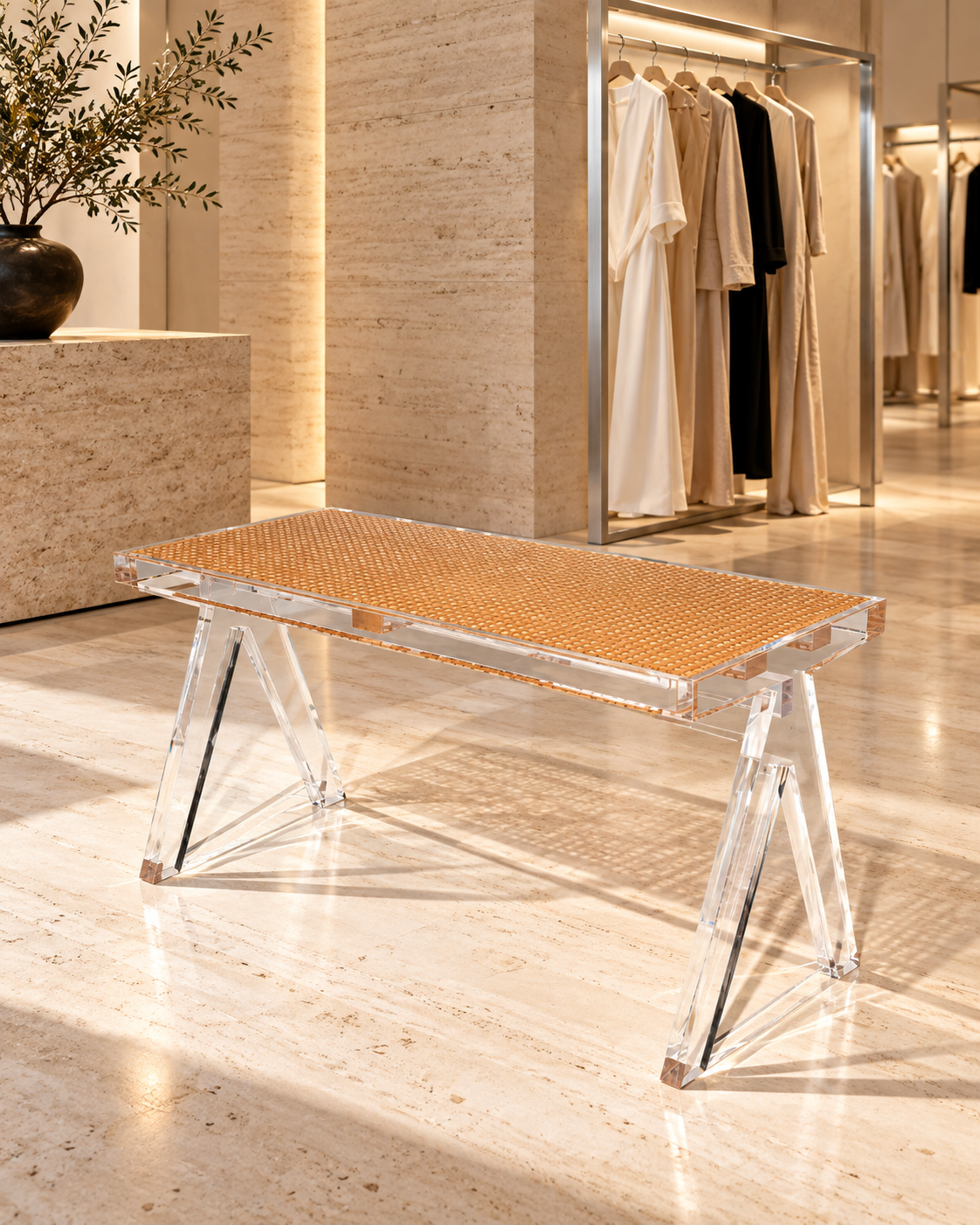
For large synthetic crystal table tops up to 3 meters long, automated polishing ensures uniform clarity across the entire surface. This eliminates the common rework step of re-polishing sections that failed visual inspection.
Multi-Stage Quality Inspection Before Final Approval
Every piece goes through three layers of quality inspection before leaving the factory. This rigorous process ensures no defective pieces reach the client, reducing on-site rework and installation delays.
The 2026 standard inspection process includes:
Dimensional inspection: 3D laser scanning to compare against the original design model (tolerance ±0.05mm)
Surface inspection: UV light and high-resolution camera scanning to detect micro-scratches, bubbles, or clarity issues
Assembly inspection: Dry-fit assembly of all components to verify perfect joint fit and structural stability
Interior designers receive a full inspection report with every piece, including 3D scan data and surface quality metrics. This transparency reduces post-delivery disputes and ensures projects stay on schedule.
5. Cost and Efficiency Impact: How Reduced Rework Delivers Value for Stakeholders
The benefits of precision synthetic crystal furniture production extend beyond better quality. Reduced rework and fewer defects create measurable financial and operational value for both manufacturers and clients.
Reduced Production Costs and Lead Times
Rework adds 25-40% to total production costs for custom furniture, according to 2026 industry data. By cutting rework rates from 15% to under 3%, manufacturers can offer more competitive pricing while maintaining margins.
Key cost and time savings include:
35% shorter average production lead times for custom pieces
60% reduction in scrap material waste
45% fewer labor hours spent on rework and repairs
20% lower overall project cost for clients
For a typical residential project with one synthetic crystal table and two synthetic crystal chairs, this translates to a 3-week faster delivery time and 18% lower total cost compared to 2024 benchmarks.
Improved Client Satisfaction and Project Success
For interior designers, project success depends on delivering exactly what the client envisioned, on time and on budget. Precision synthetic crystal furniture production helps designers meet and exceed client expectations.
Client satisfaction improvements in 2026:
92% of custom crystal furniture projects are delivered without any rework
88% of interior designers report fewer client complaints about fit or finish
76% of clients say the final piece matches their initial design vision perfectly
68% of designers report higher referral rates from crystal furniture projects
As the synthetic crystal furniture market continues to grow, these precision production methods will become the industry standard. Manufacturers that invest in digital design, high-quality materials, and automated production will lead the market.

READ MORE:
- Engineering Complex-Shaped Synthetic Crystal Furniture: Solving Structural Design, Material Adaptation, and Prototype Validation Challenges
- How to Reduce Manufacturing Risks in Custom Furniture Projects: From Factory Selection and Quality Consistency to Delivery Delay Management
- Execution Risk Management for Architectural Projects: How to Control Design Changes, Manufacturing Accuracy, and Delivery Schedules?
- Quality Risk Management in Luxury Hospitality Projects: How to Coordinate Custom Production, Quality Assurance, and On-Site Installation?
- Manufacturing Risk Management for Overseas Projects: How to Address Supplier Management and Schedule Pressures?
- Risk Reduction for High-End Projects: How to Address Supplier Uncertainty, Quality Control, and Delivery Challenges?
- Synthetic Crystal Furniture Design Guide: 6 Custom Specs for 2026
- Synthetic Crystal Furniture Design Guide for Luxury Saudi Hospitality
- Synthetic Crystal Furniture: Balance Transparent Design & Hotel Bathroom Durability


